
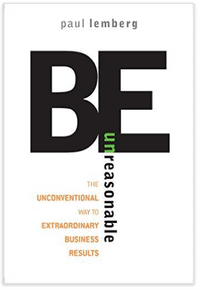
Today I got a copy of the new book Be Unreasonable: the Unconventional Way to Extraordinary Business Results by small business coach Paul Lemberg. In the book, Lemberg uses me and True as an example of starting a business in an “unreasonable” way (in his chapter on “Unreasonable Thinking”).
He summarizes the birth of This is True and how my colleagues at NASA’s Jet Propulsion Lab were “disbelieving” and “discouraging” of my idea to quit JPL and work online full time with my news commentary feature — because they couldn’t see how it could possibly work when my plan was to give it away for free.
 “Talk about unreasonable,” Lemberg writes. “At the time, the Internet was considered to be a pristine, unexploited commons. There were all sorts of cultural rules and norms in place forbidding commerce: nobody was going to sell anything, and certainly no one would be making any money.
“But Cassingham, seeing the future, charged ahead and ignored those rules. (If you think this is common now, it is. But not in 1994!)”
Lemberg raised his eyebrow over another set-in-concrete rule I broke: while I have a clear copyright on True, he points out that right from the start its wording encouraged readers to share the (free edition) issues with friends. It was an unheard of idea in publishing.
Thus, he concludes, “This is True may have been the first viral marketing success.” Maybe so.
If you’re interested in more, click the cover to see more about the book.
– – –
Related: the story of how This is True started.
* FTC Notice: If you buy products through links on this site I may receive an “affiliate” fee, which does not affect the price you pay. Details on True’s Privacy page.
– – –
Bad link? Broken image? Other problem on this page? Use the Help button lower right, and thanks.
This page is an example of my style of “Thought-Provoking Entertainment”. This is True is an email newsletter that uses “weird news” as a vehicle to explore the human condition in an entertaining way. If that sounds good, click here to open a subscribe form.
To really support This is True, you’re invited to sign up for a subscription to the much-expanded “Premium” edition:
Q: Why would I want to pay more than the minimum rate?
A: To support the publication to help it thrive and stay online: this kind of support means less future need for price increases (and smaller increases when they do happen), which enables more people to upgrade. This option was requested by existing Premium subscribers.
“Reasonable people adapt themselves to the world. Unreasonable people attempt to adapt the world to themselves. All progress, therefore, depends on unreasonable people.” ~George Bernard Shaw
I enjoy This is True, but,with all due respect you’ve only copied the most successful marketing plan in history. In the last 60s and early 70s, when computers were making their debut, DOS competed with CPM and other operating systems for dominance. ONE act, made by Bill Gates, ultimately made him the richest person in the world, and resulted in Microsoft’s dominance in the computer arena. Gates released the source code for DOS to the public. He GAVE it to PC manufacturers and emerging computer techies – the user still had to pay for it, but all the software designers wrote their programs in DOS; the rest is history.
You could do FAR WORSE than to copy the most successful marketing plan ever…
Thanks for your work; it makes the weekends even more enjoyable.
Now THERE’S a switch… copying FROM Bill Gates?
Actually, Gates didn’t even invent that marketing plan. Jacob Schick utilized it in 1926 with his injector razor, nearly giving away new razors since people would need to spend money on replacing the razor blades. Why are inkjet printers SO cheap these days? Because the money is made in replacing the expensive ink cartridges.
Still, when one company is successful in a marketing plan, not every company that copies it is equally successful. And there is the hitch: What makes YOUR company more successful than all the others who do the same thing?
Go back and read how everyone thought that such an idea (selling a newsletter on the Internet) couldn’t possibly be successful, and even the resistance to an idea of commercializing the Internet, you’ll realize that it really was a burst of inspiration and dedication was required to make it a reality. No, it was a LOT more than simply “copying” an idea.
—
Not to mention I had no idea that MS-DOS was a give-away product until now, if in fact that’s true — I had never heard that. And even if it is and I had, it’s quite a stretch to say that Microsoft’s success would be obvious by early 1994, or that giving away a newsletter was in any way “copying” their marketing plan. It’s certainly “unreasonable” to think that could be inspiration. -rc
DOS was not free. Computer manufacturers paid a licensing fee to include it with their computers. The cost, obviously, was passed onto the consumer in the price of the computer.
To upgrade (as I did when DOS 2.0 came out), there was a cost which I had to weigh for cost/benefit ratio. As cost of computers continued to drop, eventually permitting easier consumer purchase, DOS was still (of necessity) included in the package. Licensing fees were still being passed onto the consumer in the hardware price.
Part of the illusion that pre-windows DOS was free was that there was a proliferation of bootleg copies of DOS out there.
Bottom line is that Gates has always charged for DOS. That was the basis of his agreement for the production of IBM clones at the beginning. The anti-trust lawsuits arose from his insistence that computer manufacturers MUST include Internet Explorer in the Microsoft bundle AND must pay for it, passing the cost onto the consumer. That goes into a different direction, though, and could consume pages of discussion. There may be slight discrepancies in my synopsis, but the essence is there.
Neither example is quite like True. My comments are based on the statements above, which I did not try to verify. Microsoft gave away enough of their product to force other to have to buy it. Schick introduced a new product at a reduced price, “nearly giving away” was how it was described.
Randy did neither of these with True. He gave away his product, and continues to do so to this day. There was never a requirement to buy a Premium upgrade. The best comparison to prior art I can think of would be some software. Some people sold a piece of software that had some functionality turned off, charging you if you wanted the full version. True did the same thing with copyrighted material, using the newly mainstream email medium for distribution.
Changing the topic, I found most interesting the comment “This is True may have been the first viral marketing success.” Randy took the concept of a computer virus, and found a new method of delivery. Now we have been spreading his “virus” for him, and if the people I have “infected” are any example, we are happy to be victims.
Well, I suppose if you wanted to draw comparisons, you could say that it’s like a drug dealer getting a customer hooked by first giving away some free hits, and then charging for the addiction. Just a tongue in cheek comparison showing that you could draw an analogy between almost any two things. Like most analogies, what applies to one doesn’t necessarily apply to the other. But the concept definitely didn’t originate with Bill Gates.