
Anytime I run a “gun story” I get a lot of comment from both hugely polarized Americans, who want to rant for or against guns, and foreign readers, who don’t understand the American “obsession” with arms. I’m going to take a stab at helping foreign readers understand it a bit better. So first, the “gun story” that prompted this essay, from True’s 15 February 2009 issue:
Ready, Fire, Aim

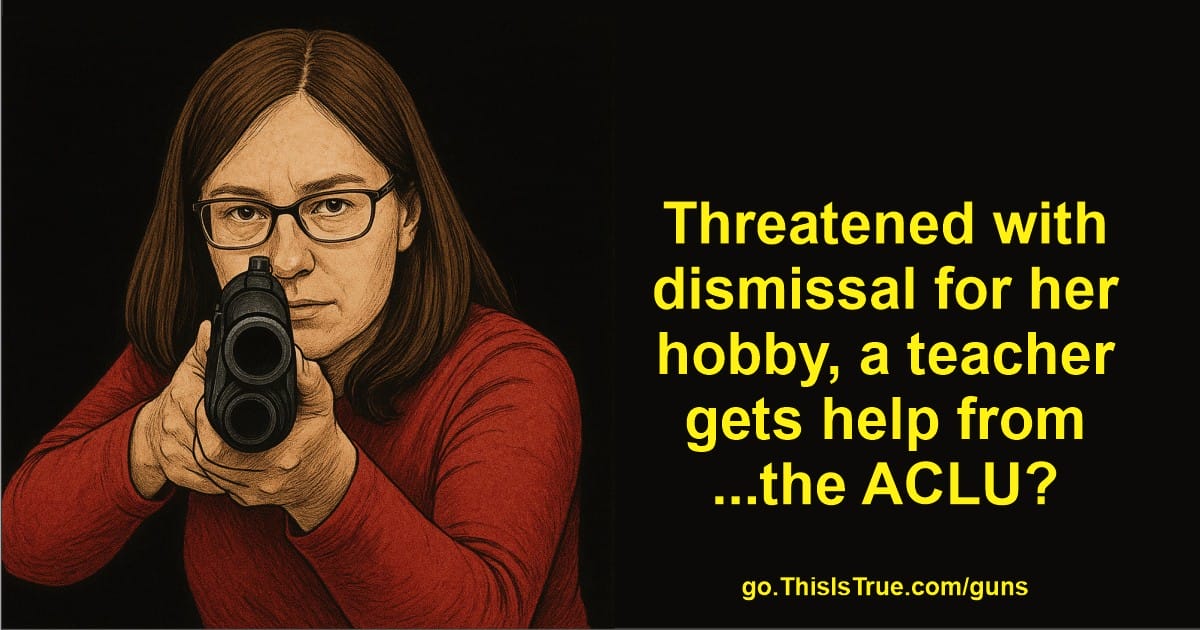
Betsy Ramsdale, a teacher at Beaver Dam (Wisc.) Middle School, had a photo of herself on her personal Facebook page, showing her with a gun. When school officials found out about it, they immediately suspended her. The photo “appears to be poor judgment,” district superintendent Donald Childs told a local TV station, who said the photo was brought to the district’s attention by another employee. Ramsdale immediately removed the photo when she heard the district was concerned. In follow-up interviews, Childs said he thought there was “nothing negative or hostile” in Ramsdale’s motivation, and that she was “a good and capable teacher.” The teachers union refused to comment, but the Wisconsin ACLU is defending Ramsdale. “Absent any evidence that the teacher poses a threat, the district should not overreact to the sight of a gun in one of their employee’s hands,” said an ACLU spokesman. “While school safety is of paramount importance, public school teachers do not lose their right to free expression when they are not working.” After the uproar, the school quietly allowed Ramsdale to return to work. (WKOW Madison, Beaver Dam Daily Citizen) …Let me guess: she teaches American History and the Bill of Rights?
American History
OK, so for (especially) foreign readers, my try at explaining why guns are a part of the American Way. I’m necessarily going to move fast, so don’t skip anything.
Americans grow up learning about how our forefathers were denied religious freedom in their native lands, so in the early 1600s they came to the New World so they could practice religion the way they saw fit.
Then there’s a lot of gray area that’s skimmed over, and in the mid-1700s there’s the American Revolution: the Declaration of Independence (and I’ll bet half of our high school grads wouldn’t be able to tell you from whom: the British), and the brilliantly formed Constitution of the new country based on individual liberty (“We the People” — and never mind that by then, plenty of Americans owned slaves kidnaped from their own lands), which established the “great experiment” of democracy.
Of course, England didn’t just roll over and say “Fine” when we declared our independence: there was this little thing called the Revolutionary War, which lasted from 1775 to 1783. When that combat was over, that’s when we created our Constitution, and that’s the environment the founders were in: a revolutionary war battleground.
The Constitution was ratified in September 1787, over the objection of many because it didn’t enumerate a number of rights that they thought should be explicitly called out. Others felt that there was no need for such a listing of rights: the Declaration of Independence declared that “We hold these truths to be self-evident, that all men are created equal, [and] they are endowed by their Creator with certain unalienable Rights.” In other words, rights are not given to individuals by the government; rather, those rights are endowed unto us all by “their Creator” from the start, and if we’re of a mind to, the people might allow the government to do some things in our name. It was a revolutionary idea indeed.
In fact, Alexander Hamilton argued, “Here, in strictness, the people surrender nothing, and as they retain every thing, they have no need of particular reservations.” (Federalist Papers #84)
Ten Amendments
Still, the Bill of Rights — a collection of ten amendments to that still-new Constitution, was passed by the First U.S. Congress in 1789, and sent to the states for ratification. It took just over two years, but that was completed in 1791.
One hears plenty about the First Amendment, the first set of rights in that Bill of Rights: “Congress shall make no law respecting an establishment of religion, or prohibiting the free exercise thereof; or abridging the freedom of speech, or of the press; or the right of the people peaceably to assemble, and to petition the Government for a redress of grievances.” Many think of those as being THE basis of American rights: the freedom of religion, speech, the press, and the right of people to demand that the government right wrongs.
Then we get to the Second Amendment: “A well regulated Militia being necessary to the security of a free State, the right of the people to keep and bear Arms, shall not be infringed.”
And There’s the Issue
It’s that wording that gets Americans gritching at each other. One side points to the “well regulated Militia” wording to say that yes, the government can have guns for the “militia” (which they take as meaning “army”), but certainly not individuals.
The other side points to the words “the people” — clearly and obviously, that means individuals. The U.S. Supreme Court is charged with interpreting those words, looking at what the framers of the Constitution intended (using, for instance, other writings of the times, like those Federalist Papers), looking at the realities of their times, and trying to see how it all fits into a modern world.
So Here’s How in the founding era the “realities of their times” fits in: we were freshly finished with a Revolutionary War — we fought off the British. There was (and there remains) significant distrust in government in the American psyche. Even our own government.
The consensus of Constitutional scholars is that the purpose of the Second Amendment is, in fact, to allow individuals, not just the government, to “keep and bear arms” for a very fundamental purpose. Not just for self defense, but to overthrow the government if it goes too far in restricting the “unalienable Rights” that were “endowed by their Creator.”
So yes, Americans “cling to guns” because they represent their only guarantee of their god-given rights.
Deeply Ingrained
I doubt most anti-gun people mean to be unAmerican, despite the feeling from pro-gun people that they are. They’d love it if society was “mature” enough to not need guns — and who wouldn’t?
But a lot of people believe there is evil in the world: it helps to explain why there are so many bad people — people who want to come and hurt us. And when we see planes flying into our buildings, that’s all the proof needed: there certainly are people who want to hurt us! There are even bad people in church (sidebar), not to mention everyday robbers and criminals.
And, of course, if the government gets too cocky, “The People” will fight them, too.
That makes the anti-gun people pretty nervous: they see that there are total whack-jobs out there waving guns around talking about “rights” — and it doesn’t help that a small but vocal minority are just the sort of people who really wished they could still own slaves, that things sure were better in the good ol’ days of segregation and minorities “knowing their place.”
Obviously…
Yep: there are maniacs with guns. The anti-gun people love hearing me say it. They’ll hate this: there are also evil people who want to hurt others, and it has to be a fundamental human right to fight back against them. Not just in one’s home, but out in the real world, too, since that’s where they’re most likely to strike.
So what’s my conclusion?
There are fundamentally sound reasons that our founding fathers thought individuals needed the right to bear arms, and like it or not that’s a fundamental right in America. Society needs to come to grips with that fact, but yes, we also need to come down hard on those who abuse guns — as criminal tools. Those laws are already there, and need strong enforcement.
We can do better to keep guns out of the hands of mentally unstable people and criminals, but that doesn’t include taking them away from honest, law-abiding people who indeed have a right to have them to protect themselves, whether from robbers or an out-of-control government.
The real problem, by the way, isn’t guns, it’s violence. But I’ve already argued that point.
And Let’s Be Clear
I fully and readily admit that this particular essay is slanted toward the “pro-gun” side — that’s the nature of the intent of this essay, which was stated at the top: “helping foreign readers understand the American ‘obsession’ with arms.”
Still, I’m sure both sides will be dissatisfied, and accuse me of skipping over some things. Yeah, I did: I covered 300 years of history in less than 2,500 words, including the sidebars! But if both sides are unhappy, I’ll be happy: it means I was pretty darned balanced. Especially considering I started this essay just 90 minutes before my deadline. 🙂
(P.S.: I already hear others asking, regarding the story at the top: “Really, the ACLU? No way!” Yeah, really. This is the second time the ACLU has appeared in True.)
– – –
Bad link? Broken image? Other problem on this page? Please Let Me Know using the Help button in the lower right, and thanks.
This page is an example of my style of “Thought-Provoking Entertainment”. This is True is an email newsletter that uses “weird news” as a vehicle to explore the human condition in an entertaining way. If that sounds good, click here to open a subscribe form.
To really support This is True, you’re invited to sign up for a subscription to the much-expanded Premium edition.
Thank you. Without a doubt, one of the best essays on gun rights I’ve read in quite some time.
As an NRA life member, I must say I basically agree with your explanation, Randy. Also, your sidebar explanation of why the NRA reacts as they do also agrees with my perception of their motives. It’s no secret that most societies that have never had, or have given up, gun ownership freedoms are paying the price for it in many ways, not the least of which is loss of personal safety in their own homes. Now, the new administration is beginning to introduce bills to restrict the types of weapons that may be owned (primarily the never well-defined “assault rifles”). This, in my estimation, is simply another attempt to institute gun control by misdirection, just as your analogy of banning smoking by passing a few “common sense” laws was. I think that your reasonable approach to explaining the issue is the one that should prevail, but there are no “reasonable” zealots out there.
—
I agree there are no reasonable zealots. But there are plenty of people who are reasonable, yet have never understood the facts on either side. This is just one brief attempt to shine some light on the subject without resorting to emotion, since we’re all better off with more actual information. -rc
A very balanced and reasonable essay on American gun ownership and gun control. You got the NRA reasoning dead on. I’m with you.
You did just fine with this essay. It is violence that’s the main problem, as criminals try to hurt you, and they have better access to guns, even if they are illegal in places. I will never give up my guns, and recently have been contemplating getting a CCW cert. The elevated number of senseless attacks on groups of defenseless people is getting too scary to ignore.
Imagine that! What would happen if we actually ENFORCED the thousands of laws already on the books instead of passing dozens more restricting the rights of law abiding citizens? Thanks, Randy for trying to put a logical, non-hysterical viewpoint on the issue.
You said:
> And, of course, if the government gets too cocky, “The People” will fight them, too.
The government is made up of people; it is SOME of the people in (or who work for as contractors or whatever) the government who are getting “cocky”, not the entire government as a whole, although I grant that there may be emergent phenomena (the group acts in a way that is not predictable from the way that the individuals act).
On another issue, I often read articles saying that people are safer when there are fewer guns, and other articles saying the opposite. Can you provide some clear facts on this?
—
No, the irony of “The People” fighting “The Government of, by, and for The People” doesn’t escape me.
As far as your question: if readers have useful links, they can add them in their own comments. -rc
Good job on the essay. I want to comment on what might seem like a minor point – the ACLU supporting the teacher. For some reason, the ACLU has gotten a reputation as extreme liberals – commie & anti-God. In reality, they are attempting to protect the rights given in the Bill of Rights. So yes, they defend speech I find offensive as well as the right to use quote the Bible. They regularly defend people from all points on the political spectrum but only a few cases get significant press.
Randy, I know you know this but I think it bears repeating in this context – a right isn’t right unless it’s extended to EVERYONE – not just the people I agree with!
—
Well sure, you understand that! 🙂 But yes, I expanded on the ACLU in the blog entry I linked to at the end; I just couldn’t cover everything in one place. But I loved baiting readers with that previous ACLU story…. -rc
Scott says that government is just people, and some of the people may get “cocky”. But when “some” of those people are in control of entire agencies that have well-financed and manpowered equipment to levy upon the citizenry, then for all intents & purposes, they ARE the government. Witness the gun-snatching by the police from homeowners in New Orleans during the Katrina aftermath. BATF was formerly part of the Treasury Dept. Their primary function was the collection of taxes on Alcohol, Tobacco & Firearms. Now they’re the BATFE (Explosives) and are part of the Justice Dept whose purpose is to control crime. As with most federal agencies, the Dept can institute regulations that have the full impact of law, which stand until a lawsuit challenges their Constitutionality. Until then, a lot of rights can get trampled. It’s no consolation to someone who’s served a few years in prison that he was right all along.
I have to admit that when I clicked the link in your newsletter to read this, I was expecting a very different essay. Growing up in New York, I’ve always been against people having guns. Now I’m not sure. I have to think about it. Your essay and the two “guns” pages you linked to at the very top have taken me over an hour to read, and are very thought provoking. You are correct that I have not been exposed to these ideas before, and will have to do some research after I’ve slept on this. But meanwhile, while there are surely some “gun nuts” out there, I’m no longer sure, as I used to be, that everyone with a gun is a nut. And that’s a big step for me already. Thank you for making me think about this issue, as it’s an important one.
—
Yes, it is an important issue, and whatever your conclusion, I’m gratified that I’ve had a hand in helping you think about it. -rc
Randy, I think you’re right on with many things concerning guns. Of course, you omitted the recent Supreme Court decision concerning the Second Amendment, but you may have thought it wasn’t necessary to mention it. The Supreme Court affirmed that the Second Amendment ensured the individual’s right to keep and bear arms. You also omitted to mention that many Americans hunt for food, not just for sport.
There have actually been a couple of places that “liberalized” their gun laws and found that crime rates lowered appreciably. Now the criminals are leery of their former victims!
Lastly, I do have a link for you concerning Gun Facts. It’s http://www.gunfacts.info. The author has a book you can download for free.
Keep on keepin’ on!!
—
I know I omitted a lot of details, but this wasn’t meant to be an exhaustive survey. I did start to talk about the Supreme Court decision, but then went on a bit of a tangent and didn’t get back to it. And I’m going to hit the sack for the night, so didn’t have a chance to review the site you mentioned, but I will. -rc
Wikipedia has a short section on the subject: http://en.wikipedia.org/wiki/Gun_politics#Statistics
Mike, note that when some people talk about “the government”, they are talking about the President and his (her) policies, and the side effects of the implications and implementation of those policies. As an example, consider how much effect the Civil Rights Act of 1964 has had; US society would change significantly overnight if it were repealed, often in ways that few people now would predict.
I live in a city (Chicago) that (like Washington, D.C.) has decided that by banning gun ownership outright, we will combat gun crime. When D.C.’s ban was ruled unconstitutional, the mayor vowed to fight any attempt to overturn Chicago’s law. However, no one seems able to explain why despite the fact that it is illegal to own or possess a gun in the city limits that people continue to be shot and injured or killed (in fact I think the gun crime rate went up last year).
Of course – if I am okay with shooting someone (which, by the way, is illegal in and of itself), then I’m not going to have too much issue with illegally obtaining the firearm to do the shooting.
I think the gun ban here is about as successful as the ban on buying/possessing spray paint (no, I am not kidding). We still manage to have plenty of graffiti, but I have to go to the suburbs to buy paint to refinish my furniture (shhh! hope the CPD aren’t reading this ;))
I started to write commenting on the fact that as you were writing for foreigners, you should not have assumed they would know who ACLU was. Then I thought “all we need to do is look it up, so why tell him”. Then I thought, “Dammit, I’ve typed it out, so I’m going to send it anyway!”
Well, thanks for making me think – again!
—
The story indeed should have spelled it out. The link at the bottom of the page — the only part “written for foreigners,” definitely does. -rc
Your article verifies what I’d figured out as your Canadian neighbour. Thanks for your balance. Living in China [a law-abiding country on the surface] I felt [and was] completely safe from violence. Now in Moscow [what’s law?], the legacy of the turbulent 1990s sometimes emerges: the owner of the complex being constructed across the street from me was shot a year ago about midnight and I heard the gun. In this city, I only walk alone during the day and never in one of the large parks. Yes, it’s violence and looking for victims that is the issue. I have no problem with someone having a tool to stop this as long as the supposed power doesn’t turn one’s head. A friend in China taught me some Tai Quan Do kicks for the same effect.
That has to be one of the best articles about arms rights (not just guns, mind you) in the US that I have read in a long time.
Oh, and for those who are interested, here is an article that I found after a brief search. It covers the impact of concealed carry permits on crime for the period from 1977 through 1992.
http://hematite.com/dragon/Lott_ORDu.html
The short answer: Concealed carry permits tend to deter any crime that will bring the criminal into contact with a possibly armed victim.
—
John Lott’s study is what’s behind the This is True story that I linked to at the very top of the page: https://thisistrue.com/guns/ -rc
Leaving completely aside the rights and wrongs of gun ownership, what seems very strange to me is that, whereas it is OK for people in the USA to own real guns, it is illegal for some of them (notably children) to own toy guns. Furthermore, as evidenced by the story that accompanied this essay, it seems that it is also forbidden (if not unlawful) for people to use pictures of guns being used in certain ways.
In the UK it is only possible to own a gun if you obtain a licence, and such licenses are extremely hard to obtain and are granted only to those who have a proper reason for needing a gun (simply wanting one is not a good enough reason). However, in the UK we have no problem with people having toy (not replica) guns and you can use as many pictures of real guns as you want.
—
I believe you’re referring to “zero tolerance” stories that I report on time and again, where kids are kicked out of school for having “fascimilies” of “guns”. It’s not illegal for the kids to have either one, but rather school policy. Now, never mind that these are almost always government-run schools; they are also very often denying students due process in forcing confessions (without parents, let alone a lawyer, present). Big difference in theory, even if it looks quite similar in practice. -rc
Back in the early 1990’s (long before Columbine), I was in my senior year in a California high school. One of those gun-toting whack-jobs showed up on my campus determined to let everyone know how crappy his life was by killing a teacher and three students, wounding a dozen others, and holding scores of us hostage for hours. For some who went through that ordeal, the nightmare won’t end until the man responsible is finally put to death (he’s still on death row after 16 years).
I grew up with a healthy respect for guns. After high school I joined the military, earning three marksman ribbons (two for the M-16 and one for the 9mm). Though I have never owned a gun and to this day have haven’t had the desire to own one, I am not afraid of them. But I wonder sometimes how things might have played out if one of the students or teachers had “been packing” that day. Would it have made matters worse and increased the number of innocent lives lost? Or might it have ended the whole mess that much sooner with a single, well-placed round?
While I generally support the concept of mentally-stable, licensed, law-abiding citizens owning guns (after a background check and cool-down – I mean – *waiting* period), I am vehemently against the whole fully-automatic assault rifles and armor-piercing bullets issue. People who want those scare me, ‘cuz there is no legitimate — reasonable — civilian reason for having them. Then again, I’m fairly conservative about a number of common sense things, like kids who cuss at teachers, car stereos that you can hear from three blocks away, and the proliferation of cellphones with unlimited text & minutes (just because it’s unlimited doesn’t mean you have to be on it 24/7… in the bathroom… really).
Going back to the gun issue, though… knowing what I know now, I think I might have tried to take that shot (like the woman in the church). Some people may not appreciate her act, but *I* sure do.
Recently I visited Anchorage AK. In the museum was a native people’s whaling boat made from wood and animal hides. My guide told me that when the people had demanded exemption from the restrictions on whale hunting as it was part of their tradition and livelihood it was agreed that they could continue their tradition – subject to them continuing to use the traditional equipment i.e. the traditional boats, no engines and traditional harpoons, no firearms: [link removed in 2021: no longer online]
I have a proposal, under the second amendment restrict the right to what was intended at the time, the type of firearms available in 1791.
An awful lot has been written on both sides of the US gun control arguement but it’s not my concern – why should I care if Amercians murder each other at many times the rate in all other developed nations. Anyway as I look at the “facts” and “statistics” they look very selective to me – example: “The handgun ban in Washington D.C. caused an increase in crime”. True, the homicide rate in 1981 was greater than in 1976 when the law was passed. But on the other hand… rates in 1976 were significantly lower than in any of the previous 8 years and stayed that way for 4 years, then showed a blip, increasing, but still not to the pre ’76 peak. (Note the figures are homicide, not just gun related homicide, so the arguement that if a gun isn’t available, the killer will choose a different weapon doesn’t work). For what it’s worth my opinion is that crime is driven by poverty and that’s at the root of the problem in the US. Switzerland has much higher rates of gun ownership but much lower crime rates – poverty rates are about a third of the US figures. So keep your guns but first how about raising the quality of life for the bottom 20% who cause the crime? then, like the Swiss, ensure guns are kept securely, that owners are properly trained and have no criminal record. Meanwhile you guys just get on with killing each other at the rate of 16,000 a year (puts 9/11 in perspective), not my problem.
I’m a filipino and a gun owner. While we do not have the same constitutional guarantees that the Americans enjoy, we are, at least, allowed to own guns. It may be harder to own and carry a gun, but threats to violence and freedom is real and universal. I own two guns, and while I am deathly afraid to use them against another living thing, being a victim or a mourning father/husband scares me even more.
Thanks for your post. It’s a well-reasoned (though US-centric) defense of gun ownership. Cheers!
—
Well, it is titled “Guns in America” so yes, it’s U.S.-centric. -rc
You know the rest of the world, where there are a lot fewer killings by firearms per capita than in the USA *really* gets the “safety through many guns” principle. Sure there are stories such as the one above, where a legal gun owner did something right, but I am quite sure that the majority of incidents with legal guns would better not have happened. Just how many people die through unclear situations that couldn’t have happened if there hadn’t been a gun around?
I admit, the founding fathers (or whoever actually amended the 2nd amendment) had reason for that law, but in case anybody missed it, more than 200 years have gone by and there has been a little change!
About smoking, which is in great part my opinion about guns: It is something that does not benefit anyone (apart from the tobacco industry and government), indeed endangers and kills many people each year. Most such things are banned outright, but no, smoking is holy (especially over here), so we only slightly restrict it…
You know, steering a car with your knees might be fun (I wouldn’t know, haven’t tried it), but since you *might* hurt someone, the law states that you must not do it. Those, who do and get caught get at least a fine. If you kill someone through it, you go to jail.
Smoking ALWAYS harms everybody in the area, so why is it still allowed? Because it’s a slower death?
Back to guns: They are dangerous! Even people, who have to carry guns for their job and are being trained, regularly have accidents. So we really trust Mr. and Mrs. Average with them… Great!!
—
I don’t know “many people die through unclear situations that couldn’t have happened if there hadn’t been a gun around,” but I’d guess it was in the low-hundreds per year. Meanwhile, I’ve consistently seen estimates that the number of times a crime is stopped because the victim had a gun available to stop it is about 1 million per year in the U.S. alone. (Note that it’s extremely rare for a shot to be fired in such circumstances.) -rc
The intent of the founding fathers is lost when the kinds and numbers of guns and other armaments The People can own are restricted. The government has much more firepower than we do. I say if you want to park an F-14 Thunderbird in your suburban driveway, it should be legal.
I enjoyed the article and your mostly well-reasoned arguments. I do have an issue with the NRA sidebar, however. It is certainly true that anti-smoking laws in many places have gotten extreme. No doubt many of those laws will be removed when and if enough people take them to court over it. Problem with anti-smoking laws is that there is no real right to smoke defined in the Bill of Rights – while anti-gun advocates have that pesky second amendment to deal with. Take the District of Columbia vs. the Supreme Court as prime evidence arguing against the NRA position on that one.
Randy, it would be totally unfair to call you a pro-gun person. At least when I think about two of your recent postings, about the British girls who clubbed an intruder in a bookstore shop and about the elderly person (also in the UK) who said “I don’t have money in the house, but let me retrieve some from the ATM next corner”, just go get out and call the police. Your punchlines were both along the line of “in the US people would have grabbed the guns and shot the robber to death” and they sounded to me like “… but I think it’s better the way things are dealt with in Europe”.
And here’s exactly where I am trying to drive the point to: the usual argument (which you are also putting forward in this essay) is “there are ARMED bad guys around us and when they assault us with their weapons, we have to be able to retort”. Which appears to be a fair argument, but in reality it’s only a sophism: if guns were banned to the large majority of people, then someone who’s just angry that his wife let him down, boss fired him or whatever would simply not have the chance to arm himself with three guns, 1,000 rounds of ammunition and go rampant in the church. And then there would not be any need for the well-trained, responsible, permit-carriers who carry a gun with them “just in case”. Sure, this would mean bankruptcy for so many arms stores, unemployment for so many people working in arms factories and so on.
No matter how strict the laws are, some will always get their hands on weapons, sure. From the contract killer to the drug dealer. But here in Germany there are so few cases of weapon assaults and with two, maybe three notable exceptions in the last years, they all fall within the circle of organized crime (more organized than the street gangs). Which means: I am not allowed to carry a gun, but I can be confident that no one around me carries one, either, so I don’t have to fear for my life.
You presented a short history and explained why 250 years ago it was so important to allow, by law, people to own firearms. That was true, but that was more than 250 years ago, for God’s sake! Things do change and people should adapt. This argument reminds me of my father’s experience in Iran, the Islamic Republic: he was told that you’re not allowed to wear a necktie, because the Prophet did not wear one either. When my father replied that they should not drive cars either, since the Prophet did not drive one, they said that it’s a different story. Different? How that?
It seems to me that in most western countries people stay happily alive without carrying guns with them; it might be a good argument for banning the right to carry firearms. And “Bowling for Columbine” might be an interesting DVD to watch the coming weekend…
—
It’s interesting how people interpret my taglines. The one you refer to was actually, “That’s one hard-headed criminal.” How is it you thought the message of that comment was “I think it’s better the way things are dealt with in Europe”?! -rc
Guns kill.
I will absolutely not have guns in my house (or car)!
But I =WANT= my neighbors on either side of me to have theirs…
—
Heh! I absolutely support your right to not have guns. But I’m shocked that you have a car, which kill more people in this country every day than guns do. -rc
I have stopped buying (or in any way supporting) the News Media. We are subjected to biased propaganda by the news media in every issue of every news paper, and every news broadcast on Radio or TV. The propaganda comes in the form of what stories are selected to print. When I was a child, if there was a person accused of a crime, a negro would be listed by name and race. A non-negro would only be listed by name only. If you read ten news articles about crimes and the perpetrators were half listed as negro, bu the time you finished you would think there were a surfeit of blacks committing crimes. This no longer happens (I hope). However every news story about guns involves their use in crimes. I wonder how many papers printed the fact that a civilian with a legal gun stopped the killer in the church?
—
Actually, it was reasonably well reported. But the school shooting where the vice principal ran out to his car and got his gun, and then stopped the rampaging gunman, saving many students from certain death, was much less well reported. Does that case sound familiar? I’ll bet not! Here’s a very brief write-up of the case, from Pearl, Mississippi — and note that the VP didn’t have to fire a shot to stop the rampage. -rc
That’s an excellent and well written article – no less than I’d expect from you, Sir. I feel that it presents well the idea that people need weapons (not necessarily guns) to defend themselves against those who would harm them, whether they be criminals or oppressive regimes.
I do honestly do not understand the “anti-gun” lobbies in the crusade to remove guns from the hands of the law-abiding, because then only the criminals and wrong-doers will have weapons to prey on the sheeple that will be left. Surely any reasonable person can see that criminals, by definition, break the law, so passing new laws will not affect them?
Thanks — very well said. I was in China when the Virginia Tech killings happened. A Chinese friend point blank asked me if I owned guns – it was widely reported in China about the “cowboy” mentality of the US with guns. I explained that (a) the person may have obtained the guns legally, but he was in a place where no one was supposed to have guns and (b) the outcome could have been different if some law abiding citizen had been allowed to have a gun and was there. I have no problem being accountable as a gun owner.
—
My brief comments about the Virginia Tech shootings led to quite a few comments from readers. -rc
I would like to reply to the post by Richard English. First with a nit-pick, then with some more general comment.
OK, let’s get the nit-pick over with. Richard says “It is only possible….”. Would that this were the case. It is only LEGAL to own a gun if you go through the licensing process – which is a lot harder now that it was when I left school – but all the evidence shows that there are still far too many (criminal and/or terrorist) people who de facto OWN guns without such a licence.
Now the more general stuff. I agree with just about everything else he says – with the usual caveats about odd pockets where strange things happen. I also note the distinction he draws between toy guns and replica guns. The UK law makes this distinction very clear. Unless you have a specific need for a real-looking replica, for example as a theatrical prop, you cannot buy such a replica unless it is painted all over in a non-removeable day-glo colour to make it clear that it is a non-functional replica.
I owned a number of toy guns when I was growing up, as did many of my friends. None of us had or have the slightest urge to do anything stupid or illegal with the real thing, should we ever come to possess such a thing. I too do not wish to enter the debate on the right or wrong of gun ownership, as I can see both sides of the argument. However, if gun-ownership were to become legal over here I think I would feel the need to purchase one, as this step would almost certainly have an effect on the behaviour of criminals, if not on the percentage of them that own guns.
Your analogy of the anti-smoking progression is an excellent example of the “slippery slope” type of actions governments take that defenders of the bill of rights everywhere, including myself and the NRA, fear.
One of the things you touch on but ignore the implications of:
While very worthwhile in the days of kings and tyrants, today this government has at their disposal ICBM-equipped submarines, weapons of mass destruction, stealth bombers, etc. I find it disturbing that the argument used to support guns can also be used to put such tools as these in the hands of the neighborhood crackpot — or the power-hungry (such as the TV series Jericho posits.)
Either it goes both ways or this justification is no longer appropriate. Would the Founding Fathers have written differently if they knew of weapons which could eliminate an entire city?
I’m still left with two questions (although the second one was sort of answered):
Firstly, The US isn’t the only country born of bloody revolution whose Founding Fathers wanted to take precautions to make sure the tyrants never return. I’m thinking of one example of France (where I believe even the weapon of choice in 1792, the guillotine, is illegal now) – granted they’ve replaced their constitution many times since the Revolution whereas the US hasn’t, which would make it harder to repeal the 2nd amendment. So how did a country with very similar beginnings to the US evolve 200 years later to the antithesis of the US?
Secondly, I always chuckle when I hear people say about how the militia of the people (or however the amendment is worded) is needed to keep the government in check so that the people could rise against the government if they get out of line, like they did 230 years ago. I don’t think any individual, or even a substantial group of individuals, no matter how well armed they are, can take on the US Army and all its firepower – this may have to do with the fact that not everything is permissible to be bought by the average citizen (like a previous commenter said about his Harrier jet example), but part of the reason (I think, I may be wrong) that the “average armed American” won against the government (ie the British) during the American revolution is that the citizenry were better armed. I pity the group of citizens who do decided to exercise their second amendment rights and keep the government in check by means of firearms, they’ll have a cold dose of reality.
—
As to your first question, I don’t know why France is different; I only endeavored to give a clue as to why America is what it is. As to your second question, what’s the question…? -rc
Unrelated to my previous comment: Your sidebar about smoking is surprisingly paranoid. What makes you think you were lied to? People discovered that being smoke-free was a surprisingly good thing, and decided they wanted to expand it.
If you come up with some document that says, “First we’ll ban smoking from long flights, then with that toe in the door we’ll start banning it everywhere” then you have a case. Otherwise, you (and if it’s not actually “you” but the people whose minds you’re trying to read, you’ve worded it badly) have an overly simplistic and conspiracy-theory-minded view of the world.
—
As the sidebar notes, the example is what I think the NRA believes about the subject. It is true that we were told that it would only be on short flights, that smokers would be accommodated on the longer ones. Whether it was a “lie” or a good idea expanded is certainly open to interpretation, but that’s my example take on what the NRA would argue — and several NRA members have already confirmed just that in their comments. But really: you think we were all surprised that being smoke-free was a “good thing”?! -rc
“Meanwhile, I’ve consistently seen estimates that the number of times a crime is stopped because the victim had a gun available to stop it is about 1 million per year in the U.S. -rc”
Or you could use USDOJ figures instead of unsourced estimates http://www.ojp.usdoj.gov/bjs/pub/press/hvfsdaft.pr bringing the “crimes stopped” figure to less than one tenth of that estimate.
Repetition of data does not constitute validation of it and unsourced data is worthless.
The DOJ figures are survey results too (and so open to challenge) but from a sample size of 90,000 whereas the Gary Kleck estimates (his figure ranges from 1M to 2.5M and is quoted by the NRA) were based on much smaller samples (from 600 to 5000) and less rigorous survey techniques. A cynic might suggest that headline grabbing statistics may positively influence book sales… If you want more analysis of the research and can cope with lengthy academic documents this is a good read: [link removed in 2021: no longer online]
—
Yes, the link you provide is interesting — for 17-year-old data. It took me about 3 seconds to find a more recent example that indicates the 1-million estimate is far too low: http://www.lewrockwell.com/lott/lott14.html -rc
For most of my adult life I naively believed that “reasonable restrictions” was the solution to gun violence. Thank you for enlightening me with your excellent essay, especially the sidebars. Your balanced explanation clearly shows that the problem is complex and the solution is not black or white. I agree that strong enforcement of existing laws is the best course of action at this time.
So, Randy, the word “Arms” in the second amendment is not qualified as to the type of arms. Why should I not be permitted to keep and bear, say, a small-kiloton nuclear weapon in my truck? Keep the FBI out of my religious compound by setting it off if they get too close? Why should I not be permitted to have, say, weaponized Smallpox or Anthrax in my basement?
For that matter, why not a flamethrower or a tank or shoulder-launched surface-to-air missiles? An automatic machine gun (as opposed to semiautomatic)?
There are slippery slope arguments on both sides of this argument.
By the way, the argument about smoking isn’t really the same thing, although the analogy is appealing. Smokers who blow smoke into my breathing space are externalizing the costs of their pollution of my environment, whether it be the smoke triggering my asthma/COPD/lung cancer/etc., or just the used butts that they feel is their privilege to discard on sidewalks, parking lots, waterways, dry grassy or wooded areas which burn homes, etc. If a smoker smokes in their own car with the windows closed, an ionic precipitator running continuously so none of it leaks out of their space, self-enclosed ashtrays which cannot be dumped on the road, and pay extra in auto insurance so when they drop a lighted ember on their pants (or have a heart attack while driving) they can compensate me for colliding with me, then I can’t argue with their right to pollute themselves.
Bravo!
Thank you for giving a well balanced but terse explanation of our history and of the Constitution. It is well said, but I fear will not be enough to sway emotions (which guide the opinions) of those who are staunchly anti-gun.
While “the problem isn’t guns, it’s violence” has some surface appeal, may I present a little thought piece? Suppose we did a one-to-one nationwide distribution of hand grenades on the same basis as guns. Everyone who has a gun or three gets a grenade to match, gun stores sell them, gun shows sell them, same possession and background check rules, etc. What do you suppose would happen to the death rate from hand grenades, currently rather low? How about criminal misuse? Kids blowing themselves up? Accidental deaths? And I’ll bet it wouldn’t be five minutes before the National Grenade Association was sending out demagoguery-laden requests for finance from grenade owners and running PR campaigns informing the public that “Grenades don’t kill people – people kill people!”, while the rest of us non-grenade fans were looking at the whole show and thinking, “This is NUTS!”
We pay a very heavy annual price for our societal fondness for firearms. The bodies are out there to count. While I have long since given up on convincing anyone who thinks that a gun is a necessity of daily life that perhaps that very belief is part of the problem (asking for an 8-quart blood donation usually gets a more positive response), I find the comparative absence of gun crime and misuse in countries where guns are essentially absent somewhat compelling. If “more guns = safer”, Somalia ought to be one of the safest places on Earth.
I’m not feeling motivated enough to repeat the research, but it seems to me that the last time I trawled the studies alleging millions of annual “defensive uses of guns” here in the good old USA (largely based on impossible-to-verify anecdotal assertions from phone survey contacts) a small but significant fraction of those reported encounters resulted in the bad guy being shot. Great! Something we can actually validate! If I recall correctly and the reporters are to be believed, there should have been on the order of 50,000 wounded bad guys turning up somewhere for medical treatment . When I actually looked around, the number of unexplained firearms injuries was far less than that, rendering the whole assertion that lots of good guys are out there shooting lots of bad guys suspect. As that was about the only statistic that had any physical evidence, it made me a bit skeptical of the whole “millions of defensive uses” scenario.
We’ll never get rid of guns – for many, they’re just metal oxygen. Over the average American’s lifetime, I’m reasonably certain that the chance of getting injured or killed with a firearm is a lot higher than the chance of needing to take to the barricades against the Royal Marines.
Your mileage may vary.
—
You paint an amusing picture with your grenade analogy. Me: I doubt it would happen that way. -rc
On your sidebar you used the anti smoking laws as an example.
Another, and even more poignant example, is the RICO Act (Racketeer Influenced and Corrupt Organizations Act). When the government was lobbying congress and the American people to pass this law we were told it would be used only on organized crime leaders and was not intended for the run of the mill criminal. Now it is added into every indictment where they can squeeze it into.
One example is where they are, or were, threatening the use of the RICO Act against abortion protesters. I believe in abortion rights but think this is going overboard.
Another is the seatbelt law. Here in Florida when they were trying to pass the seatbelt law we were promised that law enforcement would not stop a vehicle because of any seatbelt infraction. The law would only be invoked if a vehicle was stopped for another violation and then the driver was found to be not wearing a seatbelt. That has now morphed into a full seatbelt drive. True, seatbelts save lives, but the government promised it would not be used in the exact way they are now using it.
In time after time the government has proven they cannot be trusted to keep their word, and that is why the NRA (and any thinking American) does not trust their government.
Guns aren’t inherently bad, it’s the nut-jobs who misuse them. One can wreak havoc with a baseball bat or a stone. The far greater danger is the use of the “guns button” to further rip God-given rights away from American citizens. Far better to regulate the use of psychiatric medications (most of the mass-murdering “he used a gun” criminals were on anti-depressents) which cause or at least contribute to the murderous rampages than to take away a means of protection from encroaching tyranny.
“Yes, the link you provide is interesting — for 17-year-old data. It took me about 3 seconds to find a more recent example that indicates the 1-million estimate is far too low: http://www.lewrockwell.com/lott/lott14.html -rc”
If you reject the DOJ data on grounds of its age then you should at least offer something conducted with comparable rigour not just another guy with a book to sell – and who, by the way, states “I used data… for the entire country from 1977 through 1992 (and, in some estimates, up to 1994 [1996 2nd ed.]).”
I expect you are too busy but hopefully some of your readers will take the time to read and understand the content of my second reference which exposes the illogicalities in the 1M plus estimates.
—
My point is, it’s easy to find references to data that show that guns are used a lot to stop crime. Your source says it’s only around 100,000 times/year? That’s still many times more than were used to kill, purposefully and accidentally combined. But yes, I’m too busy to dig in to the details, and hope interested readers will. -rc
I recently had this conversation with a pro-gun friend. I don’t believe there is anything wrong with carrying “appropriate” weapons for self-defense. But there is no more purpose carrying an assault weapon than in carrying a personal bomb. It’s only purpose would be to kill many people.
Your description of the NRA’s fears are logical but the analogy is iffy.
—
The NRA members who have commented on it so far don’t seem to think it’s iffy. Those who make comments — and thus expect them to be read — should really read the comments that were published before they got there, don’t you agree? -rc
I’d guess that guns in churches (by licensed carriers) present little danger, especially compared to guns (and even knives) in bars–not to mention all manner of guns in cars! I oppose guns carried in schools by teachers only because they could easily fall into the hands of mentally-disturbed students.
Good, balanced opinion, with nothing to really annoy either side.
Many people have a need for guns, whether for self-defense, hunting, hobby target practice, or whatever. Of course they should have them, because these are legitimate needs.
But what about those who don’t currently feel such a need? If they change their mind and want a gun at some time, they should certainly have that right. That’s what the second amendment is about.
The more fundamental purpose of the amendment is much larger, though. The governments that most restrict gun rights also tend to be the most restrictive in other areas. The obviously oppressive dictatorships speak for themselves, but the current nanny state of the UK also comes to mind, among developed nations (apologies and condolences to my British friends).
As for public policy, that should be a no-brainer. The Constitution affords the right to keep and bear arms, so don’t infringe it. But use a firearm in the commission of a crime, and we throw the bloody book at you.
@David, Silver Spring MD :
>Problem with anti-smoking laws is that there is no real
>right to smoke defined in the Bill of Rights – while
>anti-gun advocates have that pesky second amendment to
>deal with.
Rights are *not* granted by the Bill of Rights; it only states which rights they believe that are “fundamentally important to the structure of the US”; the Bill of Rights was *never* meant to be an enumeration of the people’s rights (and if it is, look at the 10th amendment).
I have a very Peter-Pan philosophy:
1. Have fun.
2. Don’t hurt anybody [but I don’t look very very abstract]
3. Take care of anybody smaller than yourself.
If we were to let abstract fears rule us, there is no freedom:
A. He likes firecrackers, he might blow up his hand.
B. He likes guns, but he might shoot someone.
C. Model rockets are right out.
We have become so entrenched with fear that we are no longer free to pursue our joys.
Those who argue that there is no legitimate purpose to carrying an “assault weapon” have been blinded by anti-gun propaganda aimed at slipping the camel’s nose under the tent. The biggest fallacy is that there is such a thing; the proper term is “assault rifle”, and applies only to fully-automatic rifles that fire more than one time per pull of the trigger. The ownership and transfer of those by civilians has been very strictly controlled since 1934, and it has not been legal to register a new one since 1986. Further, there has been exactly one crime committed with one, and that was by a former policeman.
So-called “assault weapons” differ from other semiautomatic rifles only and entirely in cosmetics. They look different. They only fire once per pull of the trigger. They don’t fire any more rapidly. They can’t “spray” bullets. During the debate over the original “assault weapon” ban in 1994, CBS showed a report on the story that included someone firing a fully-automatic M16 while taking about the semiautomatic AR-15. (Ever since then, I’ve completely mistrusted the mainstream media.) They’re no deadlier, and usually less deadly, than a deer rifle. They aren’t any more useful for criminals, and that’s borne out by the statistics: the number of such weapons used in crime is vanishingly small. They’re also more expensive: the AR-15 that is so despised in some circles is 10 times as expensive as a small, concealable revolver.
Calls for banning ugly guns, which is what calls for banning so-called “assault weapons” really are, are nothing more than emotion with no basis in real fact.
Go ACLU!
(I wonder how many people are members of both the NRA and the ACLU – I’m sure it’s not a null set.)
I am both amused and dismayed at how many folks commenting here seem to be solely focused on the use of guns to commit or deter crime, and forget that, as Randy pointed out, the primary reason Americans have this right in the first place was to make sure “The People” had the means to overthrow their own government should the need for it ever occur.
The Second Amendment doesn’t just guarantee the right to keep and bear guns, it guarantees the right to keep and bear ARMS – a much more generic term for a weapon in general. Yet even that right has been increasingly curtailed in the last 100 years; for instance, it is currently illegal in most states for a person to carry a sword save in rather limited or special circumstances, even though in most states it is legal for that same person to openly carry a rifle, which could be argued to be a far more dangerous weapon.
The framers of our constitution knew their history, which teaches time and again that the most oppressive governments are also those which limit or prohibit the right of citizens to arm themselves. This is not to say that societies living under such rules are chaotic, in fact often just the opposite; Japan’s Edo era from 1603 to 1867 was an especially peaceful time, comparatively speaking, and other than the expansionist policies of the Soviet Union, it could be said that its internal citizenry similarly enjoyed a comparatively peaceful time under Marxism and socialism (more generally peaceful than under Prussian rule before that, anyway).
The problem here, is that almost without fail these same societies also ended up severely and even brutally restricting the lives and liberties of the individual, creating class-based systems that had little freedom and far more oppression of the majority by a minority. The class system of Japan’s Edo era was designed to prevent the general populace from ever challenging the elite samurai rulers and military Shogunate government, while Stalin’s regime from 1917 to 1953 saw some estimated 20 million citizens of the USSR killed in brutal labor camps (not including those who died defending their country during that time).
America was founded on the concept of the unalienable right of liberty for the people, which is the basic building block of prosperity and civilization. Our founders recognized that the greatest threat to this basic right was almost always government itself. Even though government is supposed to protect the liberty of all, it can only do so by limiting individual liberty, and in doing so becomes a danger to everyone should too many individual liberties be removed. The “gun-free” mindset ignores or glosses over this basic precept of history, believing instead that individual liberty must take a backseat to other social priorities like equality and the social peace, even though history has shown time and again that such limitations on liberty inevitably lead to inequality and social oppression.
Liberty is not free, nor is it even particularly secure, and will disappear if it is not defended, by force if necessary. As Benjamin Franklin once said, “Those who would give up Essential Liberty to purchase a little Temporary Safety, deserve neither Liberty nor Safety.
Very well written and thought out essay (not that we True readers expect anything less). I’m one of those people who feel the emphasis should be on the “A Well regulated milita” phrase but with the recent Supreme Court decision and 200+ years of history, that battle’s been lost.
Someone made a comment about how in Chicago gun violence has increased in spite of a ban on gun ownership. People who mention this (and similar situations in New York City and Washington, DC) call for stricter enforcement of existing gun laws. What these people don’t mention is that because gun laws are very different from state-to state, criminals can gain access to guns in a state with more leinient laws (ie. Virginia, until recently had a law that allowed a person to purchase up to 12 guns/month), carry them illegally across state lines and sell them. There was a time in the recent past where Virginia was the #1 source of guns used in crimes in DC and NYC! Then, of course, there’s also the gun show loophole where dealers at gun shows don’t have to have a federal gun dealer’s licence. You can go to gun shows and buy guns from unlicenced dealers and not file any state-required paperwork.
As for the ACLU, it’s interesting that Micheal Moore is a member of both the ACLU and the NRA. The NRA has an important role in the American body politic, just as does the ACLU, the Sierra Club,etc. I wish they would call for more uniform laws that would prevent how easy it is to transfer guns into the criminal world. And to keep guns locked away when not in use to prevent so many of the accidental deaths that occur each year because children gain access to their parent’s guns and shoot themselves or others.
Well said. You have echoed my feelings on the matter exactly. The old saying, “When guns are outlawed, only outlaws will have guns” is absolutely correct. I can kill someone just as dead with a knife, or a rock, or a match, or a telephone cord, or my bare hands, or my vehicle, etc. Shouldn’t we outlaw ownership of all of these items? According to the logic of the “antis” we most certainly should. How ridiculous could this sort of thing get?
There’s another reason we like guns: they’re just plain fun! Why do we need cars that can go twice the speed limit? All that power is a kick! Fire a gun (in a safe manner) and it’s an awesome feeling to control all that power. It also is scary though, to realize the potential harm. And that’s a good thing, that healthy fear. People that lose that are dangerous.
That photo is somewhat disturbing. It’s not like a typical “hunter’s portrait” where the weapon is pointed up, this one is pointing right at the camera. Though I don’t condone it, I understand why the school over-reacted. I would have made a quick, quiet, strong request to the teacher to remove it.
—
And I’ll repeat that the moment she learned people were upset, she did. That should have been the end of it. -rc
The biggest problem is not possession of a gun. The problem is recognizing that anyone who uses or threatens to use ANY weapon has a hugely aggravating factor of intent to harm another person. Upon conviction this type of criminal should get a longer sentence even if no one was harmed.
The British courts recognized this for decades. Criminals caught with a weapon always got significantly longer sentences as carrying a weapon was always a sign of intent to harm. Criminals became very creative in carrying a tool rather than any obvious weapon in order to get out of jail sooner.
Canadians have a very high rate of gun ownership. Any Canadian who displays or uses any gun inappropriately is in serious trouble. Hunters always keep their rifles in the trunk and unloaded until they are actually hunting. No one wants to accidentally harm another person and the lack of control when a firearm goes off is a significant danger to anyone within the range of the bullet.
American courts fail to recognize the obvious intent of harm when a criminal is caught with a gun.
—
What’s the basis for this claim? It’s typical for there to be enhanced penalties for criminals in the U.S. when a weapon is involved, including your own state’s “Use a Gun, and You’re Done” law. -rc
Proving that Illinois won’t run out of screwball politicians anytime soon, a bill has been introduced to require gun owners to have $1,000,000 insurance to cover harm caused by their weapons. Here’s the link: http://www.ilga.gov/legislation/BillStatus.asp?DocTypeID=HB&DocNum=687&GAID=10&SessionID=76&LegID=41158
Wonder how much I should carry for my chain saw, machete, or saber?
Excellent essay. Concise and right straight to the point.
As I was reading your essay, my mind turned to some anti-gun folks who also preach the idea that if the United States put down our guns, that peace will prevail.
In separate conversations, many of these people discuss how much they respect the people of Tibet and the Dalai Lama for their anti-fight-back (read: peaceful) ways.
The irony is, of course, you have a leader, the D’Lama (that is his street name down in the hood), who has brutalized and sacrificed the lives of his people simply by denying them the means with which to defend themselves from their brutal oppressors.
These people that stand as a “model of peace” have done a lot to show us that violence is going to occur no matter your stance on guns (or for that matter, self defense).
Richard in Baltimore asks what’s to keep the 2nd amendment from being taken literally and allowing nuclear weapons, weaponized Smallpox or Anthrax, etc.
It’s probably a rhetorical question for most people, but I’m sure that even the more fanatical (yet sane) 2nd amendment believers would not support allowing such things: these are clear genocide weapons, allowing many people to be killed indirectly and at a distance, with little effort.
On the other hand, I doubt that it’s illegal to keep an F-14 Thunderbird in the driveway, as someone else suggested, as long as it doesn’t have any weapons, unless local ordinances ban parking aircraft in residential areas.
Here’s something to consider. In Randy’s church shooting scenario (or any school shooting, or any other mass shooting), who wouldn’t wish that there was an armed policeman right there to save countless innocent lives? Surely just about everyone would. It would still be a sad and terrible thing, but at least the damage the madman was trying to wreck would be minimized.
Now consider this: in such a terrible situation, which one is less likely to shoot the wrong person, or injure innocent bystanders: the policeman, who is highly trained and has to demonstrate shooting ability on a regular basis, or the legally armed civilian, who typically has to take a safety class, and MAYBE demonstrate the ability to shoot every 1-5 years prior to being issued a permit to carry a gun?
It’s a trick question: the civilians have better statistics by far. So if you think it would be great to have a cop around you in any dangerous situation (expected or not), the only logical and intelligent conclusion is it would be even better to have an armed civilian with you instead. So, what was your objection to ordinary people “bearing arms” again?
As one of the pro gun people I support “reasonable and commonsense” gun laws. Shall carry laws and castle defense laws are among them. Any law restricting honest citizens from purchasing, owning or carrying guns is neither reasonable or commonsense. Violence against the citizenry is inversely proportional to the level of freedom they have freedom they have to be armed. Wouldn’t Chicago like to trade crime statistics with Vermont? Any law restricting “funny looking” guns is also not acceptable, like the ones confusing regular semiautomatic rifles that look like machine guns with real machine guns.
—
For those not up on the subject, “shall issue” laws — which exist in most states — require that whoever issues permits in that state (such as the county sheriff) “shall” (must) issue the permit to anyone who applies for one and has met the requirements, usually safety classes and sometimes demonstrating their proficiency with their firearm, and isn’t otherwise prohibited (felon, known mental issues, etc.). Other states have “may issue” laws, which means the issuer can decide whether or not to issue the permit, and some have been quite arbitrary about it. -rc
Restricting or disarming a nation’s people is like declawing a housecat. It’s possible the cat may never encounter a hazardous situation – but should the need ever arise, it no longer has a way to defend itself from harm.
Deborah Ford in San Jose posted a gun facts link requested by Randy after I asked him for such: http://www.gunfacts.info
I started reading it two nights ago, and just got done with it; at 94 pages, it’s fairly long, and some of what I read was shocking.
It does have a number of typos, and near the end, it is rather obviously biased. Having spent time on Wikipedia, I must admit that I am BIASED in favor of balanced articles.
I think that the best thing that gun control advocates can do for BOTH sides is to read the documents and confirm a large majority of the statements made, and note any inaccuracies created by the bias.
—
Good advice for any big issue. And yeah, I hate poorly written stuff: typos get in the way of content, and casts suspicion. Quality matters! -rc
I don’t like guns and don’t own one, mostly because I haven’t the faintest idea how to safely use one (Swinging it like a baseball bat to hit someone with the stock doesn’t count, I’m told…) After a recent shooting here in NJ, in a church, where 3 people were killed, I’m danged sure not about to restrict the rights of those who DO know how to use a gun properly, and have the mental faculties and legal rights all lined up correctly. If we had a “Ms Assam” there, things might have turned out quite differently. I’m speaking as the granddaughter of a police officer and a supporter of the local PBA; police can only do so much – we have to be able to protect ourselves.
As for me, I’ll stick to the “weapons” I can legally own as “tools of my trade” as a homemaker, cook and Home Economist – cleavers, carving knives and large shears. Much less skill needed to use, although the wielder has to be much closer to the other combatant.
Here in Canada we have a “long gun” registry…rifles, shotguns etc. It cost $2-$3 billion to set up, get guns registered and the like and did absolutely no good whatsoever. Most crimes are not committed using “long guns”, but hand guns. The mayor of the city of Toronto wants to ban hand guns in the city. This will affect legal gun owners who use them at hand gun ranges for practice shooting and sport. I believe these guns are registered. I don’t think the criminals using hand guns have registered them.
On the topic of smoking, here in Ontario it is now illegal to smoke in a car when there is a passenger under the age of 16. Case in point, a 20 year old motorist was stopped for this infraction and while the ticket was being written up the 15 year old passenger got out of the car and lit up a cigarette. It is not illegal to smoke at 15 but it is illegal to buy cigarettes when under the age of 19. Yeah, go figure that one.
Banning hand guns does not work. Tougher sentences would.
Being Australian, where our gun laws are different, I have to honestly say that I’d prefer a “no-guns” stance. Regardless, I’m actually writing to ask about what the consequences would be for people who use their “inalienable” rights to defend themselves using guns in America. Given the articles I have read in This is True, as well as in other sources, I find it hard to believe that the so-called “lawsuit” country could possibly not punish the people who (quite rightfully) defend themselves.
You yourself would be more than aware of the various lawsuits demanding compensation due to the person’s own lack of intelligence, which is why I struggle to see how people don’t end up in gaol for defending themselves with weaponry in America. I have visited America before, and although trained in CPR and first-aid, was advised before I left NOT to step in and help someone unless I was the only person around, due to a friend being sued for slightly bruising a person whilst performing the CPR that saved that person’s life.
I also know that here where I live, there have been cases of people defending themselves from armed burgalaries and being sent to gaol, which further puzzles me when I then look at the case such as you have presented in the sidebar. Surely poor Ms Assam must be in gaol by now, or having to pay a multi-million dollar compensation package to the shooter’s family?
I apologise for the long comment, I just wanted to make sure you understood what it was I was trying to ask – what happens to the people who defend themselves, given how frequently it appears to be that people in America claim for compensation?
—
(For those unused to Brit English, “gaol” = “jail”.) Yes, our lawsuit culture is robust, but not that robust. The church shooter Ms. Assam shot was the son of a prominent doctor, who surely had the means to hire lawyers. As far as I know, she was not sued, and she certainly was not arrested, let alone jailed. She was, and remains, a hero. The uproar that would have resulted from her saving lives would have been immense: we all want someone to save our lives should we ever be in such a situation ourselves, so the “Court of Public Opinion” would have come to her aid should someone have done something stupid to her for being that hero. -rc
as i have heard ammunition has a use by date as the chemicals brake down over time.
old ammo from defense get sold cheap
gun manufactures. and ammo manufactures are the main lobby for guns
—
Ammo does not have a “use by” date on the box. Sorry to blow your theory. -rc
It’s not just about the legality issues in the US that leads foreigner to ask about “why guns”. Guns in themselves, not just a protection devices, are cultural items. Some cultures put emphasis on dress or religious conformance. The US holds handguns in esteem.
Like jewelery or fashion, in some parts of the US, discussions about what guns you have, where you got them, how well they fire, etc. are integral to small talk. Think of how others talk about their cars, their pets, or their other hobbies.
The gun culture is definitely a socio-economic indictor. If you can afforded to own 30 weapons, you are better of than someone who can’t.
—
Could be — but I’ve never been to that part of the U.S., and I’ve traveled widely. -rc
I enjoy this essay; I did wish to read about Heller v. DC. For those who don’t know, one man basically (it was a 5-4 decision), via the Supreme Court, ruled that the 2nd Amendment was indeed an individual right and that all people have a right to self-defense. Barring another lawsuit wherein someone tries to say that their right to not be around guns was infringed, it’s US precedent, which is very hard to overthrow (and we know how well Roe v. Wade stands despite the opposition to abortion).
Actually, in MA we have that right enshrined in our State Constitution (“All people have a right to self-defense”).
—
For those interested, here’s the case, District of Columbia v. Heller. -rc
I was expecting a bit of an “anti” rant but you’ve encapsulated what needed to be said quite nicely in 2500 word or less. Firearms have saved my bacon three times (all without a shot fired).
Incidentally, I’m a lifelong NRA member, a Concealed Carry permit holder for many years and never been sued or shot anyone. With any luck, things will stay that way. Thanks.
“My point is, it’s easy to find references to data that show that guns are used a lot to stop crime. Your source says it’s only around 100,000 times/year? That’s still many times more than were used to kill, purposefully and accidentally combined. But yes, I’m too busy to dig in to the details, and hope interested readers will. -rc”
I don’t think ease of finding data should be relevant to validity of data. I mean, if you look up UFOs on Google I’m sure you could find plenty of data about various conspiracy theories and whatnot. But none of those are really that credible.
Just from a gut reaction, I’m far more inclined to trust the validity of DOJ data and a scientific study (complete with methodology) than a website maintained by a non-objective organization trying to sell a book.
That said, I just don’t think the culture of the United States is conducive to maintaining successful gun control laws. There’s too much of an underclass for which violence might seem to be the easy way out. As long as there’s a significant demand for illegal drugs and guns, no matter how tight laws are, people are going to keep on running guns into the country.
Contrast that with a country like Japan, which even in medieval times prohibited the commoners from owning swords. That sort of heritage along with their culture allows their gun control laws to be successful, in my opinion. It shouldn’t be much of a surprise their crime rate is so low. There just isn’t any demand for guns.
—
I wasn’t asserting that “easy to find” = “valid”, but I can see how someone might get that impression. -rc
I’m seeing the question, “Why guns in church?” I’m licensed to carry a concealed handgun. I’m the guy next to you at checkout in the supermarket. You don’t give me a second thought. I’m the guy next to you in the hardware store, or pumping gas, walking through the mall, walking down the sidewalk in front of your house. You never notice me. So why would I be any different in church?
Do I NEED a gun in church? I doubt it, but it beats leaving my weapon in my car where someone could break in and steal it, adding to the number of illegal guns on the street.
I don’t know about other states, but here’s what happens in Texas. Before I can get a CHL (Concealed Handgun License), I have to pay $130 for a 2-day CHL class where I have to learn about the law, the types of incidents we can face, what’s acceptable, what’s not, and above all, that weapon STAYS concealed until there’s no doubt about needing to pull it out. No pulling aside my jacket just to show that I’m armed. That weapon does NOT exist until there is a verifiable danger to my safety or someone else.
During the class, we also have to spend money on practice rounds because we must ‘qualify’ on a target range. At 30 cents a round, a few hundred rounds adds up. But nobody wants stray bullets flying around, killing bystanders rather than bad guys. So we have to qualify 175 points out of a maximum possible 250.
Now, after all that, it still costs another $140 for the CHL. So, just to get it, we’ve already spent $300-$400, and that’s only good for 4 years. After that, we have to go through the whole thing again. Only the class is $90, and the CHL is only $70 for the next 4 years.
After spending all that money AND time, going through the background checks, and still being restricted on how we can use our guns, do you really think we want to risk that hard-earned CHL by randomly firing off shots around innocent civilians?
I’m the guy next to you in the grocery store, the shopping mall, and in church. And you’d never know I was armed until someone wants to commit an illegal act that can cause injury or death to me or others.
As for defense statistics, the DOJ only publishes reported figures. When I’m walking to my car late at night in a deserted parking lot, and a couple guys follow me, pulling out a knife, and demanding my wallet, I’m justified in drawing my weapon. Now, someone with a knife isn’t interested in confronting a handgun, so they put away the knife and retreat. Me, I don’t need hours of reports over something that didn’t happen, so I get in my car and go home. You don’t find those incidents in the DOJ statistics.
Excellent article.
What many on the anti-gun side of the debate lose sight of is that guns are simply tools. Certainly they can be dangerous when misused, but so can chainsaws, machetes, and carving knives. The main difference is that we don’t mentally endow chainsaws with magical/mystical powers and start believing that if they are in our home, or possessed by our civilian neighbor, that they will “cause” bad things to occur. We do that with guns.
This is a form of pre-cognitive thinking: a descendant of the ancient idea that at any moment, this tree, or that rock, might turn into a monster and crush or eat us. In the 21st century, it is really time to put away such primitive and superstitious forms of thought.
We trust and are confident in the idea that our neighbor, driving a 2,500lb weapon at 30-70 mph, will not suddenly be controlled by “evil car influences,” or a sudden and irrepressible desire to jerk the steering wheel from side to side, and run over us as we stand in our yard. And we don’t think that a parishioner with a pocket knife might suddenly be overcome by the desire to stab people. But our neighbor, wearing a gun safely in a concealed holster, in church — oh my, the horror!
Many people are now afraid of guns. They are irrationally afraid. But learning to use powerful tools (of whatever kind) in a responsible manner is one of the things that leads to self-confidence, self-respect, and self-discipline. It is a part of the growth process that leads people to be more fulfilled as human beings.
Learning gun-handling and marksmanship requires learning patience, self-control, maturity, the ability to repress impulsive behavior, mental calmness, and self-discipline. All of these valuable qualities that my (now grown) children possess were, in part, the result of learning to handle, safely fire, and be extremely accurate with guns. I’m certainly not claiming that shooting rifles was fully responsible for this growth — but one doesn’t get to the marksmanship rank of Distinguished Expert without learning to apply those qualities.
Part of what makes American culture unique is the idea that individuals should be, and ought to be, free to develop themselves as far as they are able to or wish to, without hindrance from others. Another part is the fundamental belief that we are responsible for our own lives — and sometimes for protecting them. Some people who take this responsibility seriously wish to do so by using the most powerful and efficient tool available for the job.
The tool happens to be a gun. But the goal is protecting the most fundamental right that it is possible to possess: The right to their own life, and to defend it if necessary.
It is sad that people suffer from irrational fears. I learned gun handling as an older adult — and suffered those exact same self-limiting fears as I began the process. Now guns are merely tools to me — something certainly to be very respected, just like a chainsaw, but hardly feared.
Fundamental to the uniquely American experience is that each and every person in America has the right to take (or refrain from taking) that same self-development journey. Admission is not limited merely to those persons that some government employee deems to be privileged enough, or worthy enough, or possessed of enough political pull. In some small way, that is what the concept of freedom is about.
—
This comment is profound. Anyone that skimmed it is advised to go back and read it. -rc
I am one of those from overseas who does not understand the US peoples gun obsession, so I read your article with interest. It has not changed my opinion; I still think our system in the UK is better.
The reason I am writing is that I was shocked by your expalnation of the NRA position because it is clearly undemocratic.
Your comparison to smoking gradually being banned by degrees implies that the US american people have been hookwinked into a ban. In reality if people felt strongly enough public opinion would have ensured that a ban was not made.
Likewise if public opinion in the US is against gun legislation it will not happen. If the NRA is a democratic organisation (I assume they are) then surely they should be happy to have open debate and campaign for their point of view. To hold a view that we won’t consider any form of gun restrictions because it may be the “thin end of the wedge” is basically saying “we don’t believe that democaracy can stop this when the people think it has gone far enough”.
It may be that this is the heart of the matter; do we trust our democracy – maybe you expressed that in you comment about the ultimate option about overthrowing your government if nesesary.
Personally I would trust the US democratic system more than ours in the UK.
Finally; surely the answer to the threat of a madman in a school or church is not private armed individuals but armed staff members designated and trained to respond in such an emergency.
I dread to think of the horror if twenty individuals returned fire in a crowded church building! (I am a church minister myself)
Thanks for the challenging thinking you promote
—
I’ll let any NRA readers here answer for themselves, but nowhere did I say that the NRA isn’t interested in debate — they do it constantly. The point of my smoking ban comments (remember I said I’m not a smoker, and would just as soon never be near smoke) is that the smokers — a minority — had their “rights” stomped out by the non-smoking majority, despite assurances to the contrary. There is no way we could have started with an outright ban; instead, there was a program of domino steps to get the goal completed. -rc
I think this has been the most balanced analysis of the situation I have read in a long time.
Also, if no one else has mentioned it, the right to bear arms originally came from the English Bill of Rights of 1689, for exactly the same reasons: the ability of the individual to defend himself from an oppressive government.
In the aftermath of Dunblane, the British decided that they could not be trusted as adults to own guns.
As an American, I had never seen the great need to defend gun ownership, but living here now, I do appreciate the nostrum: If guns are outlawed only outlaws will have guns. It’s happening here, and I have now become a strong believer in gun rights, because I know I can’t trust the government to protect me from the bad guys.
Thank you for the article – it did go a long way to explaining the situation. However, reading through the comments, several things crossed my mind.
– I grew up in New Zealand. Gun laws there are strict: guns just aren’t a part of daily life for most people (in the city – I’m not talking about hunting rifles). It’s not perfect, and people still do get shot. People still do go on rampant shooting sprees (google ‘Aramoana’). However, I would much prefer to live in a society where things like that happen occasionally than one where people are almost routinely shot – accidentally or otherwise.
– I have spent the last couple of years here in Prague, Czech Republic, and have been a witness to more violence than I would like. However, not once was there much risk of someone pulling out a gun and shooting. A knife, possibly, but that involves much less risk of killing a bystander who happened to be in the wrong place at the wrong time.
– You mention the need for arms is partly to allow the people overthrow the government when necessary. How exactly do you imagine this would work? What if a well-armed portion of the public believes it’s necessary, while the general public disagrees? How do you ensure the ‘people’ as a whole agree before overthrowing the government? This ‘keeping the government in check’ argument reminded me of Fiji. The government there was overthrown by force – by people with arms, who thought it was necessary – in 1987. And again in 2000. And again in 2006. Is that instability really what you want?
– And finally (apologies for the long comment), I personally disagree with the idea that guns make people safer in any way. However, I do see that it is ridiculous, because of the current situation/society/prevailing attitude, to suggest that America restrict the ownership of guns – that would require people to turn in what they have, and I think that is something that law-abiding citizens would do, while the criminal elements would be less likely to. On the other hand, is it ‘normal’ – by the standards of the rest of the Western world – to be afraid to leave your house without arming yourself first? To feel that your life necessarily depends on being able to defend yourself when you go to church, to school, to the supermarket? These, I think, are the attitudes that non-Americans find so difficult to comprehend.
I was born and brought up in NYC and used to read and subscribe to various socialist journals like Dissent and The Progressive. My cousin came back from WWII and gave me a present of a German Mauser rifle. One day while I was away at school, my mother took the rifle to the local police department who screwed it up so it wouldn’t fire. I never forgave her for that, since I was a very responsible kid, something of a sissy in fact, didn’t have any ammo, didn’t know how to get any, and wouldn’t have fired the rifle anyway.
Because my “hobby” was reading about the Holocaust, when a ghetto riot was threatened in Harlem (I lived on its outskirts), I was determined that if I had to go down, my assailants would go down with me. So I went to a gun shop (ironically enough, in Harlem) and purchased a 12 gauge riot model shotgun. That is, despite being a “liberal” and a “socialist” I had no problem with gun ownership.
I then moved to a rural area and began teaching at a liberal arts college. One day one of my students inferred that I had an interest in guns and decided to become my mentor. This eventually led to the purchase of handguns and an AR15 rifle, the acquisition of a concealed carry permit, the taking of numerous courses in the use of guns, knives, and pepper spray in self-defense, and, most pertinently, the undying hatred and fear of my ultra politically correct colleagues in the social sciences. I asked one of them whether he would have a gun to protect his two darling twin daughters if his home were invaded. He wouldn’t deign to answer me. Such is the rationality of the anti-gun zealots.
I liked this article, but he did understandably leave a lot out. Besides the legal/historical facts, Americans have had a special relationship with firearms since time time of the Pilgrims. We (I) see them as a tool that fulfills a very narrow niche, and not much else. In a survival sense, hunting is possible, and in defense, a last resort.
What bothers me, and most people when I think about it, is the accessibility to firearms that have no purpose other than to be showy and potentially violent. There is very little reason to own the most up to date knock off military hardware, such as M4’s or M16’s. Historical firearms can be abused under the guise of being a collector, or an enthusiast.
I personally own two rifles, neither that has any real use except for target practice for personal use. I was trained how to properly respect and handle firearms, so as not to hurt anyone or myself.
People who fear firearms do have a genuine fear of a very dangerous tool. Sadly, the people that they are afraid of have little or no respect for their firearms, which are more of a status symbol with their friends than a tool that has a purpose.
Although it may have been relevant in the early days, surely the ability of the people to remove the government from power using guns as weapons is neither practical nor relevant and basically non-existent.
What I think has become more important and culturally ingrained is a feeling of safety. It seems to me that americans feel safer when carrying a hand gun. In no-gun countries, such as mine, people feel safer knowing that the chances of actually encountering a gun are pretty much darn near zero.
I’m 30 years old now and the only guns I’ve ever seen in real life were quite literally museum pieces or in police officers’ holsters.
Ms. Assam is a hero in my book, even if I find her own action of taking her gun to church questionable, there’s no denying that she saved lives. My wish is that she and others who carry a weapon never let go of their common sense and always use it responsibly (which should basically mean restraint and in the best case, never use it at all). After all, you can take a life, but you can never give it back.
If she is a good person, and I would assume that she is, I submit that part of her also struggles (or at least should struggle) with the fact that she has actually killed a person. I know I would, if I had been in her position.
While she may have done well, that very story should also make a strong point against guns. If guns hadn’t been freely available, Mr. Murray would most likely not have had any to go on his killing spree. Without guns, there can be no gun-related crimes. Firearms do exist and we can’t realistically put the cat back in the bag there. Making them less accessible would mean that fewer people have them.
Carrying a gun yourself for self-defence may sound like a good idea to some, but it’s better if there’s nothing you need to defend against. A firearm is a highly effective attack weapon and a piss-poor defensive tool (working only through the notion that “offence is the best defence”). Anybody could potentially shoot you at random and you’d probably never get the chance to react at all and even if you did, it’s a very hit and miss affair (no pun intended). If you do manage to incapacitate your attacker, you will have brought harm to, or even have killed, another human being, even if it is one of er… questionable moral rectitude. You will have done an evil deed, for a good reason and with good results, but evil nonetheless.
I’m in a generous mood and will say that a mere 10% of the (global) population are nut-jobs. I wouldn’t be surprised if 90% of especially those people owned a gun or at least tried to (with only 3% of handgun permit applications in the US denied, I’d say they’re likely to succeed there, whereas in most countries the chances are very small, maybe 1% — In this country I’d say 0.1% is a more realistic figure). If I walk around in my home town of 40000 people, there can be as many as 4000 maniacs out there as well. Given the above guestimates, that means there are between 4 and 40 gun-toting idiots in my town, versus approximately 3492 in a similar-sized town in the US (where, with an estimated 35% of the population owning guns the total amount would be some 14000 armed people). Wanna hazard a guess as to where I feel safer?
Just one of several reasons I’ll never visit the US again.
—
“It seems to me that americans feel safer when carrying a hand gun.” It sounds as if you think most Americans, or even the average one, carries a gun at all times. Nothing could be further from the truth, so I have to wonder about any conclusions you’ve based on such ideas. -rc
I live in the Ann Arbor Michigan area, will not own guns, but have no problem with others who choose to do so – legally. I do wish there was some way to make the application process safer. I don’t actually know – some? most? if not all? states have a waiting period for handguns. The last I knew, MI did not have a waiting period for rifles.
On the other hand, it is all too easy for a “nut” to get what he/she wants illegally. How many of the “nuts” who go on a rampage used their own legal firearms? Teens who go on a rampage – did they usually use their family’s weapon(s)? I wonder what the statistical tally is.
Detroit has opened up the option more than once to bring in a gun for a “buy back”. Some are legally registered, turned in by their owners. There is one major problem with the program – no questions are asked (guns are melted down), so a murderer could essentially get away with a crime, and easily get another illegal gun.
I’ve known police officers in the past, and they always tell their friends who have guns/rifles – if you are burglarized and shoot the person dead on your porch, pull them inside the house.
—
Why would someone shoot a burglar who is outside? I’d call 911 and let the police deal with them — virtually no paperwork, either. But if a burglar got inside, knowing that I’m right there warning him off? Well, then things change…. In other words, it’s a silly thought exercise. “What if” you shoot a burglar on the porch? Answer: you don’t, because your life isn’t threatened by that. -rc
Good Gosh
You present the logical arguments for both sides better than anyone else that I have had the privleage of reading. You hit the nail on the head several times:
* Yes it would be great if “We The People” never had to worry about violence against us, BUT IT ANI’T GONNA HAPPEN!
* Yes it would be great if “we The People” never had been lied to regarding “just one little law” which does infringe won’t become a greater infringement on our freedoms (Income tax will never be greater than 3%, Social Security will be voluntary, etc., etc.), BUT IT HAPPENED.
* Yes it would be great if “We The People” never had to be concerned with the possibility of a government getting too powerful and turning into a dictatorship/totalatarian power, BUT IT HAPPENED IN NUMEROUS OUTHER COUNTRIES WHICH DIDN’T HAVE THE PROTECTION OF OUR SECOND AMENDMENT. SIX MILLION JEWS THUS WERE EXTERMINATED DURING THE HOLOCOST!
* Yes it would be great if we as a society matured to the point whare no one needed to be concerned with self defense. If anyone believes this will happen, I’ve got some ocean front property in Arizona for sale cheap.
I am a gun-nut. I’m not obsessed, but I have a few (not 30) and like to shoot, handle, and admire guns. I also reload my own bullets. I do it not just for self-defence (by the way I’ve never needed it…yet), but it is also a fun past time, shooting at targets of all kinds in a safe environment.
No there isn’t a “use by” date, on modern powder, just black powder and some older manufacturing components (they used to use paper for shot gun shells) and it is recomended you don’t use ammunition if you suspect it was improperly stored.
We do like to talk about guns, as it is a hobby, but it isn’t really decided but which part of the country a person lives in, though in small towns and rural areas they seem to be more likely as it is easier to find a place to shoot. Nor is it a status symbol, (though I like to say “You can always have more guns than you need, but you can never have more than you want”). It is (like I said) a hobby, either you like them or you don’t. They are facinating (to me) in style, mechanics, and power. The challenge of controling them, so you can hit what you are aiming at, is exciting in a fun way. And I like to examine the the function of them to understand how they work (or don’t work). Oh and by the way (since Karen, Canada specified) it isn’t just handguns, but also long guns.
Gun control is not about guns. Gun control is about control.
That is one of the best essays I’ve read on the subject of private gun ownership to be written this century. OK, that’s only a few years so far, but I have read a lot of articles on the subject, from emotional rants to well thought out essays such as yours. Given that you only had 90 minutes till deadline, I think you did an excellent job explaining why so many of us feel private gun ownership is so important. Thank you.
To support the militia concept of the second amendment, when militia were called up during the revolution, it was a common requirement for people to provide their own rifles, or be heavily fined for failing to do so. Obviously the government at that time wanted people armed.
Very nicely written. A good condensation of US history and the 2nd Amendment. I will be borrowing this (with full credits, of course!) next time I need to explain the gun love to people outside the US.
—
All you have to do is provide the URL. On twitter and other places where you need to be brief, the shortcut https://go.thisistrue.com/guns will get you to the entry. -rc
I’ve thought you might be interested in this article about guns in Switzerland : http://news.bbc.co.uk/2/hi/europe/1566715.stm
Indeed, there are more than 2 million guns for 7.6 million inhabitants (including 1.6 million foreigners), and the crime rate due to guns is so low it’s virtually impossible to track.
So maybe the problem is not guns after all, but the gun culture itself…
—
An interesting article indeed. -rc
I’d like to reply to Mel, who wrote from Prague. He commented about how many times in recent years a certain government had been overthrown, and asked if we would want that level of instability.
I think the best response to your question is to refer to the statements of one of the gentlemen who wrote the US Constitution and the Bill of Rights – Thomas Jefferson. He wrote (in The Federalist Papers, I think, though my memory is hazy at the moment due to prescription medications) that he felt it would be a good thing to over-throw the entire government every 20 years, “just to keep (it) honest.” Even if this is taken to have been a joke, when we look at the government of Illinois over the last 15 years or so, it is a valid point worth keeping in mind.
For those who don’t understand my reference to the US State of Illinois, several years ago a corrupt Republican governor was ousted, and replaced by a Democrat who’s campaign centered on reform and ending corruption in the state capitol. Just after Senator Barack Obama won his campaign to become our new President of the US, the Democrat who was elected to replace the corrupt Republican Governor in Illinois was arrested by the FBI on charges of corruption and conspiracy to sell Obama’s vacant Senate seat.
Thomas Jefferson wrote the Declaration of Independence. He wasn’t even in the country when the Constitutional Convention was held — he was in France. The person known as the “author” of the Constitution was James Madison. Nor did he have anything to do with the Federalist Papers. That was Alexander Hamilton, James Madison, and a couple by John Jay. Nor did Jefferson have much of anything to do with writing the Bill of Rights, although he strongly supported them. That, again, was James Madison who put the proposals together and shepherded them through Congress.
There are plenty of reasons to go back to the Founding Fathers for their understanding of what the Constitution and Bill of Rights meant, but you’ve got your people mixed up.
Minor points, perhaps, but the right to overthrow the government was the purpose of the Declaration of Independence. The Constitution, however, and specifically the right to bear arms, had to do with the fact that people have the right to defend themselves against the “bad guys”, whoever they might be: a covetous neighbor; a band of marauders; a takeover by another country or by a government that meant to oppress them. The Constitution was brilliantly constructed with checks and balances to reduce the likelihood of any branch having so much power that it could completely overtake the Republic. But no matter how difficult they might make it, those framers were well enough convinced that the possibility would always exist. And a takeover would be made much easier if only the government were allowed to own weapons. Kind of like hunting cows.
I don’t believe the founding fathers ever anticipated the advent of the Tommy Gun that turned Chicago into a battlefield during prohibition or the advanced weaponry of the armed forces of the new millennium, but at the same time, by conceptual “right”, the typical homeowner should be able to defend himself even with dirty bombs if he believed there were a significant threat of a nuclear attack.
While I agree in principle with the analogy you make with the expansion of cigarette laws, it is true that legislated restrictions might increase, but I have to say that that’s as far as the analogy can go. The government only began supporting smoking restrictions (with the approval of some major business) once it realized that the health consequences of smoking (i.e., catastrophic and long term illnesses, and premature death) were costing them (as the largest employer in the US) as well as mega corporations and…wait for it…INSURANCE COMPANIES….billions of dollars in insurance claims, benefits, lost time, lost productivity, etc, all amounting to huge sums in lost revenue.
America runs on one inalienable right which supercedes all other rights: the right to make money. If gun ownership were to be proven to reduce ones ability to make money in the kind of proportions as cigarette smoking does, I assure you, it would be restricted vigorously and immediately. Until then, gun resstrictions are unlikely to occur unless the PEOPLE can more loudly influence the legislators than the gun lobbyists. So far that hasn’t happened.
True story for those of you who feel you want your neighbors carrying guns: in May of 2008 a young woman was shot multiple times in her apartment in Boston. The case is still under investigation but it is rumored that it was either a case of mistaken identity or a random act of violence. Either way, the young woman was an innocent victim.
Most important: None of the bullet wounds were in and of themselves fatal, but she bled to death on the floor of that apartment–because not a single one of all the neighbors who were ear witnesses in that building or in surrounding buildings ever bothered to call the police. No one phoned either during the attack or after. She was assaulted with a semiautomatic weapon.
If you imagine that your gun owning neighbor will run to your rescue and put themselves in harms way, you might want to rethink. If people do not care enough to make a phone call, what makes you believe they would step into the line of fire? Only those who are there and believe that they might be next MIGHT draw their weapon. Under duress, there’s no telling whether the guy who could save you will fight or take flight. Until you’re in the situation, you don’t know about yourself, either, and target practice is an exercise in false empowerment.
Moreover, if you own a gun, in order for it to be effective, it has to be easily accessible and ready for action. The possible negative consequences of that are absolutely staggering and could be quite costly in many, many ways.
The issue is still debated because it is complex. If it were simple, we would already have arrived at a solution, and this discussion would likely not be happening.
Your sidebars about Smoking Laws and The NRA were right on target.
I am one of those ‘Gun Nuts’ (Life Member of the NRA). There are many people who think they know what is best for me and are just waiting for the opportunity to “make our society safer” by outlawing all guns. Then we will all be at the mercy of people who do not obey the law and use their guns for criminal activity.
Look at what has happened in England. Since making private ownership of guns illegal, gun crime has gone off the charts. They have even made personal self defense illegal. Ask some crime victims who are now in jail how they think that is working out.
If the NRA is a little touchy about “Common Sense Gun Laws”, smokers should understand.
—
Actually, I’ve read recently that England is loosening up now on self-defense, making it legal again. They’re starting to realize they went too far. -rc
It always amuses me to hear liberals moan about gun owners not being able to support their (Liberals) so-called “Common Sense” laws (and of course no conservative’s were asked to help create thee common sense alws either).
I think it’s for the same reason Liberals will never support “Common Sense” laws concerning Abortion, When laws governing stopping “late-term” abortions, and third trimester abortions, Liberals cry out that they cant support them because it’s only a stepping stone to destroying “women’s rights” to unlimited abortions.
The one difference I think that gives Gun owners the moral superiority in this argument is that their “rights” are clearly defined and protected in the Constitution and abortion rights were given by a liberal court and are not protected or created in the constitution.
I really appreciate your thoughtful description of the gun issue in the United States. As much as you make me uncomfortable by your conclusions, I am afraid you are spot on correct in your overall observations.
Emotionally, I really don’t like there being so many guns around. Yes, if the entire population were thoughtful, courageous and wise, your arguments would have a lot of strength. The problem is that too much of the population consists of the muttonheads you write about. Arming them gives me a lot of concerns.
I recently toured Lexington and Concord, Massachusetts, where this all started. The museum there made it clear that the framers of the Constitution were still touchy about how dodgy that whole revolutionary war was. The difference that made for victory was armed citizens. So, yes, in principle we should be able to arm ourselves to protect ourselves from the government. Now THAT’s something I’m sympathetic to.
But it ain’t gonna happen.
And yes, arming myself against the muttonheads is appealing. But they’re likely to be better armed.
Again, thanks for your essay.
A little gun history:
* In 1929, the Soviet Union established gun control. From 1929 to 1953, about 20 million dissidents, unable to defend themselves, were rounded up and exterminated.
* In 1911, Turkey established gun control. From 1915 to 1917, 1.5 million Armenians, unable to defend themselves, were rounded up and exterminated.
* In 1938, Germany established gun control. From 1939 to 1945, a total of 13 million Jews and others who were unable to defend themselves were rounded up and exterminated.
* In 1935, China established gun control. From 1948 to 1952, 20 million political dissidents, unable to defend themselves, were rounded up and exterminated
* In 1964, Guatemala established gun control. From 1964 to 1981, 100,000 Mayan Indians, unable to defend themselves, were rounded up and exterminated.
* In 1970, Uganda established gun control. From 1971 to 1979, 300,000 Christians, unable to defend themselves, were rounded up and exterminated.
* In 1956, Cambodia established gun control. From 1975 to 1977, one million ‘educated’ people, unable to defend themselves, were rounded up and exterminated.
Defenseless people rounded up and exterminated in the 20th Century because of gun control: 56 million.
It has now been 12 months since gun owners in Australia were forced by new law to surrender 640,381 personal firearms to be destroyed by their own Government, a program costing Australia taxpayers more than $500 million dollars.
The first year results are now in:
* Australia-wide, homicides are up 3.2 percent
* Australia-wide, assaults are up 8.6 percent
* Australia-wide, armed robberies are up 44 percent (yes, 44 percent)!
In the state of Victoria alone, homicides with firearms are now up 300 percent. Note that while the law-abiding citizens turned them in, the criminals did not, and criminals still possess their guns!
While figures over the previous 25 years showed a steady decrease in armed robbery with firearms, this has changed drastically upward in the past 12 months, since criminals now are guaranteed that their prey is unarmed.
There has also been a dramatic increase in break-ins and assaults of the ELDERLY. Australian politicians are at a loss to explain how public safety has decreased, after such monumental effort, and expense was expended in successfully ridding Australian society of guns The Australian experience and the other historical facts above prove it.
You won’t see this datum on the US evening news, or hear politicians disseminating this information.
Guns in the hands of honest citizens save lives and property and, yes, gun-control laws adversely affect only the law-abiding citizens.
Take note my fellow Americans, before it’s too late!
The next time someone talks in favor of gun control, please remind them of this history lesson.
With guns, we are ‘citizens’. Without them, we are ‘subjects’.
During WWII the Japanese decided not to invade America because they knew most Americans were ARMED!
—
I had to look up the Australia figures because I couldn’t believe that the “new law” there was just “12 months” ago. Indeed not: their gun buy-back was in 1997, according to a Snopes analysis of that portion of your copy and paste. -rc
Mr Dale, the article goes on to say, after the piece you copied and pasted (which was a quote from an ex-policeman), that “the conclusions drawn in this piece were both premature and inaccurate, however. In a peer-reviewed paper published by American Law and Economics Review in 2012, researchers Andrew Leigh of Australian National University and Christine Neill of Wilfrid Laurier University found that in the decade following the NFA, firearm homicides (both suicides and intentional killings) in Australia had dropped significantly…”. The rest of the article confirms that gun related homicides in Australia have fallen since the NFA. You seem to have only read the sections which coincided with your own views.
As an Australian citizen, I can say that most (if not all) Australians are very happy with the gun laws as they stand. No Australian I have ever met has any desire to own a gun. We are happy for anyone who legitimately needs a gun to have one.
Suzanna Gratia Hupp explains meaning of 2nd Amendment!
http://www.youtube.com/watch?v=M1u0Byq5Qis
this is all that needs to be said.
—
Suzanna Hupp is a former Republican member of the Texas House of Representatives. She was with her parents in Luby’s Cafeteria in Killeen, Texas, in 1991 when a madman burst in and started shooting. Hupp had a gun, but since Texas law at the time restricted carrying in restaurants, hers was in the car. She, and anyone else who could legally carry a gun, therefore couldn’t do anything about the madman, and both her parents were among the 23 people the gunman killed. The linked video is her resulting furious testimony to lawmakers. -rc
Mike from Dallas raises some salient points.
However, I’d like to point out that the superficial examination of the American Revolution and its aftermath did not consider the fact that the passing of the “right to bear arms” was well thought out.
Our founding fathers (possibly the greatest group of thinkers ever assembled) were well aware of the huge costs of outfitting armies and supplying weapons and ammunition was a major expense. They had noted that during the war, Americans tried various kinds of weapons until they found those that were well ahead of anything the British had in their arsenal. So they wound up buying it themselves in many cases. Our genius forefathers recognized that someday, sometime, perhaps future American citizens might have to defend themselves and their country’s well being against a government that had grown too powerful, too controlling. Thus the argument for civilian purchases of full automatic weapons and combat ready weaponry.
I carry a CW and have no compunction about using it. But I am also a law abiding citizen and do not suffer from any of the popular “rages”.
Oh, BTW, I was taught gun safety in Wisconsin (which has more hunters than Michigan has car builders).
This is getting longer than I intended so I leave with a word to you RC: Cut down the size of some of your articles.
—
You think 2,500 words (including two sidebars) on the history of why the American Experience includes guns is too big? Huh. The biggest criticism I’ve seen so far is I left too much out. Go figure. -rc
There are two key points in making modern decisions about this, for me.
First, criminals (who are already banned by law from owning handguns — the ones with felony convictions and some others) who routinely import tons of drugs into this country will have no problem whatsoever getting guns. If they can’t import them, they’ll steal them from the police (which happens fairly often already — breaking into police cars to steal the shotguns, in particular). The laws we have already do more than is reasonable to block criminal access to guns; they have other channels that the law doesn’t touch.
Second, if we succeeded in having a world without guns, it would just mean that the old, injured, small, or disabled would have to fight robbers and rapists and murderers hand-to-hand. Guess what — violent criminals tend to be relatively young and strong. And have more practice. Guess who will win?
“It seems to me that americans feel safer when carrying a hand gun.” It sounds as if you think most Americans, or even the average one, carries a gun at all times. Nothing could be further from the truth, so I have to wonder about any conclusions you’ve based on such ideas. -rc
Not at all. I am talking merely about the underlying emotions. Americans seem to seek reassurance in having the ability to defend themselves (be it by carrying a weapon or by having it in a drawer somewhere), whereas others seek reassurance in the safety of not having to defend themselves against such situations. My guesstimates appear to be rather accurate according to studies done in Canada a few years back. Here’s an interesting graph: http://www.gun-control-network.org/International.gif
It shows the relationship between gun ownership and gun related deaths. Crudely said: in the US (with 35% gun ownership), every year you have (on average) a 0.01% chance of getting killed by a firearm (that includes suicides and accidents) — so that’s about 1 in 10,000 people. In the Netherlands (with 0.12% gun ownership) you have a 0.0005% chance of the same — about 1 in 200,000 people.
This has the rather funny coincidence that in a year about 80 people die of gun related incidents in this country whereas the same number die of such in a day in the US.
—
Your link doesn’t work — “no such file.” -rc
“What bothers me, and most people when I think about it, is the accessibility to firearms that have no purpose other than to be showy and potentially violent. There is very little reason to own the most up to date knock off military hardware, such as M4’s or M16’s.” – Matt, NY
There is very little reason to own a car that can drive over 100 mph in the USA, either, but that is the “problem” with freedom: we have the freedom to be over-the-top if that really is what makes us happy. “Pursuit of Happiness” is one of the “Truths” that our founding fathers declared to be an “unalienable Right.”
You use the phrase “potentially violent.” The funny thing about potential is that it’s meaningless until it’s actuated. An automobile has the “potential” to be far more dangerous than your typical gun, and yet most people have no such irrational fears surrounding car ownership.
A most interesting discussion. I read all the comments. They made me think, which was your intent, thus you were successful.
Your 2500 word essay was also most excellent. Take a bow! Although I now live in Canada, I lived 10 years in the USA, in Arizona. I am most familiar with the Declaration, the Constitution, and US culture. AND: I have had some exposure to the Canadian and British versions, too.
Like you, I see both sides of the argument at hand. I have to agree with the framers of the Constitution:
1) A well regulated Militia is a necessity. Militias can do more than fight wars. In Canada, a few years ago, after a blizzard swamped Toronto, we used our militia to help shovel snow. They did a fine job. They would have done a better job, had the “powers that be” sent them with shovels… but our lads knew hardware stores stock shovels, and they knew how to ask for them.
2) The right of the PEOPLE to bear arms, is also needed. Heinlien, and Van Vogt, and some of your commenters, have all made far more cogent arguments than I can. Yes, there are occasions when this right causes trouble. And this era is such a time. But the Founders wrote what they wrote as a document for the ages, not just a few decades. The Constitution CAN be changed. It is not easy. The Founders intended that. Do not fear. If America fails/falls, it will be Americans that failed, not the Constitution.
We do need many fewer stupid laws. We do need much better enforcement of a few wise ones (which we may or may not have yet). But laws, in the end, are of the people, and people need to as a society, bear the responsibility, not only to make & enforce laws, but also to run society. In many ways we have failed this. North and South of the 45th Parallel.
When you are beaten up by bullies, and for some reason are incapable of defending yourself, and society punishes you, and not the bullies… then it is society – you, me, and all your readers that have failed a little bit. But more importantly, it is those we allowed to become “those in charge” that have failed – and big time. It is our job – as you are so admirably doing – to point this out to them (and to the rest of society) AND: To take Proper Action. As you have advocated.
People: It is time. We have to start taking proper action. If the bullies can be made to stop with a mere rebuke, then let that be sufficient. But if the bullies need more than a rebuke, then, let us do that.
As for people who all too often are forced into becoming or being unbalanced, and who do ghastly things – whether it is suicide, or the killing of others…. Then we need to study how a bit of ACTUAL USEFUL HELP IN ADVANCE might be a good idea. Prevention is better than cure.
I do not have all the answers, but it is clear to me – we are not doing all we can or could or should.
I can understand those who become so beat by misfortune that they wish to leave this world. I have seen it. Unless you have come to that point, let me tell you: You know not what you are discussing or judging. It is a terrible sequence of events that overtakes a normally good, sane, useful, likeable person. The help to prevent is usually never there. The help to recover, sometimes is.
I think for some of those who lose their faculties and do harm to others, except those few who always have been clearly bullies, a similar terrible sequence of events happens. Clearly, they are all too often in great pain, which they unfortunately share disastrously with those around them…
In both cases we need to discover what sort of preventive help is needed. If no preventive help is possible, then we must stop them from doing harm to themselves or others, as soon as possible.
Sorry for being so wordy… but I have been there, and seen things I wish I had not seen.
—
Wordy, perhaps, but the perspective of someone who has lived here and there is helpful. Thanks. -rc
I live in New Mexico, previously many years in California. There is a definite cultural difference, and guns are part of that difference.
A Zen example: In Santa Cruz, CA, it can take 2-3 years to get your building plans approved, and the county can actually stop your construction after they approve the plans.
In Albuquerque, it takes a day or two on average to get the plans approved (I just did it twice), and the city guy will work with you to make sure the plans are up to code && you understand the process.
If the Albuquerque city (or Bernalillo county, containing Albuquerque) was to try what Santa Cruz does, in short order someone would walk in with a 45 and make their protest very personal. The New Mexico officials *know* this, and treat the citizens with much more respect than in California.
Part of this, I think, is related to the fact New Mexico (unlike most of California) is highly respectful of the military. About half of the Baatan force in 1941 (and about half of the deaths) were the New Mexico National Guard. About 15% of the returning American head-injury cases are New Mexico National Guard (this is having profound effects on the VA health system in the state, which is also one of the best in the nation). One of the major Military Cemeteries is in Santa Fe.
Point is, *many* families have had *many* members in the military, and are generally comfortable with guns. The state government is *very* aware of this.
Also, the general assumption is the other guy is probably armed, and Mr Colt has made him equal. It doesn’t matter if the other guy has a CCW, or not, or open carries. You just assume. It makes for a *very* polite and respectful society.
(There are specific places where guns, other than belonging to cops, are not allowed. Federal & state buildings, bars, and banks are on the list. The parking lot is a different story.)
You also *know* that if you enter someone’s house “uninvited” they have the *right* to kill you. As long as the body is on their property when the cops show up.
You also *know* to respect the cops. They cultivate a fearsome reputation to cut down on the problems that can arise. Be cool, they are cool (generally). Become belligerent or disobey them, they get nasty fast.
As far as the F-15 in the driveway, etc…
I am an engineer. Any competent engineer (and there are a fair number of us) can fashion some pretty nasty things out of junk – watch JunkYard Wars for some simple examples, and they had little time && were trying to be polite. Look up Survival Research Labs – they have some *really cool* toys. One is a 2×4 launcher, with a 20-deep magazine. They had to ratchet down the launch speed because the 2×4’s were disintegrating into splinters.
Keep in mind the IRS got polite only *after* an automotive engineer started lobbing home-made mortars at it. And – the dirty little secret of the engineering world is the automotive guys are fairly low on the list.
I know how to wreak havoc, because it has been my job to *prevent* it – I don’t need a gun.
Where do you think the Military gets its toys from?
It is my opinion that harsher sentencing does not deter crime, whereas more concealed hand-guns in the population do seem to deter criminals. Training and jobs might be more likely to help with deterring crime than harsh penalties.
Another thing I was thinking about was “Why are there still so many gun-related casualties in places like Georgia, where we have CW permits.” I think the answer might be in that so many violent acts are domestic violence or “victim and attacker are acquainted” situations.
Josh of California says: “…non-objective organization trying to sell a book”. Josh, if you’re talking about http://www.gunfacts.info, take another look: the book is FREE to download. I won’t say that they’re not trying to make money by also selling the book (it appears that books which are free to download may actually sell better). I grant that they are BIASED, but I haven’t seen anyone document that they are not correct.
Dex in Northern California: I agree with Randy that your statement is profound. Randy, you should quote at least his 1st and 3rd paragraphs at the end of your essay, for the benefit of those who don’t read comments.
Mel in Prague: If people are sufficiently unhappy to be willing to risk or give their lives to overthrow the government, then perhaps it is time to do so. If enough other people disagree strongly enough to be willing to risk or give their own lives, then they can fight back. I hear about riots in the US every once in a while, but it seems like they’re “normal” in some other “developed” countries. I’m not familiar with the details of Fiji, so I can’t pretend to comment intelligently about it.
A comment on Randy’s response to Linda of Michigan: You WANT the burglar to enter under his/her own steam, so that there’s break-in damage and other evidence to support you, plus you won’t have those pesky neighbors talking about how they saw you drag a body inside.
To Fred of Havana, Florida: I don’t mean to sound insensitive to the Jews that you mention, but native Americans and native Africans apparently did not enjoy much 2nd amendment protection, at least until relatively recently.
Kurk of Michigan: You mention abortion; I think that the right or wrong of abortion should be debated entirely by women. I’ve yet to see any pregnant men.
Randy, on your reply to Dale of Ohio, you did not mention that Snopes basically says that the statements about Australia are false. Plus, Dale’s entire post appears to be an uncredited quote; there are many sites which have these statements.
—
I didn’t point out that Snopes says they’re “false” because that’s not what they say: they say the status is “multiple”. I linked to it, however, so that those who are interested could read the lengthy explanation for themselves. -rc
The monthly magazine “The American Rifleman” published by the NRA for its members has an item each month entitled “The Armed Citizen” featuring news clips from around the country describing how guns were legally used to ward off attackers. I believe a book featuring these archives may also have been published.
Concerning gun fatality statistics, unless reporting guidelines have been changed recently, I believe it important to note that ALL gun fatalities/injuries are included in the government data. Accidental, criminal/victim, victim/criminal, criminal/criminal and police shootings are all categorized under the same heading of “gun deaths/injuries”.
Let me just join the choir and say what a great piece. Ninety minutes — my god! My GRADUATE students in writing classes couldn’t do that!
And a quick aside to Mike from Dallas: I agree with Randy’s assessment: profound.
Let me start by mentioning the response of one contributor who maintained the Bill of Rights doesn’t give us rights. While I’m certainly no constitutional scholar (nor, indeed, even a lawyer), I found that a unique interpretation, in my own experience. The very name “Bill of Rights” is the first indicator. Further, it is enshrined as an integral part of the constitution — the supreme law of the land, with which all other laws must conform. Even the Supreme Court can’t *negate* any portion of it, only *interpret* it. Nor can the Court Justices add anything to it.
Randy, you asked we read all the comments before adding anything, so I did (and am I glad I did — what a thoughtful thread with many insightful contributions from all sides).
In the discussions of the Second Amendment of which I’ve ever been aware, the attention has focused on “militia” and the need for one in the first part of the statement and on “people” in the latter part.
Something I’ve wondered about is that hyphenated expression preceding “militia.” To wit, “well-regulated.” At first blush, the meaning of that is clear, a point to which I’ll return. But hopping back to “militia” for a moment, the online Compact Oxford English Dictionary gives as the primary definition of the term as “a military force raised from the civilian population to supplement a regular army in an emergency.”
It appears that a “well-regulated militia” is one raised from the citizenry, specifically to assist a “regular army.”
Therefore, one *can* argue that people have the right to bear personal arms so as to be prepared to assist the regular army when called upon.
In the 21st century, we have to pause and consider just how likely it is some Army officer will knock on our doors and ask us to grab our guns and come help the troops? Not likely, at a guess.
Just what, then, is a “well-regulated militia”? Is it an organized group of citizens who are armed and take part in some sort of periodic formal training? I guess we have to consider the roles of groups such as the National Guard and Army Reserves in that context. Presumably, the regular Army does the “well-regulating,” if we posit than the National Guard and Army Reserves are essentially citizen forces. (Please — no one bring up what’s happened with those two elements in the Iraq and Afghanistan wars; that’s beside the present point.)
It may seem I’m moving towards an anti-gun stance — but I’m not. Hang with me a minute.
We have, on the one hand, “a military force raised from the civilian population to supplement a regular army in an emergency” — an *armed* population, according to the second part of the amendment.
Returning to who calls such a civilian force to arms, well, since a regular army is mentioned, it’s that organization, if for no other reason than by default. And, as I speculated, that’s highly unlikely today.
But consider what’s *not* said. Nowhere does the Second Amendment say people have to disarm, under any circumstance. Nor does it say the Army *must* call them up, nor that they (the Army) can say, “Okay, folks, just check your guns in right over here since we’re never going to call you to arms.”
All that said, neither does the Second Amendment say a single word about training, licensing, etc. But it neither forbids that. I feel a “shall issue” mentality ought to prevail, though I am not in the least opposed to keeping track of guns nor requiring periodic — and FREQUENT; not this every-once-in-several-years stuff — re-qualification.
When I worked in police and security work way back when, we certainly had to re-qualify, at the very least once every six months. Several contributors have voiced concern about danger to bystanders, and that’s a perfectly legitimate concern. I personally chose to re-qualify, at my own expense, at least every three months for precisely that reason, on a police combat range, including when I was in security. (The metropolitan police worked closely with us and didn’t require us to pay range fees, only to schedule around the police.)
I’m not a hunter; never have been. But a whole lot of my rather vast extended family are. None of them would dream of going out after a break of even a few weeks without doing a little limbering up by taking a few target shots to be sure they honed the edge a bit.
Do armed citizens prevent crimes? Sometimes, demonstrably so. Do armed citizens hurt/kill innocent bystanders? Ditto. Both questions and answers can be said of the police as well.
In summary, there are a lot of bogus arguments on both sides. A reminder: I started off saying I’m not a constitutional lawyer. But I am a university-level English instructor, and I don’t find parsing what the amendment contains very difficult. It’s the assessing the intent of the Founding Fathers that gets tough.
—
Regarding 90 minutes: students, even grad students, are students. I have the advantage with 25 (gulp!) years of writing experience. Also, I did address where “rights come from” in the original essay: they’re “endowed by our creator” — colloquially, they’re “god-given”, not granted by the government. As I noted, there was argument at the time about whether the “Bill of Rights” was needed. -rc
The phrase “well-regulated,” as it was used then, did not mean what we would think it means today. It meant a thing working as it should and/or under self-control. It had nothing to do with there being an external regulator.
I’ve got a list of it used in context from contemporaneous writings, but here are a couple:
The advantage of living a well-regulated life was never better illustrated than in the person of his brother Andrew. — “The Prodigal Father” by J. Storer Clouston
Lord Byron’s mind was as well regulated as it was powerful. — “My Recollections of Lord Byron” by Teresa Guiccioli
Reading these posts are very interesting and a great resource to do more reading on the subjects, especially looking into statistics and issues from other countries with different gun control laws.
Responding to your response to my earlier comment – the shooting was scenario was to prevent an armed robber from actually entering the home – they’d already started to do so, and had a weapon. It could be that the robber fell backwards onto the porch, or half in/out of the house when shot by the homeowner. It’s happened before, and the victim was sued by the robber’s family.
Even though crime is lower in most rural areas compared to the nearby cities, most people I know who have some type of weapon live rurally, and few of those people are hunters. It’s more for protection as it could take 20 minutes or more for the police to get there.
This is to Andara of California and others who like to blur the distinction between guns and autos:
Collecting and displaying aside, the user value and purpose of a gun is to maim and/or kill. The user value and purpose of an automobile is transportation. I know of few cases where people bought vehicles for the express purpose of doing damage, even though I’m sure some may exist. The purchases of guns to maim and/or kill, however, is probably too many to count. Even the gun purchased for self defense has the same ultimate goal.
True, we must be careful on the streets while driving; good reflexes and defensive driving practices can help avaoid accidental tragedy even in the case of drunk drivers. There is no defense, however, against a gun wielding lunatic who has little or no regard for life.A fear of guns is therefore NOT irrational or unreasonable; neither is NOT fearing autos.
In a world in which children are inured to violence, experience it in almost every facet of their entertainment, weapons become an attractive alternative to boredom, a substitute for self esteem and, for ending disagreements, the first resort of the incompetent–and they are all incompetent because we spend no time teaching them alternative methods.
—
“…the user value and purpose of a gun is to maim and/or kill.” That’s a pretty warped view. About 10 billion rounds are sold in the U.S., not since the revolution but per year. So you’re saying that all of that is used to “maim and/or kill”? Every year? No, clearly all that ammo is being used for something else, so you are basing your conclusions on completely erroneous ideas. The fact is, far more people are maimed and/or killed in the U.S. by cars than guns and, as mentioned in the comments earlier, hundreds of thousands to several million crimes are prevented by guns in the U.S. each year, usually without any shots being fired. -rc
I’ve been thinking of upgrading for a while now, and the final force between the scapulas was your Guns in America essay. The thought that it was the product of a 90 minute rush makes it all the more extraordinary. It is one of the few intelligent non-emotional discourses I have ever read on the subject. It occurs to me that if the NRA could stop briefly and realize that third parties are able to communicate their thoughts far more eloquently than they themselves are capable, they might re-tailor their message and enjoy far more support in the general population.
—
Good point. And far more for me, I enjoy such challenges. Maybe I’ll tackle abortion or something just as polarizing next! 🙂 In any case, I appreciate your support: upgrades are way down this week, although there haven’t been any protest unsubscribes — at least, not that have said anything about it, and unsubs in general are only very slightly above the norm. -rc
* Any comment that starts with accusing the other side of an irrational fear of guns is not persuasive.
* The slippery slope argument against gun laws assumes that because unreasonable regulation is bad, any regulation is bad. Certainly we may disagree where the dividing line between “good” and “bad” regulation may be, but (since I have yet to see a comment defending the right of a citizen to bear a F-16 in their driveway) we *know* there is at least *some* reasonable regulation. Where the line may be is a valid object of dispute. What’s an assault rifle? Remember taggants? Does gun registration facilitate solving crimes the same way VIN numbers do? Target shooting is *fun* (give it a try!!!) but is that a reason not to register your weapon?
* Gun law arguments frequently confuse between what’s Constitutional law and what’s practical. “How many people guns have killer or saved” is a very different matter from “Whether the Founders intended the 2nd Amendment to let heroes or drunks carry muskets or Glocks in church or in bars.”
* Setting aside the constitutional issue, let me make a few points as to the practical question of the utility of civilian weapons in modifying the behavior of our government:
** It is highly unwise for anyone posting on the internet to suggest they’re willing to shoot Officer Friendly for the perceived crime of representing an oppressive government. *Highly*unwise*.
** Here in America we have a revolution every four years, half a revolution every two years, and mini-revolutions even more frequently. These “elections” worked even better than our Founders could have hoped for, although they frequently don’t go the way I wished. When I lose, I start working on the next revolution a.k.a. election.
** If you can’t get 50% at the ballot box, you aren’t going to win a violent revolution.
—
Indeed we do have “revolutions” every 2/4/8 years in the U.S. — a great point. It’s one of several reasons why there have not been any revolutionary wars since the first. -rc
First of all, I want to congratulate everyone on how beautifully this entire “conversation” has been handled. To disagree without being disagreeable is the true mark of civilization.
Kurt, you made several excellent points.
As a history teacher, specialising in the American Revolutionary War, I will tell you that the main reason for the Second Ammendment was probably financial. The Governemnt was so broke at the end of the War that the Army was disbanded because we couldn’t afford to keep it up. (We only *think* we have a financial crisis right now!) About 600 officers, scattered among the thirteen States, had to depend upon a “well-ordered militia” to defend the country, in the event a foreign invader got past the Navy and landed on our shores. (This is why the Navy can claim to be “America’s oldest fighting force”.)
At that time, we were primarily a rural nation, either hunting for game to eat, killing wolves, or pursuing our “a good Indian is a dead Indian” philosophy, so guns were readily at hand, and people knew how to use them.
If you are familiar with the War of 1812, particularly in the Washington, DC area, you know just exactly how effective this “well-ordered militia” was. They just about handed the country back to the British! Serious consideration was given at the time to repealing the Second Ammendment, but the Westerward Expansion put an end to that. And we did re-establish a proper Army.
As Kurt pointed out, there’s little likelihood somebody is going to bang on your door tomorrow and yell “The Russians are coming” – or any one else – so historically, there is no reason for the Second Ammendment to even exist. It is sort of the Appendix on the Body Politic, but it’s there and we need to learn to live with it as best we can.
Thanks again for a very enlightening series of postings!
That last post (by Lady Anne, Maryland). Though mostly true is inaccurate (to my memory). Correct me if I am wrong, but weren’t there, at least, a couple of arguments for an armed populace, for the sake of self defense, in the Federalist Papers, which carried the urging for a stronger federal government to the general population?
That in itself would mean there is a historical reason. Say nothing about the British version of the bill of rights mention in a previous post (in which everyone could have guns except Catholics…again if I remember right).
Although admittedly the UK is not totally gun-free, something like this story would never happen here.
“The weapon was a youth model 20-gauge shotgun, designed for use by children, that belonged to the boy, according to investigators.” – that sums up all that is wrong with the US gun culture, why oh why would an 11 year old have free access to his own weapon?
An excellent article though, keep up the good work!
—
“Designed for use by” is decidedly not equal to “free access to” — you don’t know the concept of parental supervision in the U.K.?! -rc
That’s not a warped view. The gun was not conceived or developed for target practice, Randy, and no amount of rounds purchased (for any reason) can change what it’s original purpose was and still is. How you use it, whether to hunt animals or as self defense, it’s still a tool for maiming and/or killing.
Besides, how can you presume to know where the purchased rounds are going, or for what purpose? ATF will be happy to tell you that guns and ammunition (in bulk) are smuggled out of the U.S. for foreign destinations on a regular basis, and munitions companies routinely sell to American buyers who represent foreign entities. You could also count among those purchasers all the law enforcement agencies that require their employees to frequent the firing range to keep up their skills; and of course you are a;sp speaking of the multitude of people who own guns and go to the practice range. Still doesn’t change the reason they carry guns in the first place or why they need to practice.
If the appearance of the weapon is a sufficient deterrent to crime, all the better, and I hope to hell I never have to fire mine anywhere but at the firing range. Nevertheless, I own a gun knowing full well that some time I may actually have to use it to maim or kill. In fact, that’s why I have it. If I didn’t believe that, I could carry a replica instead…but that wouldn’t make me feel nearly as secure.
I have no problem with rational, responsible gun ownership. I have a big problem with immature persons, loose cannons, gangs, young children and criminals owning or having access to guns.
I bought an SUV when the road was so full of them that I in my small car was at a serious and dangerous disadvantage. I bought a gun for the same reason. I hate that I felt I needed one. I don’t approve of them. I will defend my right–and yours–to own one, though, not because I ever think I might need to use it to overthrow my government, but because my government can’t protect me.
Aye, there’s the rub, and the real predicament…next time, when my window is smashed by the intruders, given the little time I feel I have, will I run and get my gun, or phone the police? And if I get my gun and chase them from the premises (assuming I don’t have to kill them,) will they then wait until I’m away, burglarize my home and steal my gun? Or, having brandished my gun, must I then carry it on my person to prevent it from being stolen from my home? These are only some of the scenarios the police presented to me–wanting, perhaps, not to influence me either way–and I had to choose.
Now, Randy, where are you getting your information that “hundreds of thousands to several million crimes are prevented by guns in the U.S. each year…”? And what kind of crimes would those be–crimes with or without victims’? And those guns, who was in possession of them, normal citizens or law enforcement officials? And how many crimes were committed by perpetrators who had guns (whether fired or not?)
Sorry, I can’t just lay down and play dead on this one and I won’t be intimidated by unqualified “facts.” No matter how many perfectly wonderful. responsible, rational people own guns, myself included, they are still weapons, meant to stop a criminal, assailant, animal, whatever, and capable of stopping them permanently. They were conceived as weapons and they have been developed, improved upon and upgraded to be even more efficient and effective at maiming and killing over the years and as technology allowed (as opposed to cars, to which more and more safety features are and have been added.)
No, mine is not an irrational fear of guns, it is a very, very rational one based on personal knowledge, experience and much consideration.
—
I wasn’t speaking of the original intent of the firearm, I was speaking to the “user value”. Ten billion rounds is obvious testimony that that “value” is far more than mere “maim and/or kill”. As for the other stats, I noted they were already in the comments. Please read them. -rc
“Just what, then, is a “well-regulated militia”?” – Kurt/Bangkok
I have actually been part of a militia, although it is arguable that we were “well-regulated.”
The time was during the Compton riots of 1992, and I happened to live in a predominately white neighborhood on the outskirts of Compton. Police assistance was expected to be unavailable, if there was a need, so the on-site security for the community and the residents set up a command center in the clubhouse and those who were able-bodied and armed arranged a patrol and guard stations.
It turned out to be ultimately unnecessary and there were no incidents, but it was much better than just cowering in our homes and praying that nothing happened.
“that sums up all that is wrong with the US gun culture, why oh why would an 11 year old have free access to his own weapon?” – Stephen, Manchester, UK
Considering that the attack appears to be quite intentional, a knife would have worked nearly as well, since it appears the victim was asleep in her bed at the time.
I don’t trust any of the news stories or even police statements to be completely accurate or unbiased. Both agencies have agendas that are sometimes at odds with seeing that justice is upheld, and neither are infallible. For two notable examples, look into the JonBenet Ramsey and the Stephanie Crowe cases.
Both my brother and I have had access to deadly weapons since before the age of 11. Our parents also took the time and made certain that we both were impressed with and understood the danger inherent in all weapons, including those considered toys, such as BB guns and archery sets.
But I was speaking of the intent of the firearm. The value of the ammunition may not be the same as the value of the weapon. We agree that firearms are weapons, and I already disqualified those that are purchased as collectors’ items, even though technically if they are authentic, working examples, they still qualify as weapons.
Ammunition purchases in any quantity neither proves nor disproves anything other than that people buy the stuff. It certainly doesn’t mitigate the purpose of a weapon for which they were purchased. I have plenty of unused rounds that I may or may not ever use. But I use plenty when I go to target practice. But I didn’t buy the weapon for target practice and I own far more ammunition than I need for any purpose. I’m sure many people do. But this was a discussion inspired by your article with a particularly provocative sidebar regarding carrying a gun into a church.
Let’s clarify my intention here. It is to refute the claim that people (at least I) have an irrational fear of guns, and that I should be more fearful of vehicles on the street. Since the author of that comment, (which you recommended we all read) claims that a gun is a tool, I want it categorically stated that that tool is not ALSO a weapon, but is in fact a weapon by design and purpose. I don’t intend to use my vehicle to hurt someone, even though the possibility exists that I may. But if I carry a gun I intend to use it (if I must)–to stop someone, perhaps permanently, from committing what I believe to be a crime against me. therefore, the intended use of the gun is to maim/kill someone. Again, if I only wanted to frighten a would-be assailant, I wouldn’t need to carry a loaded gun, I could carry a replica. The fact is, surveys or no, I believe I need more than a replica. I believe I need a loaded gun.
The very existence of that gun increases the probability that I will use it; in fact, my sense of security because I have it could cause a behavior change that might even invite danger, but either way, it also increases the probability that someone else will gain access to it.
I went back and read everything I could find on all the statistics. Gun proponents like best Kleck’s study from the U of F. Not surprisingly, the results vary significantly from law enforcement stats because Kleck believes that people responding to law enforcement are more likely to lie if they felt uncertain that their actions were legal. And Kleck thinks his survey is therefore, more accurate. But people lie on surveys all the time. So much so, that no one’s been able to even quantify it. People lie for various reasons: to intentionally skew the results, to enhance their own self esteem, to justify their beliefs or behaviors, to please the author…. Therefore, surveys are not an entirely credible source of information, at least not in the way that scientific method produces data that is observable, measurable and repeatable.
In the absence of data gathered scientifically, we have surveys which can be interpreted however one wishes and the results are influenced as much by the questions (how they’re asked and even by the order in which they are asked) as much as the answers. As far as I’m concerned, survey information may be documented but also largely and generally unreliable. I also find the credibility of results suspect in a survey of nearly 5000 people, (in which 50 of them responded as weapons owners who had used their weapon defensively against an opponent/assailant/intruder) as a representative sampling purporting to represent 2.4 million incidents. It’s particularly troubling since Kleck explains that the study means to represent the entire lower 48 states, but was intentionally weighted to phone numbers in the South and West. We believe stuff like that at our own peril.
State and federal law enforcement agencies have some interesting statistics of their own, based on witness information and testimony regarding the incidents of weapon carrying civilians being overpowered/disarmed by their assailants. I was referred to those by the same police officer who recommended that I buy a gun and go to the practice range.
The Kleck survey did not address whether the gun was licensed or not–too sensitive information–and in several places, Kleck disqualifies his own study:
“KLECK: About 8 percent of the defensive uses involved a sexual crime such as an attempted sexual assault. About 29 percent involved some sort of assault other than sexual assault. Thirty-three percent involved a burglary or some other theft at home. Twenty-two percent involved robbery. Sixteen percent involved trespassing. Note that some incidents could involve more than one crime.”
and also:
“KLECK: Yes, about that. It could be as high as that. I have many different estimates and some of the estimates are deliberately more conservative in that they exclude from our sample any cases where it was not absolutely clear that there was a genuine defensive gun use being reported.”
Undoubtedly there were also some less conservative estimates. And we are still speaking of estimates, not accurate, data because there’s no way to corroborate or validate any of the responders’ answers.
—
I believe you still miss my point: there is no use for ammunition without a firearm to put it in. That Americans use up 10 billion rounds per year without using it to “kill and/or maim” others (even animals) shows there is a huge use for firearms other than killing and/or maiming. You want to classify tools on their “intended” purpose. That’s fine. I don’t “intend” that I use my pistol on a person, just as I don’t “intend” to hurt anyone with my car. But I’ll use either one as a weapon as appropriate if I’m forced to in order to defend someone’s life. Both cars and guns remain lethal, despite their “intended” use.
As for your point, there are clearly many people that have an irrational fear of guns. I have no opinion as to whether you do, since I don’t know you; but since you say you own one, the odds are you don’t. But that doesn’t mean many people don’t have such a fear. -rc
In the article beginning you said “established the “great experiment” of democracy”.
Randy, we are not a democracy. We are a republic. That’s a crucial difference. A democracy was viewed by the framers as the tyranny of the masses. A republic was viewed by them as the only available means to limit government power, which was the whole point of the contsitution and the bill of rights.
You know, that photo of Ms. Ramsdale is reminiscent of campaign-era photos of Sarah Palin. I can see why it pushed some folks’ buttons.
Second, to build on the comment of Kurt in Bangkok: in “A well regulated Militia,” the phrase “well regulated” had long been in use at the time the Constitution was written, and referred to something that worked as it was expected to — anything from a clock to a body of men, each of whom brought their own firearm, and each of whom was expected to know how to use it properly.
Third, Karen in Atlanta muses that “I don’t believe the founding fathers ever anticipated the advent of the Tommy Gun”. In fact, they had the blunderbuss — an 18th-Century shotgun that did a lot of damage — and, of course, cannon, with exploding shells.
Question for Steven, NL: How would that graph look if it excluded suicides and criminal shootings?
I love these comment threads. They’re often better than most anything else on the web.
Paul in NJ – neither the blunderbuss nor the cannon nor even the ship-of-the-line refute the point that our founders did not anticipate the Tommy Gun.
Every existing technology has roots in the past, but it is difficult to reason plausibly from this that our Founders anticipated current-era problems arising from technology; otherwise the law of digital rights management would be a lot simpler (…after all, they knew about electricity and therefore the internet!)
If the guns are banned, there will still be violent crimes; however, knifes, baseball bats and fists are far less lethal, and they don’t harm at distance, which means that bad guys will have to show far more courage during assaults which must bring number of violnet crimes down considerably.
You go on about what the constitution says, explaining the circumstances etc. Well, the circumstances have changed a lot in the last few hundred years, and the ideas that were excellent at that time surely not all are good anymore.
The reason that people need guns to overthrow the cocky government is simply stupid. First of all, there are peaceful ways of overthrowing the government called elections, impeachment etc. If that doesn’t work, there is also peaceful resistance successfully used in India to gain independence. To overthrow the government that possesses nuclear, chemical and biological weaponry, not to mention the strongest conventional arsenal in the world, using some people with guns – you must be joking…
In my opinion supporting rights to have guns means supporting belief that conflicts can and should be solved by violence. When applied to international matters, this leads to ”justified” wars, which I can cope with, but also to horrible things like invading foreign countries under false excuses (think Iraq), torturing prisoners of war (think Abu Graib), ethnic cleansing (Bosnia – don’t think I’m only picking at USA) etc…
—
Yes, things do change over the centuries, which is why the framers of our Constitution put in an amendment process. -rc
“The reason that people need guns to overthrow the cocky government is simply stupid.” – Aljosa, Slovenia
When you take it that simply, and without reflection, it certainly does sound rather thin as a reason.
However, history has proven, time and again, that one of the early steps a government takes when it becomes oppressive is the disarming of the populace.
I’ll leave you with the following quote, which quite nicely illustrates one of the ideas they were trying to instill in The People.
“When governments fear the people there is liberty. When the people fear the government there is tyranny.” – Thomas Jefferson
There were [several] reasons for every one of the Amendments, but the Second was the only Amendment in which one of the reasons was specifically stated. Regardless of the reason, the Amendment itself is part of the Constitution. Whether one, or all, of the reasons are still valid, it STILL requires another Amendment to repeal it. Nothing is said in the Constitution nor Second Amendment about hunting, yet few regard it as invalidated on that basis.
The NRA was not always a kneejerk organization to protect the Second Amendment rights of the people. It was originally dedicated to the hobby of hunting/marksman sports. Until the Gun Control Act of 1968, and the NRA realized that there was little to prevent the steamrolling of the entire Second Amendment, including hunters, by excessive regulation to accomplish exactly that.
The Supreme Court has established that the police are NOT obligated to protect any individual from crime. The police are not personal bodyguards. Their purpose is to enforce the law against those who have already broken it.
As for those who believe that a well-regulated militia no longer exists, or is even feasible, in these modern times, consider the Algiers Point (LA) militia during Hurricane Katrina. A group of homeowners organized themselves to protect their neighborhood with a show of arms against potential looting or other crimes. While the supervisor of the New Orleans police was busy confiscating firearms from citizens on the mayor’s orders, while failing to protect them, Algiers Point suffered no confiscation nor looting. The term “Algiers Point Militia” was not given to themselves, but by people in the surrounding communities. Amazingly, no shots were fired during the seige of Algiers Point. Just the knowledge that the people were armed was sufficient.
The audacity of the New Orleans mayor to strip his people of protections under the Second Amendment encouraged several states to pass laws rendering the government unable to claim emergency powers to confiscate firearms.
Your essay was an excellent attempt at a balanced approach to a touchy subject, but I found some of the replies even more entertaining.
The last sentence from Ed of Ohio made me smile — “…Use a gun in the commission of a crime, and we’ll throw the bloody book at you.”
No, Ed, you would not, or if you do so, it’s a paper comic book at best compared to elsewhere.
If you are convicted of using a firearm while comitting an offense in the States, there seems to be a sliding scale of sentences according to whether you merely had it with you, or pulled it out and pointed it, or fired it, or injured someone, or killed them outright. And if the victim survives but later dies of their injuries, you get to start all over again with another trial for murder, or at least manslaughter.
After your conviction, there is a whole series of presentence reports, appeals, bargains in return for information, pleas for pardons … or at least clemency … and so on that can take a decade or more to work through, and if they finally do decide on capital punishment, it’s usually years before they actually get around to killing you.
I’ve never heard the expression “Use a gun and you’re done” regarding California’s laws, but I doubt that they have the force and finality of the ‘Singapore Solution’ either.
In Singapore, if you use a gun while committing a crime, or even if you just have it in your possession while doing so, the death penalty is mandatory. Period. They don’t fool around with a lot of lengthy appeals, either, and they will execute you without much delay. After all, either you had a gun with you or you didn’t. There are no repeat offenders for such crimes.
They also have a very Draconian definition of arms trafficing – posession of more than two guns, licenced or not – for which the penalty is … you guessed it!
Drug possession and trafficing and other such things that plague America are also treated the same way, with the same penalty. There is no short shrift for foreigners, either, and a goodly proportion of those on death row came to Singapore feeling that they could act there like they did back home.
I’m not saying that such an approach would work in America, or is even desirable, but it makes for a damned safe city to walk around in.
Of course, you’re afraid to litter or spit on the sidewalk, and God help you if you spraypaint graffiti anywhere … 😉
This is in response to Aljosa, Slovenia “In my opinion supporting rights to have guns means supporting belief that conflicts can and should be solved by violence.”
Your first mistake is figuring guns are being used to solve simple conflict. In most cases they are not. Guns are used either to initiate force, or defend against force (or target practice and hunting). In a truely free society it would be illegal to initiate force, and those who do would be arrested and punished. But also in a free society any one who finds themselves on the recieving end of that force, should be able to defend against it.
If you take away the best tool that allows even the weak to wield it (guns), then all that is left is brute force (knives, clubs, and fist). This would be a compromise, and who do you think benefits?
The thing is those who initiate force are evil. And in the words of Ayn Rand: “If you compromise with evil, only evil wins.”
You can not stop evil, only hold it at bay or defend yourself against it. Or you can allow it to do as it will and punish it later…maybe. I wish all those statistics (especially from the DOJ) would show who the “victim” is. Is it the initiator of force or someone who was defending themselves against it?
I don’t care if someone dies because they initiated force, after all they probably got what they deserved. I do, on the otherhand, care if someone cannot defend themselves against force be it murder, rape, or even just theft. Especially if that someone happens to be me!
Since posting my last comment, and reading all those in between, this thread has been going round and round my head. I now have one question.
Are you really that afraid?
Afraid of each other, afraid of your government (which really is just ‘each other’+), afraid of guns themselves?
Am I afraid of those around me? No. Am I, as a citizen (albeit an absent one) of New Zealand, afraid of the New Zealand government? No. Am I afraid of guns? No (although I do reserve the right to be *very* afraid when one is pointed at my head. Even if mine is in my pocket) – just like I’m not afraid of cars, or hammers.
All these things deserve – and often demand – a healthy respect. All potentially pose some danger. We should be aware – and sometimes wary – of them all, and of the risks they represent. But does that mean living your life under the assumption that the danger is clear, present and immediate? Most people I know, Czechs, NZers and others, would answer a resounding ‘No!’. For many Americans, it seems, the answer is a definite ‘Yes’.
Randy, how would you like to explain *that* one for us foreigners? 🙂
—
I can only speak for myself; others can weigh in if they wish. No, I’m not afraid. Are people who have smoke alarms and fire extinguishers in their houses afraid of fire? Nope, but they do understand that fires happen sometimes, and it’s stupid not to have simple defenses against them, even though “only” about 4,000 Americans die in fires per year. But if there is a fire, you can bet those who are in the middle of one wish they had an extinguisher close at hand. Just as most people who have a couple of extinguishers aren’t paranoid, I don’t think most people who have a gun aren’t either. -rc
Mel, Czech Republic; I got to side with Randy on this, I have guns and I have a fire extinguisher. But you know what next to my bed isn’t a gun. There I have a big knife, an axe, and a sword. I do this for three reasons. First and foremost: if someone breaks in and gets all the way to my bedroom, I don’t want to have a lawsuit on my head for shooting someone (I think the justice system is slanted against guns). Second I am hard of hearing so someone coming into my house will probably make it all the way to my bedroom before I know they are there (even if they are trying to wake me along the way). And last but not least, a blade does not miss fire, it does not jam, and it does not empty. Always try to be practical.
—
Er, um, yeah: that’ll convince Mel Americans aren’t overly afraid! -rc
For Mel from the Czech Republic:
I’m not much of one for statistics, but I remember reading that the #1 fear of Americans is being a victim of street crime. We hear about it on the news. We read about it in the papers. We see TV shows that are nothing but continuous short subjects of crime after crime. We see movies and TV dramas about victims of street crime. You might think that America is now worse than the Old West ever was, what with all the crime in the streets. But it’s not.
That doesn’t mean there is NOT any street crime; there most definitely is. It’s just that the fear of it is irrational in many cases. Interestingly, I’m not sure about the DoJ statistics about the number of gun owners, but it seems the people who are most afraid of street crime are also those who are unarmed. If I remember right, out of a population of over 200 million adults, only 60 million own firearms. That includes rifles and shotguns, and a large percentage of them do not carry their firearms on them in the normal course of a day.
So what is it that we gun carriers fear? Not much of anything. We can, so we do. I also have homeowners insurance. My house isn’t likely to burn down, nor someone slip on my sidewalk and sue me, but I’m prepared if it happens. Although the law requires that I carry car insurance, I’d so so anyway since it’s a large investment if I’m in a collision. Certainly not planning on getting into one, for sure. Oh, yes, life insurance. Not figuring on dying soon, but just in case, I want to make sure my family has some time to readjust without worrying about bills.
That’s all a firearm is, insurance. Which will probably never be used, but good to have if necessary. No fear. My bigger fear is actually having to use it, facing an overzealous prosecutor, spending thousands on my defense, potential lawsuits from the family of the mugger who tried to take me.
I also teach martial arts. Same thing applies. Be careful when you use it because your very training may be used against you in court, even when defending yourself. The single most valuable benefit in martial arts is NOT knowing how to fight and win, but knowing, in most cases, that you don’t HAVE to. Same with guns.
Your insurance analogy between guns and fire alarms is a false one. Guns firing will kill you, fire alarms going off will not- they’ll actually save lives. I would have expected a much more logical rebuttal of Mel’s argument from someone who is usually so articulate and erudite as yourself.
—
Sorry, but I guarantee I could kill you with a fire alarm. Meanwhile, I’ve fired guns thousands of times and I’m quite sure I have never been killed. I believe most people understood my point very clearly — so much so that one would have to miss it on purpose, as I just did with yours. -rc
Randy I don’t know what is clouding your logic. You fail to understand that of the 2 items you mentioned one is primarily designed to kill and maim (the gun) and the other to save lives (the fire alarm/smoke detector). In the end and going to extremes anything could be offered to be used to cause harm. I’d like to know how many homicides and robberies have occured with fire alarms as the primary weapon (my google search only brought up safety discussions). By the way to kill me with a fire alarm you’d more than likely have to catch me by surprise (and of course that is not necessarily impossible) and on my own,with a gun I could see you coming, be with a group and still not be able to defend myself- even if I was carrying a concealed weapon. I still reckon yours is a false analogy. Pity people don’t carry fire alarms in their pockets~ yes I know there’d be the problem of those who are so hot, cause down there, they’re ‘smokin’! 🙂
—
It’s impossible for me to put it more clearly than I did last time, Andrew: “I believe most people understood my point very clearly — so much so that one would have to miss it on purpose, as I just did with yours.” -rc
For Andrew, Melbourne Australia.
What you fail to understand is that, If I (a law abiding citizen) am firing my gun at someone, it is my desire to maim or kill them, so they will not maim or kill me (or steal my property). This action is right, because they have no right to do those things to me.
If no one tries to do me harm through theft, assault or murder, they have nothing to fear from me.
My comment is about the side bar story of the progression of smoking bans. If you smoke in a restaurant or in a public place, I, as an innocnent person am affected by it (second hand smoke). If I legally carry a concealed pistol into a public place where it is legal to do so, I do no harm to anyone. In fact, there could be only be a potential positve outcome (if some else decided to shoot up the place and I (who am legally carrying a gun) shoot and stop that person. If you smoke in a public place, it does me nor anyone else any good. Just a thought.
—
Yeah, but you didn’t think of the resulting smoke curling out of your barrel, now, did you, Patrick!? 😉 -rc
A well written (in 90 minutes!) fair explanation of the reasoning behind the “right to keep and bear arms”.
While it does not change my opinion that the guns are bad and the people using them illegally are bad…too many people are killed needlessly because of negligence AND anger. There are just too many available. I don’t know the solution and doubt if there will ever be a time when senseless deaths STOP. There is more of wild west and criminal mentality here in Arizona than there was in Washington State where I lived before.
Randy, Thank You for writing TRUE and other publications. Hopefully they make people lighten up up a bit and not be so tense…that they have to use a gun…or other violence against others.
I’ve been reading the comments on this (and other) blogs concerning yes or no about my right to have gun(s).
I have a right under our Constitution to bear arms. Finis.
Now, something that should really be attacked by all these people who are worried about responsible gun owners:
I do NOT have a right to keep and bear a driver’s license. (Neither do you.) Not one, single, written right. I have the privilege of having one, but absolutely NO right to it. Now, I’ve got two potentially one and a half to two ton killing machines sitting in my driveway. The statistics about road deaths are far more scary and reveal more death dealing than our statistics on accidental and deliberate gun deaths in our country. But no one suggests we eliminate and do away with automobiles. Why, shucks, no. In fact, one of the first things we do is see to it that children 16 year old children (complete with the fog this age group carries around in its collective head) gets a driver’s license and a car. And that will enable it to kill many of our citizens. And no one will raise a hue and cry about this. In the words of Puck: “What fools these mortals be.”