
Last week, I promised to tell you a bit more about my trip to Hawaii, and one of the adventures I went on.
Several friends that were with us are scuba divers, and Steve (who I worked with at the Jet Propulsion Laboratory), told us about a dive trip that he enjoys there: swimming with manta rays. (But Steve ended up with the flu and had to cancel at the last minute. Sorry, Steve!)
The rest of us went anyway, with more than one humming the theme to “Gilligan’s Island” as we set out on our three hour tour (a three hour touuuur. OK, it was really 4-5 hours, but still!)
On the Water
We went out with Jack’s Diving Locker, whose very experienced employees are probably the top Hawaii-based experts on this sort of dive. (Not scuba certified? You can snorkel instead.)
They take you to a cove off the Kona coast on the Big Island and anchor in about 30 ft of water. On the way there we got to see a pod of spinner dolphins, who declined our invitation to come play in our wake, and a trio of humpback whales — two adults and a baby. The mother and baby followed us to the anchor point, and we watched the baby nurse from mom just 200′ off our bow. Amazing to see, but the resulting photos are hard to make out:
Humpback Whales


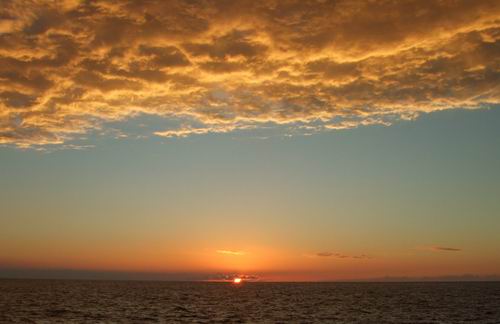
We then did an hour’s dive among the tropical fish (and lots of them), then got back aboard the boat for a snack — and to wait for the sun to go down. (Now there is where I got a great photo!):
Sunset from the Boat
Manta rays can have a “wing span” of 25′ across — over 7 and a half meters — and weigh up to 5,000 lbs. More typically they’re around 15′ across and 3,000-4,000 lbs. These aren’t “sting” rays — they have no barbs and are very gentle plankton eaters. The best way to see them reliably: dive at night and attract them with lights.
Yes: At Night
Also attracted by lights: plankton, their food. Jack’s crew dropped a big battery-powered light into the water and settled it on the bottom. As the sun sank we could see the eerie glow in the water. Once it was plenty dark, we all got back into the water with hand lights.
Let me tell you: it’s really freaky to be in the ocean when it’s so, so dark.
The divers went to the bottom and shined their lights up into the column, and the snorkelers stayed at the top, shining their lights down. As time went by the water got more and more cloudy with plankton and tiny shrimp attracted by the lights: a feast for a gulping manta.
Yes, it is quite safe: mantas don’t even bother the swarms of fish that are also attracted by the lights. But (dang!) no mantas showed up this time. The accommodating folks at Jack’s gave me a photo to show you from an earlier dive:
Mantas Feeding
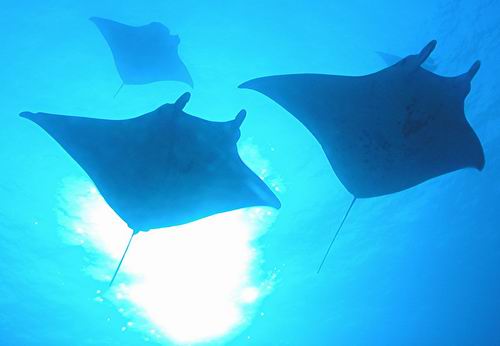
And check out this amazing video of mantas feeding at this same site, taken by another Jack’s employee. You can see the divers and snorkelers as the mantas circle from surface to floor, gulping up food. Swimming in the open ocean in the dark was wild; I can’t imagine the thrill of having a 20′ ray brushing up against me in that environment, too!
The whole idea was for our group to have an amazing group bonding experience. Even though no mantas showed up, the trip, the dolphins, and the humpback whales made it a fantastic success. Even Steve was jealous of our great humpback sighting (but no, darn it: we didn’t hear any whale songs while we were in the water). I can’t recommend this trip more to avid divers and snorkelers.
Need Fuel?

I guess this is for the people who didn’t like New Coke, either. I mean really: classic gasoline?! I guess they have to do something to justify the $3.91 price; most stations I saw on the island were charging around $3.25/gal.
Punalu’u Beach
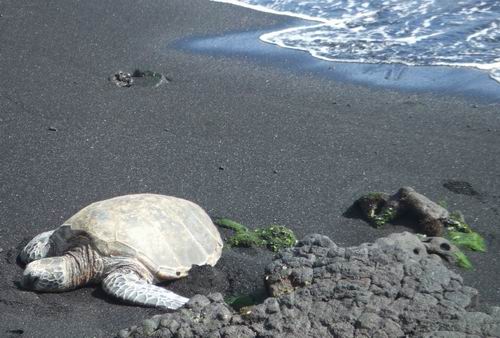
Yes, it’s Really Black

You say, “The fin is the last thing you see….” – that’s a little misleading, as it is a TAIL fin, or simply tail, not a side fin.
If you go to the west side of Kauai, there are black sand beached in Waimea and Kekaha, too. Each island has its own eco-centric quirks.
We’re glad you enjoyed your stay here – y’all come back! Aloha nui loa – (love is the best)
—
I do consider the tail fin a fin. -rc
I’ve always heard the tail of a whale referred to as the “flukes” not fins.
—
Fluke is another name for the tail fin of a whale or dolphin. -rc
The black sand makes me think of here. It’s a little lighter where I am. Of course, I’m living in Hokkaido… so, well, I’m living on a volcanic island.
It’s not very active around here any more (Hokkaido gets a lot less earthquakes than down south), although the newest volcano in Japan is a ways southeast of me. (Showa Shinzan)
It’s very rocky around here, but all the sand you find is this grayish-black. My husband and I paint miniatures as a hobby and he loves the sand for basing the miniatures. It’s really beautiful…and strange… to see these rocky black sand beaches.
I’d love to visit Hawaii sometime. The weather is definitely WARMER than here… it looks fantastic! 😉
I went on this dive 5 or 6 years ago. It was fantastic, they were “flying” less then 2 feet over us as we sat on the bottom. There must have been at least 20 of them flying in and out of view. I also went on a dive in Papua New Guinea and saw a bunch there, but Hawaii was by far better.
Next time you dive off the Kona Coast, try the “airplane Dive if it is still there. I dove the Airplane way back in the early eightys.
Thanks for the pictures and the travelogue. Whether the majesty of the Rockies or the serenity of Hawaii, these sideline tours outside of True are always a thoughtful diversion. I see the whale, beautiful sunset and mantas feasting, and it’s humbling. In the great scheme of things, many of our everyday concerns don’t really matter. Which is why I’m stunned that the first posted comment is from someone “correcting” you for being “misleading” over what is and is not a fin. Seems to me, Angela missed the point.
I enjoyed your description of your dives off Kona with Jack’s – my husband and sons dove with them when we were there over New Year’s 2002. The boys went on the manta ray dive and did see the mantas – they said it was just astounding having them brush against them and swoop overhead. (They would have been 14 and 11 at the time). And it took their minds off the fact that their dad, who was supposed to go with them, was in the Kona hospital with a ruptured spleen, sustained while body surfing at the beach. Quite the experience in every sense of the word – thanks for the memories!
—
Ouch! It’s a bummer to get hurt/sick when on vacation. -rc
Great looking photos and video of the Manta rays. My wife and I will be holidaying in Hawaii in October this year with some friends from Iowa. This looks like a great adventure with Jack’s Diving Locker. I will inform our friends in Iowa, Harold & Evelyn, to view it. They will control the bookings for tours so I can see this as being for us. Thanks for the great Idea.
I loved this blog on diving in Hawaii. I’m green with jealousy! I dove there 20 years ago and had the same dolphin escort experience – sure does make the soul feel good! While I didn’t have the Manta sightings either (we weren’t looking for them) I did have the extreme pleasure of diving with a bunch of giant sea turtles. Truly an awesome experience. Thank you for awakening such great memories.
Glad you liked Kona, Randy! My parents recently purchased a condo there, and I got to make my first trip there with them over the Christmas holidays this year. I made it out on 6 dives with Jack’s Diving Locker, and did the manta ray night dive. The mantas did not show up for us, but a number of yellow headed morays came to play. Next to Bob Soto’s in the Caymans, Jack’s is the best I’ve ever been on. I can’t wait to go back!
If you enjoyed swimming with mantas, you would probably like snorkel/SCUBA with manatees. Go to Clearwater Fla. [about 30 mi. N of Tampa]. Between Dec. and March, the manatees swim from the ocean into the inland fresh waters. Water so clear you can see 70-90 feet down. Manatees are huge — about 2500 lbs., but totally gentle and curious enough to swim up to you and spit in your ear.
—
Interesting. If I do it, I’ll be sure to wear ear plugs. -rc
My first thought when you said a night dive in Hawaii was “ouch!” I spent a week on the big island to get my advanced open water certification, one requirement was a night dive. We all had flashlights, and were having a great time just checking out the environment when I realized we were starting to see more and more of these things floating around us — they looked like giant centipedes (4-6″) and were swimming towards us, attracted by the lights. I had a bad feeling about it and avoided them as I quickly returned to the boat. One of the other divers wasn’t so lucky — one brushed against his bare arm and left painful welts. Our dive shop guy said they were so uncommon that it didn’t even occur to them to warn us — they had never actually seen any before! I don’t remember what they called them, but from what I’ve seen, they were probably bristleworms — or something very similar in appearance and venom.
The only other sealife I had a problem with was a huge eel — I guess I swam too close to his den, he came out and chased us for a good 30-40 yards out from where he lived! I have to say though that everything else about the trip was wonderful — the great people, the warm water, the incredible visibility, the variety of creatures… it was a great place to learn to dive. It certainly spoiled me for diving locally in San Diego!
I spent 10 summers in HI and took hundreds of sunset pictures. I don’t recall seeing a cloud formation like the one at the top of your sunset picture.
I was lucky enough to hike along the Kamoamoa coast and visit the “Queen’s Bath” before the lava buried it all.
Thanks for bringing back some fond memories!