
A previous post mentioned Hong Kong’s terrible smog (a word the Chinese don’t seem to know, but they understand “air pollution.” Another reader says there’s another term for it that’s spreading like the smog: the “Asian Brown Cloud“).
The next day a breeze came up and we had blue skies, which was sure nice, but over the next couple of days it got progressively worse again. But even then, it was never as bad as our next stop, a brief stay in Guangzhou (formerly known as Canton), where we could literally see haze between our bus and the buildings along the street.
The next morning we headed for the airport for our flight to Lhasa, Tibet, where we anticipated we’d see clear skies. We were definitely not disappointed.
Difficulty Breathing
In the smog, though, Kit had developed a nasty cough. She’s a bit predisposed to bronchitis, and was a bit worried that it would get worse the longer she stayed in the smoggy environment.
And I was noticing it hurt to breathe, too — very reminiscent of growing up in Los Angeles. So it was a literal breath of fresh air to see the clear blue skies of Tibet. Here’s our first impression of Tibet: not exactly what we were expecting!
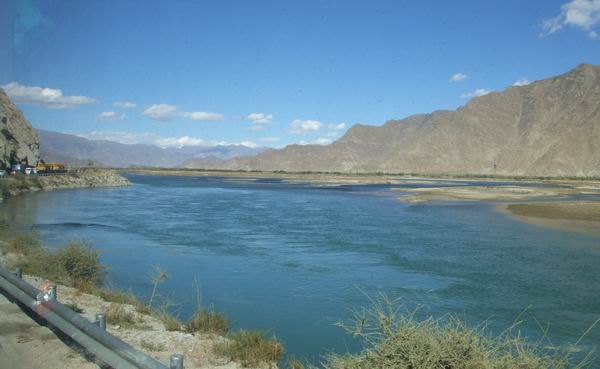
Lhasa has its own respiratory issues, though, due to its altitude: nearly 12,000 ft (about 3,650 m), which makes the air pretty thin — altitude sickness is fairly common here.
I didn’t think it’d be much of an issue for us, since we live at 7,500 feet ourselves. We’re quite well versed in the subject: altitude sickness is a common problem with tourists in our county, resulting in a fair number of ambulance calls, so it’s covered well in our EMT classes and continuing education. (One highlight of that was a lecture by the top western medical expert on the subject, Peter Hackett M.D., who lives near us.)
But even though we live at altitude, Kit’s cough/bronchitis was already causing her respiratory distress, and getting up to 12,000 feet pretty well pushed her over the edge. By the first night she was doing quite poorly, and we checked her blood oxygen saturation: just 79% (ideally, it should be in the 90s).
House Call
The hotel we’re in here in Lhasa is truly 5-star: they have a doctor on duty 24×7, and we called him in. Not surprisingly, he was Chinese. He had an interpreter, but communication was still pretty difficult. That was particularly painful for me: I really wanted to know what he thought and what he planned on doing, but I couldn’t really get full information; we just had to put Kit in his hands and trust he knew what he was doing.
He came up to our room — by then, it was well after midnight — and treated her right in bed. Oxygen, an IV, and a wide variety of drugs, which appeared to be a combination of western and Chinese. He assured us that Kit would feel better in the morning.
And… she did. He didn’t leave our room until about 3:15, and by then she was able to sleep pretty well. And even though I canceled our 7:00 a.m. alarm in hopes she’d get some extra sleep, she popped awake at 7:30 feeling about “95%” well, she said.
It was in marked contrast with another American guest in the hotel that we saw today, who decided not to go with the full treatment, and still felt quite ill the next day. We checked Kit’s oxygen saturation the next morning too: 89% — not yet ideal, but far better than last night.
Medical School
It all very neatly tied in with one of our stops today. Our tour guide, knowing we have an interest in medicine, arranged for a stop at the institute for traditional Tibetan medicine. Our host there was an expert in both Tibetan and Chinese acupuncture, and spoke excellent English. He gave us about an hour’s lecture on how traditional medicine is taught to students, using Buddhist thangka charts developed 700 years ago.
And even for someone like me who is steeped in western medicine, it made total sense: one chart (shown below, though not very clearly) showed a tree that broke into two branches, one (left) being the healthy body and the other being the sick body.
He pointed at the “healthy” side: simply, he said, physiology. The other side: pathology. In its way, this 700-year-old chart showed the basics of western medicine — what we have learned in the past couple of hundred years.
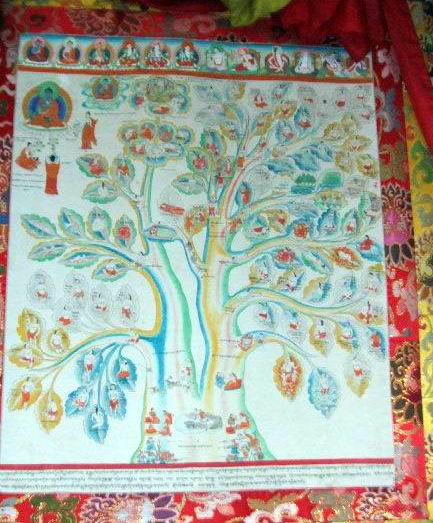
Not bad for an hour’s lecture; a full course for a new student, he said, takes five years.
Even though we’ve never met, I’ve developed a bit of camaraderie with you over time and felt considerable concern when I saw your first information about your wife’s illness. I’m glad to read that she’s getting better.
Interesting, too, isn’t it, the large differences between a person learning conversational English and technical English?
Beware, the air pollution in Wuhan will be about the same as it was in Guangzhou. It hurts to breathe after a while.
—
Yeah, we’re expecting it…. -rc
I’m glad to hear Kit is feeling better! I had similar problems with pollution in London; I can’t imagine adding altitude to the smog mix! Hope this is the last of any hang-ups on this incredible journey.
Funny how altitude sickness can creep up on you. I grew up near and around Denver, CO…but now have a day or two of adjustment when I go to visit. Not fun, my sympathies to Kit.
Like Mike from Dallas, I was concerned to see that Kit was not well. Glad to hear she is better. Good health and good travel to both of you.
—
We’ve both been coughing for days, but we’re pretty sure it’s because our used-to-clean-Colorado-air lungs are reacting to the terrible air in mainland China. -rc
Wow, how extraordinary to add such an experience to the journey. While I am sure you were worried about Kit, it goes to show that there is a lot about medicine we don’t practice in the West. Best wishes for an uneventful remainder to this trip.
I had similar smog experiences in Tel Aviv and Tokyo. Really drives home that the U.S. clean air efforts are working. We don’t appreciate how bad things could be. In addition, my well known make of Japanese rental car got only 12 MPG when I was expecting over 30+. A check under the hood showed a carburetted engine instead of fuel injection, which is standard in the same U.S. models. Again, we don’t appreciate our progress enough until we travel.
Hang in and kiss the ground when you get home.
Hi, I hope Kit continues to do well! I sympathize especially with the feeling when you’re not getting enough air because I just got out of the hospital after a pulmonary embolism. I’ve never before known or needed to care what my oxygen saturation was.
I also wanted to say, the EMTs were awesome. Among other things, of the three IVs I had placed during this, the best one was the one the EMT did in a MOVING ambulance. Seriously, those guys were excellent. I’ve enjoyed True for a long time and I hope you are having a great time and Kit is feeling better.
You didn’t get a REAL taste of Tibetan medicine unless you had a doctor diagnose you… by smelling, observing and, sometimes, tasting, your PEE.
Go back and demand the real thing. 😉
—
American doctors used to do that too. Now they order expensive tests. 🙂 -rc
I just saw the reply referring to Wuhan. You might want to eat at the Aloha Diner if you get a chance; it was opened about a year ago by some people from California, serving mostly Mexican-style food. Say Hi to Ralph and Janie if you do.
—
I’m in Wuhan now, as I approve this post (two days after you made it…). All of our on-the-run meals are set up in advance at restaurants that specialize in local foods. My favorite has been the Szechwan style, and no, I’m not getting sick of “Chinese food” yet! -rc
I’m glad your wife is feeling better and you are having an incredible trip. I went to China in February and found the worst air quality in Shanghai. I did not really notice the problems in Wuhan or Beijing. In case no one else has mentioned it, there is a very nice little park along the river very close to the Holiday Inn in Wuhan. Well worth a visit in the evening as they have all the statues and carvings lit up.
I’m sorry…what part of Randy’s story said that it was the traditional (or “non western”) medicine that had any effect for Kit? O2, an IV and a wide variety of drugs were used which means crediting any particular portion of the treatment for her recovery is dubious at best, either post hoc ergo propter hoc or the fallacy of tradition.
Randy I’m glad Kit is feeling better now and I hope that the rest of the trip continues with everybody in good health.
—
Indeed, I don’t know what the drugs were, let alone whether they were “traditional” or “Western”, which is why I didn’t even want to imply what had helped her. I’ve always thought that the best approach is to study all treatments, and choose which ones work best — regardless of the source. -rc
When I first went to mainland China in the late summer of 1985, a few months later I got a nasty case of flu, aggravated by the terrible air pollution. I went to the clinic at the university where I was teaching, and got a great doctor, a Chinese lady trained in China in traditional Chinese medicine, including acupuncture, *and* in Western medicine in a U.S. medical school. She also was board-certified in one of the New England states.
She asked which I preferred, and I left it to her to decide. She gave me a combination of oral medications from both traditions, and added a large bag of the worst tea imaginable, warning me to let it steep with a lid on, to contain the smell, then to drink it down quickly, assuring me it tastes as bad as it smells. She was right — but she was also right that the tea made me feel markedly better in under an hour.
I was impressed, to say the least.
We went there in 1988. A sign in the lobby showed signs of altitude sickness to watch for. Once was “loss of appetite.” Sure enough, I only picked slight at the food all week, but figured I could comfortably lose 10 pounds, so let it go (having no other symptoms).
The last night, the hotel staff said “in honor of our American guests, we will have London Broil tonight.” I ate it all up and had seconds!
It was then that I realized, it wasn’t my appetite — it was the food. Everything was cooked in Yak fat, and tasted disgusting enough that it kept my appetite at bay. 🙂
A fascinating trip though. We also went into a working hospital and saw patients being given acupuncture — with the needle going from one patient to the next with zero cleaning between. Made me glad I did not need any such treatment.
—
Yikes! Hope that has changed since 1988. -rc