
I “invented” for-profit email publishing on Wednesday, June 22, 1994. I’m not aware of any others who claim to have invented it before that time [but see the update below]. This is a brief description of what I came up with, and how.
At the time I was working at NASA’s Jet Propulsion Laboratory in Pasadena, Calif. I was on the engineering staff since I was doing software engineering, but my college degree is actually journalism.
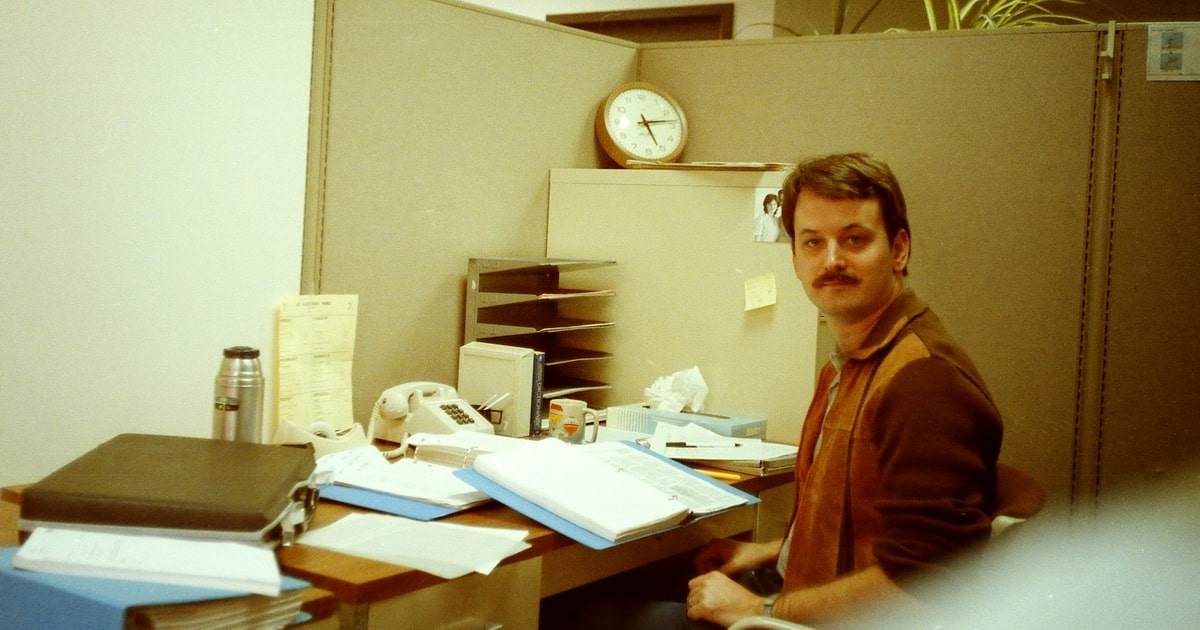
I had wanted to be a newspaper columnist when I went to school, but I quickly saw that it was an unrealistic goal: I would have to start as a reporter and, over the years, work my way up to being a columnist. (Forget that! I remember saying to myself.) Since I enjoyed science writing, my specialty became explaining complex technological topics to a lay audience, and (long story short) that led to a technical publishing job at JPL, which evolved into software (user interface) engineering.
One of the best things about JPL: they’re very high tech. There were around twice as many computers than people at the Lab, and there were a lot of people — around 6,000 at the time. For most of my tenure there I had two computers myself: a Mac and a PC.
That’s Puzzle Piece One
A lot of people post cartoons on their office walls. For years (later traced to early 1987), I had posted weird-but-true newspaper clippings on a (cork) bulletin board outside my cubicle at JPL.
Just posting paper clippings wasn’t enough: I couldn’t help but to hand-write comments on the articles. For instance, one that I recall was about a woman who kept two things under her pillow: an asthma inhaler …and a gun. One night she had an asthma attack, grabbed the gun instead of the inhaler, and pulled the trigger. On the article I wrote, “There she goes, shooting her mouth off again.” [More on that specific story]
As the years went by, they got very popular at JPL: I’d just quietly call out “New clips going up!” and go back in and sit down. Clusters of co-workers would crowd around the bulletin board in the hallway to catch the news — and laugh at the comments.
One of my biggest fans was my nearby secretary, Dotti, who would often proclaim as she read the clips, “You need to write a column!”
That’s Puzzle Piece Two
During the early 1990s, I was one of the early JPL employees to get my office computer attached to the ILAN — the Institutional Local Area Network — and was starting to explore this “Internet” thing that the ILAN was connected to. I was astounded at how easy it was to connect to computers half-way around the world.
I long had online access at home — my first CompuServe account was dated 1983 (and I kept it until AOL shut it down in 2009). I mainly used my CompuServe account for email, and my NASA computer’s email too: I worked with people all over the country, and later the world, and it was rather handy to be able to send them notes no matter what their time zones. Many of them became friends.
During that time, when I had a slack period where I had more time at the office than work to do, I started studying the Internet. Among the things I read about was “listservers” — server-based software which take an email message and then copy it out to everyone on its internal “list.” They were mostly used for email “discussion groups.”
It’s quite possible they were even used for newsletters that far back, and thus I don’t claim to have invented email publishing as a whole, but in 1994 doing business on the Internet was virtually unheard of; making a profit online was actually considered a terrible thing — the ’net was supposed to be a pristine environment of academic interest ever since it first went online (October 1, 1969, when the University of California at Los Angeles hooked up to the Stanford Research Institute, creating the Department of Defense’s ARPAnet). For-profit email publishing simply didn’t exist at the time.
I don’t actually remember being a member of any lists then, but still…
That Was Puzzle Piece Three
June 1994 was a pretty warm month, and my apartment had one crappy air conditioner that couldn’t keep up with the heat. It was stifling inside, and I couldn’t sleep. I was tossing and turning, wishing I could move the hell away from the desert to a cooler climate.
If I had to work for someone, JPL was an awfully interesting place to work, but I really, really wanted to get out of L.A.! I had been a small publisher (printed newsletters and books) before JPL, and I really wanted to get back into writing and publishing again.
That Was Puzzle Piece Four.
The Pieces Fall Together
In a flash of inspiration as I was tossing and turning, unable to sleep, the puzzle pieces fell into place: by using the Internet I could bypass “paying dues” as a newspaper reporter and become an online publisher, going directly to my audience without a newspaper publisher behind me. I’d use my “weird news” interest as the content vehicle, and the commentary to give it personality.
To get the biggest audience possible, I’d give my new column away online for free, with profit coming from three primary sources: advertising in the newsletter (radical, in 1994!), book compilations (there’s the old book publisher in me chiming in!), and — once the column got popular — newspaper syndication.
In other words, despite the lack of commercial activity online, the original inspiration included the concept of for-profit activity from the email newsletter, even though I had never even heard of such a thing before.
Don’t Lose the Idea!
I leapt out of bed, booted my computer, and jotted down some notes: I knew I had come up with a great idea, and I wanted to be sure nothing was lost. But it was so burned into my mind I needn’t have worried.
In addition to the profit sources outlined above, my June 1994 business plan also spelled out the mechanics of the email publishing portion:
The first method of distribution is by direct subscription via electronic mail on the Internet. A “listserver” is an automated Internet computer program designed to disseminate information electronically to a large audience. By sending a standard electronic mail message to the listserver with the word “subscribe” in the body of the message, the listserver reads the email address of the sender and adds it to a file — a file containing the email addresses of people who want to subscribe, i.e. be added to the list.
When an issue of the newsletter is ready for distribution, the author passes it to the listserver for full distribution. The newsletter is electronically duplicated — a copy for each person on the list — and each copy is electronically mailed. Distribution is thus handled quickly, and virtually without human effort. To grow large very quickly, promotion will be aggressive — and distribution by this method will be free. Since this distribution is free, I suspect most people will want to get their own subscription, rather than depend on a friend to make them a copy.
There it is: the basics of my “invention” — for-profit email publishing. You can kinda tell I was working in “engineer” mode! 🙂
Why a Business Plan?
I hadn’t planned to write a business plan, but on Thursday morning, I was excited enough about my ticket out of L.A. that I told a couple of JPL friends about my idea. And they didn’t get it. At all. It was so obvious to me I couldn’t believe they couldn’t see it. I said I’d be making enough income from it that I could quit my Day Job within two years and go full-time with my email publication.
“How are you going to make money giving it away for free?” they asked. Sigh!
So I went home that night (Thursday, June 23) and booted my computer again. I fleshed out my notes into a business plan. The usual reason to write a business plan is to explain a business concept to investors to get funding. I realized I didn’t need funding, but wrote the plan anyway to help explain the concept — not just to my high-tech JPL friends, but to less online-savvy people, like my father.
On Friday I brought the business plan back to JPL to show my friends; they could read the concept, including details on how profits would be generated — and including my estimate of two years of ramp-up until I could quit my day job. After all, there weren’t that many people online in 1994.
And my friends still didn’t get it. They thought I was crazy. But I pressed forward: over the weekend, on Sunday, June 26, I wrote the first issue. I’ve kept the Sunday writing schedule ever since.
January 2009 Update
Well, it looks like someone else also invented it, and before me:
Sorry, Randy, but TidBITS has always been commercial. For the first year or so, we didn’t make any money, but we started our corporate sponsorship program in 1992 (which is, as far as I’m aware, the first advertising program on the Internet, though the first commercial use of the Internet was ClariNet). We do also accept direct contributions from readers, but that came many years later when readers requested it. It has never been a significant source of revenue. Since our entire 19-year archive is online, all of this can be verified in our back articles.
TidBITS started in April of 1990, and the only older technology publication I know of that’s still in business (there were plenty before us that are no longer around) is the Irish Emigrant News, now a Web site.
By 1994, we had published over 200 weekly issues, and our subscription list was growing extremely quickly due to the publication of my “Internet Starter Kit for Macintosh” book.
Sorry to have eclipsed your date — you were right in there in the beginning too, and what’s more important is that you’re still going. There were a lot of people doing interesting stuff back then, but most are long gone now.
–Adam C. Engst
27 January 2009
Hey, Adam, no apology necessary! I’m glad to get things clarified, because I was still wondering. I can’t think of a better team to hold the crown.
So I’ve updated my claim: True is — as far as I know — the Oldest Entertainment Publication on the Internet.
Something Even Earlier
So if True is the earliest and longest-running online entertainment publication, and TidBITS was the earliest and longest-running email publication, what was the earliest online publication of any kind?
RISKS Digest went online Thursday, 1 August 1985, “a new on-line forum. Its intent is to address issues involving risks to the public in the use of computers.” It was published by the Association for Computing Machinery’s Committee on Computers and Public Policy, and moderated by Peter G. Neumann, the Committee Chairman. It was originally published on Usenet.
The cool thing is, as of 2023, it is not only still publishing on a slightly strange schedule (over 37 years, it’s divided into 33 volumes of 45-98 issues), but it’s still moderated by Neumann, who is 91 years old! Fun tidbit: While a student at Harvard (on 8 November 1952), Neumann had a two-hour breakfast with Albert Einstein, discussing simplicity in design. Neumann has spent most of his career at the Stanford Research Institute (now known as SRI International) in Menlo Park, Calif., and apparently still works there.
There is a full and searchable RISKS archive.
– – –
Bad link? Broken image? Other problem on this page? Let Me Know, and thanks.
This page is an example of Randy Cassingham’s style of “Thought-Provoking Entertainment”. His This is True is an email newsletter that uses “weird news” as a vehicle to explore the human condition in an entertaining way. If that sounds good, click here to open a subscribe form.
To really support This is True, you’re invited to sign up for a subscription to the much-expanded Premium edition.
So YOU’RE the guy who corrupted the inter-net! [grin] Always wondered who was first…
Too bad folks who followed didn’t adhere to the same standards and code of conduct to which you subscribe.
I’ve read you for, hmmm, several years now and truly enjoy your writing.
So, how did you “aggressively promote” the nascent newsletter?
What did you expect or predict the growth would be? Did the growth meet or exceed your estimate?
—
I originally anticipated being “aggressive” about promotion by sending out press releases — but I didn’t have to. The Internet was bursting into the public’s consciousness, and all sorts of magazine and newspaper reporters were looking for SOMETHING to write about. There was very little actual content online in the mid-90s, and the content I was putting out was of particular interest to reporters (since I said what they wished THEY could say when writing the stories!), so I ended up with a lot of press coverage — much more than I anticipated getting with press releases.
The growth rate thus ended up a significantly higher than I expected. -rc
Besides agreeing with the other two comments (especially Jim’s), I have been trying to remember when and where I first heard about your newsletter. I know I’ve been through several ISP’s and screen names while getting your funny comments. So what? So keep up the good work.
One question: Since there are so very, very many (seems to me) people who take way too much literally, how do you keep your sanity during the ridiculous attacks you receive from the sober-sides? Kudos to you for being able to that.
—
I’m simply entertained by it — at least, most of the time (it can certainly get old sometimes). Their letters just end up being part of the entertainment for many readers. -rc
I’ve enjoyed your newsletter for several years and realy enjoyed this brief ‘where it all began’. I look forward to your blog.
Like Igor, I can’t remember where or exactly when I first heard about This Is True. I suspect it may have been one of those early computer magazine articles, as I distinctly remember subscribing from my uni account, and given my memories of those old green screen terminals we had to use, I suspect it was in 1994… I’d be interested to know when. I don’t suppose you’ve kept the records?
13 years later, I’m proud to be a premium subscriber, and pay you back (even just a little) for all those laughs!
—
Indeed my records don’t go back that far. Even if they did, I wouldn’t be able to check without your then-address. I figure anyone who remembers the title being “This Just In” is a true old-timer, and I often do hear from people who remember it. It had that title from June 1994 through April 1995. -rc
A fascinating story; it’s always good to get a glimpse of an idea from another person’s mind. But interestly enough, the inability of your associates to understand, even as you explained it to them, ties back to your articles about Zero Tolerance in schools. Not only is “thinking outside the box” something that is frowned upon, it is brutally beaten out of students. Even with success as your proof, many will insist that it’s just a fluke and can’t be duplicated. In any case, congratulations on your inspiration during the early days of ARPAnet and thank you for making it a reality.
I’d love to hear more on how it all started. Your last line “And my friends still didn’t get it. They thought I was crazy. But I pressed forward.” left me looking for the link to the next page. What happened when you pressed forward? How did it all come together?
—
Continue reading the older posts right here in this blog. It’s all there. -rc
“Invented” for profit email publishing?
Tidbits beat you by a few years. Issue #1 was published 1990.
I understand Tidbits is the second longest running internet (for profit) newsletter (I don’t remember the longest running one).
True is fun and you were certainly one of the earlier ones, but “invented”? Almost.
—
My understanding from Adam is that Tidbits was not formed as a for-profit, and even today subsists on “contributions” from readers. I don’t call that a commercial operation. -rc
Like others here, I really enjoyed reading about the genesis of “Randy’s Most Excellent Adventure.”
To me, as a reader, it matters not whether you genuinely deserve the crown for inventing anything. Of course, I realize the bragging rights that confers. In *any* case, you certainly are a pioneer — that’s something no one can dispute or take away from you.
Guess your friends at JPL might have been brilliant at guiding spacecraft (or whatever they did) but had little of the business visionary about them! 😉 (Of course, I know engineers who wish their excellent businessman boss would stay to hell out of their way.)
I love your stuff. So do people I’ve told about it. And I’ve plugged it on my own website, generating some appreciative email from folks who discovered your sites there.
—
Thanks for helping to “spread the word” in your part of the world, and your part of the Internet. -rc
I just finished reading “How The Web Won” by Ken McCarthy in which he describes how he and a few others initiated the first “commercialization” of the Internet in San Francisco (it’s a pretty interesting read). After reading this article, I’ve come to the conclusion that the same idea was coming to a lot of people at the same time, and those who took action reaped the rewards and in at least a few cases, made the Internet a better place.
—
Yes, McCarthy convened “the first major conference ever devoted exclusively to the subject of commercial opportunities in web publishing” — on November 5, 1994, in San Francisco. That was several months after TRUE had started, and the same week it broke the 20,000-person subscription level, and I didn’t even have a web site yet. -rc