
Updated 16 July 2022
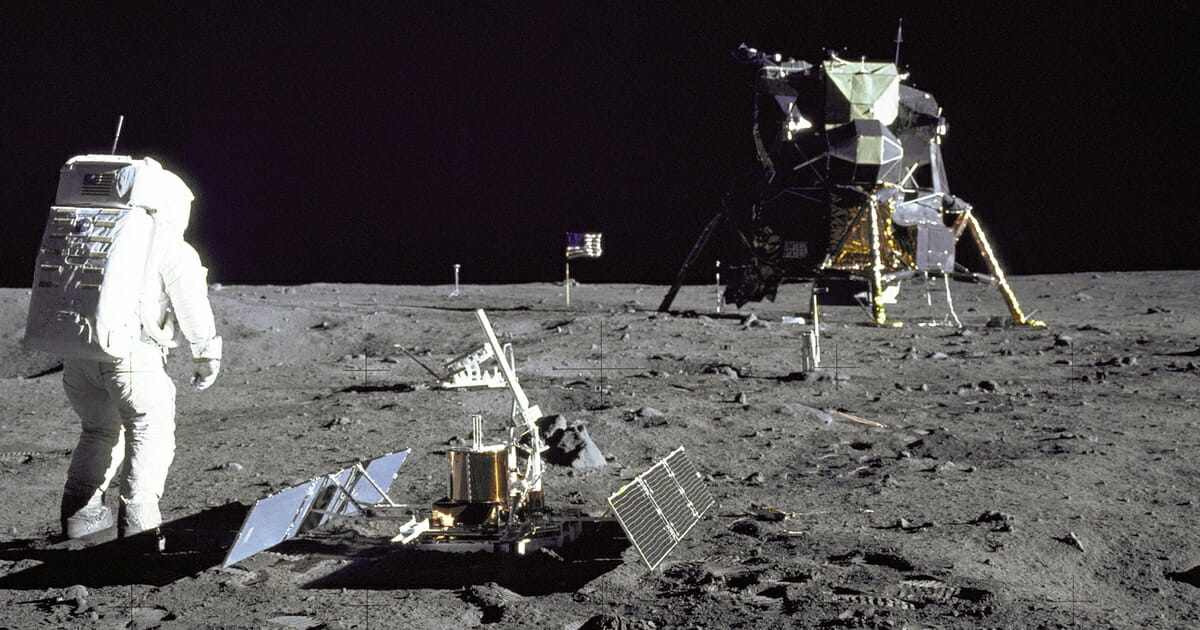
It was 50 years ago Saturday that Apollo 11 astronaut Neil Armstrong piloted the Eagle — the first manned lunar-landing spacecraft — to the surface of the moon.
 He had to land manually, as the onboard computer couldn’t process instructions fast enough as they sped toward a field of boulders; landing on them would have surely meant death. But he settled down with less than 30 seconds of fuel remaining and, after a few hours of rest, stepped onto the surface of our moon, followed shortly by Edwin “Buzz” Aldrin, while Michael Collins circled as few as about 66 miles overhead in the command module, Columbia.
Driven by dreams — and funded by a burning desire to beat the Russians — the first moon landing on July 20, 1969, was a defining moment in human history. Never before had so many people, in so many countries, watched a single event with such awe.
“It was probably the greatest singular human endeavor, certainly in modern times, maybe in the history of all mankind,” said former astronaut Gene Cernan as the 30th anniversary approached. Then 65, Cernan was the last of the 12 men to walk on the moon, from Apollo 17 in 1972.
Chances of Success
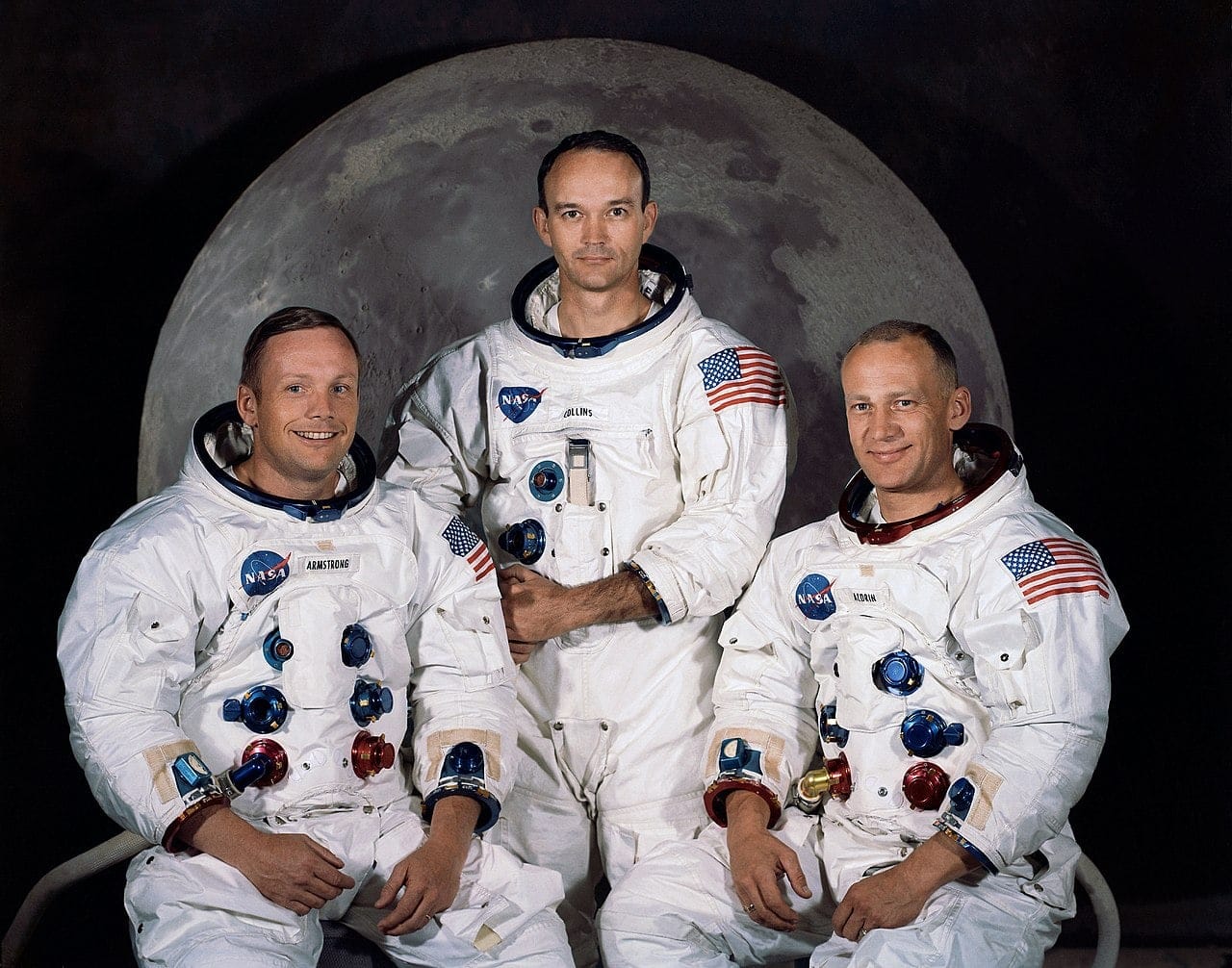
The astronauts had their own opinions about the likelihood of success: they were cool-thinking, technical men. “I thought we had a 90 percent chance of getting back safely to Earth,” Armstrong said for the 30th anniversary celebrations, “but only a 50-50 chance of making a landing on that first attempt.” Buzz Aldrin concurred. And Michael Collins? “I think we will escape with our skins,” he wrote in a NASA history, “but I wouldn’t give better than even odds on a successful landing and return. There are just too many things that can go wrong.”
A 50-50 chance, but they went anyway, and gladly.
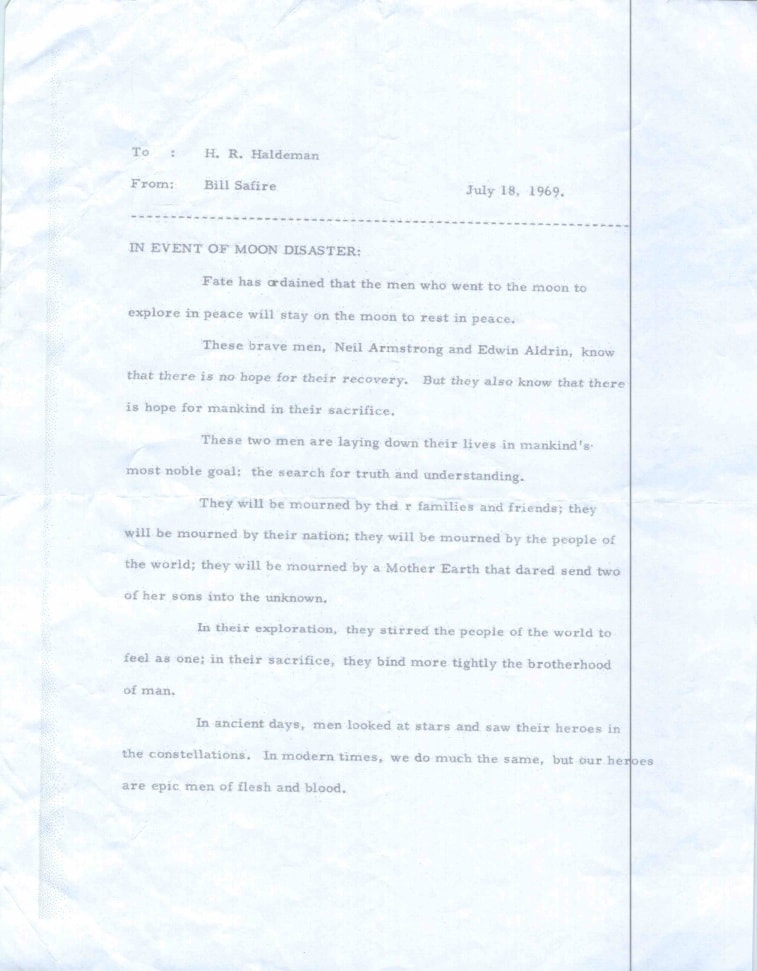
Everyone in the program knew there were significant risks — right up to the top. Just three days before Apollo 11’s Apollo 8 astronaut Frank Borman, the NASA liaison to the White House, called the White House to urge William Safire, then the president’s speech writer, to create a speech for President Nixon in case of “mishap.” Safire (later a columnist for the New York Times) wrote the words Nixon never had to use, sent as a memo to Nixon’s Chief of Staff, H.R. Haldeman. It’s an amazing piece of work created during a hectic few days.
The memo was titled “IN EVENT OF MOON DISASTER”:
Fate has ordained that the men who went to the moon to explore in peace will stay on the moon to rest in peace.
These brave men, Neil Armstrong and Edwin Aldrin, know that there is no hope for their recovery. But they also know that there is hope for mankind in their sacrifice.
These two men are laying down their lives in mankind’s most noble goal: the search for truth and understanding.
They will be mourned by their families and friends; they will be mourned by their nation; they will be mourned by the people of the world; they will be mourned by a Mother Earth that dared send two of her sons into the unknown.
In their exploration, they stirred the people of the world to feel as one; in their sacrifice, they bind more tightly the brotherhood of man.
In ancient days, men looked at stars and saw their heroes in the constellations. In modern times, we do much the same, but our heroes are epic men of flesh and blood.
Others will follow, and surely find their way home. Man’s search will not be denied. But these men were the first, and they will remain the foremost in our hearts.
For every human being who looks up at the moon in the nights to come will know that there is some corner of another world that is forever mankind.
PRIOR TO THE PRESIDENT’S STATEMENT:
The president should telephone each of the widows-to-be.
AFTER THE PRESIDENT’S STATEMENT, AT THE POINT WHEN NASA ENDS COMMUNICATIONS WITH THE MEN:
A clergyman should adopt the same procedure as a burial at sea, commending their souls to “the deepest of the deep,” concluding with the Lord’s Prayer.
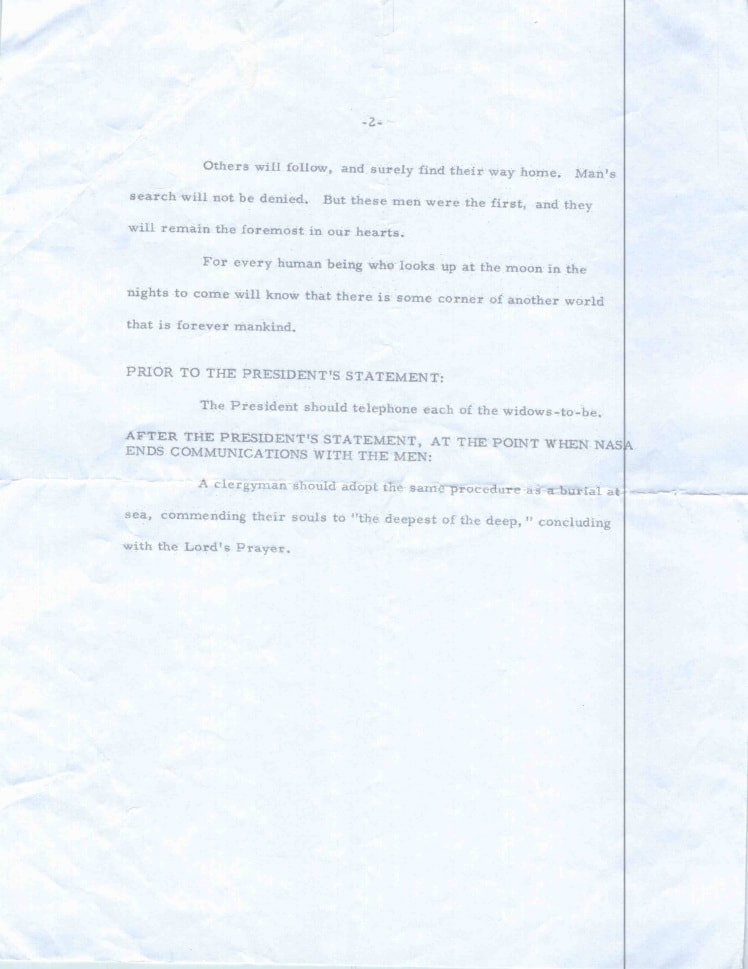
Two Specific Phrases really jump out: “widows-to-be” and “when NASA ends communications with the men”! My guess is that NASA would be there for the guys until they couldn’t communicate anymore, rather than sever communications and leave them to die without any link to home.
And that’s one hell of a position for Safire to put himself into: dictating specifically what a “clergyman” should say to the entire world at the conclusion of his service.
Pressure to Succeed
Imagine the pressure they must have felt! But they thought it was important to take such risks. True heroes indeed, and it was worth it: their bold steps inspired an entire generation, not just of Americans, but of the entire human race.
Including me: I started my career as a science writer, with a specialty in explaining complex topics to a lay audience, proudly working at NASA’s Jet Propulsion Laboratory for ten years before I left to work on True full time. I loved being shoulder to shoulder with the people that make our reach toward the stars happen.
For a terrific summary of the Apollo 11 mission — as told by the astronauts while it was fresh in their minds — well illustrated with great photos, see NASA’s The First Lunar Landing site, released for the mission’s 20th Anniversary.
Update: July 16, 2022
Twelve Apollo astronauts walked on the moon (marked in the table below with *), and 12 more flew to the moon without landing there.
Here is the status of those astronauts as I update this page on July 16, 2022 — the 53rd anniversary of the Apollo 11 launch. The date (mm/dd/yy) is the mission start, and the links go to NASA’s Mission Overviews.
| Mission | Crew | Crew Status |
| Apollo 8 12/21/68 | Commander: Frank Borman, Command Module Pilot: Jim Lovell, Lunar Module Pilot: Bill Anders | All three astronauts still alive: Borman and Lovell are 94, Anders is 88. |
| Apollo 10 5/18/69 | Commander: Thomas Stafford; Command Module Pilot: John Young; Lunar Module Pilot: Eugene Cernan | Stafford is still alive at 91. Young died 1/5/18 at 87; Cernan died 1/16/17 at 82. |
| Apollo 11 7/16/69 | Commander: Neil Armstrong*; Command Module Pilot: Michael Collins; Lunar Module Pilot: Edwin ‘Buzz’ Aldrin Jr.* | Armstrong died 8/25/12 at 82; Aldrin is still alive at 92; Collins died 4/28/21 at 90. |
| Apollo 12 11/14/69 | Commander: Charles ‘Pete’ Conrad Jr*; Command Module Pilot: Richard Gordon Jr; Lunar Module Pilot: Alan Bean* | Conrad died 7/8/99 at 69; Gordon died 11/6/17 at 88; Bean died 5/26/18 at 86. |
| Apollo 13 4/11/70 | Commander: James Lovell Jr; Command Module Pilot: John ‘Jack’ Swigert; Lunar Module Pilot: Fred Haise | Lovell is still alive at 94; Swigert died 12/27/82 at 51; Haise is still alive at 88. |
| Apollo 14 1/31/71 | Commander: Alan Shepard Jr*; Command Module Pilot: Stuart Roosa; Lunar Module Pilot: Edgar Mitchell* | Shepard died 7/21/98 at 74; Roosa died 12/12/94 at 61; Mitchell died 2/4/16 at 85. |
| Apollo 15 7/26/71 | Commander: David Scott*; Command Module Pilot: Alfred Worden; Lunar Module Pilot: James Irwin* | Scott and Worden are still alive at 90; and 88. Irwin died 8/8/91 at 61. |
| Apollo 16 4/16/72 | Commander: John Young*; Command Module Pilot: Thomas Mattingly II; Lunar Module Pilot: Charles Duke Jr* | Young died 1/5/18 at 87; Mattingly and Duke are still alive at 86. |
| Apollo 17 12/7/72 | Commander: Eugene Cernan*; Command Module Pilot: Ronald Evans; Lunar Module Pilot: Harrison Schmitt* | Cernan died 1/16/17 at 82; Evans died 4/7/90 at 56; Schmitt is still alive at 87. |
– – –
Bad link? Broken image? Other problem on this page? Use the Help button lower right, and thanks.
This page is an example of my style of “Thought-Provoking Entertainment”. This is True is an email newsletter that uses “weird news” as a vehicle to explore the human condition in an entertaining way. If that sounds good, click here to open a subscribe form.
To really support This is True, you’re invited to sign up for a subscription to the much-expanded “Premium” edition:
Q: Why would I want to pay more than the minimum rate?
A: To support the publication to help it thrive and stay online: this kind of support means less future need for price increases (and smaller increases when they do happen), which enables more people to upgrade. This option was requested by existing Premium subscribers.
Comments Note
This page was originally written for the 30th anniversary of the Apollo 11 mission on July 20, 1999. Thus, the comments start awhile back, though not in 1999: the site didn’t have comment capability back then as it was still hand-coded.
Part Two of this story is in my podcast, The Giant Leap for Mankind (which page also has a transcript).
Related: I had the honor later of attending Neil Armstrong’s final public appearance.
– – –
Bad link? Broken image? Other problem on this page? Use the Help button lower right, and thanks.
This page is an example of my style of “Thought-Provoking Entertainment”. This is True is an email newsletter that uses “weird news” as a vehicle to explore the human condition in an entertaining way. If that sounds good, click here to open a subscribe form.
To really support This is True, you’re invited to sign up for a subscription to the much-expanded “Premium” edition:
Q: Why would I want to pay more than the minimum rate?
A: To support the publication to help it thrive and stay online: this kind of support means less future need for price increases (and smaller increases when they do happen), which enables more people to upgrade. This option was requested by existing Premium subscribers.
Great story!
One of the reasons that the module was being hand flown was that NASA had not accounted for the small push that the leftover air in the hatch would give to space landing vehicle. It was enough of a push to require them to select an alternate field, as they would miss the original planned landing field (a nice, safe, flat area) and end up over a rocky one. So… hats off even more to the pilot who had to deal with what could have easily been a total disaster.
I’ll disagree: in a lengthy comment elsewhere on this page, it is discussed they the LM disconnected from CM and ‘hovered’ around for inspection reviews before it was cleared for descent. The ‘puff’ from a low-atmosphere* pressure residual in the coupler would be insignificant (*command /landing module air pressure was 5 PSI, vs ‘normal’ pressure of 14.7 PSI at sea level).
I too had a real interest in the space program. My dad was an engineer for Aerojet General, the Liquid Propolusion side of things. Aerojet was responsible for the Saturn V rocket so I recall watching every launch and splashdown! Thanks for bringing back such a great memory.
—
Very cool, George! We lived in Burbank, on a hill overlooking Burbank airport, where there was a big Lockheed facility. Some of my earliest memories involve sonic booms from the various experimental aircraft Lockheed was developing at its “Skunkworks”. -rc
July 20, 1969 Hollywood, FL
I was 16 years old and sick with the mumps, something considered quite hazardous for boys my age. I had been confined to my bed for a long time already and asked frequently to be allowed to see the planned moon landing.
Finally, when the astronauts were at the moon, but had not yet landed, I was allowed to walk slowly and with assistance to the other end of the house where our television was located.
As the lunar module was piloted down I almost passed out. I had forgotten to breathe. Such was the excitement of the event. Never before and nearly never since, has anything impressed me to that point. It truly was a miracle for mankind.
My 107-year-old great aunt and her family were sitting in front of a 25 inch color television watching the first step on the moon.
She recalled the first time she saw a man fly when she was a little girl. It was a Frenchman in a hot air balloon at a World’s Fair. She said that was just as exciting as the moon landing.
Now that is cool!
Some child today will tell of watching Franky Zapata 50 or 100 years from now.
I was nineteen that summer, and stationed on a fire lookout about 50 miles from Portland, Oregon, and at least 20 miles from the nearest thing that could be called “civilization”. I watched the landing on a 4″ Sony portable television. It was roughly 12″ x 15″ x 6″ and weighed nearly 15 lbs; I had to steal dry cell batteries from my communication radio to power it. By today’s standards, that is ancient technology, but I was filled with wonder at the time to be able to see pictures direct from the Moon in my remote location. Even today, I still tear up when I hear Armstrong say, “The Eagle has landed.”
I was 11 when this happened. My family had a small black and white television set that we watched it on. My mother and I both loved to read science fiction stories, and here we were living one vicariously. Back then, we were sure that by 40 years later, there would be permanent settlements on the Moon. *sigh*
My husband and I had been intrigued with the previous programs and were following every step of the Apollo flights.
He was fossil hunting with friends that weekend but made it home before the scheduled broadcast. Our older son was 6 months old and we sat with him in my lap to watch.
Four years later, my husband was in charge of producing the map of the moon landing site for Apollo 17! That was the flight when the fender was damaged and the astronauts used copies of the map and duct tape to create a new fender for the Lunar Explorer. They brought it back and it hangs in the Space Display at the Smithsonian Air & Space Museum in Washington, D.C.
July 20th is my birthday, and on July 20, 1969 I received the best birthday present of my life, thanks to NASA, the Apollo astronauts, and a country then not afraid to lead.
Just a minor correction; the Command Module was, if memory serves, in an elliptical orbit with perilune (closest approach to the moon) about 60 miles, and apolune (furthest distance) about 120.
I too have distinct memories of being permitted to stay up late to watch the first steps on the moon. A real high point, if not *the* high point (so far), for our species.
PS: if you haven’t done a Zero Gravity training flight yet, do so. My entire family flew one last year, and it is worth every penny. In all the accounts I have read on space flight, I have never seen a really good description of what freefall feels like, and now I know why — it is very hard to describe (but it doesn’t feel like you’re falling!)
—
I agree that the use of “circled” is misleading, since he didn’t stay in a <10-mile circular orbit, but indeed the orbit dropped that low for the lunar descent by Armstrong and Aldrin:
And it continues from there. (Source: NASA) -rc
My folks dragged the TV into the dining room so we didn’t miss anything. I wanted to stay up to see them jettison their trash, but the excitement wore me down. It’s disturbing how little media coverage there is of space exploration today. All the gadgets that allow us to tweet and Facebook are possible because of the engineering that space exploration required. I also think it’s interesting that the astronauts don’t consider themselves heroes. To a man, they said they were just doing their jobs. As an aside, RIP Uncle Walter.
A touching and inspiring memoir. I was 10 years old at the time of the moon landing. It has stayed with me as a high point of my childhood.
Let us not forget the contributions of Jack Parsons, who co-founded the JPL, and whose contributions to rocket science made it possible for the space program to take off (pun very much intended).
In 1937 Parsons addressed a meeting of the science fiction club founded and conducted by Ray Bradbury, then a senior in high school. His parting words were: “Do not give up on your dreams. We will land on the Moon in your lifetime.” Sadly, this was true of Bradbury but not Parsons himself.
“He had to land manually, as the onboard computer couldn’t process instructions fast enough as they sped toward a field of boulders.”
AIUI this is not true. It was always part of the plan that the crew would have and probably use the ability to steer the lander (or as Armstrong put it afterwards, exercise his “God-given right to be wishy-washy about where I was going to land”), but the computer was an essential part of the Apollo flight controls. Attempts were made in the simulator to fly the lander fully manually but they failed — the lunar lander was simply too unstable to be handled without electronic mediation.
It’s true that the onboard computer issued alarm codes during descent (“1202 alarms”) which indicated it was heavily loaded. However it’s important to realise that the computer was a multi-tasking machine and had other roles than mediating the flight controls. One of these was monitoring the lander’s 2 radars, one aimed at the lunar surface for the landing, the other aimed back at the command module for docking and undocking.
The exact explanation of what happened is a little unclear but it seems that the computer was only specced to handle the volume of radar data from one radar at once. However during the descent both were active, or at least appeared to be from the computer’s point of view, and it was getting swamped. It therefore did what it was designed to do in this situation – drop the lowest priority tasks (the rendezvous radar calculations) in order to ensure the higher priority flight control tasks got the resources they needed. It then popped up an alarm to let astronauts and ground control know what was happening.
I’ll end with a few articles which go into the story with more depth and/or eloquence than I’ve managed above.
http://history.nasa.gov/alsj/a11/a11.1201-pa.html
http://kn.theiet.org/magazine/issues/0912/smart-apollo-0912.cfm
—
I was being necessarily brief. The computer didn’t crash per se, but Armstrong did have to alter the landing location at the last moment because of unanticipated boulders in the way. The 1201 and 1202 alarms were definitely a distraction, and in a simulation 11 days before launch, the flight director, not understanding the alarms (that were included on purpose) aborted the landing. That turned out to be a good thing, since when they popped up during the actual landing, they knew it was a simple overload situation and that it was OK to proceed.
For a more technical description of the LM’s onboard computer systems see https://history.nasa.gov/afj/compessay.html
-rc
Here’s another postscript to the LM’s Landing Computer which I found fascinating:
https://padailypost.com/2019/07/15/locals-restore-apollo-11-computer-get-it-to-run-moon-landing-program/
Thank you for acknowledging that it was indeed “…one small step for a man…”. I remember it vividly- I had just returned from Vietnam (and discharged from the USAF) two months previously, and my Mom and I were in the Living Room, glued to the TV, just as we were in Nov., 1963. I always wondered what ever happened to that “a”, and what else in our history has been “corrected” that we don’t notice!
—
I acknowledged that he meant to say “a man”. What he actually said, however, was “That’s one small step for man, one giant leap for mankind.” — dropping the “a”. Analysis of the tapes have shown that it was not dropped from the transmission, but rather not said in the first place. -rc
On 20July1969, my Marine unit, 1st Battalion, 9th Marine Regiment and I, after having been pulled out of Vietnam by presidential order, diembarked at Okinawa. We found out later that day what happened on the moon.
—
Talk about mixed emotions! You missed witnessing fabulous history, but getting out of ’nam is a pretty good reason. -rc
One quick correction — Michael Collins orbited in Columbia approximately 66 miles above, not 10.
“Later, a second burn of the SPS for 17 seconds placed the docked vehicles into a lunar orbit of 62 by 70.5 miles…”
I got that quote from here: https://www.nasa.gov/mission_pages/apollo/missions/apollo11.html
The confusion may be from the fact that the Lunar Module was initially in an orbit that would take it only 10 miles from the surface at it’s perigee, before it entered the landing phase. But the Command Module Columbia, with Michael Collins in it, never got closer than 62 miles from the surface.
—
Thanks for not only clearing that up, but for figuring out where the error came from! I’ve corrected the text. -rc
It’s not a detail I’ve thought about recently, but I vaguely understood “when NASA ends communications with the men” as meaning something akin to “at the end of transmission, after the astronauts have lost consciousness”.
I do recall seeing that Susan Borman, interviewed years later, admitted to wondering whether the widows-to-be would even be permitted to speak to the astronauts if Apollo 8 were stranded….
I thank you for updating and reposting this one. I never saw the original post as I didn’t subscribe to Premium True until 2015. I am surprised that the first comment (at least among these displayed here) wasn’t until 10 years after it was posted. I’m also surprised that there hasn’t been a comment posted since 2017. Anyway, I thought I’d kick in my 2 shekels. Maybe we can get some more good stories.
I discovered science fiction in junior high and haven’t recovered since. In 1960 I borrowed a friend’s telescope to try and see Echo 1 pass overhead. In that same year my mother let me stay home from school to watch Alan Shepard’s first flight on a 13-inch B&W TV. (I was blessed to have parents who fostered scientific knowledge in us.) The next year we sat in front of the same TV to watch John Glenn take his first ride. It was a thrill like no other.
In 1969 I was working the night shift at the Post Office in North Hollywood, CA and our supervisor allowed us to halt operations. We all crowded into a tiny office to watch on a TV someone had brought in. Having watched the liftoff (of course), I was on the “edge of my seat” you might say, as most of us were standing. I don’t believe I was holding my breath, but I got the most incredible rush hearing Neil Armstrong say, “Tranquility Base here. The Eagle has landed.”
Having closely followed developments since then, I think I can safely say that science fiction ain’t all fiction. Just good adventure stories wrapped around science fact, much of which elicited lots of thinking about the universe and our place in it.
I’m 73 now and I hope I’m still around to hear that first person radio back from Mars, “Sojourner Base here. The Eagle has landed, again!”
—
When this was first posted in 1999, the web site didn’t have any commenting capability. I’ll clarify that in the Comments note above. -rc
For those that don’t know about XKCD’s spin on the data in 2017 update (which was done a few years before 2017) consider this.
Thank you for the Astronaut update. I was in Vietnam when the flight took place and didn’t see a replay until I got to Japan in a Purple Heart recovery ward. One of my uncles worked on the Gemini Program as well as the Apollo Program in California.
No-one has mentioned President Nixon’s actual direct call by telephone to the astronauts. Especially the message: “For one priceless moment, in the whole history of the Man, all the people on this Earth are truly one. One in their pride in what you have done. And one in our prayers that you will return safely to Earth.”
The telephone call was replayed on a Belgian TV programme during the week. I had never heard it before.
No mention of it on UK News reports this week, either. Slightly odd.
I was rather moved by its message.
—
I wonder if Safire wrote that, too. -rc
I was curious about this, so I looked it up. According to astronaut Frank Borman’s book Countdown: An Autobiography (available used on Amazon), Nixon originally had a long speech prepared to read during the phone call. But Borman, who was at the White House as a NASA liaison during the Apollo 11 mission, convinced him to keep his words brief. That conversation was:
Nixon: Hello, Neil and Buzz. I’m talking to you by telephone from the Oval Room at the White House. And this certainly has to be the most historic telephone call ever made. I just can’t tell you how proud we all are of what you’ve done. For every American, this has to be the proudest day of our lives. And for people all over the world, I am sure they too join with Americans in recognizing what an immense feat this is. Because of what you have done, the heavens have become a part of man’s world. And as you talk to us from the Sea of Tranquility, it inspires us to redouble our efforts to bring peace and tranquility to Earth. For one priceless moment in the whole history of man, all the people on this Earth are truly one: one in their pride in what you have done, and one in our prayers that you will return safely to Earth.
Neil Armstrong: Thank you, Mr. President. It’s a great honor and privilege for us to be here, representing not only the United States, but men of peace of all nations, and with interest and curiosity, and men with a vision for the future. It’s an honor for us to be able to participate here today.
Splendid, Randy
I had the programme recorded from the TV and stop-started it afterwards in order to be able to write down the full speech and Neil’s response.
I also found a YouTube video which showed President Nixon speaking from his desk, with the astronauts also in view, suggesting (though not confirming) that they received the call while gamboling around outside the lander. He seemed to be speaking naturally, without referring to notes, although he could have been.
He seemed uncertain about ending the call, hesitating several moments before replacing the handpiece.
Nonetheless, having never heard it, nor anything about it, until last week, it had me intrigued.
I liked the way he referred to seeing them next Thursday once they had splashed-down. It was amusing, him talking quite casually about their meeting, whereas days of the week had little meaning to the astronauts at that moment and they still had everything to do, with all the dangers, in order to make the date.
—
I don’t remember if I saw it live, but at the very least heard about it, and probably saw a clip of it, the next day on TV. My take is that he’s reading, and that’s OK with me. Thanks to the round-trip-light-time delay, there were definitely some odd pauses, and no doubt Nixon was advised that this would happen. It was intriguing that Neil Armstrong didn’t do some sort of perfunctory “goodbye” at the end, but I did notice he (or Buzz?) saluted. -rc
I was 3 years old so really don’t remember that. Maybe I will live long enough to see humans land Mars. (:
—
I hope so! -rc
At the time, I was living in Huntsville, Alabama, home of the Marshall Space Flight Center. It was exciting watching the moon landing, knowing my home town played such a key role.
The day of the landing, I was just shy of my 12 month tour in Vietnam, and flat on my back, “out cold,” with a possible case of malaria (there were two types where I was at, the type that stayed with you for life and you had relapses of, and the type that either killed you…or didn’t! Guess I got the “good” kind.)
I found out when I came to, and then watched the tape delayed newscast from CBS over AFVN (where I later worked.)
For the time of June 4th, 1969 to June 4th, 1970, I did not have the time to wonder about the moon landings, so I missed 3 of them. I also missed the one in January, 1971 for the same reason, Vietnam.
What has always struck me as being profoundly sad, is that manned exploration of the Moon ended with Apollo 17. The United States had the determination to get to the Moon “by the end of the decade,” but the determination ended there.
What has been lost during that time?
The “Oh! Wow!” factor that everyone (save one) on this Comment page has expressed. That may not be a “bad” thing, but it sure hasn’t been there for our children. The interval between Apollo and the ISS, having lost the “Oh! Wow!” factor, made spaceflight and exploration that followed, a bit less heroic, more work-a-day and mundane to our kids.
I can actually never go on a space flight, I’m too old, too out of shape, and (this one is the kicker) too tall at 6’5″ (space suits just haven’t been made to suit me, and I don’t know about the accommodations. Will I even fit in the ISS?) But, I will travel with every flight that leaves this planet. I believe that the future of mankind is out there.
And “there” is where we will be someday.
—
I still watch every SpaceX flight I can, too. Never gets old for me. They expect to start manned flights around the first of the year. I’ll be watching. -rc
For all his years writing for The Times, the most famous thing William Safire ever wrote is probably the speech we were never supposed to see.
Have you been able to watch the series “For All Mankind”?
—
It’s one of several that intrigued me, but I haven’t seen it yet since I’ve never had Apple+. But I just checked and can rent it on Amazon for $3. -rc
I can only guess how much tougher would it have been, for the man in any of the obiters, to have to leave their crew behind.
Is it human nature to set things up without planning for their longtime maintenance? I’ve seen (and done) a lot of projects that once complete, never worried about them until something broke.
Noticed the ages and thought they seemed long lived which the xkcd meme seem to agree with. Wondering if because they were excellent ‘specimens’ or just that well taken care of. Suspect it’s quite a bit of both.
—
Probably quite a bit of both. Leaving crewmembers behind would be agonizing. I’m so glad none of the command module pilots had to endure it. -rc
I am truly grateful that the mission was successful, and that the failure message was never needed.
Hard to grasp the complexity of this event even 53 years later. Bravo!
—
That’s for sure, especially when you consider the technology of the 1960s! -rc
Your opening about “the words Nixon never had to use” reminded me of the “deepfake” film that was produced for the 50th anniversary of the lunar landing, in which “Nixon” actually gave Safire’s speech. Produced by the MIT Center for Advanced Virtuality, the project website includes the film, resources, and an about page. Going through the resources is time well spent to learn more about the technology and where it’s heading.
You can cut to the chase and view the full film separately here: https://vimeo.com/439750398
There’s also a documentary produced by Scientific American called, To Make a Deepfake.
BTW, I was at Newport Beach, California with friends working on my tan when the Eagle landed, and watched the first steps that evening during the rehearsal for a high school summer choir concert in Riverside. I was 16 at the time, and remember it all very clearly.
—
I’m several years younger, but I sure remember watching a lot of the effort building toward the moon landing. The deep fake is indeed sobering. -rc
“New” achievements are still watched. My best friend and I skipped class … twice … to watch the first shuttle launch. He was going for his engineering degree to qualify as an astronaut himself. He washed out due to a color perception problem. Nowhere near color blind, but he could only discriminate about half as many shades as most.
Fortunately, we didn’t have to skip for the first landing, but in typical fighter pilot fashion, his first comment was, “I could have done better.” on that little bitty puff of dust when the nose gear touched down. 🙂
I still re-watch (well, listen with visuals) that double sonic boom on the first two concurrent SpaceX boosters landing. And their first manned launch. And the last Mars landing where we actually had camera feed all the way down. It’s still fun to watch Ingenuity take off and land. And….
Our youngest granddaughter wasn’t even thought about when this happened (mum was only three!) but she now has a PHD and works for JPL — on the space landing projects.
—
Awesome! -rc
And to think that there’re all these people out there believing that it never happened!
—
There are obliviots everywhere. -rc
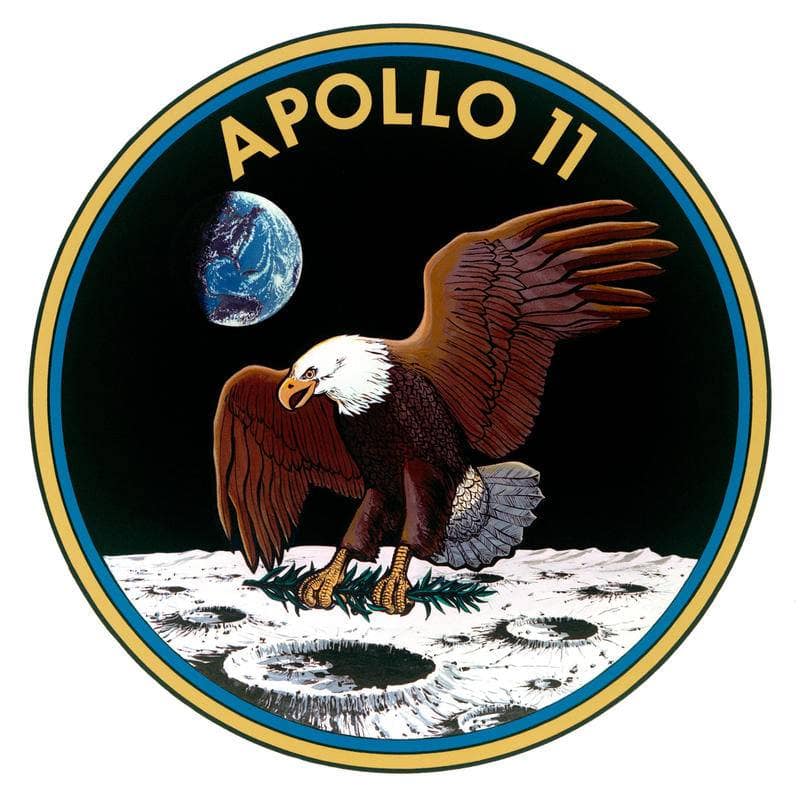
If you look at the mission patch:
The LEM was named the Eagle because that is the Seal of the United States. The first voice transmission from the Moon was “Houston. The Eagle has landed.”
The Eagle is holding Olive Branches (and not the arrows) because “We went to the Moon in Peace for All Mankind”.
—
Actually, and from memory, the first transmission from the moon’s surface was, “Houston, Tranquility Base here. The Eagle has landed.” -rc
You are correct. Oops!
I was 11. My dad bought a TV for the landing. I was reading Science Fiction by then. I was hyped when they landed. I had no knowledge of the risks. The astronauts truly had the Right Stuff.
Apollo 10 tumbled out of control before they fixed the problem. “Experts later estimated that a crash would have been imminent if the tumbling had continued for another **two seconds**.”
There was a primary reason we were able to beat the Russians: the GI Bill. It gave us the engineers, scientists, technicians, mathematicians, technicians, machinists, etc we needed for the project. No GI Bill, no folks to make it so.
(This is a compelling reason for free college, perhaps with 2..4 years of public service. We are foolish to not educate the next generation.)
It is sad that politics caused the end of the moon landings. I wanted (still do) want to make it there. My ashes will.
We have the technology to make and read these posts *because of Apollo*. The Apollo effort created the tech base we are now casually using to hate each other.
For the idiots who think it was fake:
—
I’ve used that second point many times. Russia (among other things) used highly directional antennas to see exactly where the transmissions were coming from. They could see that the command module was in Earth orbit, that it left orbit, that the astronauts sent voice and video (and telemetry) on the way to the moon, went into orbit around the moon, descended to the moon, and sent voice and video (and telemetry) from the moon’s surface. And yes, they would have screamed “FAKE!” had any of those not been true. -rc