
One of the (many!) highlights of our trip was a visit to the Chengdu Research Base of Giant Panda Breeding (it probably sounds better in Chinese). Chengdu, our first stop after Tibet, is the capital of the Sichuan province.
The Giant Panda is endangered — there are only 2,000-3,000 left in the wild. The Chengdu panda research center, one of about 40 state-sponsored panda reserve centers, has been quite successful in breeding the animals, which don’t like to reproduce in captivity.
Our guide noted that they try to encourage natural breeding here by showing the bears sex films. “Panda Porn!”, one of our group members exclaimed. I even covered the idea in True way back in 2000 (“Pandamonium” in Volume 6). In 2006 alone, 12 cubs were born here — mostly thanks to artificial insemination, not panda porn.
Eat and Sleep
Another factoid from our guide: the Chinese say the panda “needs sleep” — hence the black circles around their eyes. She noted pandas sleep about 21 hours per day, making it sound more like my cat than a bear.
“The giant panda is a favorite of the human public, at least partly because many people find that the species has an appealing baby-like cuteness,” Wikipedia says. “Also, it is usually depicted reclining peacefully eating bamboo, as opposed to hunting, which adds to its image of innocence.”
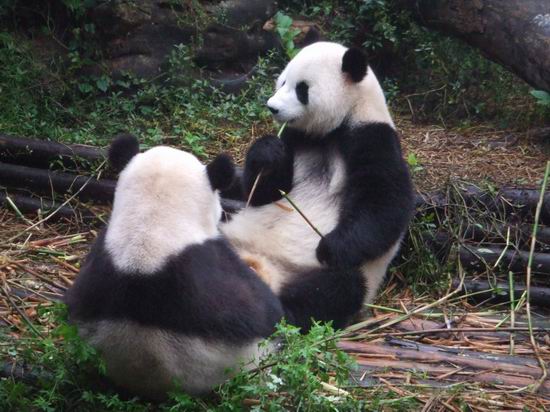
Virtually its entire diet consists of bamboo, and indeed, that was our first in-the-flesh view:
But that wasn’t our only view. One enclosure had six bears in it, and we were lucky enough to see them playing. Their play is rough: they wrestle and like to be “king of the mountain” by pushing others off the high ground.
More than once we saw bears fall 6-10 feet and land on their heads — and then another would fall on top of them. I really wish I had my video camera with me, but here’s a typical sequence I took:
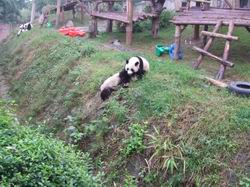


Another sequence I didn’t get resulted in the lower bear falling all the way down into the “moat.”
We did wonder about something: “Giant panda” implies a “lesser panda.” Is there one? Yes, sort of: the red panda, sometimes known to the Chinese as the “firefox” — so now you know what the browser is named for. It isn’t actually a panda, as it’s more related to the raccoon; it’s not a bear. It’s also endangered — only 2,500-5,000 left in the wild — and the Chengdu center does have quite a few:
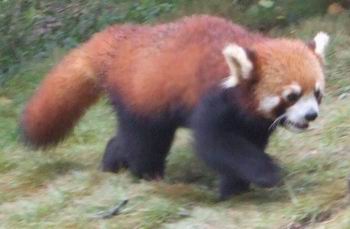
Catch that long bushy tail! It’s hard to tell here, but they’re about the size of a raccoon, too. I had never even heard of the red panda before, let alone seen one.
Our guide said we were extremely fortunate to see so many animals, and being so active, even playing — especially considering they sleep so much. It was well worth the side trip here to see them.
I was lucky enough to see the Giant Pandas loaned to Calgary during the Winter Olympics (1988). Very appealing. They weren’t as active as the ones you saw, though.
I did know about the Red Panda, although I’ve never seen one. I found out about it when I was checking out whether the Giant Panda is a bear or not. The scientific community keeps changing its mind, for now they seem to have decided that the Giant Panda is a bear, after all.
I believe that, if you check, you will find that the giant panda is not a bear but is, as you said about the red panda, a relative of the raccoon.
—
See the previous comment. The panda is currently classified as a bear. -rc
What a bunch of cuties on those pics. Really beautiful! Thanks for the view.
I’m lucky enough to live in a city that has a true world-class zoo. The Cincinnati Zoo has a nice exhibit of the Red Panda, so I’ve known about them for years. And, yes indeed, they are cute!
I have also seen red pandas, and will see them tonight, at the Washington National Zoo. They have a beautiful new enclosure, and are often much more entertaining than the big pandas, even Tai Shan, the “baby” of the three pandas we have here. And check out the Firefox browser logo. If you have ever seen that, you have seen a red panda! 🙂
—
I wasn’t sure if the Firefox browser logo was a red panda, or a red fox — which are different. Looks more like a fox to me, but then, it’s a cartoon…. -rc
Thanks for sharing your trip.
Your mention of the lesser or red panda reminded me of the first time that I heard of them. I was in elementary school at the time (probably second or third grade), so that would have been in the late 50’s. I remember reading a book about a brother and sister who went to see pandas. I don’t remember how I came to be in possession of the book, perhaps it was in the school library, or why I choose this book, more than likely because the word panda was in the title. I, of course, at the time only knew about the big black and white pandas and thought that was what the story was about. I remember being disappointed that it was not about giant pandas, but I have not forgotten since that time that there are two kinds of pandas in the world. If the book had been about giant pandas I doubt that I would have remembered it at all. Thanks for reminding me of that experience.
Randy, you really must visit the Denver Zoo. On my last trip to the zoo in May ’07, I photographed a lovely little red panda. Yep. There is one in our very own zoo.
—
I’ve never been! Even when I lived right up the road in Boulder. Now, I’m a 5-hour drive away. -rc
Omaha’s Henry Doorly Zoo has a couple of Red Pandas. Our zoo is consistently rated as one of the top zoos in the nation! Come visit!
Whoops… I always thought *all* pandas were more closely related to raccoons, not just red pandas. And I call myself an animal person 😉 Hey, I’ve always liked the red ones best anyway! They remind me a little of lemurs (though no relation).
Upon reading the Wikipedia info, actually, it looks like giant pandas, too, are related to ‘coons and have had their taxonomy under debate, though recent genetic testing has placed them nearer “true” bears. Red pandas, meantime, are from the “superfamily” Musteloidea–including weasels, skunks, and yes, raccoons. No wonder I was confused.
Coincidentally this hits my inbox right after my friend and I were discussing our own upcoming trip to the Denver Zoo (not to mention the story on Chinese health precautions; our trip’s being delayed until whatever bug said friend has caught is gone… I remember seeing numerous people in South Korea wearing those masks, too, but even when I was ill it never occurred to me to emulate them).
Another famous red panda…
http://news.nationalgeographic.com/news/2005/05/0524_050524_standpanda.html
We have red pandas at the Woodland Park Zoo in Seattle…but I must admit your photo is much clearer than any view I’ve had of one; they’re always up in the trees, a patch of red here or a beady black eye there.
—
Yeah, they tend to be pretty shy. We watched some keepers go into one area to drop off some food. Even with the promise of yummies, they wouldn’t get within 50 feet of the humans. -rc
The genetic testing is recent, and thankfully it has settled this question, as I was getting sick of the debate (I studied zoology and wildlife along with my aquatic biology degree).
I can’t believe you didn’t know about red pandas before. They are the cutest things ever. This is one of my favorite videos of all time: http://youtube.com/watch?v=oimTxlCi36E 🙂
In response to how shy they are generally, I just had to point out that there seem to be a couple of hams in this video: http://youtube.com/watch?v=aGWvzVxTHRE
How cute! I’m quite jealous of your whole China trip, but this part in particular makes me wish I could have been there.
One more interesting fact for the Panda file. When the Chinese government loans Pandas to zoos around the world, the loanees agreed to send any Pandas born outside of China back when they have matured.
The San Diego Zoo on Monday 11/5 packed up Mei Sheng (whose name means “Born in the USA”) to head back to the Wolong Nature Reserve.