
We have now left Lhasa, Tibet, and we discovered that this was quite an interesting time to be here, politically speaking.
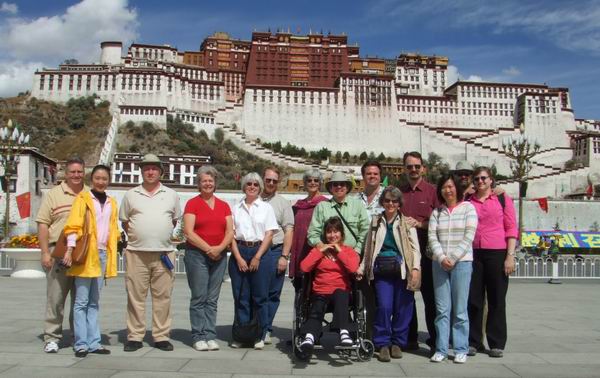
The True Readers China Tour group in front of Lhasa’s Potala Palace:
Local Guide
Our guide here was a native Tibetan, and a Buddhist, and was very knowledgeable about the history of Tibet, the history of Buddhism, and more. He talked quite a bit of the history of the Dalai Lamas — up to Number 13; he never spoke of the 14th, the current Dalai Lama, and either ignored questions about him or refused to answer them.
There is a simple reason, of course: China put down an uprising in Tibet in 1959, and does not recognize the Dalai Lama, who escaped to exile when the uprising failed. (I don’t think I need to go into that here; if you want to know more, Wikipedia has extensive information.)
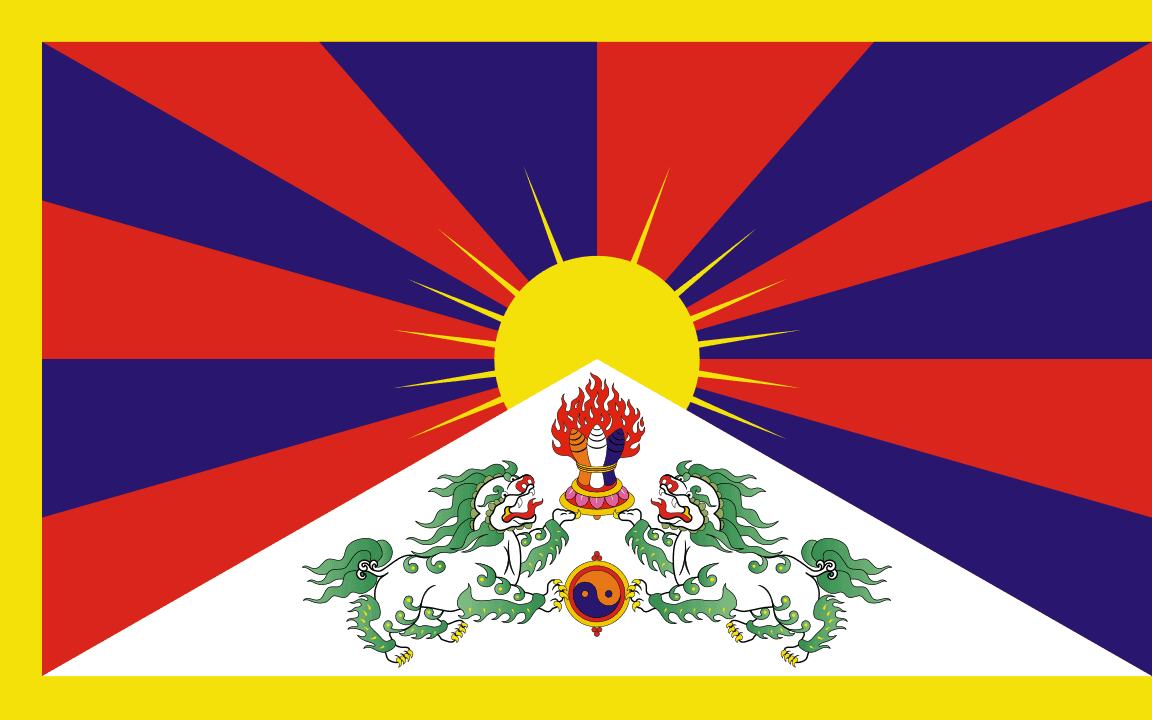
This is Tibet’s flag, introduced by the 13th Dalai Lama in 1912. We didn’t see any of these in Tibet: it’s been declared illegal by the Chinese government.
Uneasy Timing
And what timing that we should be in Tibet this week: the Dalai Lama is in Washington D.C. this week to meet privately with President Bush and to receive a Congressional Gold Medal — the highest civilian honor given in the U.S.
“We solemnly demand that the U.S. cancel the extremely wrong arrangements,” said Chinese Foreign Minister Yang Jiechi hours before the meeting. “It seriously violates the norm of international relations and seriously wounded the feelings of the Chinese people and interfered with China’s internal affairs.”
“We in no way want to stir the pot and make China feel that we are poking a stick in their eye,” said White House spokeswoman Dana Perino, who insisted that the meeting and medal were simply to honor “a great spiritual leader” and promote greater religious freedom in Tibet.
Clearly Calculated
Yet the timing hardly looks like a coincidence: also this week is the 17th National Congress of the Communist Party of China, a significant meeting that determines political leadership for the following five years. Understandably, the Chinese government is thus quite upset with the U.S.
There was an obvious heavy police presence in Lhasa, apparently more than usual, but we didn’t feel hassled by them — not even by the black-clad “undercover” secret police who followed us around at the market.
They were watching us, a guide told us in a whisper, because they were afraid westerners were in town to drop off and pick up “messages” to disrupt the National Congress and further embarrass the government. Once we put two and two together, we were a tad nervous at the timing of our presence there, feeling like we were at “ground zero” as two superpower countries sparred with each other.
Last: It was interesting trying to research this entry — finding the right link to the Wikipedia article, even getting news articles about the Dalai Lama — many of the pages I tried to go to were blocked. I am, after all, in the middle of mainland China, connected through Chinese-based Internet access….
This entry was updated after my return to the U.S. to add detail I couldn’t get from China.
China’s invasion and occupation of Tibet is one of the great unpunished crimes of the 20th century. Another equally great crime is our shameful lack of action or even condemnation, until now anyway. If Tibet had oil and China was smaller, we would have been in like a shot….
An interesting book about Tibet in the 1940’s and 50’s is Seven Years in Tibet by Heinrich Harrer. He was a professional mountain climber. He and the rest of his climbing party were arrested in India by the British at the outbreak of World War II and imprisoned as enemy aliens, but he and and another climber escaped and after a year of trekking through the mountains made their way to Lhasa and befriended the Dalai Lama and other members of Tibetan society. The book has great photos and is much better than the movie.
—
Sheesh: I’m still in mainland China, and had a hard time searching Amazon for those links — apparently because of the word “Tibet” in the search box. I got around it, showing the futility of censorship…. -rc
The Chinese are taking an intelligent approach to the use of the Internet with that blocking strategy you mention. There is a lot of stuff on the Internet that the people should not be exposed to. Such as gun-nut websites (the NRA), right-wing brainwashing websites (like that of the viagra using Rush Limp-baugh) and Faux News websites (Fox News is nothing but a Bushite-RepubliCONs propaganda machine!). We should implement that same kind of blocking here in the USA. There are some things that the general populations just shouldn’t know about.
—
Yes, there are things on the Internet that people shouldn’t see. But I’d much rather decide for myself, rather than let someone else decide for me, since only I know what I want to know and, more importantly, why. How sad it is that people can’t grasp how stupid it is to try to dictate what others should know and how to think. I hope someone does it to you, and you can see how ridiculous it is for yourself. -rc
As the writer I.F. Stone once said, “All governments are liars.” Nothing the government of China has to say about Tibet is any more relevant or truthful than things our own government has to say about the situation in the middle east or anywhere else.
What everyone knows, and what politicians everywhere refuse to acknowledge, is that the people of the world are far more inclined to get along with each other than their governments do. I have traveled half the world and consistently found people in other lands to be friendly, curious and, unfortunately, as misinformed about my culture as I was about theirs! And in every case the source of most of our misinformation was our own governments.
—
Absolutely. A group of us was speaking to one of the Chinese guides, and one mentioned that when growing up, his parents tried to get him to eat by saying “There are children starving in China.” Funny, the guide replied: when she was growing up, she was told “There are children starving in America.” Really? I asked. Yes: the reasoning was that capitalism caused parents to think only of making money, rather than taking care of their children. The bottom line: propaganda muddies the truth. -rc
My daughter is a freshman at Ithaca College in upstate NY. The Dalai Lama spoke there (and at Cornell University and a theater in downtown Ithaca) two weeks ago. Unfortunately, the appearance on campus sold out immediately. But he is so highly respected that there were incredible crowds just trying to get a glimpse of him.
“Children starving in America…” Very insightful. Being an adventurous sort while growing up and as an adult, I always found the concept of institutionalized Communism to be stifling and suffocating. It wasn’t until I worked with several Chinese gentlemen from Beijing that I found out how they viewed institutionalized Capitalism.
While I see Capitalism as the opportunity to discover and try new things, to take accomplishment in my endeavors, they see it as being ruthlessly cast into the ‘wilderness’ to survive as best as one can, if at all. They see Communism as a family relationship where people watch out and take care for each other.
While it didn’t change my preferences, it did provide insight and understanding into the way that others choose their preferences.
Randy, I can’t believe you dignified the comments of “Tariq – Ohio” with a response. If his/her/its comment had been posted in a political forum, it likely would have been deleted as flame-baiting and/or trolling. His/her/its ignorant, extremist desire to block the kind of speech that he/she/it finds offensive is exactly why we have the freedom of speech we do — for example, my version of what’s “right” is about as likely to offend “Tariq” as his/her/its did me. God Bless America. 😉
—
The main irony: if “his system” was in effect, he would not have the freedom to post his opinion on what should be done. -rc
Two thoughts:
First, it seems that our country is just out to pick fights the last few weeks. I’m not thinking that’s a good idea – if EVERYONE put a trade embargo on us how long would we last?
Second, I assumed Tariq’s comments were tongue-in-cheek given that the sites he mentioned that we shouldn’t see are the ones that advocate censorship! Just goes to show that email is a hard way to communicate when you can’t sense the sarcasm or not.
Appreciate the virtual tour – keep it up. (oops, guess that’s 3 thoughts)
I for one am glad that you publish opinions that you disagree with. “Tariq – Ohio” gives the impression that only his/her opinions are correct. He/she has classified me as a right-wing gun nut while my leanings are more toward libertarian, primarily because when the government takes away his/her rights, it also takes away mine.
“Melodie – Olympia” brings up a good point. One of the major causes of the great depression was international reaction to protectionist policies our government instituted. Of course there were other causes too, but it was a major contributor.
And yes, I’ve also found while living in other countries that individuals tend to get along a lot better than our governments do.
The comment that “if Tibet had oil or China been smaller” is a myopic view of international politics. 1959 was still in the middle of the Cold War. The U.S., the Soviet Union, AND China were conducting nuclear bomb tests, all in preparation for attack by one of the others. Kruschev had just put down the Hungarian uprising with tanks. The Berlin Wall went up just a couple years later. 1959 saw Castro and Che Guevara take over the island of Cuba. Not long after that, they started exporting their concept of revolution all over the Caribbean and Latin America. Alaska and Hawaii were admitted as states that year. It was the time of Sputnik and the beginning of the Space Race between the U.S. and Soviet Union.
The first Americans died in action in Vietnam, and was the beginning of a seemingly unending conflict in which 58,000 Americans died over 10 years. In fact, China with its population of 3 billion compared to America’s under 200,000, looked like it would welcome a nuclear war just to reduce its overcrowding.
1959 was a year in which it looked very much like the world would not survive one more decade. Oil was not a consideration back then, even if Tibet had been loaded with it.
—
Good reminders all, except that you bollixed China’s 1959 population. That was the start of The Great Chinese Famine, which saw at least 13 million people in China starve to death, dropping them from about 671.5 million in 1959 to around 658.6 million in 1961. The U.S. population in 1960 was 179.3 million.
China’s current population is about 1.3 billion. -rc
When my husband and I lived in China, it was before the quite recent “crackdown” on the Internet which I believe has greatly limited politically “sensitive” articles’ or sites’ access in China.
I think China is having one of its paranoid fits amidst a sensitive political climate. The current leaders want to look conservative enough to the old guard of the Party, and a visible crackdown on allowed Internet sites is a good way to do so.
However, I did also discover that some sites that people assumed were blocked by China’s “Great Firewall” were, in fact, not.
A number of American ISPs block all of China, sometimes all of Asia, because of spam. China’s internal internet security is ABYSMAL. They have open relays all over the place that spammers use to move their email. So, the only solution that many ISPs have found is to just ban the IP range and be done with it.
An example of this, as of my last check, is the Voice of America website. You cannot reach this website from a lot of places in China because the IP ranges for those places is blocked by VOA’s ISP.
I find this interesting because without some net savvy and a good amount of time to spare it’s hard to find out who’s blocking what.
As a housewife in China and a serious computer junkie, I had time so I got to look into it. It’s interesting to think of what impact these kinds of censorship could have on a theoretically “open” Internet. I would say that governments and corporations alike have said Net Neutrality be damned. Of course, the reasons are very different — one is political, the other economic — but it’s still working out similarly.
You refer to “mainland China.” Is there another China?
—
Absolutely — I’ve already talked about Hong Kong and Macao, and it also does not include Taiwan. China probably considers Tibet to be part of the mainland; others don’t. “Mainland China” is a geopolitical term that has been in use for 57 years. Try to keep up. 🙂 -rc
Your note of the “secret” police. Um, besides being a little dramatic in phrasing, if you knew who they were, exactly how secret could they have been? 😉
—
Note I mentioned that the locals told us about them. They’re quite familiar with the sight. -rc
Tibet aside, you’re lucky to access anything at Wikipedia at all, since it’s one of those sites that usually gets wholly blocked by the Great Firewall. Over the past few years it’s probably been blocked, unblocked, and reblocked more than any other website. Of the 1-1/2 years I lived in China, I think we had a grand total of 1 month of Wikipedia access!
Luckily, there are plenty of anonymizing sites to let everyone get around the censors. It’s so common that I’ve even seen published media listings that included anonymized URLs since the sites were blocked!