
I write True to make a living, yes, and it’s gratifying that enough people support the publication to make that happen. But there’s another reason, too: I want to change the world just a little bit, on both a micro and a macro scale.
It’s really cool, for instance, to see other columnists slowly getting on my anti-Zero Tolerance bandwagon, which is more of a macro effect
The Micro
But the most powerful effect on me is the micro: the letters I get from readers who get something really personal from my writing. There have been many over the years that get me right here.
This week it was Al in Alberta, Canada, who wrote:
This has been a tough couple of months. My wife of almost 31 years passed away in December by what they call galloping pneumonia. Death within 12 hours of admittance. It has taken me a little while to come to grips with her passing as she was only 59 and I’m 10 years older. Anyway, while reading your regular column, I said to myself that it was time to not only upgrade my life but also your column. I enjoyed my first premium upgrade today and look forward to many more in the future. Thank you Randy for helping me keep a grip on my sanity.
The Context
 I just finished a two-day conference on emergency medicine put on by the Children’s Hospital in Denver. Topics ranged from labor and delivery, to why it’s sometimes difficult to keep children breathing, to detecting child abuse (never, ever shake a baby!), to dealing with the death of a child (the surprisingly uplifting final session today — since I’ve had pediatric patients die during my mostly volunteer EMS career, I expected anything but “uplifting” as my reaction to that lecture).
I haven’t had to deal with what Al is going through, but I’ve lived through my share of tragedy, which is just one of the reasons I so enjoy making my living through humor.
You Don’t Get Over It
Those who haven’t suffered such a devastating loss like to say “You’ll get over it: life goes on.” Yeah, life does go on after a loss, but you don’t have to “get over it.”
We do sometimes have to work a bit to get to the point where the pain moves out of the way enough so that we can enjoy the happy memories again: the things we remember about the child, parent, spouse, or friend that makes us smile and feel good.
Sometimes, people get mighty upset at stories in True, up to and including telling me I’m going to hell — and even the occasional death threat. To those people, I say this: your life is awfully charmed if a story that’s funny to most of the world is the biggest tragedy in your life. Get over yourself and look at the real tragedy in the world — and it wouldn’t hurt to help solve or soothe some of it, rather than put so much energy into stirring up more.
True is sometimes tragic, yes, but we can learn from tragedy. If life was all sweetness and wonderful, would we care? I think we need the contrast of bad things so we appreciate the good stuff. True isn’t about laughing at others, it’s realizing that we’re all stupid sometimes, and if we can learn to laugh at ourselves more, life gets better and better.
The Day’s Final Training
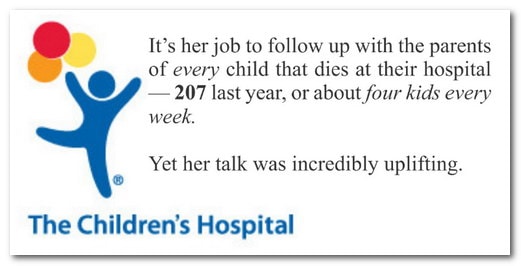
That last lecture today was by the hospital’s “Director of Bereavement Services”. It’s her job to follow up with the parents of every child that dies at their hospital — 207 last year, or about four kids every week.
The 200+ medics in the room said they wouldn’t trade jobs with her for anything. Geri Nelson’s response? She wouldn’t want our jobs for anything!
She assured us her job wasn’t anywhere as depressing as we might think: she helps parents get to the point where they can bring up the good memories again, and what an uplifting thing that is!
After she was done, I went up and told her the very brief story of how the Get Out of Hell Free cards came into being, and handed her a stack. As I suspected, she loved them. She’s a cool lady: she has dedicated her life to soothing some of the tragedy in the world — she has worked at the hospital for 25 years now, and clearly loves her job.
So, Al, I won’t tell you to “get over” the sudden death of your wife, but I’ll promise you it will get better, if you work at it. You may feel like you’ll never smile again, but you will, because the good memories of your wife will make you. And if True helps you in any way to do that, then I’ll get my reward: the knowledge that I’ve done my job well. Thanks for taking the time to send your note.
– – –
My very special thanks to Children’s Hospital in Denver for putting on fantastic educational programs for EMS workers for break-even prices. You’re truly doing something to help your community. -rc
– – –
Bad link? Broken image? Other problem on this page? Use the Help button lower right, and thanks.
This page is an example of my style of “Thought-Provoking Entertainment”. This is True is an email newsletter that uses “weird news” as a vehicle to explore the human condition in an entertaining way. If that sounds good, click here to open a subscribe form.
To really support This is True, you’re invited to sign up for a subscription to the much-expanded “Premium” edition:
Q: Why would I want to pay more than the minimum rate?
A: To support the publication to help it thrive and stay online: this kind of support means less future need for price increases (and smaller increases when they do happen), which enables more people to upgrade. This option was requested by existing Premium subscribers.
To Al in Canada. It has been my experience that we do not “get over” the losses we suffer. But we do get “used to” them.
I subscribe to the theory from my native Cuba, “Que me quiten lo bailao,” which means, “You can’t take away the dance I’ve already danced.” When I think of my deceased loved ones I deliberately remember the good times we had together, and even death can’t take those memories from me. So when I think of my Papa I always smile instead of get sad. My sister, who misses Papa terribly and gets sad every time she thinks of him, argued that if I got Alzheimer’s I would forget those good memories of him. True. But then I wouldn’t remember I’d forgotten, so it won’t be a problem!
—
I suspect that deep down, even then you would remember him. -rc
my sincere condolences to “al” who has lost his wife. my best girl and i are 74 years old and have been married 44 years, i don’t look forward to her losing me, or me losing her, but it will happen someday, as it does to us all. keep the good memories al, she’d want you to.
To Al in Canada and anyone who has lost a loved one:
There is a wonderful book called TEAR SOUP. I read it myself after my mother died and I have recommended it to many people of all ages. The most important lesson of this book is we all grieve in our own time. There is no set time when grief is done. It is done when YOU are ready, not when someone tells you it’s time to stop or move on.
As Randy said, eventually it will get better. Give yourself all the time you need.
Today I attended the funeral of the husband of a dear friend of mine. Two weeks ago was my grandma’s funeral that I was unable to attend — I just couldn’t afford the flight to California. I so appreciate your poignant words about the tragic things in life making us appreciate the good. Life can be a roller coaster ride of emotions sometimes but it keeps me from taking the important things — family and friends — for granted. After years of reading your thoughts I feel like you are a friend. Thank you for making me laugh, keeping me informed, and helping me be a better person.
As someone who was widowed at the age of 40 (she was 5 years older), and having talked with a lot of people with similar experiences through support groups and one-on-one, you never really get over it. What you do is get through it. Or you don’t. But if you don’t you get stuck, and that’s not healthy, either mentally or physically.
Al, you are free to grieve for as long as you need to. You are also free to move on when you are ready. Anyone who judges you either way is a meddling busybody and you can tell them so for me.
Very good advice, Randy. I am a retired clergyman who has been a Chaplain at the local Hospital and the Chaplain for a Hospice group so I have a lot of experience in dealing with death. I have also lost two wives, my parents and many friends. Your words of advice are right on. Most people never get over the death of someone close to them but it does get easier as time passes. The mourning period is at least one year because there are a lot of birthdays, special days, etc. that one must get through. And sometimes something will remind us of the deceased and the grief hits us hard again. Thanks for your good words.
Vivian from Florida, I agree with you. My first wife died of cancer when we were 40. My kids and I always try to remember how very lucky we were to have had her in our lives as long as we did.
Important words, well written.
While only those of us who’ve “been there” can understand at the same level, EVERYONE can (and should) help.
RC: I can’t even imagine how many people you help. Thank you.
And, yes, after 32 years in EMS I’ve NEVER seen a hospital support EMS the way Denver Children’s does (from another volunteer rural CO EMT!)
Regarding ‘Al’, from Alberta, your comments were excellent.
The warm and thoughtful suggestions for handling his situation should be used by everyone going through the same tragic scenario.
Do I have your permission to use this copy for use in my volunteer Cancer Patient Driver service?
—
I’d rather you pointed people to the page so they could read, and post, comments. -rc
I lost two sisters within two years, one of them by suicide. Grief comes and goes and returns and dissipates according to its own pattern. It doesn’t necessarily follow the stages or schedules that well-meaning people tell you about. In my experience, the best medicine for grief is a combination: tincture of time plus whatever it takes to get through the day.
—
My EMT instructor likes to say “The body didn’t read the manual,” or more simply, “Everyone is different.” So true. -rc
Thank you for your comments on grief and grieving. I think that one of the saddest lacks in our culture is the lack of proper grieving time and rituals. In Romania, for example (where I lived for 4 1/2 years), you have specific rituals (a special meal, for example) that you perform at various points over the next few years (mostly in the first few months and then at certain anniversaries [I think every year for the first 5 years or so, although I don’t remember for sure since it’s been a bit since I returned to the States]). This gives people an official outlet for dealing with their grief, which I think is very healthy.
When I experienced my first serious death (my mom when I was 9), my whole life was destroyed. I’ve since come to think that this is the case for most deaths of people we are very close to. Life as we know it, life with that person, comes to an end. This doesn’t mean that we stop living, or that we can’t continue to have many wonderful experiences after this; it does mean, however, that this death, loss of relationship, potential change of status (married person to widow[er], for example) will have profound effects on us for the rest of our lives, and that our lives after the death will never be the same as what we had before. It’s not something where you mourn for a week or a month or two and then you’re better.
I am a mental health counselor here in the Midwest – and I work with clients who are dealing with grief on many levels. One of the things that constantly comes up is the American belief that we can avoid death, and/or that “good” people can avoid bad things happening to them. I often find myself challenging both of those concepts so that my clients (and I) may accept the fact that bad things happen for no reason, it’s not God’s punishment for something we may or may not have done, and it’s up to us to figure out how to live gracefully in the aftermath.
I am frequently struck hard by how often I can see that the Divine Creator (use whatever name you want here) has placed good, supportive, loving people in our lives years before we’re aware that we’re going to need them. Losing someone we love is one of the most difficult things we’ll ever have to survive, and it is up to us to decide how we want to live. I have experienced multiple losses in my life, the most painful and most recent was the death of our son, 3 1/2 years ago. Phillipa is so right on when she says there are no stages, and there is no “right” way to grieve. Some days I’m fondly thinking of funny things my son did and some days, I’m so angry at him for dying, and some days I’m so overwhelmed by the pain of not ever getting to touch or talk to him again that I can’t breathe around the pain. And yet, to be able to see the support I get, to be able to find the path through the dark times is a skill we all need to learn and then teach to our children.
We are never the same after a death, but that doesn’t necessarily mean that we have to be destroyed.
Four years ago tonight, I was woken up by a phone call telling me that my mom had died. I agree, you never “get over” it, but you do get through it in your own time. Everyone is different and will deal with the grief in their own way.
The important thing is to deal with it and not shove it down and bury it. I ended up with panic attacks because I thought I had to be strong for my family, not realizing that they were afraid to grieve because I was hiding it, and they were afraid of upsetting me.
One of the most important things you can do in the grieving process is to talk about the person who is gone. Find someone who is willing to listen, or start a journal. As long as we remember the good things, the person will still be a part of our lives and the hole left behind won’t seem quite so dark. Of course, some days are harder than others like anniversaries and birthdays.
Having spent over 38 years behind the badge as a cop, I’ve seen my share of tragedy, much of it personal, most on a professional basis. Losing a loved one is not something one gets over with time, but they can get through it. I can only hope that I managed to help a few people along the way, as others helped me.
“Yeah, life does go on after a loss…”
Sometimes, I think that’s the hardest part. When you experience a loss like that, you wonder how it’s possible that life for everyone else just keeps going along as if nothing happened.
Sympathies to Al and the other posters.
Chris in Indiana – that last sentence of yours is very true.
Having lost three premmie children in the past few years, I found that, of all things, my love of nature documentaries was a big help – particularly the excellent BBC ones narrated by David Attenborough. Having watched many of them over the years, they gave me a profound appreciation that death is a natural part of life. I particularly remember one segment where a group of elephants paused in a journey to caress the bones of one of their herd who had died several years earlier.
Personally, it made it a lot easier to get through the immediate grief, and hold on to the good memories (and it also amazed me that there *could* be good memories coming out of an event like that). While some of the sadness remains, I also feel a warmth when I think of those children. They will always be with me, and I feel privileged to have met them.
It has been almost 20 years since my daughter died of leukemia, there are still days when I miss her so much that I can barely get through my day. The pain is something that time eases, it doesn’t take it away. I still remember her philosophy, “Life is rough, then you recover.” and I still try to live up to it.
I agree with the comments that each of us has to get through (NOT over) a death in our own time and in our own way. I have lots of experience to back his up. My dad died when I was 15, I buried a son when I was 24, a wife when I was 45 and my mom whan I was 48.
Anyone who has been through similar experience will tell you that each one was different and yet each was in some ways exactly the same.
I miss all of them terribly and while it may be trite, life does go on and while I am in this world I must continue to be a fully functioning human.
Randy, I can’t imagine what it must be like to lose a patient you’ve tried to rescue or save – especially if it’s a child. In your kind of work, the entire episode plays out in a very short time, and you either win or lose and that’s that. I’m sure you and your coworkers each have a different personal way of dealing with those situations, but none of them can make it anything short of heartbreaking. I can only guess that sometimes, God takes them so they won’t have to deal with too much pain and suffering in living.
Most people don’t ever get over the loss of a loved one, but thankfully the terrible pain is eventually replaced by fond memories, and that will be a comfort forever.
Thanks for writing such a wonderful post, for all the work you do as an EMT and an author, and for creating a publication so wonderful that a post like this draws beautiful comments like so many people have already written.
I’m fortunate enough that this discussion makes me thankful that I’ve never really had to go through any of that kind of grief. The closest I’ve had was losing the dog I had from age 2 to 8, and a grandmother I was particularly fond of. Yet another thing to remind myself not to take for granted. Thanks for the reminder.
I totally agree with your comments. You will never ‘get over’ the loss of someone close to you, but that certainly doesn’t mean you can’t move forward. Unfortunately, some folks have a more difficult time than others moving foward. I lost my Dad 32 years ago, and some days it seems like yesterday. That’s the nature of the heart, I guess. The Director of Bereavement Services has an amazing outlook, and is obviously in the right job for her. I know some folks who could use her talents — too bad they are too far away, and won’t take any suggestions from family about these issues. We all have our challenges, don’t we?
You have been blessed with a gift of presenting facts/stories/thoughts in such a way that your readers can’t help but look at things differently once you show us the way. And I’m eternally grateful that there are stupid people out there so you can continue on this journey with the rest of us!
—
Yes, Geri is perfect for her job. She has done other things at the hospital, but realized that she’s good at helping people deal with the after-death part of hospitalization. It doesn’t mean you don’t have bad days sometimes — everyone does — but I can attest that there’s not too many things in life that are better than being paid to do something you have a passion for, and do well. -rc
I really appreciated your “Psychic Pay” story, and I thought you might be interested in this resource for the idea of remembering our loved ones who have died: “Remembering Lives: Conversations with the Dying and the Bereaved” by Lorraine Hedtke. It’s a great book, and she also has one written for children to help them cope with loss.
Randy, this is very powerful for/to me, especially regarding what Geri does. I welled up when I immediately and automatically started thinking about how one might go about it. “Tell me about the last time [lost loved-one] made you laugh… Tell me about the last time you held her/him close.”
—
Yeah: you can see how that could be a REALLY tough job — as well as a truly fulfilling one. It takes a special person to want to try it! -rc
This past year and a half death has visited my wife’s family that it almost seems like he’s taken up residence in the spare bedroom. I made the ‘mistake’ of thinking about how much I miss her dad (passed away almost a year ago, at the end of July) that I almost can’t see to type this for the tears.
I’d lost my mom thirty-odd years ago, and my wife was there to comfort me; now it’s my turn to do the same for her.
No, you don’t ever really get over it. You do get used to it, and you start to tell the jokes about the person. And the smiles, however wavering, begin again.
Thanks for letting me share.
—
It’s a good reminder to appreciate the people in your life while they’re still here. Thanks, Dana. -rc