
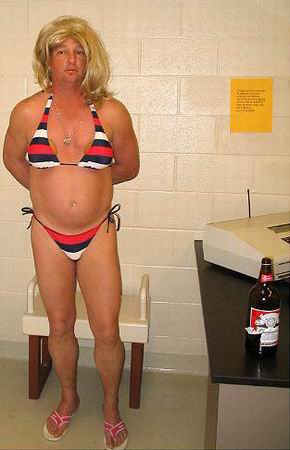
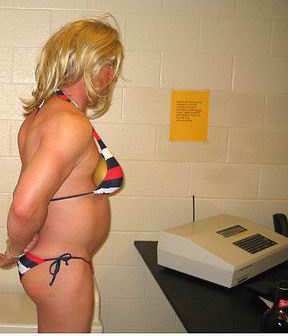
Well of course I have the photos of the bikini-clad fireman. But first things first — here’s the story:
Public Humiliation in the Internet Era
Visitors at a park in Mason, Ohio, called police after an apparently drunk man climbed into his pickup truck and started driving around, including near the children’s play area. When an officer arrived, “I observed [the suspect] to be wearing a very skimpy woman’s … bikini with two tan water balloons taped to the top to simulate two woman’s breasts and a pair of pink Speedo flip-flop sandals,” Officer Scott Miller said in his report. Steven S. Cole, 46, a volunteer firefighter who had emergency lights on his truck, was also wearing a blond wig, and allegedly had a blood alcohol level of .174 percent. He explained he was on his way to a contest at a “gay bar”; police found more wigs, a pair of silver go-go boots, beer, and other items in his truck. Cole was charged with drunken driving, having an open container, public indecency, and disorderly conduct. (Cincinnati Enquirer) …But since police released his booking photos and they’re all over the web, they really need to drop the charges to avoid Double Jeopardy.
Gone Viral
The photos are widespread, and I really debated running the story. I decided it was a worthy discussion driver: seriously, surely the guy is humiliated. It’ll probably take him years (and probably a move to another state) to live it down.
Even without getting into a debate about his perhaps being an alcoholic and needing help (blah blah blah), there is a huge issue about what punishment he “deserves.” Driving drunk inside a park near where kids are playing certainly does deserve punishment. Some judges actually sentence people to public humiliation, such as having to carry a sign that says “I drove drunk” or being required to have a fluorescent bumper sticker or license plate frame with a similar message.
OK, that’s fine. But with this guy, we’ve already got that whether he’s convicted or not. Does piling on legal charges constitute — in a way — a double punishment? Why or why not?
And here are the photos, courtesy the Mason Police Dept.:

Follow-Up (13 May 2007 issue)
There were a lot of comments on last week’s drunk driving bikini-clad fireman story. And it’s not so much just the number of comments, but rather the tone of them: people really are totally sick and tired of drunk drivers, and they’re ready to see them go to jail.
No hand-holding, no “Awwwww, he must have real problems,” and certainly no tendencies toward lenience because photos of him wearing a bikini stuffed with water-balloon boobs were released to the public.
I had wondered aloud whether such leniency might be appropriate not because I have any sympathy for drunk drivers (I’ve seen far too much of their carnage to have any), but rather because I thought it was an interesting question to debate.
But pretty much no one wanted to take his side; that’s how strongly people feel.
My take? I don’t think America’s politicians have any idea just how strong sentiment is on this matter. Why are there people with dozens of DUI convictions still out there driving?
Update (5 July 2007)
Not surprisingly, Mr. Cole has pleaded guilty. In a plea bargain, he accepted the charges of OVI (operating a vehicle while intoxicated) and disorderly conduct; in exchange, prosecutors dropped the other charges: open container [of alcohol in a vehicle] and public indecency.
Also not surprisingly, the public humiliation angle was brought up by his lawyer as part of the defense. “I think it’s enough, isn’t it, if you lose your job?” said Attorney Charlie Rittgers. “[To] lose a line of work where he was a fireman where he enjoyed helping others. Where he embarrassed his family and himself. I think that’s enough punishment as it is.”
Obviously, the judge didn’t agree: Cole was sentenced to a 72-hour driver intervention program, plus two years of probation; he was banned from town parks for two years, he may not drive (except for specific events, like going to and from work) for six months, and he was ordered to pay a $250 fine.
In addition, he must continue the psychological counseling he started after his arrest. All in all, a reasonably stiff penalty for a first offense, especially when you consider he was ousted from the fire department, where he was a volunteer, and his full time job, too.
Oh, and in case you wondered: he wore a conservative suit and tie to court.
(Sources: WCPO Cincinnati, Cincinnati Enquirer)
– – –
Bad link? Broken image? Other problem on this page? Please Let Me Know using the Help button in the lower right, and thanks.
This page is an example of my style of “Thought-Provoking Entertainment”. This is True is an email newsletter that uses “weird news” as a vehicle to explore the human condition in an entertaining way. If that sounds good, click here to open a subscribe form.
To really support This is True, you’re invited to sign up for a subscription to the much-expanded Premium edition.
In this day and age there is no guarantee that he IS being humiliated by this! He could be laughing it up with his buddies down the bar, or even negotiating a guest appearance on JACKASS!
Whatever one may be thinking about the gentleman here, who evidently was not thinking, the Fashion Police would probably let him go. Look how color-coordinated he is. The partially-consumed Budweiser’s label matches his bikini as though it was designed to be an accessory.
First, they better drop the public indecency charges, unless they plan on arresting lots of women wearing similar outfits.
Disorderly, well, I wasn’t there, but it just sounds like he was drunk, already included.
That’s the charge that needs enforcing (open container laws are a silly variation of ZT); I have no sympathy for those who endanger the lives of others, disease or no disease, and we can’t assume he’s humiliated (as the previous poster noted) or that he’s learned anything.
There are lots of us who drink responsibly. Some of us have the self control to limit our drinking to the first hour or two of the festivities, during which we consume no more than 3 drinks (not enough to get you to the legal limit), then switch to coffee or soda so we can be sure most of the 0.06% we might have peaked at is far behind us by the time we leave. Or in other circumstances, we don’t drink at all.
At his height and weight, to get to 0.174%, you have to drink nine beers in the space of about an hour.
Randy, as an emergency responder who has seen the damage drunk drivers can do to innocent victims, do you honestly think a few stupid pictures on the Internet should be the end of his punishment? If he was a first-time offender, I’d tack on 30 days in County, 2 years of probation, mandatory AA twice a week, and periodic random urinalysys to make sure he had no alcohol in his system. If he was caught drinking during probation, he’d serve 2 years in the state pen.
You know what? WA state is throwing the book at some of those drunk drivers who manage to get caught without getting into accidents.
One young man I know had 3 DUI’s in a month and managed to get this all done to him:
And after his AA meetings and his Agape meetings and his PO meetings he still goes out and gets drunk. He thinks he doesn’t have a problem. It is so sad.
You are presuming that publication of the photos is a form of humiliation for this guy. Judging from the lack of humiliated expression on his face while taking the pictures, it is entirely possible he secretly enjoys having these pictures widely available, which means it’s not an implied punishment.
Although I do have to agree with the previous posting about what constitutes public indecency. In most jurisdictions, poor/revolting taste is not the same as indecent. So, I vote for as much as the law will allow for the DUI charge. If he goes before a judge who wants to shame offenders into compliance, I hope the Judge makes sure this guy is not a “shame junkie” before trying that technique. Is the outfit he was wearing sufficient probable cause for a psych evaluation before sentencing?
—
The only thing I presume is …the guy was still drunk when they took the booking photos…. -rc
Here in my part of California, 1st violation gets you 48 hours in county (and you pay for the accommodations), court costs, odd and sundry fees totaling $5,000 minimum, unless one is stupid enough to get an attorney also. Suspended 30 day license, restricted 6 month license. How do I know? My daughter has a 23 yo friend who was real stupid, stopped pulling out of a bar, when she swerved because she dropped her CELL PHONE and blew a .08 – legally drunk in Calif. None of them goes ANYWHERE without a designated NON-drinking driver, NOW.
This “guy” deserves so much more because he shoulda known so MUCH better! The people of his community relied on HIM for their protection, volunteer or not. I have no compassion for ANY drunk driver with any excuse — I grew up with parents who drove drunk and scared the living daylights out of me. Fortunately I lived to tell the story.
As far as Double Punishment I don’t think so. Being arrested is a matter of public record. I’m sure he is being humiliated by these photos but where do you draw the line? We’ve seen lots of celebrity arrest photos. Could they claim having just the photos on the internet as punishment enough?
I’m sure the defense will bring it up during sentencing and the Judge can consider it so I’m not concerned.
I agree with the public indecency comment; it seems very subjective. I’m sure that few would even have thought of charging him with that in a beach town.
That’s a “very skimpy” bikini? Would probably be considered about normal at virtually any beach.
For any single event, one can, by simply being in the wrong place at the wrong time, go from a single criminal charge to many charges. And then you have civil charges, which can sometimes occur with little or no regard to the results of a police investigation or criminal trial, even if a criminal jury says that you can’t possibly be guilty. I’d say that this (if it IS punishment, as others have noted), is not criminal punishment, which is for breaking the law, but rather his unofficial civil punishment for public lack of self-control. One does not need to break the law in order to become a public laughingstock.
Randy, would you have asked this question if the guy had managed to hurt or kill one of the kids?
—
You’re asking if there should be discussion, as I’ve initiated? Sure. -rc
Mason is the next town over from where I live. Around here, most of the roads are 2-lane if you fall off the interstate. Unlike when I was a volunteer firefighter, here in Ohio all the departments I’m aware of require some formal training before signing anyone on, but one would think a dose of brains might be considered a requirement also … right? (Well, not necessarily in Ohio) Combine an on-call vol with a volume of alky inside, with a narrow mostly full of blind spots 2-lane road or narrow town streets, and it is a recipe for disaster. Even if the idiot made it to the scene in one piece, I sure as hell wouldn’t want him handling a hose or ladder or any power equipment anywhere near me at even a trash can fire.
Is public knowledge and vision of what he did adequate punishment? No way! Just because he gets to have a siren and fancy flashing headlights and red and white lights blinking atop his pickup, doesn’t mean he should get preferential treatment by the law. Special treatment, Yes … make an example of him so no other vols, who could endanger those around them regardless of circumstances, think drunk driving and raising hell around kids is the way things are done.
They should have added the Felony, “Inciting to Panic” available in Ohio; I know I would have panicked if I were a kid who saw a drunk cross-dresser headed toward me, or the parent of a kid in that park.
But the real life story is that I doubt we’ll ever hear about any trial, let alone that he got a sentence stiff enough to sober him up. The good ol’ boys in this part of the mid-west are very forgiving of one of their own.
I do agree with Greg that he still needs to face criminal charges. Any humiliation he might feel comes from his own actions, and we don’t know what he considers humiliating (after all, he was heading to a bar in this getup). Also, using humiliation as a crime sets the precedent for uneven sentencing, as well as being possible ‘cruel & unusual punishment’.
But Greg’s mandatory urinalysis wouldn’t be legal, since alcohol is a legal commodity. As long as he isn’t D&D or publicly intoxicated, the law cannot mandate whether he can drink.
—
I don’t know about Japan, but in the U.S., as long as he’s on probation, they definitely can require that he not drink — and that he prove it. They’ll even make him pay for the tests. -rc
First, he may not be humiliated. He may be proud of those pictures. I doubt it, but we do not know.
Second, the police officer or employee who put those pictures on the internet, or gave them to whoever did it, should be prosecuted. Every department has rules against that, and every state has laws against releasing evidence. Mug shots can often be released, but this is hardly a “mug” shot.
Third, even if he was on his way to a contest, what was he doing driving around a park? But, drunks usually do not think logically.
The guy has had enough, even if he enjoys the publicity (his boss surely will not). In Spain we have no such crap “offenses” punishable by law as having an open container, public indecency and disorderly conduct, not to mention ZT, (if you are disorderly AND beat a cop, that’s another thing). BUT i’d make the silly fireman pay for his driving inside a park near kids. “Kid” is the ruling word here. Penalty? Buy them all some (non expensive) toy and offer a sincere apology.
Even if he is humiliated, it’s not a punishment that was “given” to him. Rather, it is humiliation that he brought on himself as a result of poor choices and bad behavior. It’s the consequence of actions that he *chose* to make.
To be honest, anyone who gets behind the wheel drunk is, to my way of thinking, guilty of attempted murder. Too many sober people have died as a result of the irresponsible choices of drunks behind the wheel, and everyone *must* know what they are risking when they get wasted and then go out for a drive. It’s a conscious choice that people make, and as far as I’m concerned what happens to the people responsible for making that choice is not an issue deserving any more consideration than they showed for everyone else around them by getting behind the wheel in the first place.
—
OK, I knew if I put this out for comments I’d get some good reasons! Not done to him, his choice, check! More, I’m sure, will follow. -rc
He should be charged with drunk driving, since he was operating a vehicle in an area open to the public. There are at least two problems with the add-on charges:
1) some may be dealt away, to get a guilty plea on others;
2) even if he’s convicted on all of them, the sentence will probably run concurrently, so it doesn’t add to the actual time served.
As to the indecent exposure charge, I have to ask: what are the elements of the statute under Ohio law? It appears he didn’t expose any body parts that would be mentioned in such a statute.
I don’t think those are booking photos, either–they look more like photos taken to document his appearance, as evidence. (Booking photos would show his face, right and left sides.)
With regard to the “humiliation” issue: this has to be considered–at least in part–in terms of his expectation of privacy. (Consider how different it would be if he’d been photographed while dressed this way alone in his house, for example). It looks like the photos were released in an attempt to humiliate him, but that’s a different story entirely.
—
Ah, another great point: expectation of privacy. Since he was doing this in public in broad (heh heh) daylight, indeed he had none. -rc
I would ignore the “humiliation” in considering punishment — Cole was in public, dressed as he chose, intending to perform in that costume. Giving him a wider audience should not be considered punishment. He should be charged and tried as the law specifies for driving drunk around kids, as well as for the lesser violations.
As a mother I must say that the photos are not nearly enough of a punishment for driving drunk in a park, not to mention as many people said that he may not even be embarrassed of these photos (he was on the way to a public contest dressed like this). Luckily no one was hurt, but if they make things too easy on him then he will do it again and someone may get hurt next time. I know of many people that were “busted” for DUI that still drive drunk, some without a license. If he is all over the web then maybe he would be made a great example to other idiots that chose to put themselves and everyone else in danger.
As your articles on ZT show, there are lots of people who have no concept of humiliation. Witness our schools; for that matter, look at our own U.S. Congress. Besides, as you said, all he needs to do is move and next month, it’s a fresh start.
As for being drunk in public, I don’t think that alcohol makes you do things that you wouldn’t otherwise do. It simply suppresses your inhibition to expose what you really wanted to do all along. Alcohol may impair one’s reaction time but, worse, it releases the inner demon that desperately wants to express itself. Hence, someone who runs into a crowd and blames it on the booze because he didn’t “see” them. Baloney, nobody “blacks out” and still maintains full motor capacity any more than a conk on the head causes amnesia. That’s 1950’s-style psychology.
There’s debate whether punishment has any deterrent, but giving no punishment amounts to tacit approval while ‘throwing the book’ at an offender is simply revenge. Give him the standard punishment for drunk driving.
Even if he hadn’t been drinking, the public exposure would still have rendered him humiliation and is a separate “punishment” independent of alcohol, if he’s susceptible to it.
Have you seen pictures on the ‘net of a big hairy guy dressed as a fairy princess? That’s how I won my company’s Halloween contest in 1999, and I am quite proud when people come across them.
On the other hand, I would completely humiliated if was charged with driving drunk, and everyone found out about it.
Humiliation is relative. Who can say if this guy is bothered by it or not? For all we know, he gets off on it. Do we want to give him a free pass on serious offenses, just because he *might* be really embarrassed already?
I am more concerned about how the photos got leaked. These aren’t mugshots, they appear to be taken as evidence, and should not automatically be made public.
It is easy enough to laugh when a deserving bad guy gets burned. I hear that some people actually make a living at it :). But do we really want to leave this to a policeman’s whim, without due process?
I suppose the judge could always sentence him to “humiliation served”, but the case really should go through the system to decide whether his punishment has been sufficient or not — and so that he has a record should he decide a repeat performance is in order.
I detect a hint of moral relativism in the comment “Let’s assume worst-case here: driving drunk inside a park near where kids are playing, certainly he does deserve punishment.”
Does it really matter where he was driving or who was around? Is driving drunk on a road in the middle of nowhere with no traffic less illegal than the act of this fireman?
I don’t think we should accept the idea that a crime is more or less punishable based on where it is or who it affects. For instance, hate crime laws are ridiculous. In essence, hate crime laws make it less “wrong” to murder an affluent white christian heterosexual male than it is to murder a poor black jewish homosexual female. Wrong! Murder is murder no matter who is killed. (There are a few mitigations like self-defense.)
Assuming a conviction, punish him for DUI; no more no less.
Kimberly in NH–Attempted murder?! You’ve got to be kidding! Who is the driver trying to kill?
—
As I said to you privately when you emailed me privately, there’s no “moral relativism”. There is an attempt to spur thought and discussion. -rc
He may have served any public humiliation punishment, but I don’t think that’s enough to say he’s been properly punished for his crime. If the judge were inclined to levy such punishments, he can skip that this time, but any other non-humiliation judgements still need to be handed down.
I’m a big fan of Denmark’s drunk driving laws: one offense, and your license is revoked… FOREVER! The reason people continue to drink and drive (and get innocents killed) is because the potential damage isn’t enough to deter them. It’s not hard to get a taxi, catch a bus, or have a designated driver if you’re committed to doing so, and a harsher penalty would encourage more people to make sure they have taken care of such necessities before getting sloshed. (Of course, if their licenses were revoked, we’d probably just get more driving without a license charges….)
Uh, Jarred, actually we in DK do not just revoke a license for one infraction – it usually take three to get a permanent revoke.
But you very easy end up with a 3-year suspension, depending on how sloshed you were. Another reasonable thing is that a repeated offence comes with a stiff fine – one month’s wages.
Now that does not stop a lot of boozeheads from driving without a license – some 30% of all DUI offenders already had their licenses revoked.
But if you do that, you risk getting the car confiscated.
So there is quite bit of sense here.
The limit is 0.05% alcohol – the average souse being stopped is lying around 0.1-0.15% with some heavy hitters ending up around the 0.3 – a state where you wonder how they ever got in the car.
Of course he should be given whatever punishment his state gives out for drunk driving and endangering all the children in the area. His humiliation is not nearly enough for the crime, because he must want to be looked at in his skimpy outfit. For crying out loud, he was going to a gay bar to show off his attire, or lack thereof. So he wanted to be looked at, and thus, having his photo splashed all over the Internet is not punishment to him, as it would be to a normal person. If anything, his punishment should be even stricter. The more severe the better, because he shouldn’t even be so close to exposing himself in front of the kids.
I know it’s not a popular opinion but I think drinking and driving should be prosecuted as attempted murder, with the victim simply not chosen yet. If you fire a gun into a crowd it’s attempted murder even if you haven’t chosen exactly who is to die, when you drive a car without being able to control it, you may as well be firing into a crowd.
Public humiliation as a sentence is humiliation chosen by the judge, not the criminal, and since he chose to run around in public dressed in this fashion I don’t think it could possibly be considered a punishment. Even if the police hadn’t released the pictures, by being out in public he was leaving himself open for this. If I saw a guy dressed like this run by my house, I’d certainly be taking pictures and posting them somewhere. He chose to do something stupid, and these are the results of that choice.
Other than thinking he should be required to take fashion lessons from Dame Edna Etheridge, I think the discussion on whether or not the guy will suffer adequately ignores the prep he had to do for this bikini foray.
I notice the only hair the guy has appears to be the blonde bombshell wig and judging by his lack of body hair, it looks like he waxed. Believe me folks, waxing the bikini line for a woman is not for the faint of heart and for a guy’s worth of body hair, it’s got to rival medieval torture in the screech and scream department. That in mind, I seriously doubt the pain of public embarrassment is going to deter him.
He should be sentenced take his wardrobe disaster and enter the annual Bastile Day races for the next 20 years or so. He’ll blend in with all the other guys in drag, wearing cheap wigs, spike heels and trying to hoof it to the finish line without breaking an ankle. And in his case to avoid a black eye when his hooters escape and whack him in the face.
The fact that Cole exhibited behaviors indicative of alcoholism, confirmed by the fact that he could walk at a .174, is relevant to determining consequences. He should suffer the usual ones for DUI and be required to prove abstinence–for years, as should every alcoholic who’s proven to society they cannot safely drink.
His story will go into my “alcoholics do the craziest things” files. If it’s crazy, it’s usually alcohol or other drug addiction. And if there’s addiction, the person is capable of anything.
Regarding the public indecency charges…according to the news posting in the Cincinatti Enquirer, the man who reported Cole to police said “he saw what appeared to be a naked person on the bike path, fondling or exposing himself or herself. The person seemed to be scared off moments later by a jogger…he then said he saw the bikini-clad person hop into a parked blue Ford F-150 pickup truck with red emergency lights on top and he realized the person was a man.”
That would qualify as public indecency in my book. I’m glad my nine year old daughter was not on that bike path to witness that display.
—
For the record, I discounted that report: if they couldn’t tell if it was a male or female doing the “exposing,” I can’t quite count it as exposure. But I agree that’s probably what’s behind the charge, and I agree with others who suggested that it’s likely to be dropped. -rc
The drunk driving part he should get the book thrown at him for, but I think that what’s causing all the trouble is his attire. If it was a standard, unaltered women’s bathing suit that fit him, then it covered all the essential bits, and you can’t really charge someone with public indecency who hid all the essential bits.
But of course, since he was crossdressing, we can throw the book at him for that, because the US dislikes crossdressers.
This should be a drunk driving charge. And only a drunk driving charge. Otherwise it’s a blow to freedom of clothing.
If we are to look at law enforcement as impeccable models of conduct (which they should be but aren’t), then the publicly humiliated driver should not receive any additional punishments. If people are upset by this, they can blame the law officers who publicly humiliated this man before he had a fair trial. There should be zero tolerance for drinking and driving, but there should also be zero tolerance for law officers misusing their power.
A successive approximation toward acceptance of police authoritarianism is far more dangerous than a drunk in a bikini who may have driven around a bunch of kids, but didn’t hurt anybody. If we don’t want to end up with cops or soldiers patrolling our streets and telling us how to breathe, then we need to keep conditions as far away from that as possible.
I’m not sure that it’s right for the police to release ‘photos like these of a “suspect”.
If there was good reason to release a mug-shot prior to conviction, I could support that, but even when an accused is seen to shoot someone live on national television, in front of witnesses, they are still “innocent” until proven otherwise.
Therefore, I believe releasing these types of pictures oversteps the bounds of privacy.
For all we know, Cole could be a survivor of male breast-cancer, and they weren’t balloons but rather medical dressings, and the wig was because he was suffering baldness due to the chemotherapy.
OK, We all know that this probably wasn’t what happened in this instance, but until he’s had his day in court and is proven guilty….
Endangering children and driving drunk should be a punishable offense. Having such pictures published on the internet should be a violation of his rights of privacy unless ordered by a judge who has such authority.
If he could prove who first published such photos, he would have a very good civil case.
Sure, the police might have dropped the ball in regards to privacy rights, but one would assume mug shots are public record with as many times as we’ve seen celebs on the news…they are public anyway, right?
With that, if it had been a person of at least some fame, and the pics had come from the paparazzi, would we even be discussing the double jeopardy question?
Yes, he should pay…he broke the law and got caught, therefore he should pay.
How is releasing his photo any different then any other booking photo of any other criminal? Although, I’ll admit he isn’t against the height chart that you would normally see in a booking photo. Mason is a small town, policy varies from department to department, perhaps they don’t take the photos against a height chart. Mel Gibson’s mug shot wasn’t against one. Criminals’ photographs are released every day to news agencies and the general public. They are part of the public record. It’s his own fault that his particular mug-shot happened to be in drag. Any embarrassment he suffered was brought on himself.
This man was able to actually get behind the wheel and move his vehicle with a very high blood alcohol content. Since he intended to appear in public wearing that outfit anyway, I don’t think that having the photos all over the internet is really any sort of deterrent to him behaving in this manner in the future. He really is a menace to himself and others, simply for the drunk driving charge.
Is he indecent? Not in my opinion. He’s showing less than many women do at the beach. He does, however, not make a very attractive woman. Fortunately, that is not a crime.
—
Just more proof that beauty is in the eyes of the beholder. -rc
When this happened it made the radio in Chicago and there were lots of callers. The main thrust was the courts should punish the drunk driving and the ridicule is punishment for violating the public trust, he was a fireman and most people hold police and fireman to a higher standard.
—
So, if he was a milkman it wouldn’t have been OK to release the photos? -rc
I’ve long thought that “Aggravated Stupidity” should be a chargeable offense. This sounds like a textbook example of “drunk and stupid”. Like an earlier poster, when I go out I have one drink of alcohol, then I switch to plain Coca Cola with a twist of lemon. That seems like a reasonable way to have an evening’s fun watching pretty girls take their clothes off while not endangering myself or anyone else, and I get to remember that I did have fun the next morning.
All this fool gets to remember is that he made an utter ass of himself in front of God and everybody.
Re the “indecency” charge: they may have charged him with public indecency because they lacked a suitable public lewdness law.
That said, a leagal definition of indecency is hard to pin down, and often encompasses location and context as well as choice of attire. For example, a woman on the street in matronly bra and panties is “indecent”, while the same woman at the pool in a Brazilian bikini is not.
Also, it’s often the perception of indecency, rather than the actual fact, that brings the charges. Some while ago, a radio station in Massachusetts received an injunction against a publicity stunt wherein a chosen listener (female, of course) would parade through a shopping mall whereing nothing but a miniskirt and top made from the station’s bumper stickers. That the woman would have been better covered than many who visit the mall was deemed irrelevant.
As to the piling on of charges: it’s my belief that the police often do this as what I term “guarantee” charges. You could also call the “pasta charges”: throw enough of them at the defendant, and one of them is bound to stick. In the above case, the open container charge is a slam-dunk, in case the public indecency and disorderly conduct charges are thrown out. By piling on the charges, the police are guaranteed to get a conviction.
I feel that the pictures all over the web and the charges combined might be a very effective tool to discourage others from ending up in the same mess. Fines, walking papers and jail time, whoopie doo. On the off chance that he has kids from a drunken encounter with a female, can you imagine the humiliation that this guy’s kids are experiencing at school? (If he was married, he probably isn’t anymore.) Humiliation is a great deterrent. The fact that he is a fireman sends out the message that nobody is exempt. Sure, he’s a big loser, and likely won’t learn anything from it – But others can.
It has always bothered me that a majority of the population does not understand addiction. Since it is outside their limited experience they simply choose to think it doesn’t exist. To state, “I go out I have one drink of alcohol, then I switch to plain Coca Cola with a twist of lemon” misses the point entirely. This has nothing to do with self-control. To ascribe his actions to simple stupidity misses the point entirely. Addiction and its concomitant maladaptive behaviors is far too complex to describe fully in the amount of space allotted here. Great volumes of research material is available to view on the web. It is a valuable resource. Use it to educate yourself.
Regarding the public humiliation of having one’s name and image splashed across the internet: Change is only possible when there is sufficient pain, a belief that change is possible and there is a comprehensive plan for affecting change. Incarceration will not help this man. Treatment will. IMHO, the criminal justice system should request one year probation, loss of license (for however long law will allow), that he remain drug and alcohol free, that he attend self-help meetings (AA or NA) and seek individual or group counseling. The problem is not what he did but why he did it.
The people who seem to be complaining the loudest in this forum would also be the people who think it is better to incarcerate than educate. Punishment never works – by their own admission in their anecdotal evidence. We, in this country, seem to have this bass-ackwards. We would rather punish crime than educate for prevention or treatment. Managed care won’t pay for it. The CJ system doesn’t get points for preventing crime. It is a systemic problem and I see no light at the end of the tunnel. I am all the more frustrated because addiction counseling is my chosen field. Trying to change the world one person at a time is difficult. Trying to do it in a culture which seems to be fighting my efforts is nearly impossible.
This genius deserves everything the courts can give him and then some.
I really doubt that Randy Cassingham seriously meant it when he wrote: “…they really need to drop the charges to avoid Double Jeopardy.“
Here are a few things to consider.
This moron may try to explain away his actions by saying I was drunk, I didn’t know what I was doing, or the alcohol made me do it.
Everyone should realize this fact. Alcohol will not make you do anything that you do not want to do. Alcohol merely lowers your inhibitions to allow you to do things that you subconsciously want to do, but normally think better of.
This rocket scientist dresses up like a woman (a very ugly, unattractive woman) and goes to a playground.
Am I the only one noticing the signs of a pedophile here?
This pervert claims to be going to a “gay bar” while cross dressing. This pervert has more perversions than he has common sense!
What he does behind closed doors is his business, but what he does in public is OUR business!
I hope they through the book at him!
—
Most story taglines are indeed jokes — and rather obvious ones, such as in this case. -rc
I am a great believer in public shame. It is one of the best deterents there is. It is too bad that it is not used more. Alcohol did not make him get in a several pound vehicle and drive it. He is lucky he didn’t kill someone.
I personally hope that he is found guilty of drunken driving, public indencency, child endangerment and anything else they can think of. Until there is a way to prevent this person from getting behind the wheel again, then public shaming will have to do.
HE WAS DRUNK – weather he hides it or not by dressing as a woman makes no difference at all. What he did was wrong – and allowing him to change clothes – could be the first step in altering evidence after a crime has been committed. Do we wait until he kills a child in the park and remain in the “good old boy” way of thinking – after all – he did not kill anybody?? NO! Put his ass of the front page of the local newspaper and label him as a drunk driver!!!
I can see no evidence in the report which would suggest that this man was a pedophile (sic). I have no idea what .174% of alcohol means, but it might be lower that we have here in the UK. I suspect that he might have been “under the influence”, but perhaps not drunk.
Having his picture plastered over the Web must be punishment enough.
—
The level .174% is, to put it in more familiar terms (if I have this right), 174mg per ml of blood, or more than double Britain’s current driving limit of 80, and well more than triple the proposed limit of 50. If we estimate his weight at 190 pounds (about 13-1/2 stone), it would take nine 12 oz beers (5-1/2 pints, or just over 3 liters) to bring him up to that level — over the course of just an hour. -rc
Public humiliation is a rather cruel, but nonetheless effective punishment. In China where I lived for 5 years, the best show in town was when the guards at the local prison handcuffed the prisoners to the sides of open trucks, put posters stating their names, crimes and punishments underneath them and paraded them through the streets for all to see (and apparently enjoy). It was certainly one of the few times you’d see old ladies running to have a better look. Anyone with a red cross through their poster was due for a bullet in the back of the head and you’d sometimes see these poor souls being driven through town to a piece of waste ground where they were shot. Again posters would identify them.
In a society like China, where face is everything, this was certainly a major deterrent. Personally I think it might well work. And I think it’s great that this drunken idiot gets displayed (and enjoyed) across the web.
I have a question: How did the photos get on the internet?
If the photos were released by law enforcement officials as part of a court authorized punishment, then I think Double Jeoprady is a possiblity. But, that’s that’s not the impression I’m getting form this article.
I could be wrong, but the impression I’m getting is that these photos were “somehow, mysteriously leaked” onto the internet, and not part of any officially sanctioned punishment.
If this second scenario is the case, then the “leaked” photos would not represent a secondary form of punishment. I think they represent serious violations in police procedure and the suspect’s privacy, and thus, his Civil Rights.
This is a ridiculous example of something seriously wrong. These photos are evidence of a possible crime having been commited, not email jokes to be traded around as attachemnts or posted on webpages. If these photos were “leaked”, then the Law was broken at this police station and an investigaiton needs to occur, because if the law enforcement community does not take the Law seriously, then how can we expect to enforce it properly?
—
Booking photos are generally considered public record, which is why we see mug shots every time a celebrity is arrested. -rc
“Put his ass of the front page of the local newspaper and label him as a drunk driver!!!”
Don’t they do that, in some cities, to johns who solicit prostitutes? Along with impounding their cars? Doesn’t seem to be working. The hookers are still doing head over heels business.
—
If they’re hookers, wouldn’t that be “heels over head” business? -rc
The punishment for the alcohol level is prescribed by law and was meted out accordingly. Putting the picture out to the ‘Net is very unprofessional on the part of the police and amounts to nothing more than a juvenile version of the stockade for those with a prurient interest in wierdos and the need to build him or herself up by denigrating someone else. I dare say it was plenty humiliating enough to be seen by the policemen at the station and have to explain to his wife or family. Sending it to the ‘Net was childish. Posting it here may be a discussion starter, but that’s all I can see it being worth.
—
Yet, you did click through to see them too…. -rc
I wanted to comment on what some people thought would be a good solution: requiring that (among other things) this driver would have to attend AA meetings for a specific amount of time. The problem with this is that, as far as I understand AA, you have to be willing to change in order for it to really help you. As the old proverb says, you can lead a horse to water but you can’t make it drink. AA could definitely help him with some of the alcohol issues he’s dealing with, but only if he’s ready to face them; otherwise it will just be a waste of time.
Someone else commented on how people are wanting to incarcerate rather than fix the problem. I totally agree that the true issue here (or one of them) is alcoholism, and only by treating that will a true solution be found. Unless he’s willing to work at facing his addiction, however, I’m not sure what other solution will work. He’s put several lives in danger already; no one wants him to continue doing that. A different solution (taking away his car and license, or whatever) would be great, but there has to be SOME way to deal with the life endangerment issue.
All I can say is if the guy didn’t learn a lesson from this, he has serious issues. I think I would not only move from the state but the country. I actually feel for the guy. How humiliating for him!!!
Has anyone thought about the fact that this man may not be an alcoholic? That he started out the day just having a good time and got carried away? Also, perhaps he enjoys dressing like that, however unusual we think it may be or maybe it was just going to be a joke.
I’ll admit that driving while intoxicated, especially in an area where children are playing is wrong and needs to be punished. As for the charge of public indecency, I have seen men wearing speedo’s, man thongs and ‘banana hammocks’ in public and they don’t get arrested. Public beaches, pools and water parks are very public and I have certainly seen less than what he is wearing on men twice his size. If a woman were wearing that out in public she wouldn’t be arrested for public indecency. He’d probably get away wearing that if it were halloween. Is it our place to judge someone because they have a different lifestyle than we do? I am not gay or lesbian or a cross dresser but I do not judge people for the things that they do, no matter how strange I may think they are.
By the way, I was pulled over for dui once many years ago. I am not an alcoholic, was just at a Thanksgiving dinner party with lots of friends as had a few to many. I went to the classes, not AA, and did my prescribed community hours and paid a large fine, just because I had a little to much fun one day.
—
Is it possible he’s not an alcoholic? Sure. But based on what I’ve read, I’d guess the chances are very, very high. -rc
Shame he didn’t make it to the contest – he may well have won it.
Usually guys dressing in women’s clothing consists of a shapeless flowing floral number and high heels – this guy went the bikini, I think he even shaved for it. Hats off for bravey.
PS Whose Bud bottle is that on the desk ?!?!
—
Good catch! (And I’m so, so sorry you can recognize Bud bottles.) The source story does note that “Police found an open, half-empty 40-ounce bottle of Budweiser in Cole’s truck” — which is the origin of the open container violation. -rc
I talked to a local police officer who had special training in DUI. He told me that every time a person is caught driving drunk s/he has escaped detection 80 to 100 times before. So if Mr. Fireman was caught this once that means he has been driving drunk at LEAST 90 other times without being caught. Scary thought. Throw the book at him.
And I agree, attempted murder is not too strong. I’ve seen the results of DUI “accidents”.
This is why I feel so: A woman I know is permanently crippled from having an engine land in her lap. The other driver had 19 DUI convictions. This was his 20th, but he still kept his license. Did probation, paid his fines, still drives drunk. When he kills someone… what then?
Another woman I know of is now blind in one eye and missing three fingers on one hand. The other driver denies hitting her, but can’t explain how his driver side front wheel assembly was laying by the woman’s car while his truck was about a mile away with only three wheels. Aliens was his best guess.
His trial will be next year, but I doubt anything will happen to him. Good ol’ boys. Wink, wink. Nudge, nudge. Damn right it’s attempted murder.
—
Experienced cops will tell you drunk drivers are caught an average of once for every 80-100 times they drive drunk. That doesn’t mean that they necessarily have driven 100 times drunk when they’re caught once. But it’s still a frightening statistic. -rc
A lot of gay men like to advertise their availability to attract casual sex – I don’t think he was “humiliated” at all – just given free publicity – he’s probably getting a lot of extra sex as a result.
Drunk driving? Sure. Open container? Sure. That should cover the legal aspect. But no jail time for wierdness. The jails are already overflowing with people convicted of victimless “crimes.”
This man certainly deserves to be sentenced to jail. Public humiliation doesn’t hold him accountable for the law he broke, drinking and driving.
The drinking laws are stiff to protect lives, not egos.
He was drunk & he was driving – around children. He should be booked with the maximum sentence for doing so in Ohio.
What he was wearing at the time should be irrelevant.
The suspect claims that he was on his way to a gay bar to publicly expose himself in the same fashion as the photo depicts him. He was also driving around like this in a public place. I would completely disagree that he has been exposed to ‘public humiliation’ merely because these pictures have been distributed to more people.
Humiliation would require that his actions were exposed to an audience when he had an expectation of privacy. As he was dressed this way publicly, and stated that he was on his way to publicly flaunt his mode of dress, he has given up any expectation of privacy.
That he was drunk when he made these statements does not absolve him of responsibility for these actions or statements any more than the fact he was drunk would have absolved him from running someone over with his vehicle.
It has long been argued that alcohol does not turn you into a different person, but instead merely magnifies the ass that you are. The guy has a problem, all right, but not because of the way he’s dressed. Drunk driving kills people. This man needs help with that problem, and it should be delivered by the justice system.
After all, is there evidence that this man only dresses this way when drunk?
I have to agree with everyone who has said that his clothing is not the issue, & the photos being sent out publicly is not that humiliating. If he had made it to the contest, there’s the possibility the pictures would’ve been taken at the bar & put out by a friend, or even just someone else in attendance. Nowdays if you do something stupid in front of anyone with a camera, you’re lucky to NOT have it posted everywhere.
As for punishment for his drunk driving stunt, I have an idea. Send him to my nanny’s house. I have an aunt that is a parapalegic from a drunk driver that hit her nearly 15 years ago. My nanny takes care of her almost solely, & I’m sure she’d love to have some help from a strapping fella like that (my aunt’s dead weight is no picnic to lift, no matter how small she is)! He should see what actions like his can do to a family. If more drunk drivers had to face what their actions could/did cause, I believe there would be less of them crawling behind the wheel.
—
I like that idea. It’s one of the best punishments suggested yet. -rc
Why do people continue to do such boneheaded things like this? What you do on your own time in the privacy of your home is one thing, when you take it to the streets or park as it were that’s another matter. Being a former police officer I have seen most everything, however this one is not something I have seen. Blowing a .174 BAL is another matter, this person needs help.
As far as his fashion statement, well let’s just say planning is everything, and he forgot to plan.
Seriouly, obviously the man had no clue to what he was doing and whom it might harm. That is a shame. It just goes to show that drinking and driving do not mix, never have, never will. What a buffoon!
—
Why do people continue to do stupid things? Because they’re incapable of learning from others’ mistakes. They think they can control it, unlike everyone else. Or they don’t bother to think in the first place.
I’ve always said that I’ve never had a shortage of material for True. And I never expect to…. -rc
Uh Patrick, Richard here. What the police officers did by releasing this person’s photo is not standard protocol. The department that I worked for would have taken action against the officers that posted this photo.
However, I do take exception to some of the remarks you make about law enforcement officers. Like any profession there are always going to be some questionable ones in the bunch. But would you rather return back to the days of the “ole” west? Most police officers, (myself included) take their jobs very seriously and deal with every kind of person and personality that you can imagine and yes would lay down their life for them.
I was a Narc. All I saw were the people that polluted our streets and cities with drugs, most used alcohol to the extreme as well. This Fireman’s days of serving the public should be up! If he served in my town I would make it my business to be such a fly in the oniment to the fire department that they would have to get rid of him. Then I would go after his license through the state. He has no business serving the public. It is time that we stand for something again.
Now back to you Patrick, I am so sick and tired of people that think the government, police, armed services, and the like are all out to get them. If you really think so little of our justice system, government, and armed services then why don’t you move to some place like, oh maybe China or North Korea? Then maybe you will get to experience some of the percieved oppression that you hinted at.
—
I didn’t remember anyone bashing the cops, so I went and read Patrick’s post. He did not say anything about the cops (or anyone else) being out to get him, or anyone else. He did say, “There should be zero tolerance for drinking and driving, but there should also be zero tolerance for law officers misusing their power” by releasing the photos — which YOU agree is wrong. The only paranoia displayed here is (you guessed it) yours.
You go on to say you’d go outside the legal system to harass bikini boy. That’s called misuse of power — you’re not part of the solution here, Richard, you’re part of the problem. -rc
Sorry Randy, I misread Patrick’s comments. However, I do stick to my guns when I say that I would do what is my God given right in this country and that is to remove someone from an area of responsibility that is sacred. Protecting people and risking your own life to do it is a calling. It takes a special kind of person to do this. Much like a nurse, doctor, teacher, and any other profession which you give more of yourself than you ever expect to get back in return. I don’t think this gentleman has that on his mind when he downed nearly a 12 pack, waxed himself, or whatever and began driving about like a child. Narrow minded, maybe, going out of the system to seek justice I don’t think so (clearly this person does not desire to wear the badge).
We as a country should hold people who choose these professions to higher standard, let’s face it you just might owe your life to them one day. Nuff said.
—
I appreciate your checking back to admit you misread Patrick’s post. AND I appreciate that you took my slam in stride.
I agree people in public service need to be held to a high standard — it’s what I did to you. I think it’s up to his chief to decide what to do here, not you. That said, I also agree that you have a right, perhaps even a responsibility, to convey your professional opinion to the chief if you’ve seen outrageous behavior. -rc
Back in 1991, my car was totaled by a drunken old skank. (I was unscathed. GOOD Toyota, have a biscuit!) She abruptly turned across the double yellow line trying to beat oncoming traffic, even though there was no traffic behind me for half a mile. No turn signal, naturally. As she got out of her car she said to me in great wonderment,
“Didn’t you SEE me turning?!”
When we walked into the nearby tire store, where she was going to pick up her son, he hollered, “Maw did it again!” Then I learned:
It was her fourth such “accident” in a year.
Her license was suspended, of course.
The car was not hers, but belonged to her truck-driving boyfriend who left the keys at home.
Its insurance policy explicitly denied coverage if she was driving.
The DA requested a victim’s statement from me for her sentencing hearing. Under “what sentence do you feel the judge should impose, and why?” I wrote,
“Put her on her knees and shoot her in the head, or she will do it again until she kills someone.”
She got six months in jail. I’ve no idea how much time she actually served.
What to do with repeat drunk drivers, or those whose first offense causes serious injuries?
1. Confiscate their cars until their sentence and/or probation are served.
2. Create a nationwide online database of Vehicle Identification Numbers belonging to cars that have been involved in DUI convictions, and forbid licensed mechanics to repair them. I sure won’t lend MY car to a drunk who may render it unserviceable!
But instead, our dully (sic) elected representatives just keep lowering the arbitrary blood-alcohol limit, criminalizing more people who do not necessarily harm others. They “step up enforcement efforts”, wasting cops’ time most of the time and interfering with the free traveling of law-abiding citizens.
But that buys the votes of MADDs.
I was looking at the photo, and you are all correct, he does look pretty comical, but if I were on his jury I would not consider it indecent, and I would have a hard time believing he could look so clear eyed and poised with .172 BAC. Most people are throwing up and very drunk at that point. I would be wondering about how accurate the report is.
—
Not me: I’d be wondering how long he took to get “used to” being that drunk all the time. -rc
So far I haven’t been able to find the original article to see what it actually said about the indecency charges. His attire doesn’t qualify as “indecent” by any law that I know of, just in poor taste. If he was truly running around without the bikini before he got caught, it might be hard to prove, but it explains the charges.
After reading Barbara in Utah’s statement, I went back and looked at the photos. While it is difficult to tell with the resolution of the pictures, I think she’s right. I don’t see any body hair on the man anywhere. I was wondering why he was drunk *before* going to the bar, but waxing his entire body may have required him to numb things a bit. If that’s the case, it probably took him a lot longer to un-fur himself than he had anticipated. It still doesn’t explain why he was at the park. Does he do all his body waxing there? Was he hiding the fact that he was going to a gay bar from his family?
I haven’t had alcohol in over 14 years and I don’t intend to ever again. I have no tolerance for it and I know it. Even when I did drink, I was never so stupid as to try to drive anywhere. I agree that drunk driving is similar to firing a gun into a crowd. He might hit someone. He might not. Why wait until he does? Throw the book at him!
Dave, you’re right. I’ve seen a number of civil court cases in which a defendant had something patently wrong and using the [losing] defense, “Weren’t you supposed to looking out for me?”
I’m not so sure that “dully elected representatives” was a typo. And thank you, I can knock back 25 shots in 3-4 hours and look clear-eyed, but still not be fit to back out of a parking space, let alone drive on the street. The cloudy-eyed ones are those who perpetually live in a drunken stupor everyday.
I feel we are too lax on our drunk drivers. We would have less of them on the streets if the vehicle they are driving were to be seized (unless it’s reported as stolen, in which case they face GTA charges) and the proceeds used to combat alcoholism. If the government can do that with regards to drugs at the border I don’t see why it can’t be done when people put other people’s lives in danger.
We cannot do enough to stop impaired (of any sort) driving, but it’s treated too much like a right to drive. First offense? Many places will arrange to get you off with no loss of license. Driving is not a right and should not be treated like such.
In your followup you asked — largely rhetorically, I’m sure — “WHY are there people with dozens of DUI convictions still out there driving?”
I don’t know, but I can tell you part of the problem is attitude. People just don’t get it. I’m a law student, a lot older than most of my classmates, and I recently took my Professional Responsibility course. There was some class discussion about how many DUIs would or should keep one from getting bar admission, or get a licensed lawyer disciplined. The general feeling was that one, maybe even two, shouldn’t be that big a deal, because hey, that could happen to anyone. I think there was even a remark or two along the lines of “hey, the only reason I don’t have one already is that I’ve been lucky enough not to get caught.”
I was astounded. I had previously been dismayed by how much of law school social life revolves around drinking, but now I felt like I was on an alien planet. See, I quit drinking over a decade ago, when I realized I always drank more than I started out to. But even when I did drink, I never started drinking at all if I might be driving. So I don’t have so much experience and maybe I am the one who doesn’t get it. Maybe I’m the alien one. But if that’s what the typical 23 year old thinks, this problem isn’t going to get any better.
Having said that, I’m not advocating that a single DUI should result in automatic disbarment (or permanent loss of license). People do make mistakes, and sometimes they realize it and they don’t do it again.
My problem here is the attitude that it’s no big deal, when in my view it’s a serious mistake that should result in the person thinking really hard about how they let it happen and what they need to do to make it not happen again. Anyone who gets a DUI and thinks it’s no big deal sure needs some kind of wake-up call, whether it’s jail or fines or treatment or attorney discipline or having dorky photos posted on the Internet.
—
No, you get it — probably because you are older. It’s the kids who don’t get it, but they will if they don’t shape up. -rc
What’s really bizarre here is how the notion that driving is some sort of divinely-ordained “right” has gotten enshrined in the popular mind. Driving is a PRIVILEGE, earned through demonstrated mechanical proficiency and understanding of the laws and rules of the road. And maintained by an ongoing record of respecting those rules and the persons and property of other drivers and pedestrians. As tarnish accumulates on my youth, I’ve more and more become a fan of the tenet “abuse it, and LOSE it.” And believe me, here in Canada you’d swear we were the mother lode of Morons Behind The Wheel.
Referring to Kat’s posting, I wonder what the smartass 23-year-old who figured he’d not gotten a DUI because he was “lucky” enough to not be caught would think if HE was hit by a drunk driver, and his attending physician at the Emergency ward or EMT ambulance staff arrived, reeking of alcohol because they figured “it wasn’t their night to get caught…” If a dimwit inbred 23-year-old gets to do it, ad hoc, then why not attending physicians? Why not your airline pilot…and where does the list end, and who referees it?
I’m taking an ad hoc survey to determine if there is really an upper limit to the amount of STUPID it is possible to cram between two ears on the same human head. Kat’s own observation supports my own – that, alas, there does not seem to be such an upper limit. In the words of C3-PO, “we’re doomed!”
“WHY are there people driving with dozens of DUI convictions?” I’m all for giving a second chance. The expression is that “good judgement comes from experience, and a lot of experience comes from bad judgement.” But just HOW far do you extend ‘second chances’?
Well, look at the way we raise our kids: “I’m telling you for the ABSOLUTELY LAST & FINAL time…” What, was that after saying it at least a dozen times before? As someone previously said, it’s Attitude, and we ingrain it in our children.
—
And it’s time to put a stop to it. -rc
I’ve long thought that the standard penalty for a first time drunk driving offense should be up to the defendant: you can temporarily lose either your driving privileges, or your drinking privileges. If you need to continue driving in order to support your family, be prepared to completely give up alcohol for the duration of the sentence. (This could be enforced by wearing a non-removable bracelet that bartenders would look for.)
On the subject of drunk drivers, some years back I was given the opportunity to take a test and went with a friend and his wife. The test was to:
(i) drive an obstacle course on an old airfield, get marked,
(ii) have a drink, wait, give a breath-alcohol sample, do the course again, get marked,
(iii) have a drink, wait, give a breath-alcohol sample, do the course again, etc.
Drink was in measured units of alcohol and came as spirits, wine or beer.
My friend, a well-built army major, scored 89, 92, 91, 94, 92 and 94 out of a hundred whilst drinking brandy.
His wife, a small lady who didn’t drink, was persuaded to drink brandy also (in the interests of science). Her scores were 73, 61, 0, 0, 0, 0. After the second test, she failed to be able to start the car (in fact she failed to get in it) and the test was abandoned. She was still sleeping when she reached home in the bus provided.
I mentioned this to a colleague, a psychologist, in the context of having a fixed level of alcohol per unit of blood as a determinant of guilt. The colleague said that the trouble was that if people learn a skill whilst sober, they will not perform well when drunk. However, if they learn it whilst drunk, they should perform well…
Should there be two driving tests?
On the subject of public humiliation as or instead of a punishment, I recall an US press article which told of a sheriff or Gaol Warden who punished misbehaving inmates by putting them on a diet of baby food for a week. Unlike those who had been put in solitary and boasted how well they had coped, those on baby food seemed never to boast of how they had survived the week and they seemed to be reformed characters.
I rather admire the US system that allows imaginative punishments, and to some extent regret the passing of the village stocks or pillory.
However, as far as the water-balloon equipped fireman is concerned, I get the impression that he is probably an alcoholic and is more likely to learn not to go in public dressed as he was than not to drive whilst drunk.
—
For confused Yanks, “gaol” is the Brit spelling of jail. -rc
“WHY are there people with dozens of DUI convictions still out there driving?”
Because too many of them are legislators?
—
An insightful thought indeed. -rc
First, let me say that drunk drivers should have the book thrown at them. And that I have never been cited (or even tested) for drunk driving.
That being said, I wonder if the blood alcohol levels currently used are too arbitrary. I.e. there are people who are completely capable of driving with a .08 blood alcohol level while at the same time there are far more dangerous elderly drivers out there.
Just food for thought.
I do not condone Drunk Driving, but in his defence he did it in a Park and not on an open road (if my understanding of “Park” is the same as yours). As for wearing the Bikini, he had more clothes on, than had he done the same thing, wearing only Mens Swimmers. On the subject of the Wig, Male Pattern Baldness isn’t a joke and many Men fear it greatly. As for the Chinese Safety Boots, no comment.
—
A “park” here is typically a grassy area, perhaps with some swings and such, perhaps a pond, some benches, etc. for recreation. It’s typically a place to take children, which isn’t the best place for drunk drivers to practice their maneuvers. -rc
Many people have commented on the arbitrary nature of blood alcohol levels as measures of intoxication. There is some truth to that. But on the other hand, an enforceable law needs to set standards that are reasonably clear to the subjects of the law, and objectively verifiable to the enforcers of the law.
A .08 BAC will seriously impair some people, and have almost no effect on other people. But if the goal of the law is to stop people from driving when they are impaired by alcohol, setting a standard that leaves some drivers only slightly impaired is not a problem, it’s a good idea.
The real question should be whether a level high enough to have any drivers seriously impaired is tough enough — shouldn’t the law set a standard tight enough that the vast majority of drivers will not be significantly impaired?
As for the addiction issue, yes, addiction is a medical problem, not a moral failing. But preventing drunk driving is a public health issue, not a moral campaign.
If a tuberculosis patient won’t stick to treatment, the government can confine him indefinitely until he poses no risk to the public. That’s hardly controversial, yet how few people actually die of TB each year in the U.S.?
The same standard should apply to people who cannot control their drinking yet continue to drive — if we cannot stop them from drinking, we must stop them from driving, even if that means locking them up when other measures fail. Not because we need to punish them, but because we need to protect the public from a genuine public health menace that kills and maims tens of thousands of us every year.
Ten years ago, my husband’s aunt was killed by a drunk driver who was driving on a suspended license after three previous DUI convictions.
While I have no problem with men who want to dress as women and enter contests for such (that’s entirely their business), I do have problems with people who drive drunk, because they’ve just made it my business by getting behind the wheel impaired.
I favor much stricter first-offense penalties, that is, penalties so severe that they might actually deter people from driving impaired. BTW, I also favor driver’s licenses to be renewed every three years over age 70, every two years over age 75, and every year over age 80, with a mandatory road test after age 75. I don’t think of that as “penalizing” drivers for being old, but having lived in states with large populations of older folks, and working with the elderly, I am vividly aware of people whose vision and reflexes are not what they once were … but who think they’re fine. Ever had to stop a nearly blind woman from pouring hot coffee over her wrist instead of into the cup?
The real question is… was it a thong bikini??????????
—
I, for one, certainly don’t want to know. -rc
Well, by way of comparison, let me briefly give you my example. My spouse’s check to my insurance company had bounced. (My stupid fault for not noticing.)
At a routine traffic stop shortly after, I was ticketed for driving while uninsured (yes, I fixed the bill the next day). After hearing my story, the judge sentenced me to a $500 fine, court costs, $1000 payment to the state uninsured drivers’ fund, $250 state surcharge for 3 years, FULL loss of license for a year and 35 hours community service. (My insurance increased $2000 for 3 years also.) There’s no statute of limitations on this violation, and a second mishap mandates jail time; no, it’s never going to happen!
So when a guy willingly drives drunk and puts others in danger while he makes a fool of himself, forgive me for having no sympathy.
—
Wow: that makes the fine (etc.) for driving uninsured far higher than many first offenses of driving drunk. Both are obviously a problem, but it sure seems to be that drunk driving is deserving of much worse than driving under a bounced check. -rc
I must agree that I have NO sympathy for the man, either. There are way too many alternatives available for anyone to drive drunk these days. That’s not to mention the dangers caused by where he chose to drive in that condition.
I wonder, though, if public opinion may have had something to do with the degree of punishment. With the pictures circulating the internet, surely comments similar to the ones here must be circulating as well. What judge wants to appear soft, or worse yet part of the “good ol’ boys” group on a case with obvious guilt and no sympathy from the public?
I’m a (retired) military nurse and EMT who ran two Emergency Rooms, and worked in several others. On top of what the judge gave this “clown” (and any other driving under the influence) should be a mandatory stint riding in the back of a “bus” to accident scenes. After these idiots (the DWI’s) have scraped up a family or two (and I wish to God that they would never have to, but I know better) who have been murdered by a DWI driver, they might change their drinking habits. Although never involved in any DWI incidents, I did change my drinking habits so that I never drive under the influence…I drink at home!
—
For the uninitiated, “bus” is insider speak (especially in the eastern U.S.) for “ambulance.” And while I appreciate the point, I’m not sure many EMTs would want such morons riding along, and I’m not sure the morons would fully grasp things anyway, especially if they’re still active drinkers. The ability of an alcoholic to deny what’s in front of his face is pretty startling. -rc
As a former alcoholic, I have some sympathy for first time offenders of DWI. As one whose brother-in-law was killed by a drunk driver, I have no sympathy for repeat offenders who have thus proven they are an incredible danger to others.
Having spent 11 years showing heavy drinkers how to rehabilitate themselves, I can say that your comment about their being unable to “fully grasp [such] things” is spot-on.
The claims of “powerlessness” and the inability to quit are just excuses to justify continued self-indulg– er, drinking. No matter what anybody says about a heavy drinker’s inability to control himself once drunk, there’s always that first drink — which is ALWAYS taken while fully sober.
Good Update Randy, Good judge too.
I would think that as a fireman he has likely responded to more than one incident where someone who had too much to drink turned his car, and him self, into “Modern Sculpture”.
I would think he’d have seen the direct effects of alcohol first hand and I’d think he would have sworn it off long ago.
But then I was a police dispatcher for 25+ years and know a lot of cops I could make that statement of as well. And have been invited out drinking with them (I am a coffee-hoilc, don’t like the taste of booze).
Far as I’m concerned there is no punishment enough for drunk drivers. They deserve everything the judge throws at them and more.
Cliff, I totally agree with you. Those who take that FIRST drink (or that first puff on a cigarette, or the first hit of some mind-numbing drug) use it as an excuse for their own inability to cope with life and its stress. When I could legally enjoy my first alcoholic drink, the age was 18. Even back then, the penalty for drunk driving was severe. Today I see even more horrendous examples of drunk driving than I ever did back then and I’ve asked why.
My wife says that it’s accountability. People in small towns were fairly well-known by their neighbors and it was a humiliation just in everyone knowing that you got busted. Even in larger cities, communities were still cohesive as “small towns” within the city. Now communities are in continual flux.
Perhaps, but I see something more insidious. More than ever, people feel justified in whatever they do, because they have a Good Reason (to themselves, anyway, if not anyone else) or they were driven to their actions by forces beyond their control. We now live in the Age of the Excuse and too many people, in a laudable effort to see things from the Other Person’s point of view, are too willing to accept those excuses. (The legal principle of Attractive Nuisance is a major sticking point in accountability.)
As my wife has said, nobody is accountable. There are ALWAYS circumstances that they just can’t help. We need to make up our minds whether mankind is SO powerful that we can destroy nature, itself, or that mankind is SO helpless that the shifting winds render us useless in any control over our own actions.
While taking care of a DHR child that was taken from drug and alcohohlic parents, the father came for a visit…driving without a license because of his previous 2 DUI charges. I called the police, who pulled him over and arrested him as he left my house. DHR immediately called me, said that what I did was “low”, then came and took the baby away from me. Whaaaaat???
—
Pathetic. Here’s another opinion: what you did was right. If dad wanted to visit, and didn’t have a drivers license, he should have found other transportation. -rc
I can’t believe that the child was taken from you for doing the right thing. It’s pretty pathetic that the welfare of an alcohol and drug-abusing father would come before the welfare of his child. That just goes to show you where our justice system has headed. Very sad!!!!
I can’t help but wonder…what if it was a woman dressed as a man? Our society does not consider this “humiliating.” Men’s clothing is quite a bit more user-friendly and women often wear it for the convenience of pockets, comfortable fabrics, etc. I feel that he should have had the book thrown at him for the drunk driving, but his attire should have been irrelevant.
Reply to Eileen–If a woman was wearing only a men’s swim trunks and flip flops, I think she would have gotten plenty of comment.
Drunk drivers will be punished properly only after state legislators stop driving drunk. Every one of them has a “There but for the grace of God go I” mentality.
—
I don’t buy the “every one of them” bit, but it frankly wouldn’t surprise me if it was “50 percent plus one”. -rc
How about punishment that fits the crime . . . how many other drunk drivers lose their position at work; be subjected to intrusive counseling; be banished from their volunteer activities and face community and world-wide humiliation for driving while intoxicated? It would appear that it was the clothes not the crime that did him in . . . hope their community has enough volunteer firemen who are tee-totalers.
No punishment is stiff enough when it comes to driving while drunk. It’s called “responsibility”. All one needs to do is take the bull by the horns and use a designated driver for a night out partying! Lay it on him.
Truthfully, punishment is not a cure for antisocial conduct such as impaired driving.
We do not actually have hard data about how prevalent the use of impairing chemicals including alcohol truly is within the driving public, because no one has ever tested ALL drivers in any segment of traffic.
We do know that a high percentage of drivers involved in accidents are impaired, but since we don’t know what proportion of the drivers on the road are impaired, we don’t really know the cause/effect relationship. For all we know, the percentage of impaired drivers involved in accidents is exactly the same percentage of impaired drivers in the total population.
This country is not now and never has been serious about dealing with chemical impairment. We have never taken strong steps to keep impaired drivers off of the road nor have we taken realistic steps to limit the damage done by chemically impaired people in the workplace.
Were we serious about the issue, we would test our people based upon the potential for damage that their actions hold.
We would test the top level public officials on a continuous basis and lower levels at increasingly great intervals as their potential for damaging decisions decreased.
Additionally, we would not criminalize such use, but offer treatment for those who cannot or do not control their usage, and we would recognize the true dangers by the individual chemical’s risk, rather than based upon public or legislative perceptions.
We really do not have problems with people who drink and drive–so long as they drive safely, and our enforcement shows this to be true. This being the case, we need to deal with persons who do not travel safely by treatment.
Embarrassment, humiliation and punishment are as ineffective in reducing the amount of impaired unsafe driving as torture is in extracting accurate information. What is needed is treatment of the condition, not the symptom, and impaired driving is merely a symptom.
Undoubtedly, thousands of people drive while chemically impaired each day on our roads, and the vast majority make it to their destinations with no major problems.
The two things most needed are treatment for people with self-control issues and discouragement of offenders from driving impaired in the future. The only sure method of the later part of this is to equip vehicles with the ability to determine if the driver is sufficiently competent to operate the vehicle.
Neither removal of driving privileges nor any similar restrictions will stop impaired driving, since the offenders seldom realize that they are impaired.
Humiliation and other psychological approaches only work if the persons involved have a strong connection to a community which will penalize them–and whose opinion is over-ridingly important to the offender.
In other cases such actions are more likely to lead to further impairment.
People do not set out having decided to drink and drive, they decide after they are impaired that it is o.k. to do so. Thus, any solution which depends upon behavioral change on the part of the offender, is unlikely to be effective without external enforcement.
I’m a big fan of Denmark’s drunk driving laws: one offense, and your license is revoked… FOREVER! The reason people continue to drink and drive (and get innocents killed) is because the potential damage isn’t enough to deter them. It’s not hard to get a taxi, catch a bus, or have a designated driver if you’re committed to doing so, and a harsher penalty would encourage more people to make sure they have taken care of such necessities before getting sloshed. (Of course, if their licenses were revoked, we’d probably just get more driving without a license charges….)
The claim that his sentence should be (should have been, now) made less because of the embarrassment he suffered and his loss of job–that claim is all wet! Those are not criminal punishments; they’re consequences “in the normal course”, so to speak. Judicial punishment is AND SHOULD BE in addition to anything he essentially did to himself.
If memory serves Costa Rica simply allows the officer who stops a drunk driver to shoot them on the spot… Excessive? Perhaps, but they have no second offenders, and very few first time offenders.
So don’t tell me that punishment is not a deterrent.
Public indecency? For wearing a bikini while driving one’s vehicle….please. That is not indecent. Reminds me of laws against oral sex….ridiculous. If he’s a cross dresser, so what. Doesn’t hurt anyone. Now, driving drunk, that’s a legal matter, for sure.
The real crime is drunkenness. The real help for an alcoholic is making them face the full consequences of their actions, as any loophole will “allow” them to keep drinking, and a drunk in a car is trying for murder (I usually insist that cars are weapons, and licenses should be much more comprehensive for all of them). Many moons ago I used to drink, and I made specific I could neither drive nor work while drunk, as I knew I would be “devil may care” & “I’m gonna get you” and I couldn’t predict which one was going to surface, so no pen-knife, no car or car keys, prepaid taxi on call, never be alone drinking, etc. And it doesn’t work anyway. Kindness is actually aiding and abetting, forgiveness is throwing a life away, leniency is giving full authority, and only applying the full force of the law PLUS sending the drunk to a hospital as a badly sick person helps.
Driving under the influence is attempted murder, and should be charged as such. Why isn’t it, and why are drunks given such leniency? Probably because there are too many lawmakers who drink (and drive).
NO. DUIs need a proper “Time Out” as prescribed by law.