
Back in the early years of the 20th century, as cities were starting to get electrical power, that was the problem: only cities were getting electrical power.
City clustering of homes and multi-family dwellings made for a lot of customers per mile of wire strung, and the payback to the electric companies came quickly.
Cities rapidly became hubs of commerce as factories got power to run machines. That attracted workers from the countrysides to fill jobs created in those factories, which brought more customers into the cities for the electric companies; business boomed. (And cities became crowded and dirty, in part thanks to dirty power generating facilities, many of which competed with each other.)
Left Behind
Out in the rural parts of the country, “electrification” went slowly, if at all. Rural residents were forced into makeshift solutions, like windmills to charge a battery to provide a little light after sundown. And while cities got new jobs, the rural areas of the country were left behind — much further behind Europe, which was working a lot harder to wire up the countrysides. (By 1934, almost 90 percent farms in Germany and France had electricity, vs 11 percent in the U.S.)
That started to change in 1935, with FDR’s creation of the Rural Electrification Administration (now the Rural Utilities Service, managed by the U.S. Dept. of Agriculture). From one side of their mouths, electric companies argued that it wasn’t profitable enough to serve rural homesteads (even though power rates were about four times what they were in the cities), while out of the other side of their mouths they complained about the REA, saying the government had “no right to compete” with them (or regulate them) by helping co-ops bring power to rural areas.
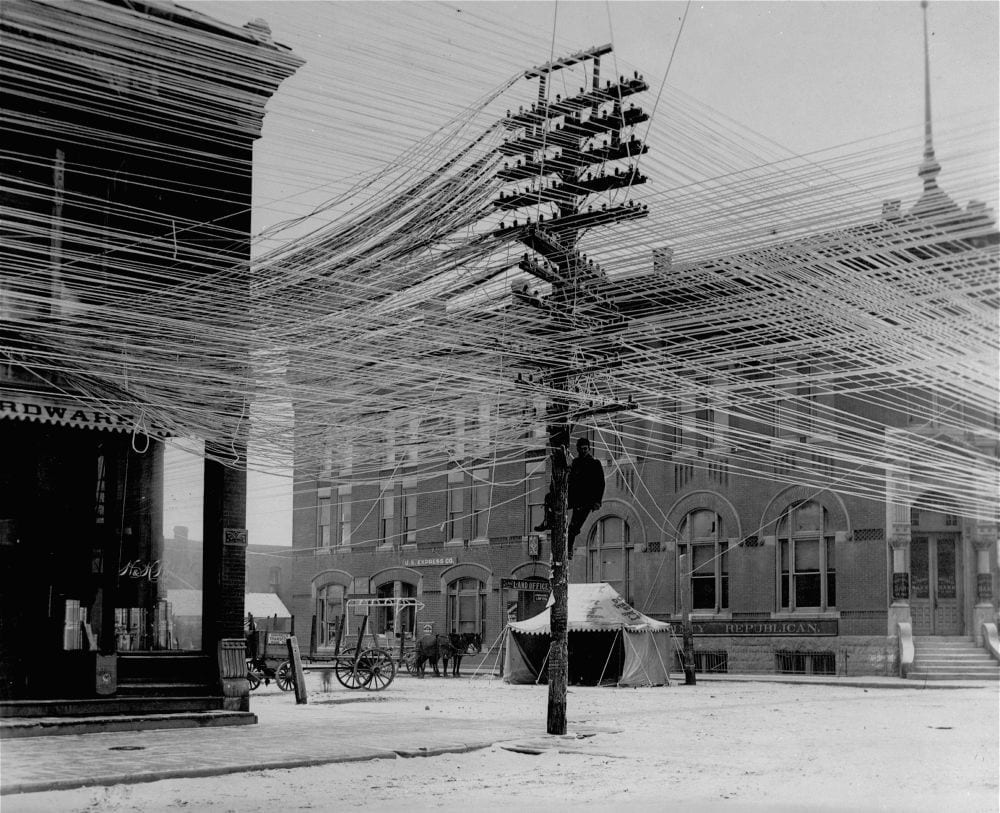
Within four years, the REA brought power to 288,000 households. And in 1949, the REA was expanded to bring telephone service to rural America, for the same reasons (and against the same objections).
That Was Then, This is Now
Now, early in the 21st century, there’s a similar problem in rural parts of the U.S. Cities have broadband Internet, but it’s much more lacking in rural areas — including where I live.
When I moved to western Colorado, I started with a satellite Internet connection. It sucked, thanks to the lag time of bouncing my signal off a satellite 22,300 miles above me. The “round-trip light-time” to go that far is about a half second … for … every … command … or … handshake … request. Considering getting just one email takes several such handshake/pings/command trips back and forth, that’s several seconds per email, multiplied by the 200-300 emails I get, and it adds up. (And don’t even ask about web surfing!)
Many of you can relate, I’m sure.
Now I use a ridiculously complex scheme to get online: Rube Goldberg would be proud! But it beats my interim solution: paying $535 per month for a T-1 line (1.54 Mbps each way), which these days is a pretty narrow pipe for “broad”band! I could afford to pay that when ad space in True cost $700, during the “dotcom craze.” That was then, this is now.
The result is in the U.S., where the Internet was invented, is falling way behind other countries. We’re not even in the Top 10 of per capita utilization of broadband, so this is far from just a “rural problem.”
The Netherlands is on top in broadband penetration, with 38.5 percent of inhabitants having broadband. They’re followed by Switzerland, Denmark, Korea, Norway, France, Iceland, the U.K., Germany and Sweden, to round out the Top 10. The U.S. is currently 15th (up from 19th in 2008), at 27.3 percent, following Luxembourg, Belgium, Canada, and Finland. Oh, if only the U.S. were as high tech as Korea! (Source: OECD, June 2011)
Attracting Jobs
So where do high-tech businesses choose to locate? Not in western Colorado — unless you’re a one-man shop, and even then it’s pretty frustrating. When I moved here, I didn’t even consider trying to use online services in Colorado, let alone the Western Slope, and I’m just a small business. I contract for email servers in Pennsylvania and Virginia, and web servers in Michigan.
Where does that leave rural communities? It’s not just a problem to get online at all, but where are the jobs going? Again not to rural areas, but the cities, where businesses can get reliable fiber optic online services. I can’t blame them for going to cities where they could get power in the 1920s, and I can’t blame them for going to cities where they can get bandwidth now.
But think about it: with the U.S. being 15th, maybe it won’t be U.S. cities that will be attracting great “information economy” jobs. (Readers outside the U.S. just started to smile.)
But do you know what’s really galling to me? When Qwest (now “Century Link”) put a new telephone cable in my road some years back, they proudly announced it had fiber optics built in. Fantastic! Well, no: a decade later, it’s still “dark fiber” — it’s not being used. They have the capability to bring broadband to me and all of my neighbors, but they have refused to do it. I’m sure they’d point at government regulations as a problem, and it could well be. Meanwhile, I feel lucky when my 3 Mbps connection stays up for a full 24 hours without interruption. Sheesh.
What can be done when someone is motivated — and in a high-density city? A year ago I heard about a new apartment building in Hong Kong, where they were offering 1 Gbps Internet connections. Not for the building, for each apartment! I’m content with 3 Mbps (when it works), and they’re getting 1,000 Mbps. Almost makes me want to move.
There is, at least, hope on the horizon: the Federal Communications Commission announced this fall they are “reforming” its Universal Service Fund (which brought telephone service to rural parts of the country) into the “Connect America Fund” to bring broadband. It promises to expand broadband to 7 million Americans and create a half-million rural jobs …over six years! The fund shift starts in January, but how long until the money starts flowing to upgrade systems? I hear 2014 at the earliest.
I fear it’s too little, too late. But, I guess, it’s a start….
(Note: About the time this was written, Qwest was being bought out by Century Link, and later the Qwest brand was mostly dropped.)
– – –
Bad link? Broken image? Other problem on this page? Use the Help button lower right, and thanks.
This page is an example of my style of “Thought-Provoking Entertainment”. This is True is an email newsletter that uses “weird news” as a vehicle to explore the human condition in an entertaining way. If that sounds good, click here to open a subscribe form.
To really support This is True, you’re invited to sign up for a subscription to the much-expanded “Premium” edition:
Q: Why would I want to pay more than the minimum rate?
A: To support the publication to help it thrive and stay online: this kind of support means less future need for price increases (and smaller increases when they do happen), which enables more people to upgrade. This option was requested by existing Premium subscribers.
One of the commonly overlooked differences when comparing the US to Europe is the sheer distance involved in trying to reach everyone here. For example The Netherlands is 16,039 square miles (thanks Wikipedia!), while my home state of Washington is over 4 times larger at 71,300. The distances involved and the population density makes a tremendous amount of difference, just as it does in the within-the-US city-versus-country comparison.
I’m not justifying having dark fiber sitting a block away — that’s horrible. But the comparisons to most countries in Europe (or the other common examples like South Korea) is one of apples to oranges.
Now, we just need the appropriate cartoon mascot a la Willie Wiredhand.
I used to work at a local ISP. We provided dial-up service for Orange County, then later started reselling another company’s DSL service.
I remember nervously watching the waves of consolidation and upheaval in the DSL industry early last decade. I also remember the established telcos (SBC and the like) insisting that the reason they couldn’t provide broadband to rural areas was that the government required them to lease access to the newer telcos, and therefore they had no incentive to build out the infrastructure if they were going to have to share it with their competitors.
The FCC removed those requirements in 2004, ushering in a golden age of rural broadband…or not.
Power lines can deliver Internet services. It’s a technology called BPL — Broadband over Power Lines. A neat concept that really fails to live up to the hype. Check out the offerings of one provider, IBEC in Huntsville: they offer, for example, 256 megabits for $50/month.
Cellular companies have them beat for both speed and rollout — we’ve been waiting for IBEC BPL for years, and while we were waiting, Verizon and AT&T both have gotten 4G networks in place. We’re still waiting for IBEC.
—
When they are rolling out new power lines (or phone lines or water pipes), they can string fiber optics at the same time for very little cost (which, I know, isn’t the same as BPL). But as you’ve also found, just because they “can” doesn’t mean they actually go online. -rc
Don’t you think wireless is more likely to reach the rural and ultra-rural faster and more cost effectively? It also doesn’t require government money (as much).
—
I haven’t seen any wireless technologies that can send gigabit-speed signals over a long distance, but with luck it’s coming. -rc
Here in British Columbia there is a 10-year plan for rural connectivity. “Currently, 93 per cent of British Columbians have access to broadband Internet and the goal is to expand high-speed connectivity to 100 per cent of British Columbians across the province in the next 10 years.”
I understand your frustration. I live in a rural area and got frustrated with dial-up, switched to satellite, and now use cellular. I don’t even run a business off or around it but I do shop, so I pay for the speed. I still have problems with using government force to accomplish your goals though. Part of the problem is government regulations. Government sanctioned monopolies in power and telephone distribution make it impossible for competitors to offer a better deal and environmental laws protect us from new start-ups because they are too expensive and the licensing and permitting also adds to that. If I were to point fingers at the problem with infrastructure I would look to history and the belief the government is the answer. Everyone said if there was going to be cross continental railroad, government had to pay for it. But J.J. Hill did it…maybe we need to start over with how we build infrastructure.
—
I wasn’t proposing a method of getting to ubiquitous broadband, but rather noting that government intervention has been successful with power and telephones. Governments build our roads and bridges to make the highway system work for us all, but that’s not called socialism. Why? -rc
I know what you are talking about. I spend 6 months in Arkansas. Had Dial up to start so slow my computer was like a Commodore 64 it was so slow. Then got satillite and was instantly unhappy with it. Got locked into a contract that makes me pay even when I’m not there. In rural Arkansas there are no options. Phone service for internet is just as bad. They had cable TV but it stopped about 1000ft from my house. They said it would cost too much for me to have it. Since then they have removed the cable because the electric coop wanted too much money for the pole attachments. I would say rural Arkansas has NO CHANCE of ever getting broadband internet service.
As a practical matter, the Internet is slowly but surely replacing the Post Office. The problems this creates are illuminated by this week’s news about many small sorting centers closing, making First Class Snail Mail even snailier than ever, largely for rural and small town residents. IMHO, this development makes extending broadband to the rural areas all the more urgent.
By my reading, the post office plays a particularly interesting cameo role in the U.S. Constitution. You can’t really say that the Constitution “mandates” the Postal Service. There is no direct mandate to be found. But it’s my impression that the Postal service is even more deeply entrenched in the Constitution than a mandate. It is *presumed*. It’s so much a part of the colonial and post colonial culture that the government will provide postal service, that they don’t even bother with the mandate. They simply talk about the Federal Government’s power to build post roads (the only government road-building justification the Constitution mentions) as if, “of course their will be a Federally operated Postal Service.” All of the few Constitutional mentions of the postal service have this presumptive air about them.
So why shouldn’t we now presume that the Federal Government will provide us with a modern-day communications infrastructure that will serve the entire citizenry — just as with the original US Postal Service? Moreover, why shouldn’t we presume it will be run in a non-profit manner, by the government? With the operating burden being shared by all citizens? On a type-of-use basis, rather than on the basis of their distance from a large-city phone office?
The US Postal Service, deeply rooted in the US Constitution, is the correct model. And the work is 20 years overdue.
—
Yes, the USPS is suffering, but they’re a lot better at hauling packages of goods than the Internet! -rc
“Governments build our roads and bridges to make the highway system work for us all, but that’s not called socialism. Why? -rc”
Not call socialism by most people. I would have to find it, but I recently read an article that most of England’s roads were originally built by private concerns, and funded by toll. That article suggested it was efficient and inexpensive. I didn’t research it further, but again, maybe we need to rethink how we build our infrastructure.
Australia has one tenth the population density of the US, yet Australia is re-nationalising the infrastructure portion of our telecommunications carriers and providing a single national network over which competing telephone, Internet, and pay TV service providers will operate.
It’s called the NBN (national broadband network) and it’s funded by the Australian government.
Even in Australia we hear of “American ingenuity”, and we hear of the efficiencies of business in the US due to the much larger markets.
So, why hasn’t the government (on its own, or indirectly through a public-private partnership) seen fit to offer Americans a similar utility?
The problem with the IBEC BPL is it interferes with Ham Radio signals. Also were it is in operation they far exceed the bandwidth they are supposed to be under by FCC rules & regulations. But I have firsthand knowledge of what is being said. My high speed internet (if you want to call it that) is Clear wireless 4G. I live in Highlands Ranch area (South Denver Metro area) but I am on the wrong side of the highway to get anything. Now here is a kicker: my brother lives down in a town called Ellicott, CO. He has DSL through the phone company population density est 100 per square mile! I had the same problem with Qwest about 10 years ago; they had all kinds of excuses why I could not get DSL. I was not close enough to the switching station (which I was). A few years later once Comcast offered broadband in the area, then Qwest could now offer DSL! They all lie like the fiber optic line we are all hook into. They where playing that up to the PUC to get a rate increase!
I have some sympathy. I’m writing from a 214Kpbs EDGE mobile connection in a small town but next to the major highway in South Africa, where we are lucky to get consistent throughput of 50-80 Kpbs.
Luckily it is much better than the 48Kpbs dial-up at extreme cost (making long distance telephone calls) we had to use for many years!
We have a very modern telephone electronic telephone exchange in town and several fibre lines running along the highway, but no ADSL data services are provided by the fixed line operator.
Treasure your 3Mbps connection!
—
Yep: that’s why I feel “lucky” (when it works)! -rc
You are wrong about the Universal Service Fund being a holdover from FDR administration. Also known as “the Gore Tax,” this taxation without representation was forced onto phone bills since 1998 by the Federal Communications Act of 1996. Like all taxes, the tax will never cease leeching funds from the general populace. Don’t ask government to fix things; tell it to get the hell out of the way of real progress.
—
Read my comments again: I didn’t say what you think I did. -rc
Personally, I think the problem is with the people who choose to live in rural areas, and then demand city services. Personally, having moved there, lived there and loved it for over 10 years, (to get away from the city). The cost of that is getting away from public buses, public libraries, professional fire fighters, umpteen police and ambulance sirens and service, paved roads, sidewalks, street lights, garbage pick up, and yes, internet access.
That is what rurtal living means, getting the benifits of rural living means giving up some of what some people call the amenities of social communities on large scale.
You said yourself, you moved there, and I assume of your own free will. Look out your window while the deer snack on your flower beds, the osprey soar overhead, and the air is fresh and clean. You probably drink unchlorinated water from your own well, you cut or choose to not cut your own grass, or grow your own food, and you sleep better at night than any city dweller.
Enjoy the benefits of slow internet…have a cup of tea on your back deck while you download the newspaper of your choice, and your childern can play outside after dark, safely.
The world does not evolve around internet speed. It evolves around patience, kindness, joi d’ vivre, knowing your neighbour, walking the roads safely and breathing clean air, drinking clean water, and living a good life, at a good speed.
If you really NEED high speed internet, save your stuff on a stick or laptop, take a drive into town and buy some groceries, go to the library and surf the net, but go home asap, cuz that ia where life is.
—
While I agree with your premise in general, you have a lot of the particulars wrong. Who says libraries here have good Internet connections? In general, library, school, and government office broadband speeds are half what they are in Denver, and much more expensive. It’s not, in fact, “safe” for children to play outside after dark, what with mountain lions on the prowl for dinner. But if the post office is reducing service because of the challenge posed by the Internet, a large chunk of the population is cut off from the rest of the world. Jobs move away. Screw them rural folk anyway! They’s just stupid hicks, right? And that’s the 21st Century you envisioned as a child? -rc
I had a 9600 connection at one time, some years ago.
At the time, I was happy. Bored, but happy I had the connection at all.
—
Yep, and some years ago rural folks were happy to have a horse to take Paw to Doc Sloane when he was hurt out in the fields. Yet progress keeps happening, doesn’t it? -rc
I live in not so rural Va. and can see a pole 300 ft. from my property that has Verizon FiOs on it. It goes 4 miles further down the road to the brand new high school.
I’ve been round & round with Verizon regarding them hooking me up. I told them I’d even pay for the line from the pole to my house. They have come up with more B.S. than you could ever imagine, diferent story every time. “I’m beyond their service area” to “No, there’s no Fios on that pole” and “there are too many people on it already.”
There are 7 houses on this road. A county road that leads to the state forest. All of us are willing to PAY for their time, man hours, etc. Still they refuse.
I use Wild Blue Sattelite & it sucks. It’s still better than dial up. I run a computer repair shop from my house and there have been times I’ve had to go to the local coffee house & use the free internet just to download updates after installing new OS’s for customers. It’s faster. Yeah, the coffee house that’s hooked up to the same line that Verizon says doesn’t have Fios on it!
—
It’s galling when a utility refuses to let you tap into existing infrastructure. That’s pretty much where I am. Would a water company be allowed to refuse to give you service when you offer to pay for it? The electric company? They’re all monopolies, allowed to operate as such by the government. Why are they able to refuse service? -rc
To answer your question about socialism, Eisenhower dubbed the Interstate highway system a defense system. Roads and bridges are essential for commerce. It made more sense when govt did not intrude in commerce, as it does with ever increasing frequency; now, the US feels entitled to intrude on every transaction and use raw force and intimidation to rob from some to give to others. The apex of govt involvement has now slowed our economy down to a crawl — like a web server.
—
So, saying something is “for defense” makes it “not socialism”? Great! So, a healthy populace is critical to our defense, therefore a single-payer healthcare system is de facto “not socialism”! Educated troops are critical to defense, and the Internet is the best learning system ever developed. Therefore government-provided broadband is therefore “not socialism”! (I could go on.) Yeah, I’m being a bit sarcastic, but that sounds like what you’re saying. Justify it as “defense” and voila! We get around that Evil Bugaboo just like *that*! -rc
Rural electrification and telephone service made sense for government subsidies in an era when the rural customers being served were largely farmers who were there because they were producing food — of benefit for the entire economy. Of course, there still are many small farmers and I wouldn’t begrudge them the ability to participate in the information age by subsidizing access to broadband Internet. But there is an increasing subset of people like you, Randy, who move to a rural area for lifestyle reasons and expect to have the same amentities as city dwellers. I’m sorry but I don’t see why we should subsidize your type. If you want a rural lifestyle, that’s fine, but you should expect to give up some things.
Unfortunately there’s probably no way for the government to distinguish between people living in remote/rural areas for economically beneficial reasons, with those who aren’t really contributing anything to the economy that they couldn’t from a city or suburban area.
—
Odds are, I pay more federal taxes than you do. There are a lot of people like me here. But we should not be allowed to contribute to the country’s economy because of where we choose to live? Really? I’m 12 miles from a city. Where is the cutoff? 5 miles? 10 miles? People outside that cutoff should thus just pack it in and go on welfare? Or better, we should be ineligible for welfare so we will be forced to live in a city? Really? How do you justify this position? -rc
I live in rural Japan… a “small” town of 15,000 people. I know that’s not small compared to rural America — I’m from Kansas!
We got fiberoptic last year, and people were complaining about how long that took. Before that we had ADSL, which, incidentally, was the same service we had in CHINA, because we had been in a major city there! People complained here how long it took for NTT to get really good broadband into the area. And they have “dark fiber” here, too — we know people less than a mile away who haven’t been able to get their lines enabled yet. Huh???
Simply put, the population density is higher here so more people have ‘net access. However, for people in the true boonies here (and they certainly do exist — eastern Hokkaido has a population density like Wyoming) they resort to cell phone service, which has a very solid infrastructure and, interestingly enough, Japanese cell phone service is cheaper than American cell phone service.
Internet and cell phone service are two U.S. sectors that need regulation because the companies won’t do it themselves — even if it would benefit them in the long run. They’re more interested in profits Now, Now, and Now, and don’t realize when they may be killing themselves and others around them in the long run. They’re having similar problems here, and I think it’s why we’re seeing the U.S. and Japan sliding behind their neighbors in the global economy.
*sigh*
Joseph/Wisconsin: sounds exactly like what I have gone through. The satellite would work if I stood on the roof holding the desk top in front of me and pointing it at the shiny thing in the sky when it went overhead. My dial up was nearly 500/month, got a lap top and now spend nearly $150 a month for wireless. And it is not fast though it is far faster than dial up.
My complaint is that the reason we need more data transfer than a telephone line can provide is to receive info that most of us do not want! I don’t want spam, pop ups nor ads. I quit paying for aol etc when I suspected they were selling my e-dress. Now, I still have all those things but I am not further subscribing to services that sell my info. Google is good at selecting out junk mail and I have learned to ignore ads (excepting those I solicit by subscribing to a site, ie TRUE).
And my son and his wife do not even have cell phone lines where they live in rural Georgia. I call once a week and they drive to the Interstate to get a signal and let the grands talk to me.
21st Century? Doesn’t seem like it.
According to the UK Office of National Statistics (ONS) 63% of UK households had Broadband in 2009, and the figure has surely increased since then. The OECD figures for the same year are 69.5% for the UK, and about 68% for the USA.
I’ve used the same source as you, and suggest that your figures for subscriptions per 100 people are less informative, as they are much distorted by the size of households, each household being unlikely to have more than one subscription.
It does still mean that both the UK and USA are lower down on the list than one might like. But then the USA is a Big Country.
—
I believe your figures are for access to broadband, whether or not they subscribe. It’s still not enough. -rc
I know how you feel. I live just 25 miles north of London, and in a sense I’m even more frustrated, as the towns just 2 miles south and 4 miles north have 20Mb broadband, while my local exchange is still limited to 2Mb — which means 1.8 in practice.
The exchange was supposed to be upgraded “at the end of 2012”. You can imagine how I felt, reading that almost 3 years ago. Just recently I came across a item which said that this upgrade had taken place in September, so I went to a BT website where I entered my postcode and it said I could now get BT Infinity (their super broadband service) and also said “click here to test your line speed”. When I did the result pages said “Sorry, you cannot get BT Infinity”! So much for upgrades!
Virgin broadband appears to have stopped their advertising campaign which used the slogan “Demand better”, which is just as well, as no matter how much I might demand a better service, the fact is that I can’t have it. 🙂
I also think that providers shouldn’t be able to tout a service as “up to 40mb” unless at least a standard percentage of the subscribers in that area can actually get that service. I think it would be better if services were described with the percentages available to 30%, 60% and 90% of the customers, so a “40Mb” service would be shown as “40 / 20 / 5”.
After all, I could offer “Discounts up to 80%” and then actually give a discount of 5%. This still fits the description of “up to 80%”!
As a final thought, will we see future towns being built without any telephone cabling, with all phone services being wireless?
I hear you! I’m not that far away from two different cities, but satellite is my only option here. Can’t even use cellular — our 1888 house has a tin roof, so we can’t get a signal inside the house. We have to run our internet business under these conditions — like trying to run a marathon in the sand. The worst part is not being able to enjoy all of the new technology — can’t view streaming movies, can’t use Hulu or any services like that, can’t view more than a couple of YouTube videos, including the tutorials I need for work. Not only is the speed slow, but there is a cap of 475Mb download per day. So when you write stories like this, it makes me know that I’m not alone. Wish there was more hope on the horizon. I’m 58 years old, and unless I move, I fear I may not have dependable truly high speed internet connection in my lifetime.
“Governments build our roads and bridges to make the highway system work for us all, but that’s not called socialism. Why? -rc”
That isn’t called socialism by most people, and there was a time I thought the same way. Then I read about J. J. Hill and the Great Northern railroad, and after that I read about the Turnpike Trust of England. These were both evidence that private industry can build a successful infrastructure. There is an entry in Wiki about the Turnpike Trust. I could also get you a PDF of an article in The Objective Standard (which is where I read about it originally) if you would like to read that. They also have a story about J. J. Hill. I originally read about him in a book called The Myth of the Robber Barons.
—
I’m quite aware that private companies — even private individuals — can and have built roadways. But that’s certainly not how it’s done generally, is it? Yet it’s not called socialism (the big Fear Word used by so many when it comes to government involvement in anything). Why? -rc
Broadband companies are making money hand over fist, and when they are told that they can’t arbitrarily decide what bits get to go over the wire (the Net Neutrality debate) they predictably go into full on “if you do this we’ll crumble” mode. Yet Net Neutrality has been the modus operandi since the net began! Its hard to consider regulation a problem when a “preserve the status quo” regulation is pushed back on so completely.
As such it becomes impossible to believe the chicken little cries of the broadband industry as to what they can or cannot do and why they can or cannot do it. They could certainly bring broadband to rural areas, but they choose not to. And then when municipalities decide to do it for themselves, they sue and suddenly get the motivation to do it themselves.
As businesses I can fully understand that they are motivated by profit. But in the broadband industry there seems to be a profit motivation far beyond what is healthy. While a major point of a business is to make profit, another major part is to provide a good product or service that will attract more customers. Instead broadband companies seem content to only provide their service where they can add an extreme markup and then content to provide mediocre service because they are the only company providing that service in any given area. And because they don’t have concentration in rural areas they can’t make an extreme profit, so they don’t want to do it.
It stinks. Yet internet access has basically become a requirement for many jobs and businesses, so we’re stuck paying them anyway. Its the worst kind of monopoly (or duopoly for the lucky ones!) — the kind that is completely impossible to avoid.
In my small county (about 10,000 people) and only 1 to 3 hours from large cities, you get Broadband when you negotiate an “extention of service”. They don’t pay, you do and after one person pays all the load, everyone else jumps on for free. Tell me how fair that one is?
Re: kris, alabama:
BPL is good, but not that good. For 256 megabits service, read 256 kilobit service. Much better than dial-up but not really broadband.
In Mexico we have 5 megabit DSL service that we complain is too slow compared to 15 megabit in Atlanta. In reality, you need 5-10 megabits per active surfer that wants to use HD video on the internet. We are currently in a hotel with a throughput of about 500 kilobits and we can’t even get a reliable low-def video to play.
As you imply, we are creating a two-tier society with many websites simply out of reach to rural communities. I lived in a tiny village in rural Panama and got a 2 megabit DSL connection.
Let’s get connected!
It costs more to make deliveries by FedEx or UPS to locations also. Should the government intervene to “solve” this problem?
It did, and its called the USPS. How is that working out?
Government ownership of road is, by definition, socialism. It is a bit of socialism we have practiced for a long time. Does it “work”? We have nothing to which to compare it. There is very little in the way of private roads, because governments don’t allow it by their preempting of the market in this area.
When you ask the government to bring a service to your remote location, you are asking the government to rob others to deliver something to you. If it weren’t the government dong it, we would call it evil.
—
Yet the governments want me to pay my taxes, and I do. The postal service is being starved by the government, so yeah: it’s suffering. It should be allowed to operate as a business with a universal service mandate, or it should be a government agency — not forced to adopt the worst aspects of each. And really: where, exactly, did I call for government to do this? I did call for the phone company to light up the fiber in the cable running by my house; how is that a call for the government to intervene to “solve” this problem? But if that’s what it takes to force a government-allowed monopoly to provide a utility service to a paying customer, why is that a bad thing, exactly? -rc
I just moved back to the east coast from Colorado. I lived to Durango and not farther north. Even though I wanted to live a little more in the in the mountains, I also need internet for work, and I can’t afford to pay $100 a month for something that will only barely get me by. I hope by the time I return in 5-6 years I will be able to move out of Durango but I agree I shouldn’t take that long to get internet. This is 2011, internet has been around long enough that every one should have it.
To John S. Cumberland, VA: Here is an idea for you. If you are friendly enough with the coffee shop owner you might be able to a deal with him and use his drop and go WIFI unless one of you are sitting down in a hole some place a lot of people will tell you it can not be done. The record for distance on WIFI is 237 miles; you can build your own setup pretty cheap too. Now for only $49.95 I will send you the plans (Just joking there) you can do a search on the web and find the plans or contact me through Randy and I will send you the link.
I’ve been fighting a similar battle here. Our little community now does have “broadband” … if you call 1mps down and .3 up “broadband” these days. And, we have promises of increased capacity in the near future 🙂
One of the interesting points on all this is that “connecting a community” by running cable or wifi is the easy part. Getting that connected to the outside world ends up being the challenge.
The “top 10” wired countries are all about the size of — and have the population of — Cleveland. Relatively easy to do on that small a scale.
I’m thinking you probably knew that service was limited in a rural area, just like I did when I moved where I live. The companies that offer me broadband now do so because they have a financial incentive, not because the government mandated it at a cost to all (also why there are few, if any, party lines left in the phone system).
Cable TV (and eventually satellite) came the same way — although it was the cities that struggled in development of those technologies, which were not as in demand since the TV signals were strong. I’ll bet Sirius/XM has a higher per capita base in the plains than downtown, too.
I’d be more interested in knowing how many U.S. private sector firms are propping up broadband Internet access in the third world in an effort to make it easier to ship more of our jobs offshore.
Socialism a dirty word? Given my druthers of one or the other, exclusively? I’d choose capitalism. Fortunately I don’t have to choose. We are a capitalist society with socialist programs for balance. Some countries are the opposite. The trick is deciding just where is the best balance. But there’s also the pervasive fear that any trend will continue unabated in that direction. Either “too much” socialism or “too much” removal of it.
Sadly, while the “Market” is the best motivator for innovation, companies are operated by nimrods who can only see in the Short Term. A few can see the Big Picture and they’re called “geniuses.” They’re not; just businessmen. It’s the many (CEOs) who can’t see the forest for the trees and they’re called “businessmen.” They’re not; just idiots.
An example is the music (and now video) industry. Rather than embrace the new technology and figure out how to PROFIT by it, the industry stubbornly holds to an old, outdated model like a religion, and continues to fight the technology. And that’s been human nature throughout history. I’m not so amazed by what we have in the 21st century as that it’s taken 10,000 years to get here.
But in an era of COMMUNICATIONS, it’s pathetic that there are obstructions because we haven’t figured out to make it profitable ENOUGH in the short run to be interested.
What has been missing from the comments so far is the recognition that the bulk of information now being put out by the government (among other organizations/institutions) is only made available on the internet. It’s great for reducing costs and improving efficiency in the production of these materials, but it’s also extremely limiting in terms of distribution. If you don’t have internet access or somewhere that you can get it (e.g. a public library), you’re plum out of luck.
Thus, access to the internet is now very important in terms of being an educated citizen, not to mention being able to shop, stay in touch with family/friends, and all of those other things the internet is useful for. In that respect, it makes a lot of sense for the government to assist in reaching those parts of the population that the companies have not yet served. I only wish they were being quicker about it.
I can relate to your frustration.
Notwithstanding Leo in Woodinville’s comment about size, yes the Netherlands is much smaller in area, in the Netherlands fiberoptic cables need EDFAs as well to overcome attenuation. It’s just that the situation in the Netherlands is completely different. Over here, the electric company as well as the phone company were always owned and operated by the state. They have privatised only in the last 15 years or so.
In the Netherlands (where I live and work with the oldest and one of the largest ISPs, which also offers POTS and since a few years fiber optic Internet, and voip and TV over IP) after the second world war, electricity and a landline was seen as a basic right that every citizen should have. So every household was connected to the Plain Old Telephony System in the 1950’s and 60’s.
With the dawn of a new age in the 80’s and 90’s came dialup and ISDN followed by DSL services, over the old copper wires that were already there. About 80% of the households are close enough to switching cabinets to have a reasonable quality of service, meaning in 2006 a bandwidth of around 8Mb(its) per second accounting to roughly 1MB(ytes) in transmission speed for about 50€ per month.
After 2005 we (as in the company I work for) decided to get involved in fiber as well as we saw the speeds of cable and mobile increase and ‘we’ needed another ace. The biggest reason that there is a fiber optics network in the Netherlands is LOFAR (check out the video, it’s really cool, sorry for the load time).
The way to get on board these new developments is sponsored by local governments, the infrastructure itself is there already (well the Metro Access network is), but the infrastructure in communities will still have to be constructed, in order to get there, people who want fiber have to start a community initiative, which is little more than a petition which says that at least xx% of xx-amount of households wants fiber and with ISP xyz. When that is completed, we simply roll it out. Go door to door to sell the subscriptions and that is that.
The real reason I can think of why the fiber is left dark is cost, one needs an Intelligent Services Access Manager to maintain a desirable qos, the services have to be configured onto vlans. I do suppose FTTH is much more desirable than FTTC, even though the latter would be a great improvement. In other words one needs a linecard to terminate the fiber, divide it into many lines for all the subscribers and sort out the last mile(s), that’s the expensive bit I imagine, In NL this is done in a central location, much like the dsl switching, just the technology is much more expensive, around €30k per 48 connections. That is feasible if you actually sell all of them. If only 12 or 14, it’s a bit of a hefty investment.
If you’re sure the I/S is there Randy, I’d rally everyone who could take advantage of the fiber, petition to your congressman and raise some hell with the ISP.
—
EDFAs are erbium-doped fiber amplifiers — optical repeater devices to boost optical signals being carried through fiber optic communications systems. Indeed, I am planning to canvas my neighbors just as you suggest to see if we can convince the telco to light up the fiber. -rc
TO: Tom, Littleton, CO
I know the owner of the coffee shop only casually. One thing though, they have unencrypted wifi and are just about 3 miles from my house. You say wifi can reach a range of up to 237 miles?
Would I have to set up some sort of range extender on their end? I doubt they would want their “free” wifi being broadcast over the whole town. The main reason they don’t have any encryption is they are very old and have no technological capability whatever. They pretty much take stuff out of the box, plug it in and hope it works. Thanks for getting back to me, Is this the method Randy spoke of? If you can, I’d like to have the link you mentioned. That way I know I have the right information. If you have access to my Email through my subscription, you may send it to me that way. If not, Post in a reply or let me know how to contact you for it. Thanks once again, John.
—
The 237-mile figure is with special equipment under ideal conditions, and I doubt the transfer was very good. With proper antennas and such, a typical limit is more like 12 miles, line-of-sight, so if you can “see” the coffee shop, you can definitely do a link. My house and office are about 1/4-mile apart, and I link them with small directional antennas over WiFi. John can either just post the URL as a comment, or he can email me and I’ll forward his message. -rc
I know there has already been a comment regarding Australia, but…. In Australia, our federal government has IMHO wisely decided that access to broadband is good for the public and good for business.
We have some population density issues too — some way high and some way low — but no real topography to talk of. So for a mere A$25B there will be 97% of household with FTTN (fibre to the node) and a line available. Choose to use it or not. This is high speed super quality broadband.
For the more rural folks, there is a very clever scheme to make use of existing analog TV signal (as the country is going to digital) to provide broadband over large areas.
And yes, we still have people arguing that all it will mean is that country people can look at youtube videos faster, rather than consider any of the social, medical, educational, business or other leisure applications.
If I understand your position correctly, you seem to favor state (i.e. government) involvement to expand broadband coverage and improve speed.
Here is the problem… such expansion clearly requires funding. In the context of state involvement, this funding is provided via taxation, and indirectly via monetary inflation (a subtle form of taxation for current dollar holders). There is no way to know what products and services are prevented from being produced when capital is taken from private producers via taxation, and allocated toward public works — in this case, the expansion of broadband.
Henry Hazlitt states repeatedly in his book “Economics In One Lesson” (free at fee.org for those interested), “the art of economics consists in looking not merely at the immediate but at the longer effects of any act or policy; it consists of tracing the consequences of that policy not merely for one group but for all groups.”
So, let’s suppose the state allocates $200 billion to increase broadband coverage and improve speed. Many people will certainly benefit. But there is no way to measure what we have sacrificed by allocating capital ripped away from producers. Might there have been another Google? Might the capital have been invested into designing new machines that are increase productivity, and thereby lower costs for consumers?
In other words, there is no way to determine who is worse off, nor the countless ways in which they are worse off (less medical care, fewer products that enrich their lives, etc.).
The road to prosperity (not the sham created by quantitative easing) is not paved with capital ripped away by politicians. It is paved through the efforts and investments of entrepreneurs who risk their own capital on the chances of enormous success.
—
Your points are all valid, whether or not they’re in reply to my supposed preference. Still, we’re left with urban haves vs. rural have-nots, simply because it’s not as profitable to build infrastructure in rural areas. So do we say “screw the ruralites”? Where is that line drawn? Roads? Electricity? Water? Schooling? Telephone service? Law enforcement? Airports? Internet access? If the private sector refuses to step in, then what?
What we often have is the private sector refusing to provide service, but if the government steps in, the private sector screams “Violation of our rights!!” Why should they have it both ways? With rights come responsibilities, which is what’s behind the Universal Service Fund. I’d much rather the private sector just did it, but they’re not stepping up. If we really don’t want the government taking action, how to we get the private sector to pay attention to the other side of the coin — their responsibilities?
This isn’t theoretical. For a specific example, the local telco, Qwest, was given a contract to bring fiber-based broadband to every county in the state. Qwest signed the contract and hooked up every county seat …except one, because it was “too expensive” (not mine; the next one south). Excuse me, but it seems to me that’s why there was a contract for all counties, and that’s what Qwest agreed to do. The bid was awarded on that basis, and Qwest did hook up every other county at significant profit, but as far as I see, they gave the state the finger for the expensive one. That’s reasonable how? But that kind of result is how liberals justify state action. Yet corporations (and the right) whine when the government takes action. Again, private enterprise wants it both ways.
The bottom line is, there is no clear right and wrong: neither the left’s solution nor the right’s actually works for all. It’s difficult to walk the perfect path, but that’s what our system demands. I’m demanding action because I pay my share of taxes too; I’m not dictating what the path should be. -rc
“Dark fiber” does not mean “unused fiber”. It means fiber that is available (or already used) for termination outside of the provider. Qwest can hand that fiber, or pieces of that fiber, out to other companies without providing bandwidth themselves.
So, even though you can’t get Qwest to give you internet access, if you had a termination point somewhere else (say in a colo facility in Denver or The Springs) you could get a 10G dark fiber wave from your house to that colo facility. However that would cost you more than the supposed T-1 Line. But you could resell bandwidth to all of your neighbors.
That being said, I think that dsl, fiber, or just cable modems should be easy for companies to provide to rural areas.
—
Well, if it’s dark, it’s not being used. If you mean just because it’s dark doesn’t mean it’s not capable of being used, then certainly. They can light it up! And, as you suggest, they could let someone else use it — but I’m not going to hold my breath that Century Link (who bought out Qwest) will do that. -rc
It’s even worse than just Qwest did not provide the contracted service because it was more expensive. Durango Mountain Resort 30 miles north of Durango has fiber-optic lines and high speed internet. But running that line another 20 miles to Silverton where people live year round was suddenly too difficult/expensive. So the end result is the people who come for vacation can get internet but those that live and work here cannot.
—
The killer is, we’re all willing to pay reasonable prices to hook up; we’re not expecting them to lose money to serve us. We want them to make a profit. Yet they still refuse service. Isn’t business in business to make money? So why…?! -rc
Thank you for highlighting my misinterpretation of your post. I apologize for not taking the time to read through the comments, and am glad to better understand your position.
On the matter of private enterprise and companies’ unwillingness to “step in,” I do not see it as their responsibility to do so. But this begs clarification…
I see the state as illegitimate in every way because it is, at its essence, a territorial monopoly of aggression. That which is illegal for you and I to do — theft, murder, etc. — is systematized by the state via taxation, regulation, and wars. The reason I point this out is because state involvement in broadband is merely another example of theft and aggression.
For instance, were I to hire you to build a deck, the exchange of my money for your services would be voluntary (assuming acceptance on both sides). By contrast, when your state contracts with Qwest, the contract is based largely on taxation, which rips capital from private producers’ hands (theft). Does Qwest have a responsibility to stick by their contract? Gosh, I guess. But by what right does your state rip away monies through taxing its citizens in the first place to pay Qwest?
If by democratic vote, I’m reminded of the definition of democracy as being two wolves and a sheep voting on what to have for dinner.
If by state decree, well… it would require an optimistic mind to believe the state has ever proven adept at allocating funds toward their most productive means. In fact, doing so is impossible. Without a price mechanism built on profit and loss, there is no way to determine what consumers are truly willing to spend their savings (capital) on. In the absence of those data, we are merely hoping for the best.
It has not worked out well for us over the last 100 years.
As an aside, I tend to float past notions of left versus right. That is akin to a shell game. Study of economic theory and political philosophy reveals it as nothing more.
—
You’re most welcome. I can’t agree that “the state” (by which I read “government as a whole”) is “illegitimate in every way”. I think it beats anarchy, but not by a whole lot. I believe national defense, for one example, is a legitimate function of government. I cannot argue, however, that our invasion of Iraq (to extend that same example) served any national defensive purpose, and thus could be viewed as “illegitimate”. We supposedly learned that lesson from Vietnam, but the national memory was too short by a long shot. I’ll just close with this: who paid for the invention of the Internet? That little experiment worked out rather well. It’s an example that the perfect path isn’t obvious. While I count that as a hit, I do know there are many more misses, too. -rc
The invention of the internet has indeed been a boon for mankind. Thank goodness it did not remain in the hands of defense and academia. Thanks in particular to the tireless efforts of countless heroic people like the recently-passed Michael Stern Hart (of gutenberg.org fame), you and I can enjoy this conversation.
Thanks for the insightful replies, Randy. It has been like playing chess with a friend.
—
I agree that the Internet immediately became far better off when the government let go of it, and their attempts to “regulate” it are all fraught with extreme peril. The freedom in the Internet (and what is this country about, if not “freedom”?!) made people like Hart and, indeed, me, possible. Good game. -rc
There have always been, and will always be, governments. Whatever one thinks of them, however they’re run, they will always be present. Might as well argue about death and taxes (which is government, right?) The U.S. has long since ceased to be the world leader in manufacturing. It can be copied, and was, without the necessary investment in research and development, trial and error. Less overhead leads to lower prices and drives out the competition. So the U.S. developed the Communications industry. Granted, it’s not that simple, but our economy depends strongly upon the transfer of information. Even marketing is expanding online. We’re talking jobs here.
Problem is, one company cannot dominate an entire industry, nor should it be allowed to. And one company is not going to resolve a problem endemic to an entire industry. Oh, eventually, the evolution of the market will one day bring solutions to the masses, but who has the patience to wait for generations for it?
Which brings in government to help an industry as a whole. The issue is not whether the government should, or should not. It’s how MUCH. At one extreme, the government controls it all, and at the other, no control as we wait for private enterprise. I see the problem as I believe Randy has expressed it. Like Randy, I wonder what it takes to kick start a solution.
Worried that taxpayer money will be spent just so some people can watch Youtube videos faster? How short-sighted. Youtube is a billion dollar business. That means JOBS. Zynga is a billion dollar business and it’s advertiser supported, all from millions of people who want to play online interactive games. So much of marketing today is online. Jobs. Revenue. And all people can worry about is whether it’s worth it to expand the customer base that accesses those businesses?
—
And then add in the online companies that they do think is “worth it.” It adds up to something huge very, very, fast. -rc
Heh when I posted my first comment on this blog post, I said that IBEC BPL offers 256 megabit for $50 a month. As Phil in Atlanta pointed out, I meant 256 kilobits — which makes the preceding statement make sense, about it failing to live up to the hype. With Verizon 4G, we’re getting about 32 times that speed (8 megabits), at least downstream, but suffering with a 5GB/month cap, for the same price (as part of a bundle with three cellphones). And I wouldn’t mind the slow unlimited service so much if it was priced competitively. Perhaps there’s another option. Clear isn’t available here yet, though I think it is available where I work, 30 miles away. I used to have it when I lived in Utah, before I moved out here. I liked it, it was plenty fast, 4G cellular based (using the 4G network that Sprint 4G phones use, which is provided by Clearwire) so plenty portable too. I’m starting to think now that broadband rollout across rural America will have less to do with BPL and more to do with Cellular.
Been there, living that. When we first moved here in 2005 we had 1.5 mg download (approx) which was fine for then. Six years later — still at 1.5 mg download. Too far from the DSL switching station to get faster…they won’t put equipment nearer us until more people move out here. But it’s a rural area so that’s not happening.
I’m offgrid — nearest power is a mile away, so getting thru the power lines wouldn’t work even if it was available. Wireless — well, I can sometimes get 3G at my house, usually not. It’s a lot slower and less reliable than my DSL. Satellite won’t work — they limit uploads/downloads, and with my job I can’t have that.
Using the library in town? Um, I work from home — I do software demos through the web. Can’t do that in the library. May end up having to rent an office in town just to do my demos. Keeping my fingers crossed I can limp by without doing that until a miracle happens. And of course, doing more trips into town to visit an office means transportation costs on top of the costs of renting the office. And putting more gas fumes into the air. Wasn’t that what the internet was supposed to keep us from having to do?
Fiber? They pulled fiber conduits with the phone line…but there is no fiber in the conduit. That was too pricey. Maybe someday?
We SO need the equivalent of the rural electrification programs they had in the 30s and 40s. I too would be willing to spend good money to get faster speed. My boss was willing to go up to $700 a month just to get 3 mg download — but that option would have required an additional $1,000 a month for the phone line to support it. (It was some kind of Ethernet transport). That was too steep.
Yes, I could move to an area with better service. And believe me, I’ve thought about it. But it’s not that easy to uproot from a place. And when I moved here — 1.5 was pretty much standard. It’s just the rest of the world has raced ahead, and we’ve stood still.
I live in rural Virginia, and have operated an Internet business for the last 16 years. Starting out with dial-up, when that was all that was available, I have moved to ISDN, satellite, and finally to DSL at my business location.
But I have a BPL (broadband powerline) connection at home (where DSL is not available) and I have to say that it is without question a really good answer for rural areas, where there is no cable TV and wireless connectivity is spotty.
I worked with our rural electrical coop to get a rural development grant which has helped make the service a reality. I think it needs a lot more attention as a viable alternative to satellite Internet, which is simply not broadband and, given the latency factor, can never be.
Being also located in rural Virginia, I am very much interested in Jeremy’s BPL solution, and would like to have more specifics. I’m not familiar with BPL (though I did just Google it) and if Jeremy has the same electric coop as my neighbors and I do, I’d sure like to be able to investigate this option further, and know what Jeremy had to do to make BPL work in his case. And Randy, thanks for starting such a lively and meaningful discussion for all of us.
I feel your pain. I lived in rural northern IN for 8 years and when they *finally* offered internet service, we signed up. If you got disconnected at 3:00 after school, you didn’t get back on until after 11:00 when the kids went to bed. Weekends were hopeless. Even 15 years later, my son complains about the speed of internet, and I have to remind him of the days of living on dial-up. I’m a patient person. He never learned. When we finally moved, it still hadn’t improved except that we had bought a 2nd phone line so we could get calls again.
To: Warrick, Perth, Australia:
Actually, the NBN is FTTH (Fibre to the Home), not to the node. Each home/site connected to the NBN will have a dedicated optical fibre running right up to the premises. This is, absolutely a very good idea, and much better than the FTTN. It’s also a better long-term strategy costs-wise, as you lay out all the cabling at the start.
Working for a major ISP as I do, I can tell you flat out that those promoting wireless solutions over DSL or fibre are deluding themselves. Wireless is a shared resource, so the more people trying to use it at once, the less throughput everyone gets, whereas DSL or fibre each user has a dedicated line to the exchange/node, and thus is not as directly effected by more users/usage.
And that’s before you factor in the line of sight, cross-talk and general weather/atmospheric interference issues inherent in current wireless technologies.
I live in rural Missouri and tried to update my speed from 512. After 3 months of wrangling with Centurylink about no speed upgrade the service people said I was just too far away for higher speeds. The people on the phones for the internet trouble line insists the guys in the field don’t know what they are doing. The whole thing comes down to companies not wanting to get off their money pits and bringing service to the people. Those farther away than I am can only get dial-up speed, if they are lucky.
@Michael, Mo.: I know how you feel. I don’t know if you read my comment above about how Verizon refuses to run a line for the few homes on our street when I can SEE the poles carrying FiOs to the High School & town from my driveway.
They have come up with every excuse in the book as to why they can’t. It would have been easier for them to just run the cable. They’d pick up at LEAST 4-5 new paying Cable TV & Internet customers. I had FiOs when I lived in Philly, what a downgrade satellite TV & Internet is!!
While I generally agree with most of your opinions and can understand where you’re coming from on others, I am astonished that you claim the internet is an American invention.
This just isn’t the case and I’m surprised that someone of your obvious intelligence would make a daft claim like that.
Apart from that one slight(?) error, I feel your pain — even in cities and towns where you would expect decent connectivity, the words ‘up to’ are always used to describe the speed and the figure after this is never reached.
—
Who do you think invented it, Derek? -rc
“Who do you think invented it, Derek? -rc”
OMG, I just cannot resist! Everyone knows that Al Gore invented the internet!
Okay, I’m being facetious about a misquote, but it was just SO ripe for picking. And Randy’s blog item about the early days of ARPAnet when it was the province of the Dept of Defense.
—
I had a Brit who (by email) insisted that Tim Berners-Lee invented the Internet. Nope, not him, either: he invented the Web, which is a protocol that rides on the already-invented Internet. Repeat after me: The Web is not the Internet! Even after I disabused him of the notion, he tried to post that as a comment here. Let’s set the record straight.
Fact: Packet switching, the base technology of the ‘net, was apparently invented by Leonard Kleinrock of MIT in 1961, when Berners-Lee was 6 years old. Lawrence Roberts’ (also of MIT) baseline plan, “Towards a Cooperative Network of Time-Shared Computers”, was published in 1966, and his “Plan for the ARPANet” was published in 1967. UCLA hooked a computer to ARPANet on September 2, 1969 (thanks to 50 kbps lines provided by AT&T). The ARPANet’s Host-to-Host protocol was published in 1970, the same year the ‘net went cross-country. Ray Tomlinson’s (of BBN) new program — inter-machine email — appeared in 1971 (a 1972 update to the program introduced the “@” sign standard). The File Transfer Protocol was invented in 1973. Finally, the first non-continental-U.S. links (by satellite to Hawaii and the U.K.) went online in 1975. “The Web”, which many people think of as “The Internet”, even though it’s only a subset of The Whole Enchilada that is “The Internet”, came along in 1991.
GROWTH: In December 1969, there were 4 hosts online. It broke 1,000 hosts in 1984, 10,000 hosts in 1987, 100,000 hosts in 1989, a million hosts in 1992, 10 million hosts in 1995, and 50 million hosts in 1999. -rc (Source)
I have the same problems with Century Link. We live in Grand Coulee, two hours west of Spokane, and it’s really hard to get decent service because of the mountains around us. I have to use an out of city provider since there is no local one, of course, very very small town.
With a sharply limited budget on monthly pay we can’t change around to see who might be better, unfortunately. We used a cable service for a while but got tired of the hassle of dealing with them, though this makes the second time we’ve gone with Qwest/CL.
The last week has been slower than dial-up and I’ve been on the phone almost every day trying to get them to sort the problem out. Got a list of excuses ranging from equipment problems to it’s our modem, to other people on at the same time. One “tecnician”, whose first language was not English, insisted I log onto Internet Explorer to fix the problem. The result of that was a very bad virus! (We use Mozilla and Qwest/CL doesn’t!) I managed to drop the battery in the laptop in time to stop it. (The hubby had it a few days earlier in the desktop and had to wipe and re-install the OS. Some sort of fake Windows virus scan that takes over the computer.) For the time being we at least are back to more or less fast internet.
When we lived in a smaller city not far from Seattle we had excellent internet service through a cable company, wish I could go back to them but they had a very limited service area!
When I was shopping for a new home three years ago, one of my first priorities was that my place should have easy access to broadband internet, preferably cable. I don’t make my living on the internet, but I do conduct some business using it, and I certainly am a web-surfer. I ended up buying almost three acres in a semi-rural setting with 15Mbps broadband cable at the end of my driveway.
Moving to western Colorado — or anywhere else — and knowing that broadband was not available when you moved there, and then bitching about it and expecting the government (MY tax dollars at work) to fix it for you, puts you squarely in a tent with the Occupy Wall Street crowd. Somehow, we have to get away from the idea that government is the fixer of first resort. We need to understand that government must ALWAYS be the fixer of LAST resort, because its “fixes” are almost always worse than the original problems.
—
Let’s get this straight: I didn’t move here “knowing that broadband was not available.” And nowhere does it say I want your tax dollars to fix it for me. All I ask is that the people who read this are smart enough to read it and understand it before jumping to asinine conclusions. That isn’t really too much to ask, is it? -rc
I find it funny when idiots whine about Socialism. The literal definition of Socialism is that those that produce get the benefit of that production. Capitalism as practiced in Western cultures is that those that are sleazier steal the benefit from those that produce via being born wealthier or by outright deception. Very few of our “shining examples” of capitalism get wealthy via their own labor. The American Revolution was a Socialist Revolution. Abraham Lincoln was a Socialist President. The Republican party was founded as a Socialist party to represent the rights of the common people.
As far as the broadband issue goes, there are a couple of thoughts — form a co-op and share the cost and cut out the local telco altogether. Some other telco will gladly connect the main line you hire installation of to their backbone system.
The other thought is that most food production is rural and farmers get price supports from the Feds to keep prices down. Why not get the rural farmers to demand 100 times the money for their crops? Corporate farmers are usually not major corporations but are instead small families that incorporated for the financial protection and tax benefits. With a massive jump in prices for city dwellers to buy that no longer Socialist price supported food, the rural areas will easily be able to afford connection at high speed. As for the starving city dwellers — screw them for being such greedy arrogant sociopaths.
Of course, before you do that let me know so I can move out of the city. I like food and support a national broadband infrastructure. Let the stupid sociopaths starve all they want. I have yet to see a “conservative” volunteer to pay real costs for their food or, better yet, grow their own.
Randy, I have read the comments and your article again just to be sure that I didn’t read something that isn’t there. Sure enough, you don’t actually say you ~want~ government intervention. By examples and structure you lead the reader to believe that broadband access should be what the monies are used for from the rural electrification fund. This is how I would expect my local legislator to write and article; you can deny whichever side of the argument is convenient. Good luck in whichever side of the argument you actually stand for.
—
Thanks for proving that you cannot read. I didn’t discuss using “rural electrification fund monies for broadband,” let alone express a pro or con opinion of the concept. All I ask is that comments be based on what I actually say, not whines based on some political bias to complain about something I didn’t come close to saying. That’s just not too much to ask. -rc
For those that say “why did you move to such and such location when you knew there was no broadband” I think you need to gain some perspective. 15 years ago, the Internet was barely something that registered in the minds of most people. 10 years ago, broadband was something that only businesses, educational institutions, technologists and the rich had. If you had the foresight to buy your home with respect to the conditions for broadband access, then I would say you either had exceptional foresight, or you’ve bought your home recently. Not everyone has had either luxury.
About 17 years ago my parents built a house in rural Florida before even basic cable was run to the area. The Internet wasn’t something they even knew about at the time. Fast forward to today and yes, now my parents would likely consider internet access important in choosing a location, but they don’t have the means to move given the housing market. The local cable company’s service leaves much to be desired, but they don’t have the option to switch. In the end they are stuck with substandard service, but even that makes them fairly lucky.
The private sector has had ample opportunity to bring excellent service to the communities they serve, but they seem unconcerned with doing so. The most potent method of spurring them on thus far seems to be to build a competing service, but doing so requires capital at a level that only corporations and governments are typically capable of. Unless something significant changes, it seems that the only plausible solution is going to be government intervention.
Corporations have no problems asking for special favors that only benefit them to be enshrined in law. I don’t see why regular citizens should be afraid to make requests that benefit their entire community.
—
Meanwhile in that past 15 years, two things have collided: an increase in information and services that are available only online, including a lot of government information and financial transaction devices, and there has been an increase in consumer devices that use bandwidth. Rural areas that “have” broadband are being squeezed by increasing utilization. Links to major hubs are heavily congested. In the county I spoke of earlier (that Qwest chose not to hook up to the backbone even though they were paid to), when the tourist train comes in, merchants have difficulty processing credit cards — there are suddenly so many people in town buying stuff and using their phones, etc., that even something as simple as a credit card authorization breaks the camel’s back. Basic economic foundations are crumbling. This isn’t a bunch of kids just wanting to play games and watch videos. It’s real world business activity that’s being impacted. -rc
We had to turn to the Business Satellite Broadband service at $140 per month in order to get enough bandwidth and speed when I work at home (30-50% of the time) and my sons taking their online college courses. Weather is a big factor on service. A heavily cloudy day slows the connection down — a decent rain can almost stop it. Snowing slows it down a lot. This is also our 3rd service provider — the other 2’s service kept deteriorating with less and less technical support.
—
It’s interesting why it degrades in the rain: the frequency is so high that its wavelength is about the size of a raindrop, and thus the drop is more able to absorb the energy from the signal. -rc
I think half the problem is people being completely out of touch. When our government announced the NBN I was amazed at the amount of people whose response was “what’s the point?” Australia has some of the most isolated communities in the world. Some farmers are literally half a days drive from their nearest neighbour. When you live in that sort isolation it is vitally important to have that fast and reliable access to communication. When you live in the city it is easy to forget how isolating your country can actually be.
You touched on one of the main reasons why this is becoming more of an issue. More and more of the things we need to do require internet access. Signing up for unemployment, renewing liscense plates, applying for jobs, paying bills, ordering items not available in stores, etc. etc.. It is becoming more and more difficult as more businesses have shifted to “internet only” available services. This will lock some people out because they do not have internet access or even in some cases the capability of using a computer.
I’m one of the lucky rural residents. I’m about 100 miles from NYC and have access to both DSL & cable while living in literally the middle of nowhere. DSL speeds are a joke but Time Warner’s speeds are more than adequate.
Even though I’m lucky to have broadband available my area is still stuck in a price lock. Cable and DSL both charge $50/mo so there really is no choice.
Being someone who works online I don’t know what I’d do without broadband. I lived in Florida for 3 months with nothing but a slow-as-molasses DSL connection and the experience was horrible. I really feel sorry for the poor people stuck on dial up.
Is that picture full of wires really electrical or is it telephone wires (or a mix)?
—
Power, as noted. How can you tell? The insulators. -rc