
When I started True back in 1994, there weren’t too many people online — especially compared to now. Once I quit my Day Job to pursue online publishing full time, I was constantly looking for peers — people to talk with that would understand what it was I was doing.
It was hard going at first, but I eventually found several communities of people using email discussion lists to communicate. I joined several, and was able to find a number of interesting people to help keep me stimulated and learning new things.
News Professionals were Early Adopters
One of those lists was called “Online News”, which was started by a pioneer in the field, Steve Outing, who since 1995 has written a column on online topics for the industry rag Editor & Publisher. (I still keep in touch with Steve after all these years; he has found my business model fascinating, and has written about it several times.)
It also helped that the Online News list dealt heavily with the future of newspapers in the face of “new media.” After all, I get most of the news for True — a news commentary column — from the news media, so I have personal and professional interest in its survival.
It was a good fit for me, since after all I was doing news stuff online. It even led to me being invited to speak at industry meetings, like the Online News Summit in Washington D.C. way back in 1998.
Yet They Didn’t Grasp It
The attendees at that one, which included participants from CNN, ABC, El Universal Digital, MSNBC, The Jerusalem Post, the MIT Media Lab, NANDO.net, Associated Press, UPI, Reuters New Media, AFP, The Irish Times, and many others, listened politely — and dismissed me as an anomaly; certainly few others could do such a thing with their classic journalism education! (The term “blogger” hadn’t been coined yet.)
So I started to realize that even the journalists that were savvy enough to join an online discussion list called “Online News” weren’t necessarily “getting” the amazing changes that were coming to the journalism business.
What really sealed it for me was a Washington Post editor who complained on the list that he could not find any “hotshots” to work for him. He wanted people who could write, code web pages, do Shockwave, run servers, guide online strategies, and hand-hold the old-guard reporters into the Information Age.
It’s no wonder he was having trouble finding a “hotshot”: at the time, a typical beginning reporter’s salary was about $19K a year. I told him there are plenty of “hotshots” out here, but we’re already making one hell of a lot more than $19K/year running our own publications. He didn’t reply.
Finding My Tribe
I dropped off the Online News list and started my own discussion list, hand-picking people who really understood the changes coming to a world where anyone could have “the power of the press” — by publishing online.
The Online News list sadly died after Steve Outing himself moved on to become a senior editor at the Poynter Institute for Media Studies, where in addition to blogging (hah!), he conducted research on the role of the Internet in the news business, including an eyetrack study of how people interacted with news sites, which was pretty new tech at that time. I’m sure he was also frustrated to see the list die out; it would have been useful as newspapers really started to have problems in 2007–2008.
But in 2008, someone who really wanted to see the list pick up again did what was needed: run it himself. He sent notes to people he remembered from the old list and asked us to get onboard again. I was flattered to get an invitation to the new discussion list, this time named “News Online”.
Sadly, not much had changed, attitude-wise, in the 10 years since.
Get Him! He Doesn’t Conform to Our Old Models!
Last week Paul, a journalist, wrote to the list with the subject “Chasing a Meme for Profit”:
I’m wondering if any other journalists have tried to go after an Internet meme like [this example]. Not as in a story in the main product about it, but a separate satellite site — a cash cow in the field so to speak? This [example site] may be a little racy for me even (I may “flip it” for profit…), but I’m thinking there may be other popular national memes that could be built out.
It’s not pure journalism, but it could be, I think. I’m sure someone has done something like this — where are the success stories?
Well, as it happens, I have done just that: I replied that I created a microsite about Janet Jackson’s 2004 Super Bowl “flash” — the infamous “wardrobe malfunction” (JanetJacksonFlash.com).

I noted it made more money than what it cost me to set it up but, more importantly, it brought me more readers. It gets another surge of traffic each Super Bowl, and people still use the subscribe form there to sign up for True.
So yeah, it made money, but more important to me was finding many more readers who wanted more thoughtful journalism.
Well Not That Kind of Example!
In answering the question Paul raised, and providing an example “success story” as he requested, I sure didn’t expect to get attacked, but David, who works for Agence France Press, the French news agency, came out swinging, replying to my post:
So *this* is what it’s come to!
If this kind of crap is supposed to have anything to do with the future of journalism, “meme” or no “meme”, I want nothing to do with it.
And if I had used such methods to attract traffic to my site, I wouldn’t be boasting about it.
A world in which every individual becomes their own little capitalistic enterprise, stooping ever lower to attract vicarious attention to their own twittering and fluttering, is a world which is doomed.
And he was serious! Doomed! We’re all doooooommmmmed! Not just newspapers, but the entire world! Oh, woe to all of us! Boo hoo hoo….
Smack. My. Forehead.
So I went back and explained in more detail what I was doing with the Janet Jackson site:
I very quickly 1) proved fairly conclusively that Janet Jackson’s event — a major news story — was no accident, and 2) made fun of the event, rather than treat it seriously as most other American media did. And you think I have something to apologize for? Please. The hysteria over 2 seconds of televised boobage was ridiculous. Really: Senate hearings?!?
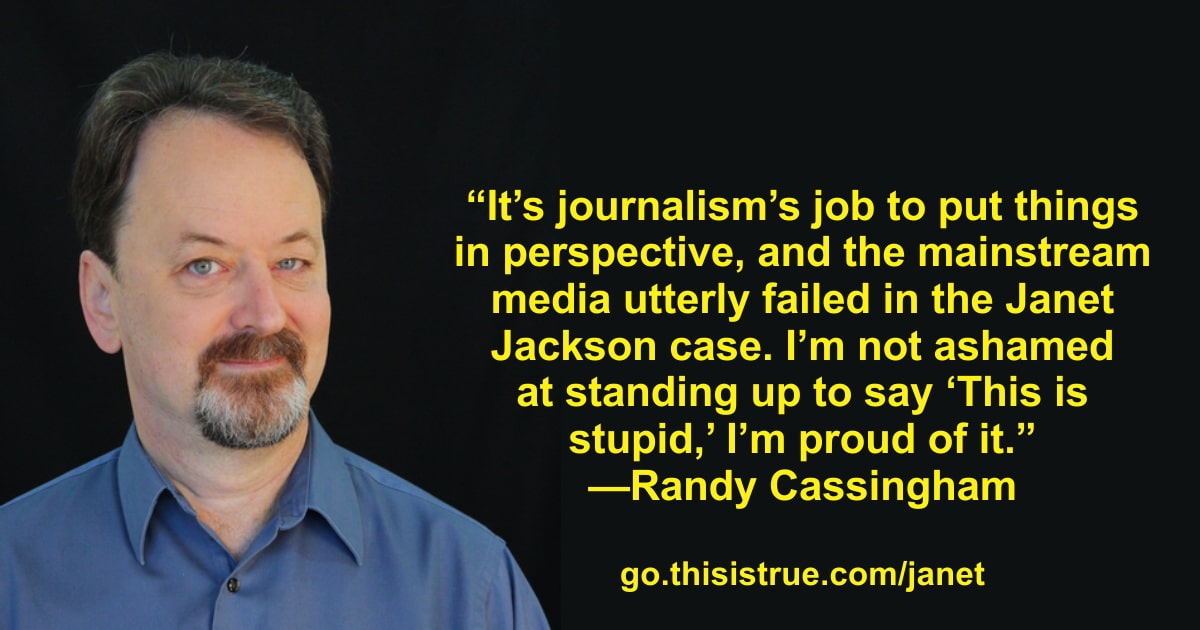
It’s journalism’s job to put things in perspective, and the mainstream media utterly failed in the Janet Jackson case. I’m not ashamed at standing up to say “This is stupid,” I’m proud of it. And if you were part of the media hysteria, which I would call “crap”, then I point the finger right back at you.
 Mainstream media pandered to hysteria, while I wanted readers who pronounced the hysteria ridiculous. And that site helped me get them.
David seems to think I should be ashamed of wanting that kind of reader. Seriously?! I absolutely do want readers to think and to be critical of groupthink, and the Jackson microsite brought me just that by the hundreds, and they’re still trickling in today.
It was a perfect example of what Paul was looking for. It was well worth the small investment of time and money, which has helped my site attract readers who think, while the media that counseled hysteria has been whacked by bankruptcy.
And David just can’t see a lesson in that. Huh.
What an Example of Not Grasping It!
David claims I’m one of those who’s “stooping ever lower to attract vicarious attention to their own twittering and fluttering,” which will lead, according to David, to “a world which is doomed.”
There’s a great word to describe David’s reaction: hysteria — the same sort that was exhibited after the Janet Jackson “wardrobe malfunction.” I’m tired of mainstream media hysteria, but David indeed does have a point, even though he wasn’t able to draw it himself: the mainstream media-led world is doomed if they keep that up. Long live the new world of the intelligent, critical consumer.
But the best part? While no one on the new “News Online” list wanted to get into the fight (and David, true to form like the first clueless guy, didn’t respond), my reply brought several new subscribers — members of the News Online list itself.
Maybe there’s a bit of hope for mainstream journalism after all.
(Note: This page originally had a link to subscribe to the mailing list, but it started dying off a short time after this, and then ground to a halt — so I’ve removed it. Gosh: a mailing list of people bitterly lamenting a dying industry? How could that not make it?!)
– – –
Bad link? Broken image? Other problem on this page? Use the Help button lower right, and thanks.
This page is an example of my style of “Thought-Provoking Entertainment”. This is True is an email newsletter that uses “weird news” as a vehicle to explore the human condition in an entertaining way. If that sounds good, click here to open a subscribe form.
To really support This is True, you’re invited to sign up for a subscription to the much-expanded “Premium” edition:
Q: Why would I want to pay more than the minimum rate?
A: To support the publication to help it thrive and stay online: this kind of support means less future need for price increases (and smaller increases when they do happen), which enables more people to upgrade. This option was requested by existing Premium subscribers.
I find this read very interesting. I worked with another internet pioneer, a guy named Fritz Nordengren. Fritz had visions in 1996 that few in the country — no, make that world — had at that time. His brainchild was a site called “Behind the Viewfinder — A Year in the Life of Photojournalism”, which took photojournalists from all over the country and allowed them to document their daily work. The site was made to educate the general public about the differences between community photojournalism and paparazzi. I was the only one in the group that moved on past the daily grind of journalism before YITL — I had opened a digital imaging and production house and was designing web sites and graphics for people who didn’t know the difference between a monitor and hard drive. I saw the response to the site and even back in 1997, it was obvious that the internet was going to become bigger and better than any newspaper could dream of doing. That vision has come true now.
I have just been doing some thinking about journalism and the changes we can all observe in the print and TV media. The changes of course have gone toward the internet. And not even so much the internet per se, but the amount of video journalism now present.
I am an active reader of written material and online material and find I can read faster than I can watch a video. But so many stories are now told online via video that it is hard to escape the prompting to click the little triangle.
This has created profound implications for the one little tool that has made so much amateur video journalism possible. The smart cell phone. By combining voice, video, and text capabilities, there are whole new possibilities for seeing news as it is or was made. The implication for dictators is not good. The cell phone may make these folks obsolete one day.
Hopefully, not all journalists or writers will go exclusively to video. The written word is precious and interesting as you are so skilled at demonstrating.
But the changes in communications via blogs, home made video, and all of the possibilities that come with the social networking sites is exciting. I am an old guy that was thrilled to find your service many years ago and have been discovering new writers and services ever since.
Keep up the good work.
The Internet did NOT ruin the printed newspaper. Newspaper publishers and striking unions ruined the printed newspaper when they stopped UNBIASED reporting as well as the pushy sales tactics that turned out to be lies. We stopped getting the paper several years ago because of double-billing and missed deliveries. Not to mention, the monumental waste of paper and, therefore, trees!
Here in Detroit, our two major newspapers merged then the joint union just walked off the job for almost a year. I can’t speak for others, but I do know that my husband and I were avid newspaper readers up to that point and we learned that we could really do without, there were so many OTHER avenues to “feed the need.” My point is that the GREED of both publishers and unions should take a major part of the blame. Same circumstances happened with Major League Baseball when they struck, it took all the fun out of the game!
TV & Cable news stations are next to go, I feel certain, because of the MOSTLY Liberal bias. The networks don’t even TRY to look at OTHER points of view and willingly insult the intelligence regularly of those who disagree with their IMAGINED authority!
You, Randy, give us the stories that make most of us go “hmmm” with a little tagline at the end of each that gives us a short “editorial” on your thoughts or to provoke thought! Which I appreciate! You don’t try to make YOUR thoughts OUR thoughts, turning us into news-zombies digesting your every thought as gospel! Thanks!
—
You’re correct, Patricia: the Internet didn’t kill (and isn’t killing) newspapers, it’s actually helping them retain readership. But you wouldn’t know that by reading newspapers! Their shrill hysteria on the subject is about as reasonable as the shrill hysteria over Janet Jackson’s “wardrobe malfunction”. Some are literally and seriously trying to make linking illegal! There’s nothing quite like a business that exists BECAUSE of the First Amendment trying to kill the First Amendment…. -rc
A problem the media has that you did not mention is their bias while claiming they are not. It has infected their news media coverage. One thing I like about you is that you will make fun of both sides. God knows they both often deserve it.
Mainstream media also continues to pander to hysteria. Look at the coverage of the death of Michael Jackson; the most recent example.
In Honolulu we have two morning papers; the Honolulu Advertiser and the Honolulu Star-Bulletin. We get both daily. It USED to be that I read the Advertiser first and spent the most time with it and then maybe 5 minutes with the Star-Bulletin. But then the Star-Bulletin switched from the typical broadsheet format to a tabloid format. I now read it first and spend about 20-30 minutes reading it. Because of the format change I read more of the stories and, surprisingly to me, more of the ads! The more convenient format has less competition for attention on each page and is more magazine-like. I now spend only 5-10 minutes with the Advertiser and would drop it altogether if my wife would allow it.
So, while content must remain the first and foremost concern, maybe a change of format that could help save the papers.
The traditional publishing business is frightened of the Internet because it can’t fit its business model into the way the Internet works. If I can get my news for ‘free’ why should I buy a paper? Answers: it isn’t free, in the UK I pay for BBC News through the TV licence fee, and the ‘free’ newspaper feeds are paid by advertising which is ultimately paid for by the consumer. And anyway they’re complementary not competitive media; I very happily buy and read printed papers as well as onine. And good old ‘True’ shows the way ahead; Internet users will happily PAY for added value!
All the best and keep up the good work.
—
The key there, of course, is added value. Papers figure they can make online users pay for commodity news — wire stories — but they are sadly mistaken. If there’s one paper that has it for free, they will end up with all the traffic. And you know there will always be at least one site giving it away for free! -rc
Or the latest hysteria… Fox “News”‘ constant stream of lies about the Britain and its health service (or in fact any country with a higher life-expectancy than the US).
At which point does a news source stop being a “news” source and start being a lobbying/propaganda organisation?
How then do you know you can trust your news source, and if you can’t trust them… what’s the point of them?
Communication has always been either one to one (verbal or later, telephone) or one to many (newspapers, radio, TV). The big difference is that it takes a lot of money to be the one who speaks to many; owning media outlets has never been inexpensive.
Until today.
Now we have many to many communications. It started with blogging, then vlogging (video blogging). Then twitter. (Witness the twitter-based communications changes with regard to Iran’s election or the school collapse in China that no censorship could effectively stop.)
I couldn’t begin to predict the changes that this will bring us, except to say that they’ll be on the kind of massive scale of change brought by the printing press or the Internet itself.
Those who cling to the old ways, whether reporters or music publishers, will die.
As a side note. What will happen to the multi-million dollar exclusive broadcast contracts for sport events when people can send high quality video from their cell phones to their twitter friends? Low quality is possible now, but that market model has a few years left in it at most. (To be followed by a few years of using the courts to try to extend its life, no doubt.)
Stay tuned. Times are certainly a’changin.
PS I just noticed the last line, “Stay tuned”. That’s an old phrase, like “Dialing a number” that has no link to current activity. I wonder how long it will last in our common vocabulary and understanding.
Fifty years ago I got a job working for a McGraw-Hill trade magazine, Electronics. I was young, had a fair background in electronics (mostly military), and had spent several years writing technical manuals which helped with my written language skills. I learned a few things–mostly from the Editor, an old written media type who had been around for a while and knew the electronics field.
I went to press conferences where flacks tried to sucker ‘us reporters’ into printing what they wanted us to print. In my travels I met a beautiful young woman who was writing for Newsweek’s Space and the Atom Column. She not only had a physics degree, but was sharp as a tack. I shamelessly took advantage of her knowledge at every opportunity I could. For example I had seen a demo of what was being worked on at the Atom Fair–Plasma Reactors. A week or so later a company held a press conference to proclaim they had succeeded. It didn’t look Kosher so I asked my friend. She said Bull Crap, they were just after some press to boost their stock prices before some stock action they wanted to perform. I didn’t then and don’t understand now what that action was. When I went back I reduced it down to a clip stating the company had announced their minor progress in the field.
The New York Times reporter–A young kid so fresh from the ivy halls of some college that he still reeked of frat parties–reported the handout they gave us, word for word, for about 10 or 12 column-inches of baloney.
On another occasion we received a press release from a California company stating they had performed some fabulous scientific deed. My Editor was suspicious. We called a stringer on the west coast and had him look into it. The major parties of the affair had disappeared into the woodwork and were not available for questions. My Editor decided it was bull excreta. One of the pulp electronics newspapers carried the full press release with headlines and a half page of copy.
I had a company rep call me and give me a story about a new microwave ILS system they had developed. It was interesting since he informed me the FAA was testing the system. I was ready to shout “Stop The Presses!” My editor brought up the facts that before it could be introduced at any airports, many many commercial aircraft would have to be equipped (at great cost) with receivers and displays for this marvelous system. As a point in fact fifty years later, it is still not in use.
There were a few people who were knowledgeable about their fields. There was a guy working for Av Week who knew everyone in the business. If he reported something you could take it to the bank. But he worked for a magazine. Most newspapers relied on young guys fresh out of school to get them information. No matter how knowledgeable the Editors were, there was no way for them to make silk purses out of the sow’s ears of information returned by these kids.
I went to a conference in Atlantic City the FAA hosted on instrument landing systems. I learned about the BRAD 25, A B-25 Mitchell Bomber that the FAA had turned into a testbed for instrument landing systems. The aim was to be able to land an airplane without the pilot helping. Hands free landings. It was progressing and a few landings had been made, but I don’t think it ever got to the point the FAA considered it practical.
I heard a Business Week Associate Editor was writing an article om the subject. I called him and told him I had just attended an FAA seminar on the subject and would he like me to come by and discuss the latest information I had. He was monumentally disinterested. His article was already in final edit, he told me, and he was happy with it as it was. When I read the article, I noticed his facts were 6 months to a year behind what I learned at the seminar I attended. I later noticed that other articles on subjects like that, on areas that I was familiar with, were often superficial and lacking in facts and information. I stopped believing in anything just because it was in print. And not too long afterward I stopped reading newspapers.
It seems to me that a lot of the controversy about how do delivery of the news in an Internet age boils down to the underlying issue of losing control. Newspapers have grown accustomed to being the only source of print news for a particular geographic area (the only alternative being one or two big city papers that may be available locally).
They are used to being able to influence opinion not just on the editorial page but also in the articles themselves. They are less frightened about having to adapt to a new system, but more afraid that they will have to give up some of their control to do so.
Now they have to compete not only with every other newspaper in the world, but bloggers, social networking, and independent niche publishers like yourself. Now they are just one voice in the crowd of ideas, not “the newspaper” for their particular area. They no longer have control.
I don’t think I’ll lose any sleep over that.
One of the problems newspapers have about Internet presentation of material rather than print editions is, of course, whether and how people will pay for it.
I have been advocating the use of micropayments for this. You want to read an article, you right click on it and agree to pay a very small fee, say 2 or 3 cents. The fees would be totaled up daily or weekly and automatically charged to your credit card account.
The argument that such a micropayment system would be impossibly complex to program and administer just doesn’t hold water. Several systems for micropayments already exist. I worked on one, decades ago at Bell Labs, the TERKS system for long distance telephone billing.
One of the interesting side benefits of this would be that newspaper editors would fairly quickly discover what readers really want to read by whether they will actually pay for it, and editorial content could be shaped by this.
There is, of course, the possibility that the same public mentality that brings an unremitting stream of sitcoms and reality shows to TV would produce newspapers catering to the lowest common denominator of taste, but I feel fairly confident that some newspapers would actually be improved by it.
I understand that the Financial Times has recently committed to such a system of micropayments for portions of its website. It will be interesting to hear how that works out in actual practice.
For Martin, London: Yes, Fox “News” is Conservatively- slanted, but I do find it odd that it’s owned and operated by one of YOUR compatriots – Rupert Murdoch – from Australia which runs a mixture of government (NHS) and private insurance-paid medical care.
Again, the STORY (as well as the health-care answer) lies somewhere in between. We, in the U.S., have to go to several news agencies just to figure out between the lines WHAT the real story IS. Sometimes we even go to Canadian or UK news sources because the REAL unadulterated news stories aren’t even being reported on here in the U.S. Where is Walter Cronkite when we need him? Or, at the very least, his school of journalism thought!
All this lament about how honorable and unbiased journalist USED to be. It never was. News is NEWS because it’s unusual. If there’s nothing unusual this day, then MAKE it unusual. And it’s always been about sensationalism. “Extry, extry, read all about it…!”
“You provide the pictures; I’LL provide the war!” ~ William Randolph Hearst, prior to the Spanish-American War, 1898
It’s about people with an agenda, whether left or right, and a platform to exploit that agenda. With enough recognition, their names become icons and they start believing that they have a Divine Mandate to continue their agenda. As in any profession, there is a tiny minority that is exceptional in their dedication and accomplishment, while the majority struggle to ascend into the quagmire of mediocrity, IF they’re successful.
So some pompous windbag criticizes your success while defending his failure, and righteously asserting that his [professional] death is preferable to your ignominy. The world changes, and those who refuse to adapt to the evolution will become extinct.
Kind of like the buggy whip manufacturers lamenting about the way that the advent of the automobile killed their business.
—
To be sure, I wasn’t saying journalists used to be “honorable and unbiased” (though there certainly have been a lot of honorable journalists. Unbiased? I’m less sure of that!) Murdoch, who is neither, at least grasped the importance of the Internet, even if he bet wrong (way overpaying for MySpace), while so many of his peers have been running around screaming “The sky is falling!” -rc
I began my writing career many years ago for an “alternative” newspaper — one of those street rack rags with pretty girls on the cover and political rants within — so I’m still emotionally drawn to print. I recently subscribed to my twice-weekly small town paper for $12 a year — my favorite parts are the police and fire calls, and the occasional story about a local resident. It’s important to be in the know should we have an epidemic of transients peeing in the streets, right?
Newsprint has wonderful secondary uses for which the computer is useless — wrapping the fish and chips or blotting the bacon grease. And, since I don’t yet have a laptop, newspapers make great entertainment in certain “closed door” circumstances…
But to be serious for a moment, it’s easy to forget that not everyone, even in America, has unlimited access to computers. We still need less expensive, more available forms of media. And even if their primary function is to distribute the weekly grocery circulars and car wash coupons, newspapers will be around at least a bit longer…
Good thing the breakaway piece didn’t snag on the, um, decoration. It looked like Justin used substantial force to assure a successful wardrobe malfunction.
—
It wasn’t until I read the second sentence that I realized the first sentence was referring to Janet Jackson. Good thing I read fast, or I would have been confused there! 😉 -rc
What passes for news these days on the telly is disheartening.
End of rant.
Newspapers should have gone to an online subscription method right off the bat. The Wall Street Journal did it years ago. My paper recycling stream has shrunk considerably. Furthermore, I can read the items online that interest me without having to look through stuff that I am not interested in. They email me links to my custom Journal everyday. I also have access to sister pubs like Barron’s.I grew up with the LA Times and would pay for online access if it would keep it from sliding further into the morass that Sam Zell created.
Print media has historically provided coverage of the Emperor’s wardrobe. We need it now more than ever.
According to dictionary.com, the definition of “capatalistic” is:
-adjective
pertaining to capital or capitalists; founded on or believing in capitalism: a capitalistic system.
And a capitalist is an advocate of capitalism, which is:
-noun
An economic and political system characterized by a free market for goods and services and private control of production and consumption.
I guess the French don’t see capitalism in the same light that many Americans do. But surely if David is a journalist, this can’t be the first example of American Capitalism that he has seen! Has he never had a sip of Coca-Cola? Has he never worn a designer blue jean?
Surely, David at least understands what a blog is (you quote the message he left in a blog). I would say that a blog is a fine example of capitalism – you can’t possibly make significant money with a free service, unless you’re very good at giving somebody what they want.
If David is trying to convince people outside of france that capitalism is a bad idea, he’s going to have to do a lot better than “[the] world … is doomed.”
There is one thing that traditional newspapers did for us, and indeed, the planet, which was to introduce plantations of trees specifically for use in paper.
So, to find this; “Not to mention, the monumental waste of paper and, therefore, trees!” within the comments was sad.
When will people get it that newspapers do not destroy our planet’s trees?
I used to be an avid newspaper reader, loyal to my hometown paper the Detroit Free Press or the Freep as we affectionately called it. I am an old newsboy and I picked up the habit of reading the paper as I always had one extra in my bag “just in case”. Most of the time that paper was not needed for the customers. So I read it.
Then in the 90s came the week of soap opera above the fold. I realized I was reading nothing but the comics and the feature page. The paper I used to read everything of but the want ads had become trash. This was well before the Internet was factor. I canceled the paper that week and have hardly touched one since. When I do I can finish a paper in 10 minutes, there is that little to read.
When the Internet posts the obit of the print paper business I wish it to record that the cause of death was suicide brought on by a constant diet of hysteria and worthless tripe, aggravated by an unwillingness to adapt as the future ran them down. It will be sad, but hardly unexpected.
Robert, Australia: Why would we need “plantations of trees specifically for use in paper” if forests of trees were not cut down to produce paper for newspapers that were printed for multiple publishers per world-wide cities for millions of people populating those cities reading at LEAST one newspaper per day?
It IS a monumental waste of paper for a temporary pleasure that is thrown away (MAYBE recycled) after one reading. And, therefore, a waste of the usually maturing trees cut down for pulp! I’m sorry but I, personally, believe that the resource is better used in oxygen and necessary building wood until a better alternative can be made cheaply for such needs.
With the internet, if you need a printed copy of an article you can print it yourself or purchase one to be sent you. Otherwise, you can READ the majority of a publishing AND save trees on those plantations you spoke of to mature and help us BREATHE.
—
The point Robert made is that trees are specifically planted in order to be used for paper, and therefore it’s not old-growth forest that is being cut to make paper. That is clear enough that I don’t understand why you’re not grasping the point. -rc
There are some other points that I haven’t seen anyone address. First, why should I subscribe to a print newspaper whose “news” is at least 10 hours old before I receive it when I can read up to the second news online? Second, one person posted a comment about FOX News commenting on British healthcare. I read FOX News, but I also read Reuters, BBC News, ABC News, MSNBC, etc. I can get a much more balanced overall appreciation of an event or item of interest online by reading all the differing reports. My “hometown” newspaper carries one version of events and I used to have to base my opinion of the world on that source. Third, my “hometown” newspaper stopped delivering to me when I moved 1/4 mile off their nearest route. They say that it is much too costly to make this delivery. I say “hometown” newspaper because that is the closest actual print newspaper from a large town. We have a local four page paper that prints local news, mostly advertisements and obituaries. I still get my “hometown” paper – online – for free. I get to read the area news which is about all I’m still interested in reading from their paper anyway.
I wholly agree with fellow Metro-Detroiter, Garry from Dearborn, as I too have given up on the printed press for the same reasons.
Unfortunately, the local news online is, I think, worse. The Detroit News and WDIV have teamed up to create Click On Detroit.com as an example.
To reduce overhead, it appears that they’ve contracted with Miss Peabodies third grade creative writing class, as is exhibited by spelling errors, horrible grammar, lack of punctuation, and garbled words.
I do however have to give them credit for instantly updating stories as the news develops.
An example would be:
Aug 10, 2009 9:30 AM
“Mr. Jones, while crossing the street with his children was struck by a vehicle and everyone is fine.”
Aug 10, 2009 1:15 PM
“It appears that Mr. Jones was seriously injured after all, and is now at Bob’s Memorial Hospital in intensive care.
Mr. Jones, while crossing the street with his children was struck by a vehicle and everyone is fine.”
Aug 10, 2009 9:35 PM
“Mr. Jones died today at Bob’s Memorial Hospital from injuries sustained in a hit and run accident on Aug 10.
It appears that Mr. Jones was seriously injured after all, and is now at Bob’s Memorial Hospital in intensive care.
Mr. Jones, while crossing the street with his children was struck by a vehicle and everyone is fine.”
So the news of the day of course is that Mr. Jones died in a car accident, was resurrected but in serious condition, then was hit by a car while in the hospital and now he’s Ok!
Can I have a Halleluiah?
Can I have an Amen?
Can I have a Copy and Paste Artiste?
“Plus ca change, plus c’est la meme chose”
Jean-Baptiste Alphonse Karr
(The more things change, the more they stay the same)
I didn’t go through all the comments I like, Allan, Rancho Cucamonga, wouldn’t it be great if everyone could realize the truth of capitalism…but then everyone would have to earn their own living.
Robert, Australia, didn’t think. If the trees are planted just for newspapers, what does it matter if they are cut down? As long as we don’t cut into the rest we should be ok.
Garry, Dearborn, MI, makes a point I’ve noticed as well, most newspapers don’t cover “news” first. I’ve also noticed “reporters” like to add their own opinions. Or (worse yet) they slant the stories to make a point, to their particular ideals.
Randy said he was surprised at the response to this blog. I’m not, those points above make a point in as to what “I” think is wrong with “newspapers”. Everyone wants to throw in their two cents worth…even me ;-). The newspapers shouldn’t do that though (keep all that on the editorial page). When they do that (in articles) they start catering to a group, which in fact will reduce their client base. I know (Randy has raised the point time and again) some people will see bigotry in most anything. But I still feel the majority would be more likely to pick up the local paper if they knew they would only receive the facts. And if they felt those facts were balanced and fairly reported.
Have you ever seen a news sheet from 100 years ago? They put 10 or twenty articles on two sides of a piece of paper. The articles weren’t embellished to the point of entertainment, and they came across as just statements. I think they need to get back to that.
I really think that most of the news-papers of this country are having such a hard time is that they are so biased in what they print, and all of there opinions, op-ed columns are so slanted, and they just in general do not tell the truth when doing any stories. In general they LIE a whole lot to make there case, and to make the general public try, and look like they have to depend on them the local rag-paper for all of there news. When now it turns out that the internet has proven to be a greater tool to find, and to get your news from. Take this past yrs. election for the Presidency, and you will see what I am saying to be completely true.
I have never bought a newspaper. I get local ones free based upon the advertising that are deposited in a pickup box by my mailbox and only read the ads for places I patronize or that attract my attention ( few and far between).
My dad had an experience years back where he submitted a tightly edited article at the request of a newspaper. Being a perfectionist and an engineer, he made it concise and factual with all the relevant and no extraneous facts involved. Unfortunately some editor cut out a few words in the article and it then made no sense whatsoever and since then my dad never submitted an item to any paper. They made him look like an idiot who didn’t know what he was saying.
Since that time, I have observed many news items that suffered the same lack of consideration and knowledge. I do acknowledge that some may have been misprints and typos, but many were statements that clearly had been edited and the missing words were vital to having proper context for the article. I admire and respect many reporters and news people on the TV and papers, but there are far too many who do not follow up on articles or research or consult with the author of a piece before editing.
Another thing that bugs me about news reporting is that there are often things sensationalized in the news that are wrong and never corrected and also there are news articles that clearly require following articles to show the resolution of something that happened and there is never any information to say what happened to such and such a person or item that was previously reported on. This lack of respect for the subjects of the news articles has made me feel the reporters, editors, and owners of the papers are not worthy of my support.
To Mr. Whetstone from Baltimore,
An interesting name for an electronics guy…
I am in the aviation trade for 5+ years as an aircraft maintenance technician and my experience regarding journalism in this field never changes: it’s horrible.
All professions where there are relatively few people with profound knowledge (health in general, aerospace, engineering, etc…), not much general information (or at least easily understandable) and a high scare factor are usually mishandled by mass media. After all these years I’m still learning (as anyone should), so how can a journalist grasp a single concept (single, not simple) in the timespan of a goldfish and produce something credible/readable. It simply isn’t possible. There is a lack of specialisation that leads to misinformation and even some of the so called “experts” are not what they seem. Going back to the item of “online information”: This new medium allows true professionals from said areas to write truthful, unbiased articles as opposed to the usual dribble we get from large, unspecialised companies.
It’s interesting to find others who reached the same conclusion I did in the ’80s and ’90s – that by and large the “news” is gone from “newspapers”. After reading everything I could find from Time and Newsweek to Foreign Affairs Quarterly, I ended up with only two subscriptions – The Economist and Science News. I get The New York Times headlines by email, to keep up on any burning issues, and to read a few columns. But I gave up television news 30 years ago, and printed newspapers (and my TV) 15 years ago – the signal-to-noise ratio was just too low.
As far as I’m concerned, newspapers are already dead. I’m sure there are a few which haven’t evolved into entertainment, propaganda and advertising vehicles, but there are still three problems:
1. Content is influenced by advertising. Advertising is the revenue source, and there’s documented evidence of stories being watered down, or issues not covered, because it would estrange advertisers, which could threaten the existence of the organization. Thus issues which should be covered, like the runup to the financial crisis, are almost completely absent from the vehicles we rely on to keep us “informed”.
2. Chaff. You have to publish a newspaper whether there’s news or not. Most of what’s published is either trivial or monumentally uninteresting. What I want is what I get from the emailed headlines – a list of the three top stories/columns in each category, which I can read if I find them interesting, by clicking on them – and ways to drill down for related stories or more detail if I want to pursue it.
3. Geography. The evolution of newspapers has depended on “local” advertisers and readers. Even The New York Times, which is a widely distributed newspaper, has to have a large segment of New York State news. The Boston Globe has multiple editions for various suburban regions, with topical inserts. Why would this model translate to electronic media, where your content is equally available to Indonesia and Flushing? Who is your constituency then? Who should advertise, and what should they advertise? Who will they reach? The playing field is completely different, and the field is already over-saturated. What is a “newspaper” in the electronic world?
With all due respect, Randy, I think your model is fine for micro-enterprises which are desperately trying to break through the massive noise on the internet, and identify and attract a particular type of reader wherever (s)he may be geographically. But I can’t see how it is remotely relevant to an established entity like The Washington Post which is trying to figure out what to evolve to to both live up to its brand and avoid dissolution.
I’m eminently willing to pay for news, but it has to be real news – relevant, timely, properly researched, and in depth. Unfortunately for the industry, that wipes out most of the candidates.
—
Yes, it does. But some of the problems you relate are solvable. For instance, local advertising. It’s reasonably easy to present you with local ads no matter whether you’re in Flushing or Fiji — if you do geolocation by IP address. Newspapers can adapt, but most simply haven’t, in large part because they don’t have the vision to do so. Which, of course, is the point of this essay…. -rc
I’m a bit surprised you talked about the future of newspapers without touching on the “paywall” issue that is the current subject of media “hysteria”: whether or not and how to charge people for access to their news website, and how to make money if they do not. With paper subscriptions dropping, and their big classified ad revenue source under siege from Craigslist, one wonders just how this is going to play out.
—
I can’t be exhaustive in a brief essay, but in my experience, what’s behind the “paywall” at most newspapers is… AP articles. The exact same commodity item available at hundreds, sometimes thousands, of other sites. When I hit the wall, I simply go elsewhere — and virtually always find what I’m looking for. The New York Times, for one, gave up on the idea, even though the majority of their stuff is staff written. They discovered few were willing to pay $2.95 per article, but opening up the articles brought in more revenue via advertising. Go figure! -rc
My home town of Rochester, N.Y. local paper the “Democrat & Chronicle” is failing we ended our subscription a year ago. Since then we have been asked numerous times to re-up. The sad part is that the journalists (if they have any left) seem to be still in Jr high. There is no depth in the articles which have been a few days old at best. Also there seems to be an alternative agenda going on. What has happened to the 5 W’s and the inverted pyramid? I understand that the world has changed yet alas poor Ulrich “core Values” haven’t we still read books & news prints. Yet when the writing staff just edits through a spellchecker and write to a 3rd grade level (don’t get me wrong I do like the larger print) 4 sections nary 300 words; they news paper is thinner then before and 3x the cost. There is more meat and potatoes in “This is True” — far more interesting and entertaining too!
Randy: I did indeed grasp Robert’s point. My point is that today’s newpapers are not worth the paper they are written on. Which is why I wrote before that it was a monumental waste.
A few years ago, I worked at an auto company that wished to promote a paperless system with the advent of more technology (computers and data storage). The result was just more work because, although the data storage was used, you still needed the BACK-UP of hard-copy in case the data storage failed. In the end, there was, in fact, still no paperless system of note.
Again, this is just my personal opinion. If a news article interests me, I go looking for several news outlets online so I can, hopefully, remove the bias and read between the lines.
I totally agree about media hysteria. Here in Australia for two weeks we’ve had a case (I’m not even sure if it’s finished yet, it still seems to pop up from time to time) where a radio breakfast show stunt went totally wrong.
They had this segment called The Lie Detector where they had a person strapped to a lie detector and a friend or relative would ask questions to find the truth about something. Usually it was couples who wanted to find out if their partners were cheating, but this time it was a mother who had an out of control 14 yr old daughter, that had snuck out of the house and had been brought home at 2am by police, so she wanted to know what her daughter had been doing, and the mother asked her daughter if she had had sex and the daughter responded that she had been raped when she was twelve.
Now I had actually heard the stunt live on air when it happened, and I heard the stunned silence, nobody knew what to do and the male host (and I understand his actions being in media myself) went back to basic interview technique of “getting back to the question” so to speak and said “and was that the only time?” Immediately everyone came back to their senses and the female host shut the stunt down.
Now yes admittedly the question the male host asked was stupid but it was an honest mistake, a reflex motion, but the media took it and turned into some sort of story about these two malicious hosts taking advantage of a young girl and emotionally torturing her. It became completely sensationalised and the media was starting rumours that it was fake or that the host knew about the rape beforehand and wanted more ratings and it was all based on that one question the male host had ask which was a stupid mistake but the media had turned it into some sort of premeditated attack.
And to me it was really tragic because here was a girl who had brought to light a fundamental flaw in the system where this mother had be given no place to turn to, to help her deal with her daughter being a rape victim (the mother admitted she knew of the rape but didn’t tell the radio show and it didn’t come up in the evaluation). The daughter had refused counselling (though after the incident she accepted the offered counsel service) but the mother had been given no counsel or support as to how she could help her daughter and had to resort to a radio stunt because the government had provided no services to the parents of rape victims, but instead the media ran with hysteria, and soon it became a hypocritical argument were the media was demanding why a 14yr old girl was being asked about sex when a government funded TV channel (in Australia we have two government funded channels, one fully funded one half funded) got a bunch of 13 yr old kids and asked them about sex, drugs and alcohol. It was just so overblown and stupid and I’m glad it’s finally dying down. It was just a tragic situation, seeing all the media following the same repeated line; it was a waste of airtime, print and even digital media. There wasn’t even a debate about the incident it was all one line of thinking and to me it there is something very “Doomed” about media when the debating is gone and everyone falls in line like a row of dominos.
Patricia wrote: “My point is that today’s newspapers are not worth the paper they are written on.”
The problem is that the whole industry is focused on the “paper” instead of the “news”. They need to stop trying to protect the printing presses, and instead figure out how to evaluate journalistic “authority” in the online world.
I contend the primary reason for the decline of newspaper writing is the “Journalism Major”. Reporters don’t know anything anymore – no history, literature, geography, biography, economics, science, math or current events. They can’t absorb and think about what they see and are told, put it in context, understand how or if it makes sense and then formulate questions.
The answers to questions help clarify the issues and promote clarity in reporting.
The statement “This change will not raise taxes for the majority of Americans” is not the same as “This change will not raise taxes for the majority of taxpayers.” I believe it’s a reporter’s job to point this out – otherwise the press release runs and the newspaper is an extension of the political public relations unit.
Of course, the public is also to blame because the average person doesn’t want read more than two or three paragraphs about anything. Instant gratification dominates.
This could lead to a discussion of fulfilling a customer desire versus boring the reader but in the past the papers were able to get the cogent points in the first three paragraphs and flesh out the story in the rest of the piece.
Now more space is given to the results of a reality TV show then the rampant AIDS epidemic in Africa.