
When discussing the Three Gorges Dam project, the Chinese guides loved to spout numbers. (27.15 million cubic meters of cement. 281,000 tons of metal structures plus 354,000 tons of reinforcing bars. 365 townships in Sichuan and Hubei provinces have been or will be inundated — a total of 632 sq. km. Etc.) What I found more interesting was the human factor.
Three Big Goals
Historically, floods on the Yantze River have been severe: one in 1911 killed about 100,000 people, and that wasn’t even the worst. In 1931, 145,000 were killed, and just four years later 142,000 more died in flooding. The 1954 flood wasn’t as bad, with “just” 33,000 killed, including those who died of the plague that followed the flood.
By the 1998 flood, technology saved many lives: only 3,000 were killed — but 14 million were left homeless. The country suffered through a $24 billion loss in damage and disrupted economic activity from the 1998 flood alone. There is little surprise, then, that China was willing to spend $22.5 billion on the damming project in an effort to control flooding, the first main goal of the dam project.
Then there’s the hydroelectric power potential, which was the second main goal. When it’s fully completed in 2009 and the reservoir is filled, the dam will produce about 40 percent of China’s electric power needs* from its 22,500 MW power generation facility, coming from 32 generators.
That will be awfully nice, since that will reduce China’s coal burning by 31 million tons per year. In North America we still burn coal, but we’ve spent plenty on making it burn cleaner. Not so in China; you recall my talking about the smog in Hong Kong? It comes from Mainland China’s manufacturing and power-generation plants, like this one along the Yangtze — one of many we saw just like it:
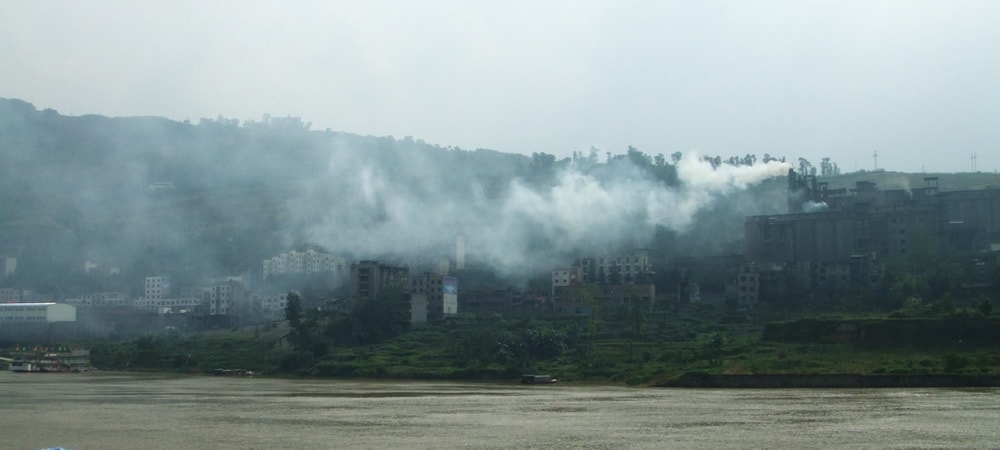
The buildings to the left are high-rise apartments. We went through that smoke cloud, and I could smell the sulfur in it. It’s not just coal, it’s low-quality, high-sulfur coal — the most polluting kind. How would you like your bedroom window to face that stack?!
The third main goal of the dam project was to improve river navigation. We certainly benefited from that; the ride was very smooth.
Big Goals: Big Changes
To make room for the project, 1.2 million people have been relocated by the government. Whole cities were moved.
But I’m sure what everyone wants to know is, now that the dam has raised the water level in the Three Gorges area, is the scenery ruined?
Well, so far the water has risen by (if my research is correct) 81 meters (265 feet), and the next (and final) phase will raise it about 19 meters (62 feet) more. Rounded, that’s 100 meters total, or 328 feet, of water rise (at the dam site; the rise will of course be less upstream, where the gorges are).
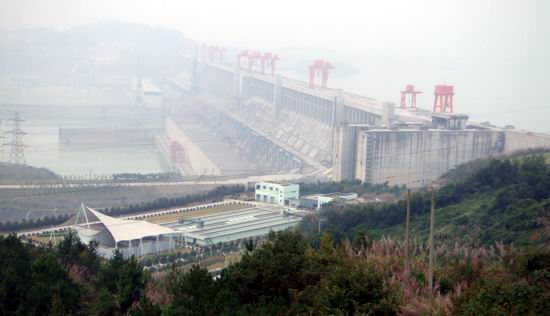
I didn’t see the gorges pre-dam; I can only report what I saw on this trip: the scenery is breathtaking. So the answer is, the dam isn’t hurting the view — the smog is. Here’s my view from the dam facility itself:
The Dam Itself: High Security?
Getting to the dam facility was a humorous endeavor. After we went through the locks, the ship docked and we got on a bus to go to the tourist center. Security was fairly tight — there were plenty of guards, and their visibility was high:
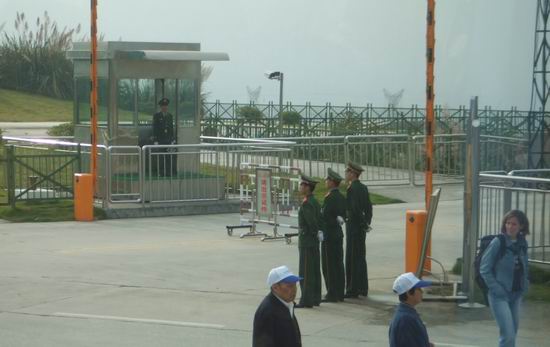
Before we could get anywhere near the dam, however, we were told we had to go through security screening. We were all taken off the bus and filed into the screening area. Any backpacks, handbags, etc. were run through an x-ray machine (like at an airport), and then we were all marched through a metal detector (like at an airport).
And while every single person set the metal detector off, not one was checked to see why! That’s right: the mandate seems to have been “everyone must go through a metal detector” rather than “everyone must be checked to ensure they don’t have a weapon.” So much for tight security. We then reboarded our bus (the same bus, where I could have left my grenade launcher in my seat) and headed in to the facility.
You’ve already seen the best photo I could take of the dam through the smog haze. To really get a view of the scale of the project, they had a very nice model:
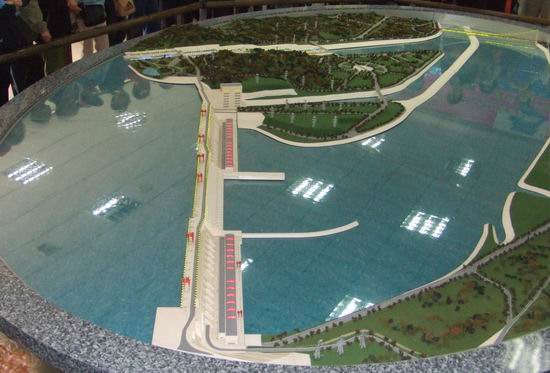
To the left is upstream — the newly created reservoir. At the far end of this model are the locks, where ships pass through five stages to get past; access or exit is via the upper channel, under the bridge at the right.
See the other channel, on the close side of the big “island”? There’s what looks like a building right up against the dam. That’s an elevator for smaller ships that are in a hurry (and can pay for the privilege): they steam into the building, the door is closed, and the elevator lifts or lowers them and their water to the top or bottom, and then they can continue on after just one lifting, rather than wait for the five-stage lock process. Wild!
Then there’s the major structure of the dam itself; the red lights indicate the power generation turbines. (The lights don’t add up to 32; there are 12 generators on the near side, 14 on the far side, and six in an underground facility south of the dam.)
Dam(n)ed if You Do, Dam(n)ed if You Don’t
A dam is either an environmental disaster that destroys scenic beauty and disrupts fish migration, or it’s an environmental godsend that allows for flood control and the generation of clean power. My take: there are more pros here than cons. Anything that keeps 31 million tons of low-quality coal from being burned every year is a great thing.
On the other hand, only time will tell. The Economist has a new article, The Three Gorges: One Dam Thing after Another, that talks about geologic stability problems upstream.
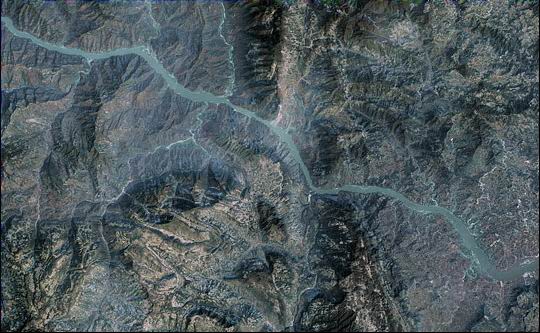
I’ll finish with before (17 April 1987) and after (7 November 2006 — and note the water level is not all the way to the top yet) satellite imagery. Throughout my trip I wondered what the difference was on a macro scale, and I never saw anything like this photo pair in China. But once home, I found them easily — taken by U.S. spy satellites:

All in all, the Three Gorges Dam is an astounding feat of engineering. I hope I never hear that it has failed.
– – –
Bad link? Broken image? Other problem on this page? Let Me Know, and thanks.
This page is an example of Randy Cassingham’s style of “Thought-Provoking Entertainment”. His This is True is an email newsletter that uses “weird news” as a vehicle to explore the human condition in an entertaining way. If that sounds good, click here to open a subscribe form.
To really support This is True, you’re invited to sign up for a subscription to the much-expanded Premium edition.
I found the Falkirk Wheel in Scotland quite interesting. Have a look:
http://www.undiscoveredscotland.co.uk/falkirk/falkirkwheel/index.html
There’s actually a video of it in operation somewhere.
—
Dylan is referring to a different kind of boat elevator currently in use in Scotland. That page notes that “Boat lifts are nothing new, though the last built in the UK was in 1875.” -rc
So, that’s one gorgeous dam, but what about the other two? Aren’t they just as pretty?
Sorry, forget it, I just couldn’t pass it up. Sorta like that river running through Tennessee and North Carolina. It’s called the French Broad River. Now I’m sure that it’s a high honor to name a river after the French Broad, but don’t you think they could have used her name?
—
Maybe they never caught it.
We did pass through the smaller, older (and downstream of the Three Gorges Dam), Gezhouba Dam too, but I was busy doing something else and didn’t see it. -rc
We went through the three gorges in 1996 when the dam construction was just underway but water had not yet started to rise, and we could cruise right past the dam without locks. The gorges were indeed spectacular, and there were marks on the canyon walls which indicated where the water would eventually rise to. It seemed very high.
The pollution then was not so bad. We visited China most recently in 2006 when the pollution was terrible. It was impossible to take good pictures anywhere. Fortunately I was able to rescue most of them using Photoshop to get rid of 90% of the haze.
Are you sure that someone wasn’t viewing images of the metal found by the detector? Sometimes this person is off-site, and signals when an image is suspicious.
—
Yes, I’m sure. It was a simple walk-through metal detector, not an x-ray machine. -rc
That bit about the security seems funny at first, but if someone were able to get enough explosives to blow up even part of the dam (not that it would be easy or even possible, but still), the resulting flooding could kill tens or even hundreds of thousands of people.
—
Part of my point indeed. If they actually need security, then they should practice it correctly. -rc
The lock elevator seems similar to the lift lock at Peterborough, Ontario, Canada on the Trent-Severne River system.
We did the same trip in Nov. 2005. We didn’t have the same experience at the dam at all, however. Our bus drove right up to the visitors center, no security, we didn’t see any guards anywhere. And though it was an overcast day, sprinkling rain at times, we got relatively good pictures of the dam.
Why would anyone think that the Chinese could get security right? Heck, they can’t even figure out that lead is dangerous to humans.
Contrary to what the article states, according to the Wikipedia article that it refers to, the dam won’t produce 40% of China’s electricity needs, but only 3%, which seems a more realistic number, seeing China’s enormous population and energy needs. I guess most of the rest will still come from air-polluting coal burning power plants.
—
I distinctly remember the 40% figure, but perhaps it’s 40% of the needs in the local province, not the country. Sorry for any confusion. -rc
I still remember when the Glen Canyon dam was built on the Colorado River upstream from the Grand Canyon. The Sierra Club has a beautiful book describing the lost scenery in the canyons.
For a while it is true that Lake Powell allowed my friends and others to boat to places that were pretty much inaccessable before. Win one lose one, I suppose.
But now the lake has become silted up and is receding dramatically. By the time it completely dries up, the blight on the land will be inexcusable.
Thanks for this write-up, Randy. I have always had a negative perception of this dam, even before I went on the Three Gorges tour back in the early 90s. This is the first time I’ve seen a positive treatment of the topic from a non-Communist-Government source.
—
To be sure, there are negatives in the project, as I alluded to. It remains to be seen whether the predicted long-term consequences come true. But in the meantime, anything that helps China get a handle on their terrible air pollution needs to be considered carefully. -rc
i am actually doing a persuasive essay on this topic, as my social studies class is covering china as a unit. i must say that i completely disagree with the decision to build such a dam on that large of a scale. archeological sites will dissappear, 13 cities, 140 towns, and hundreds of villages will be flooded, tens of thousands of acres of farmland and forrestland will be lost, and plant and animal habitats will be lost. oh and not to mention, the dam sits on an earthquake fault, which means any tectonic activity could break it and cause a flood worst than any other in the history if the Yangtze. yep, only those drawbacks. my advise for the chinese? rethink this decision.
I spent some time in Israel, and there they have metal detectors in a lot of buildings. Those detectors go off almost every time someone walks through and the guards rarely stop people. I was talking to a security guard and he told me that the detector has lights on it that tell where on the person’s body the metal is located and the approximate size of the object and based on these two things the guards decide whether to pull the person aside.
To Claire, who says the Chinese should “rethink this decision” to build the dam, isn’t it a bit late for that? What would you have them do, the dam is almost fully built and the water has already risen more than 81 meters. At this point to try to get rid of the dam would be just as bad, if not worse, than leaving it up. Whether we think the dam is a good idea or not, it is here, so live with it.
—
Even if that was true about metal detectors (I’m a bit dubious), there was no one watching it to make such a determination, and certainly none of us were pulled out of line for a check. -rc
At the security checkpoint did you know, were you told, that you would be returning directly to the same bus? and could have left materials onboard the bus?
—
It’s been awhile, but my recollection is that we were told to bring “all” of our stuff, but we knew we’d be getting back on the same bus. -rc