
This week I’ve been dragging after a tough weekend. “Just” two ambulance calls, but they were doozies. I was just starting to make a late breakfast Saturday morning when we got a call for a rollover just 3 miles down the road.
Three guys in their 20s, going WAY too fast on a dirt road, rolled up an embankment, through a barbed wire fence, and managed to land the pickup truck on its wheels — a good 20 feet from the road, and 5 feet above it.
With three people in the truck (one ejected half-way out the rear window, multiple witnesses, and lots of people who were driving by who stopped to help, the scene was chaos!
But We had Special Help
I was pretty sure the driver had a broken neck, so we had to handle him pretty gingerly. A neighbor who happens to be a surgeon was one who stopped to help, and he was worried about the neck too. (Luckily, the driver’s dad called me that evening to say no, “just” severe whiplash.)
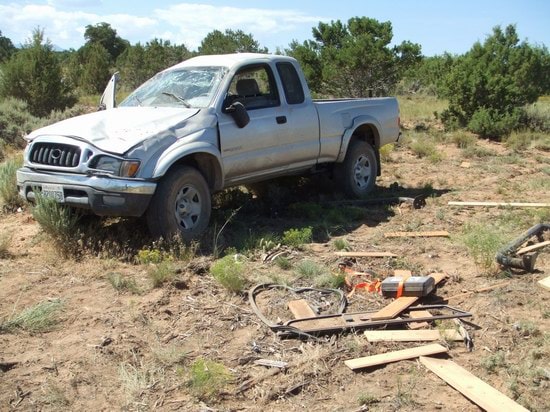
I was plenty hungry by the time we got back home, and happily I managed to get a nice breakfast before the pager went off again.
Then It Gets Worse
The second call was a bit farther out than my regular response territory, but I knew our other ambulance was out on their own rollover (that one an ATV up in the mountains), and it came out as “multiple motorcycles down, multiple injuries” on the highway.
I tend to respond farther out if it sounds like a big hairy scene where they’ll need more help, and this one was it …especially when the update came out: “CPR in progress.”
Pretty much, if someone’s heart has stopped because of a traumatic accident, nothing ever gets it started again. But clearly there were other injured parties that needed care. The ambulance that had been on our rollover was the only other in-service unit: it was still on its way back, but was at least fairly close to the wreck by the time the call came out. We rolled, even though we were 15 minutes away.
Another Chaotic Scene
Kit and I helped the ambulance crew get two other injured bikers loaded up and on their way, and then we turned to assist our short-staffed sheriff’s department with the mess on the highway — which included a body: one of the bikers, the one a bystander did CPR on, had been declared dead.
One of the first things I noticed in the “mess” — the clutter on the side of the road — was a revolver: the dead guy was a retired state trooper. The first responding trooper walked up right then, and I got his attention, pointed out the pistol, and asked him to secure it.
In this tiny county, many of the volunteers wear more than one hat; it’s why I stayed around after the medical emergency was done. And one of our senior medics is also a deputy coroner. He went to his truck and put on a different vest, removing “EMS” and switching to one reading “CORONER”, and went back to work.
There’s More to Do
As I was kept busy being a “go-fer” for the other responders, Kit was busy too: the killed trooper’s wife was sitting on the side of the road. She had been on her own bike, and had seen it all happen. She wasn’t physically injured, but she still needed plenty of care.
To get her off the road, where she couldn’t help but see her husband’s sheet-draped body, I turned my SUV around so it wasn’t facing the scene, and Kit, the wife, and a happened-to-be-passing-by mental health worker got in the back seat to get away from the chaos and help her. I’m grateful that Kit can handle such emotional stuff: I’m fine with the physical injuries, but don’t feel very useful in the midst of extreme emotional injury.
It took nearly an hour for the coroner to finish his work, and then Kit and I helped him, too: we needed to get the body into a body bag. It’s a tough job, let me tell you — especially after a nasty wreck. He had been wearing a helmet and such, but it was clear that indeed, there’s no way he could have survived the crash, CPR and quick medical help or not.
He had been going too fast to stop when cars stopped in front of him to turn. He skidded, and then rolled his bike over in front of oncoming traffic. That traffic happened to be several other bikes; he took one out, and then a second bike ran over the guy in front of him. Ouch!
Those two bikers were the ones that ended up on the ambulance; the one who was run over was in fairly serious condition with multiple fractures in both legs.
(Note I’m not telling any secret medical info here: those details were reported in various newspapers. The most complete story is from the trooper’s home town paper — but I’ve deleted the link since it aged off the web.)
“Icky!”
I know what a lot of you are thinking: “Ugh! I couldn’t do that, and I’m glad there are people that can!” I know the feeling: I felt it when I saw what Kit was doing with the new widow. She and the mental health worker were relieved by a local minister, who volunteers to help the families of victims on nasty ambulance calls. I’m really grateful that there are people like him to help, too! He took her to the funeral home in the next town, where her husband’s body went, to wait for family members to get there and be with her.
By the time we were released nearly four hours later, we were exhausted. The troopers were still there for another two hours; they had a tough weekend too. (They asked for permission to load the victim’s body in the hearse, since the guy was a retired trooper; that request was granted.)
I still managed to write this week’s column the next day, but I worked shorter days than usual to get some extra sleep to recuperate. Because I used to do it myself, I know two calls, even “big” calls, isn’t a big deal for big city ambulance crews, but I also work 60-70 hours/week for my “day job,” so it pushed me over the limit. I’m glad that happens pretty rarely.
There are no big lessons to be learned from this; I just figured some people would be interested in some of the demands on volunteers in America’s rural communities.
But hey: drive carefully, will you? Trust me: wrecks are no fun.
– – –
Kit was so intrigued by the coroner’s job that when the deputy retired, she took his position. And he handed her that same vest.
– – –
Bad link? Broken image? Other problem on this page? Use the Help button lower right, and thanks.
This page is an example of my style of “Thought-Provoking Entertainment”. This is True is an email newsletter that uses “weird news” as a vehicle to explore the human condition in an entertaining way. If that sounds good, click here to open a subscribe form.
To really support This is True, you’re invited to sign up for a subscription to the much-expanded “Premium” edition:
Q: Why would I want to pay more than the minimum rate?
A: To support the publication to help it thrive and stay online: this kind of support means less future need for price increases (and smaller increases when they do happen), which enables more people to upgrade. This option was requested by existing Premium subscribers.
Wow!! That would be a rough weekend for anyone!
And thank you for volunteering. I live in a rural county too and volunteers make a big difference.
I’ve been a subscriber for years and I’ve read about your other jobs, especially this one, for what seems like forever. It does indeed take a special kind of person to go out and do something like this. My aunt, uncle, Dad and a cousin were all, at several points in time, part of the EMS system in their home county, not just the Ambulance Squad but the Rescue Squad and Volunteer Fire Department all. My heart goes bump every time I see you post about something like this, hoping from afar that all turns out as best as possible.
Thanks for doing this, my man, you are a wonder!
I know what you are talking about. I don’t respond anymore. Did that for over 20 years as a volunteer firefighter/emt. Thank you for serving us.
—
You too, Ron — I “only” have about 9 years in so far. You deserve to rest now! -rc
Thank goodness for Volunteers like yourself and especially your Wife. I could not imagine being traumatized like that and having no one there to console me.
—
Yeah, I was really glad she was there, and able to handle such things. -rc
As a former EMT (in my younger days), I understand what two serious calls can do to you, both physically and mentally, especially when they happen so close together. Thanks for your continued service – those folks in Colorado don’t know how blessed they are to have volunteers like you and Kit. I hope they never have to find out first-hand.
I have spent most of my life volunteering, but nothing like this! Thank you and all the others who do this kind of volunteer work. I’m sure it can be rewarding, but never easy work. Thanks again for being there.
—
We all do (or should!) help our communities in different ways; it doesn’t have to be this dramatic. It all helps, so I’m glad you’re doing your part too. -rc
I understand what that can be like, although in a slightly different scenario. I am a volunteer with the State Emergency Service here in SA. Those of us in metro units tend not to attend incidents like this too often, although the rural units do on many occasions. We are kept busy in the city though.
Monday just gone I worked from 5am till 3pm, then came home only to go out 2 hours later when my pager went off. We had been having a lot of severe weather over the last 24 hours. I was out until after 2am, came home, got dressed and drove straight to work for another 8 hours. Our unit attended about 100 tasks in a 3 day period, and we are all volunteers.
It can be extremely tiring at times, but is extremely rewarding and I wouldn’t give it up for anything.
I know what you go through on these types of calls, as I was the same way. I would react to what was needed, but when things settled down, and others grieving needed to be helped, my tears probably would have not helped them at all. I am unable now to do any of this that I enjoyed, because of health issues, but I will forever feel a part of what volunteers do and go through, and I am always so proud of what they accomplish for those in need. May you always be able to assist in your wonderful way, and so, too, may your wonderful wife, be able to help those in pain. We need folks who are capable of compassion and comfort and God Bless ALL who provided it in whatever way they can.
Randy, let me tell you, as one who is more on the “other side” of calls, such as driver, go-fer, and Chaplain, we are grateful for the work you and Kit and the rest of the crew do. I am continually amazed at how you guys remember the things you remember; the key questions about health history, etc. It’s a real thrill for me on the way to calls to hear the EMT’s in the back prepping themselves with the “what to remember” things: i.e. backboard, heart monitor, etc. All I need to remember is to log times and get my directions right. However, I have done this and ministry long enough to know it takes us all working together. Great to be on the same team with you all!
—
George is a driver for the Ouray Ambulance, the “other unit” in the county (I usually work with the nearby Ridgway Ambulance). But more importantly, George is one of the local ministers who helps out with stress — it doesn’t matter whether it’s the patient who is in need, or their families, or the EMTs, he’s there for us all. He probably would have been on our motorcycle call, but he was at the other call I mentioned, the ATV rollover!
George, you have to remember something more important than the directions: you have to give injured people a smooth ride, sometimes in terrible conditions. It’s something I was good at when I was a medic in California, and believe me: when we’re riding in the back and don’t get it, we’re well aware we’re not! So thanks for the multiple ways you provide service. -rc
One of the many reasons I don’t ride bikes anymore. Thanks for doing what you do, Randy.
—
It is the very rare bike accident that I’ve been to in my 9 years in EMS that the rider wasn’t at fault — either going too fast for conditions (e.g., coming up on cars stopped to turn), doing something stupid (one I went to was a guy who decided to drag race a bigger bike up the freeway onramp; he woke up lying face-up — in the freeway’s “fast” lane! How he didn’t get run over I’ll never know!), etc. Yeah, sometimes the rider is totally innocent, and that sucks, but it’s pretty rare, considering! But, you have to go with what you’re comfortable with. Once I posted this, I finally felt good enough to go on a quick 50-mile evening ride. -rc
It is different here in the more metro area. Most of the time it is the driver of the car that is at fault. Not looking before changing lanes or something like that. That is why I do not ride. I do not trust the people in the cars. I also worked EMS many years ago.
As a State Emergency Service vol in Victoria, I completely understand what Russell from SA said about turning around after work and putting in a second full day as an emergency volunteer. We have just had a week which included a 50 hour stretch where we had 315 calls for assistance, starting at around 5PM Tuesday – right at the end of work. Questions will definitely be asked about safe working time limits after that one.
Keep up your good work – I know I will.
—
If nothing else, these posts are showing just how much volunteers are needed! -rc
I recently saw an advert from Britain, approx 4 minutes long, dramatizing the consequences of texting and driving – which is much different than talking on the phone (hands free) while driving. In the British style, blunt, bloody and to the point. It’s on facebook; if you want, I can try to find the original link for you to share.
The people I’ve talked to believe that kids won’t heed the ‘message’; however, if they live long enough while driving, it will come back to them and may alter their behavior when their brains finish rewiring.
I’ve been riding about 39 years and feel like a fugitive from the law of averages in that I’ve only had one minor accident 25 years ago. I learned to ride in the dirt and made most of my mistakes there. I suppose cutting my teeth in traffic in Midtown Manhattan perfected whatever skills I’ve learned over the years. I pass them on to other riders and have taught many to ride over the years including my 2 oldest kids.
I remind my students that when you took driver’s ed they taught you how to drive defensively. I teach them that with a bike, throw that out the window and drive paranoiacally because they ARE OUT TO GET YOU. Car drivers like fighter pilots suffer from Target Fixation and tend to move towards what they look at. Its a simple fact. Bikes are interesting and cars move towards them because an inattentive driver might stare at one not realizing that they are drifting towards it.
I’ve responded to many bike accidents in my career as a first responder and several have been DOAs and I agree, most often it is the rider’s fault. Most often, due to inexperience, or arrogance. One of the worst happened right in front of me as a car ran a stop sign which resulted in a biker who had the right of way T-boning the car. The biker crushed his ribcage as he passed over the roof of the passenger compartment. He had a hemopneumothorax. I found his knee high boots way across the road, after the ambulance left. He made it.
So folks, please, when you come to a stop sign really STOP, count 2 full seconds look both ways and in your mirror to see if Little Johnny is passing you on the right with his mini mountain bike, then go. You won’t get tickets, and you might save a life.
—
Bikers get target fixation too: they need to glance at obstacles, not stare at them — and look ahead toward where they want to go, which isn’t straight into the obstacle! -rc
She and the mental health worker were relieved by a local minister, who volunteers to help the families of victims on nasty ambulance calls.
I have to object to that sort of thing… Religious leaders receive only basic training when it comes to mental support. Their best bet is often “They are in a better place now.” Sure, that helps a bit, but there is a lot more to abating mental anguish than that.
Unless the new widow specifically requested that the minister take over, the professional mental health worker was in the wrong to walk away and let a person with minimal training take over.
Perhaps I am a bit biased due to my beliefs and disbeliefs, but it always irks me when I hear recommendations to go to a religious leader instead of a trained professional. People who desperately need to see a therapist are sent to their pastors and ministers, where far too often, the advice is “get closer to god.” These people do not help with the issue; far too often, they make it worse because of their lack of real training.
As for the story itself, it is truly a sad day when this sort of thing happens. My condolences to all involved, and my best wishes to those who responded.
—
Yes, there certainly are untrained and even terrible ministers who make things worse, but you’re forgetting a detail: he’s part of the team that does this. I don’t know this specific minister very well and can’t vouch for the training he has, but the main job is to listen, not provide therapy, and he was definitely good at that. To say that a happened-to-be-passing mental health worker has a duty to stay with the wife forever doesn’t quite cut it either; she was not paid to be there. So, I understand your point in the general, and can even agree with it in principle, but when it comes to a specific situation one pretty much has to go with what is the best thing to do at the time, and not wait for the perfect solution to appear. -rc
I know that a lot of you will think I’m a sick cookie, but I can hardly wait to get back to doing my EMS/fire/rescue/hazmat work. I too am a volunteer, temporarily on a medical furlough. It’s not the blood and excitement that I really miss, though the adrenaline is nice, it’s the sisters and brothers that are also willing to spend all that time training, on squad duty, and being willing to show up, day and night. It is not for everybody, it’s not even for most, but when it’s me in the back, with my entire focus on getting another person to the hospital alive – well, that’s when I am most alive.
—
Yep, the people I get to work with are very cool, interesting, and involved. I’ve made real friends with many of them. -rc
I am now retired & unable to work, but I know how hard Emergency Teams work here. We have just had very bad storms, which had them working overtime. We don’t have EMT’s here, but the volunteers do what they can. Even I have been called upon after car & tram accidents (I was trained as a nurse in my younger days – I also worked as a tram conductress).
I just wish I was able to help now. I know all our volunteers are needed & MORE are needed.
Thanks to all volunteers! Keep up the good work Randy!
—
I was surprised that you don’t have EMTs per se in Australia; I looked it up and found that you apparently have “advanced first aid” type drivers, and paramedics. In some states here (e.g., California), even a driver must be at least a trained EMT; in other states (e.g., Colorado), a driver needs very minimal training. So I guess I shouldn’t have been surprised that standards would vary in other countries! In the U.S., a paramedic is technically called an EMT-Paramedic in our national standards, though that is due to be simplified soon. -rc
My father-in-law volunteers for his local church, and has been working toward becoming a deacon. He would even preach from time to time. He lives in the states, while we live overseas, but we get frequent emails from him. One of the things he does from time to time as a volunteer is go to the local hospital to talk to the dying. It’s a tough job.
About a week ago we got a really sad email from him. His minister, who had become a really good friend, was in a car accident and killed. The next day, he had to give the sermon. He told us how hard it was for the minister’s wife… when I read your story, and got to the part talking about the widow, I thought of that.
It’s always hardest for the close family and friends, even harder when you witness it. I lost my father about 12 years ago. I wasn’t there when he died, but my mom was, and I remember how she was. It was hard for us to accept he was gone.
I’ve always liked your newsletters, but I now have a new respect for you. Due to being a medic in the Army back in the 70s, I frequently stop at accidents to help as a first responder to do what I can to help. I’ve done my share of covering lifeless bodies, carrying people to safety, and consoling family members. I still enjoy hearing accounts of accidents. Not for the gore factor, but to hear of the methods used and, I believe “listening” to the writer’s account has to be therapeutic to the writer.
—
Well, certainly writing it is therapeutic! And while I’m not looking for kudos, it has been very cool that so many medics who can relate have come out of the woodwork. -rc
First, Steve from Baltimore mentioned the texting while driving PSA that just came out in the UK. EVERYONE should view it, especially teens and new drivers (go to YouTube and search for “COW Taster” — God only knows where THAT title came from).
Second, let me add my kudos to you and your wife for volunteering to help your community. I spent 14 years as a cop, and am currently a volunteer FF/EMT here in Maine (in fact, I went through the EMT class again after you mentioned last year you were recerting).
America’s volunteer emergency services are in desperate need of volunteers. As the economy worsens, people have to work harder and harder to provide for their families, eating into time previously spent volunteering. Additionally, many of the younger folks today grew up in the “me” generation, and were not taught to think about others. The result — especially in smaller communities — is a shortage of people willing to help their fellow man.
One does not have to complete an EMT or Firefighter I/II course to help, either. A simple 8-hour class from your local Red Cross (www.redcross.org) or American Heart Association (www.americanheart.org) can give you the skills to save a life. And if all you can carve out of your busy schedule is one measly hour, give blood — one unit of blood can save up to three people (plus you usually get cookies afterwards… yum).
Hang in there, Cousin Randy (as Bruce Morrow says)… you may yet inspire others to get into emergency services!
—
I don’t think there’s a lot of utility in the one-day Red Cross class, but it’s better than nothing. But indeed one can learn CPR that fast, and it’s a good way to start. And yes, giving blood is a good idea too: a lot of the population is excluded from giving it, making those who can that much more valuable. Kit and I donate every 8 weeks, and truly: it doesn’t hurt at all. -rc
Thank you and your wife for filling in the gap when the bottom falls out of someone’s world while they are in your neck of the woods. I was trained as a USAF field medic in 1973 and was assigned here at Edwards AFB as a medical supply tech. My first military supervisor received a bronze star for his field medic skills when his base was attacked by charlie overt in SE Asia. I had my share of being the “volunteer” when extra hands were needed at auto crash sites or when they had a lot of crackerboxes coming with injured, my roommate was a flight medic so he was sent to the aircraft crash scenes. The worst situation was when two stationwagons full of kids from the base chapel had a rear end collision on the road in one of the lakebeds because of a sudden dust storm while they were going to a special program in town. While we were offloading the patients I suddenly recognized who the kids were and ended up missing chapel that night to pray with them, hold hands and fetch glasses of water or lemon glycerine sticks. I have had a small dish of what you have had and the fact that ya’ll haven’t gone bonkers speaks well of your faith and love for each other. Thank you for reminding me.
Nice to have people like you who actually volunteer. I myself don’t but I always lend a helping hand when I can to someone in need. Sometimes it’s a hurt victim sometimes it’s another involved.
I had a accident a few years ago myself far from home in NM. I have ridden motorcycles for 29 years and my biggest fear was going through a car’s grille. I never dreamed I’d be the one putting a fellow biker through my grille. He was traveling way too fast for a turn in the mountains and I was coming the opposite direction at the wrong time. He crossed the center line sideways and kept sliding towards me. I had my right side tires off the road and still hit him. 50 MPH and however fast he was going. No helmet. I thought it was all over but miraculously 3 hours later he got on the back of his wife’s bike and continued their trip home to CO. His bike was scooped off the roadside and my 3/4 ton truck was towed into Angel Fire. It was the perfect wreck and he walked away with only a cut on his leather boot and his doo-rag a mess. Bet he had a hard time walking the next day.
Lucky for me I had a buddy in the truck ahead of me as he and his wife conforted me and kept me from going over the edge. They continued on with the trip as I stayed behind to take care of the truck. The next day I got a rental and set off to meet back up with the group in Ouray. Heading back to Taos to get my stuff, I ran across a small church dedicated to the Virgin Mary (it’s real name escapes me now) I found myself hunkered down against the church’s locked door praying and shaking like a leaf for quite some time. I was really upset about hitting a biker and also totaling my truck after 2 years of getting it ready for mountain vacations and my Grandma’s death (we were very close) was not that far in the past. My Grandma had given me a blessed rose petal from Flushing, NY to keep me safe on my out west adventures. Why I looked over at the small weathered sign as I went driving by I don’t know but I felt drawn there. I haven’t prayed like that since my junior high days when I was still enrolled in a Catholic School. I wish they wouldn’t lock up a church but I guess with today’s vandals it is necessary.
Now to get my word out so maybe more will help as well. I have been contributing to the Ouray Mountain Rescue for the past 4 years. A small group of us Old School Jeepers invade your town every year, yea we have bricks with our groups names on them. Everyone should that plays in the mountains whether it is there or wherever they go. Small donations add up to a lot if a lot of people do it. I hope I never need them while I’m there on vacation but I feel more comfortable with knowing they are there when needed. I consider the OMR group one of two very important money contributions.
The other is the extra bucks for a Fallen Officer Plate for my vehicles that KY offers. They cost more but the money goes to the families of fallen officers. Let’s face it a police officer is the most underpaid job there is. Sure I cuss them when I get a speeding ticket but it’s nice to know they are out there working for a better world.
So, Thank You to all who help whether it is your time or money it’s all good.
P.S. I live in a small rural town that sits very near a very dangerous section of highway nicknamed “Death Hill”. My neighbor is also a long time volunteer, who also got the full time squad operations up and running here. While she is now retired from squad runs she does eveything possible for the victims of crashes in need. So I do what I can for her in return to allow her the time to spend on someone who needs a hand whether it is a out of town crash victim or an old friend that needs some help Mayme is always there. Truly an Angel sent by God.
—
It is just as important to contribute money, and thanks for recognizing that your contributions to our local team helps! Naturally, the EMS agency here works very closely with Ouray Mountain Rescue. I’m guessing the Catholic shrine you found in New Mexico is El Santuario de Chimayo. If you go again, and like New Mexican food, be sure to stop next door at Leona’s for a bite to eat. -rc
Thanks for hanging in there to do such important work.
I’ve been a forestry fire crewman (lots of farm fires and accident sites), a backup medic in the army, search and rescue team member, and a lay minister in a northern community. I still have nightmares about broken bodies (or worse) but the most painful of them all are the the nightmares where I have to explain the kids why dad and/or mom won’t be coming home. I can’t do it any more. My hat is off to those who can.
—
That’s one job I’ve never had, and I don’t want it. I can deal with broken bodies, but don’t handle broken spirits very well. I’m glad there are those who can. -rc
As the daughter of a volunteer firefighter and ambulance driver, I was raised on stories of accidents. Thank you (and your wife) for volunteering and sharing those experiences. I hope that someone reading your blog will be inspired to volunteer.
I’m glad that there are plenty of people who help with all of this. I plan to get certified in emergency communications (HAM Radio operators, you mean more to the communities than people claim). I have looked into EMT training, and as soon as I can afford it, I’ll jump.
You know a good way to help at an accident scene? Just stop and help protect the victims from other traffic! I have a full kit of amber public safety lights installed in my vehicle. Just recently I ended up behind a minor car accident. I stopped with my lights on and helped direct the traffic around the scene until the police arrived. Unfortunately the traffic on this road will just as soon run over a person trying to help as they are to move over.
When you see flashing lights in the road – move over and SLOW DOWN, you may save the life of the people who are trying to protect those who are hurt.
I spent years working as a emergency room nurse, in both large level I trauma hospitals, and small rural hospitals. I understand how difficult it is for EMS, police and the other people involved. There will always be a few incidents that haunt me. We often think of the families left behind, but seldom remember the emotional toll it takes on those desperately working to save a life.
I’ve since moved out of that first-hand role, and share my talent in a different way. Now I teach nursing and support the budding talent as they struggle with their first saves and losses. May you and your wife both continue to find peace with those you save and those you lose.
I know the article was about volunteer work, but there were a couple mentions about the inherent danger of riding a motorcycle, and the law of averages.
In my early years, I drove taxicab and later OTR truck. I worried about the ‘law of averages’ since the miles I put on would make it expensive. And I realized it was to my advantage to become an ABOVE average driver.
Same with motorcycles. With all the deaths we’ve seen with other riders, I wondered why bikes had become so dangerous. They hadn’t. Sometimes it really was unforeseen, like a car next to you with a driver having a heart attack. But most of the time, it was a lack of attention on the rider’s part. Yeah, it’s not right that riders MUST be overly cautious to protect themselves from careless drivers, but the law of survival still trumps state law.
I never want to see, in person, my wife go down on her bike, nor have her see me go down. For that reason, we don’t often ride together. My heart cries for the poor woman who watched her husband die.
Ashland, Oregon has a special group called CERT — Community Emergency Response Team. This was formed following a town-wide devastating flood on New Year’s Day 1997. The damage was largely along the main creek/river through town, but that creek is the town’s water supply, so almost all of the then-18,000-member community was without fresh tap water for upward two weeks. There were Porta-potties in many places around town….
—
CERTs are a great way to organize volunteers. It’s a well known concept, but few local jurisdictions have them. Too bad: the time to form a team isn’t during a disaster. -rc