
I fully expect to be called “anti-police” for the lead story this week. One doesn’t have to be “anti” anything to decry stupidity, or even to call to task organizations you fully support when they do something wrong.
Here’s the story, from True’s 17 December 2006 issue:
Another Ill-Conceived War We Can’t Get Out Of
The neighborhood around 92-year-old Kathryn Johnston’s Atlanta, Ga., home went downhill around her: it’s a well-known “drug zone.” She was afraid even to open the door to friends. So when three men burst into her home without warning, she feared the worst. The men took a few extra seconds to get through the “burglar bar,” giving her time to grab her old revolver; she started shooting as they entered — and hit all three of the men. But more men were behind them, and they started shooting back, killing Johnston. The men were police officers serving a “no-knock” search warrant: an informant reported having bought cocaine from a man in the house. The shot officers all survived. “It was a very tragic and unfortunate incident,” said Assistant Police Chief Alan Dreher, adding his department didn’t think Johnston had anything to do with selling drugs. The informant later said he had lied about buying drugs at the house, and a search there found no cocaine. (Atlanta Journal-Constitution) …Whether the informant was lying then or is lying now, this is the sort of intelligence source we rely on in the “moral” crusade called the “War on Drugs.”
Who Is the Enemy?
The story, of course, is another in my series on the “war on drugs.” I’ve been fighting against that war on two fronts: I think drug abuse is simply stupid, but on the other hand I don’t think our government should be fighting a “war” against its own citizens as long as their drug use doesn’t infringe on the rights of others (e.g., by driving under the influence, which is rightfully a crime).
That the “war” has escalated into case after case of bursting into innocent people’s homes and shooting them to death is a solution that’s far worse than the problem it supposedly addresses.
In last week’s issue there was a story about a guy in court to answer robbery charges who dropped a bag of pot in front of the judge. His defense lawyer (who was also his mother) told the judge her son “is brain-damaged…. This is a boy with an IQ in triple digits. His brain is glued together with Silly Putty. He can’t think his way out of a paper bag, but he can do physics.” My tagline: “A high IQ, but can’t think his way out of a paper bag? Classic symptoms of long-term drug use.” That’s an example of the first part of my war on drugs.
But it led to a reader to rant:
Every single commission report from the 1895 British Hemp Commission to the recent one by the Canadian Senate has stated the [sic] marijuana use, including long term use, does not affect cognitive ability. Sociological studies in the late 1960s and early 1970s showed the [sic] marijuana smokers had the higher GPAs. You are an ignorant prejudiced jerk and I do not need to see anymore [sic] emails form [sic] you. You want feel sorry for someone [sic] why don’t you feel sorry for all of those people you and your ignorance help put and keep in prison for doing something that is strictly their own business. There is no difference between you and someone on the radio in 1930s Germany talking about how all Jews steal and are responsible for the fatherland’s defeat in World War I or someone in the pre-Civil War South saying that Blacks needed to be enslaved for their own good. The war on people who use certain kinds of drugs is all about a cheap and easy way for idiots like you to feel superior to other people for no valid reason. So just shut up and cash your check from the ONDCP you creep. —Keith in Maryland
Well, Keith, I didn’t say marijuana, I said “drugs,” didn’t I?
But Keith couldn’t quite comprehend that I’m more on his side than the government’s — he’s fighting his own allies (and my, isn’t that useful? Might his thought process reflect, oh, long-term drug use?)
His assertion that marijuana is totally harmless, that “every report” finds that “marijuana use, including long term use, does not affect cognitive ability,” is simply wrong. During my column research last week, I came across a report on a new study. After reading Keith’s assertion I was able to find it again. It’s from The World Today (ABC News, Australia):
A landmark study on the effects of cannabis released today explodes the myth that it’s a relatively harmless drug. The report, which was commissioned by the Mental Health Council of Australia, shows marijuana increases the risk of psychosis in the young and makes almost any mental illness worse.
The full report is a 76-page PDF and is just over 1 MB in download size from the MHCA web site.
Not knowing what the ONDCP was, I looked it up: it’s the Office of National Drug Control Policy — the U.S. agency leading the “war on drugs.” Paranoid druggies think that anyone who thinks drugs are stupid must be getting paid to say that. Not even, pal. Let me tell you a story that explains why I say it.
Drugs: a Real-Life Story
After I wrote that “long-term drug use” tagline last week, I did a shift in the emergency room of a local hospital — part of the clinical experience that I have to go through to recertify as a medic. Just as I was about to leave, I heard an ambulance dispatched to what sounded like an interesting call: a 38-year-old male in cardiac arrest. I decided to stick around — 38-year-olds don’t often go into cardiac arrest.
The paramedics called in from the scene: the patient had sucked down a big line of cocaine and his heart stopped. His wife, hearing him suddenly go silent, checked on him. She started CPR and called 911. She kept him going until the paramedics were able to get his heart going again, but in an abnormal rhythm (AV junctional). They brought him to the ER. He wasn’t breathing; I took over “bagging” him until a respiratory therapist could hook him up to a ventilator.
The nurse I was working with looked at this young, otherwise-healthy man lying before us. His eyes were open; his pupils were dilated and not reactive to light. His blood pressure, which was very low at first, was slowly rising — but only the systolic (the “upper” number) was; the diastolic (the “lower” number) was staying low. That widening “pulse pressure” is an indication of brain damage.
I put my hand on his chest: despite him being stripped, I noticed he was hot, and the nurse stuck a thermometer in him: 103.2F (39.4C) — he was burning up. His face was flushed, his jugular veins were bulging. “Kids need to see people like this,” the nurse said.
The doctor ordered an emergency CAT scan of his head so he could treat any drug-induced stroke. We pulled him off the ventilator, so I went back to breathing for him as we rolled to the scanner. Once there, the respiratory therapist took over again while they did a quick scan. No sign of a stroke — the guy’s first good news since he arrived.
“He Promised.”
Once we got him settled back in at the emergency room, they let his wife in to see him. She told us he had promised to stop doing drugs. I didn’t tell her they all say that, but few do unless given a no-compromise ultimatum. Like so many, he didn’t — whether it was a case of “couldn’t” or “wouldn’t” doesn’t matter. I went home.
The next day, another student did a shift in the ER. When we met in class that night and I told the story of this guy, the other student had more details: the guy had gotten worse overnight, and was now in a “decerebrate posture” — which indicates severe brain damage. The next student, who was there the next day, checked too: the guy had been declared brain dead, but they were leaving him on life support so his family could come say goodbye. I presume that included his two kids. Merry Christmas, kids.
This is not an unusual story — as a medic in California I saw it many times before. Seeing things like this — real people — screwed up like this again and again is why I think drugs are so stupid. Everyone thinks they can control drugs, and maybe most people can deal well with occasional use. But too often, the drugs end up controlling them. Considering how impure many street drugs are, it’s hard to tell what you’re getting, which reduces the chances that someone can control it. I’m not willing to take that chance: I value thinking too much to risk my ability to do it.
But…
Yet even in the face of that, I do not think I (or the government “of the people”) should have the power to stop people from using drugs, as long as they don’t commit crimes under the influence — which infringes on my rights, and others’. Using drugs is their moral choice, not society’s; I simply think that morality should not be legislated.
“But what about the damage, like to those poor kids?” some readers will wail. I have a one-word answer: alcohol. If that’s legal, why isn’t cocaine? Or pot? We don’t have a war against booze, shooting down people who sip a pint in their homes. What’s the difference?
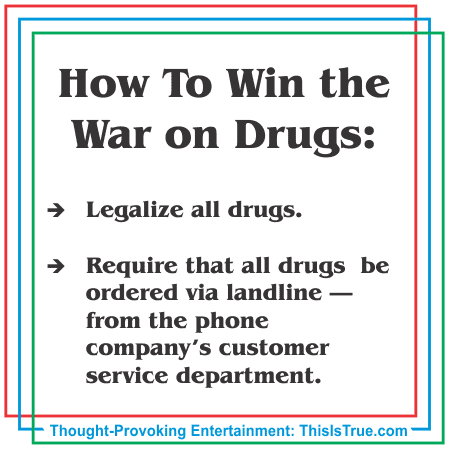
Prohibition against alcohol didn’t work (instead, it created massive organized crime); prohibition against other drugs also isn’t working (and is helping fuel continued organized crime — and terrorism, and despotic regimes).
It’s time to regulate drugs in the same way alcohol is regulated. Yes, it will still be a problem, but maybe we can get some productive use out of people who are in jail for victimless crimes (and free up the prison space for people who commit crimes under the influence). We can put the resulting tax money to use in funding clinics to treat alcohol (and other drug) addicts, and put our efforts toward educating kids on what drugs really do so they can make an intelligent decision about them. And regulate the quality to reduce the chance of overdose and bad interactions.
Last fall, I published a previous example of “kick the door in and start shooting” — the literal police execution of a minor drug user (not a dealer). I sent the URL to Keith in Maryland, but his head was too deep into his righteous indignation that he apparently didn’t even look at the page. He’s been a subscriber since 2003, so he even saw that story and the discussion! I guess his oh-so-perfectly functioning brain just forgot it. Either way, he’s so sure that I’m the “ignorant prejudiced jerk” in our conversation that he can’t grasp the concept that he’s actually screaming into a mirror.
If you agree, don’t tell me, tell your congressional representatives (U.S. House of Representatives, U.S. Senate). If you don’t, then tell them what you think should be done. The status quo — shooting people to death while trying to defend their own homes — just can’t be the way to go.
– – –
Update
A follow-up on the story that started this page, the police murder of the 92-year-old lady.
The use of the word “murder” might raise your eyebrow, but in fact, in February 2007 Fulton County District Attorney Paul Howard confirmed he would ask the grand jury for murder charges against three narcotics officers — Gregg Junnier, Jason R. Smith and Arthur Tesler — over the shooting.
“I will not rest until every person responsible for her death is held accountable,” Howard said. “When homicides occur in Fulton County, whether committed by a civilian or a law enforcement official, it is the obligation of the District Attorney’s Office to take the appropriate legal actions.” The FBI also announced it would investigate the case.
Junnier’s attorney, Rand Csehy, decried the charges as “an overbroad indictment” — and said they’re premature when the FBI is still looking into the matter. “It’s sloppy police work,” Csehy said. “It was cutting corners” — not murder.
But when the FBI finished their investigation, the U.S. Attorney brought federal charges against the three officers. The warrant the cops received to raid the house in the first place was based on lies: the informant who said he had been there and bought drugs? Didn’t happen, Junnier admitted; the officers asked the informant to lie to cover them — criminal conspiracy. Thus, everything that happened during the execution of the illegally obtained warrant became subject to criminal prosecution.
All three cops pleaded guilty to federal charges of conspiracy to violate civil rights resulting in death. In February 2009, Smith was sentenced to 10 years in prison and three years of probation. Junnier was given six years in prison plus three years supervised release. Tessler was sentenced to five years in prison plus three years supervised release. And in a stroke of genius, U.S. District Judge Julie Carnes ordered all three to pay for Johnston’s funeral costs.
“I am very sorry for my conduct and apologize to everyone for what I did,” Smith told the judge during sentencing. “There is no excuse for this conduct and I accept the sentence of this court. I pray daily for Ms. Johnston. I also pray other officers in Atlanta will have the moral fortitude I didn’t have.”
Good for Smith, but it’s a sad indictment of the Drug War — the war of the U.S. against its own citizens. It’s time for that war to end.
2013 Update
With the adoption of Amendment 64, in 2013 Colorado became the first state in the union to legalize the recreational use of marijuana. I voted in favor of it, even though I still have no intention of using it.
Sure enough, it is bringing in huge tax money, much of which is going to Colorado’s schools. Even better: in 2017, Colorado’s legislature earmarked $9.5 million of the revenue from the marijuana tax to create a statewide crisis response system, rather than put people who are in a mental health crisis in jail — pretty much exactly what I was proposing in this essay. Now that’s the way to win the “war” on drugs.
– – –
Bad link? Broken image? Other problem on this page? Let Me Know, and thanks.
This page is an example of Randy Cassingham’s style of “Thought-Provoking Entertainment”. His This is True is an email newsletter that uses “weird news” as a vehicle to explore the human condition in an entertaining way. If that sounds good, click here to open a subscribe form.
To really support This is True, you’re invited to sign up for a subscription to the much-expanded Premium edition.
That’s why I call it the war on some drugs.
What really raises my ire is the politicians putting their hands over their eyes like little children, pretending they can’t see the benefits of stopping the war on drugs; whether the anti-drug simply vanished, or whether they were controlled like tobacco and alcohol, the price would drop by a factor of 10 or 100. The pushers and their gang wars would be out of business. The drug lords would be bankrupt within days, and with them would go all the corruption they foster, all the corrupt regimes around the world and the corrupt anti-government rebellions; Colombia would bask in peace, the heroin growers in Afghanistan would have to grow real crops, the dictators of Myanmar would be broke.
Then there are all the legal hangers-on who would have to find honest jobs: drug cops, the DEA, all those prison guards would have to find real jobs and start adding to the tax base rather than swilling down my tax dollars. Isn’t something like a quarter of the prison population there just for possession, not for any violent crimes or theft to support their habit? All released; some would even get back the honest jobs they had before being caught.
The world would sure be a simpler more peaceful and more prosperous place.
The price would be some increase in drug use, but probably not an increase in drug deaths, since legal drugs would have to be more consistent and pure, or the legal companies selling them would be sued into oblivion.
I sure would like to live in such a world.
I agree with you 100%. I’ve also told my congresscritters, but they’re Jon Kyle, John McCain, and Jeff Flake — if you know anything about them, you’ll know how much good my telling them has done.
When I say “100%” in this case, I mean it literally; there are no points that you made, no matter how minor, that I disagree with, period.
—
I obviously understand that your congressmen are on the other side of the issue. That said, they do still need to hear your message. If they hear it enough, they’ll start to listen. -rc
I agree with you Randy, “no knock” search warrants are an example of rights that we have given up to win this “War on Drugs”. A large percentage of our prison population are in jail for drug use. Wouldn’t it be more effective if we focused on resolving a person’s drug abuse problem rather than throw them in jail? Unless they did something dangerous like drive under the influence of drugs or they are under 21, I see nothing wrong. I don’t take illegal drugs myself but feel locking someone up for using an illegal drug isn’t the way to attack the problem of drug abuse.
If drugs were regulated rather than flat out illegal, it will probably stop people from creating meth labs which are very dangerous to the general public and a big mess for the police to clean up. In addition violent gangs who sell drugs would disappear due to a decrease in price and no real motive to selling drugs. With regulating drugs we could also tax the drugs using the proceeds to aid in helping people who abuse these drugs. In addition, law enforcement would have more resources to solve other crimes rather than going after so many drug users.
The Duplicity of Government. Maybe that is the reason our present world’s drug problem is permitted as status quo.
Everything you have written about the control and use of drugs is 100% correct. Anything else makes no sense.
It makes one think of the quote,”Follow the Money”. Where is it? Speculate!
Since our more public involvement in the East, its history is of paramount interest. If nothing else since 1890, and because of the first and second world wars, until present, the hisory of all the governments is rank with duplicity.
Then to top it all, those who are paid to protect become “Wyatt Earps” shooting 90-year-old women after forced entry.
Maybe this is as the man said in the movie, nothing personal, business is business, Government or otherwise. Who’s the “Bad Guys”?
This reply is meant as a thank you for your perseverance and pursuit of common sense in and for a society that should be improving and pursuing the same goals.
I’ve heard other EMTs tell similar stories, including of first-time coke users who cardiac-arrested.
You want to know a funny thing about Afghanistan and opium? According to John Polanyi, Nobel laureate, the WHO says we’re facing a massive shortage of legal, medical opiates. What we need to do is license the Afghan poppy fields. Still funnier: medical opium pays the farmer more than the illegal crop.
My bend on the rant is that we need to funnel some of the money from the war on crime into the education and rehabilitation of some of its casualties. While I agree that drug use should be a personal decision, I think that the government would be better off helping the people who can’t handle the ramifications of addiction, one of which is the return to jail for the variety of crimes that are committed to pay for the habit.
Education of young people about the true effects of drugs, like the cokehead who blew out his brain cells, has proven to be a factor in rejection of drugs in later life. And finally, putting some of the funds into raising people out of poverty so that their reality is no longer so hope crushing that escape into drugs is preferable. I would rather have a government that focuses on helping its people instead of finding new ways to penalize them.
I would have to say that I agree whole heartedly with Felix. I have often discussed this with my peers and I would almost be willing to go even a step further that Felix.
I feel that drug education is the answer. The “War On Drugs” is a farce. It is nothing more than a way for government bureaucracy to grow and sustain itself. It’s a total waste of billions of tax dollars better spent elsewhere.
Give the drugs to the addicts for free if that’s their choice, with obvious limits of course. I’d rather spend a relatively small amount on providing them with the drugs they desire and on educating the children than the high cost of the crimes the addicts currently perpetrate against innocent individuals and the ridiculous war on drugs.
The story you cite shows two problems which should be dealt with in public policy: the “no-knock” warrant, and its proximate cause, the “war on drugs”. Both appear to me as symptoms of the urge by those in power to hold on to that power. By fomenting fear in the populace over the supposed ills of drug abuse, politicians and contractors are able to dupe the citizens into handing over large amounts of funding to purchase things like prisons, drug detection equipment, an endless parade of “training seminars” and so forth.
You have rightly compared the situation to the Prohibition days and rum-runners. Imagine the opportunity to convert all that illicit trade into taxable transactions. A user of cocaine or marijuana (just to pick two popular “brands”) would see a lower retail price, due to the lack of smuggling costs; the state or federal government (or both) would see a steady tax revenue, and the costs of running prisons would plummet! [Might have to convert some to luxury resort hotels?]
Without the fear of the drug boogy-man, police could concentrate on preventing or subduing violent offenders like robbers and rapists. And without the justification of the drug bust, there might be no justification for no-knock entries.
I have some notion of the emotion that overtakes one in that sort of situation. Years ago, when I lived in one of the poorer sections of Philadelphia, my home was entered by police officers with a warrant. They did knock on the door, but when I opened it, they burst in with guns drawn, pushed a sheet of paper into my hand, and started up the stairs to where my girlfriend was in the shower. We were held at gunpoint for about a quarter-hour as they demanded to know where the drugs were hidden (we had none). At one point, perhaps five minutes into the ordeal, I was showed a badge. But they had not identified themselves as police upon entry, and we were justifiably terrified. When I later looked at the sheet of paper in my hand, it was a carbon, barly legible, of a search warrant, listing “suspected drug paraphanalia” as the probable cause. In those days (early 70’s), the Philly cops considered a cigarette lighter “paraphanalia”.
I have always been grateful that there was also no weapon in that house, so that I was not tempted to try defending myself before these heavies identified themselves. I suppose I should also be thankful they didn’t have the authority to break in the front door – at least I was spared that expense. Such behavior draws its only justification from the fear-mongering performed by public figures who use that fear to gain power in public office. Others use their positions to make profit from those in office through corporate contracts. Both these drains on public trust and public funds are forms of corruption that are harmful to a democratic republic.
Randy, I must concur with you on your drug views.
It is painfully obvious to me that extended heavy drug use causes mental degeneration on several fronts. I have a neighbor who proves that to me on a daily basis. He is exceptionally high-IQ, but has lost the motivation to do much of anything except sit on his back porch, listen to 70’s music, smoke dope and drop the occasional heavier stuff – mescaline and whatever. While there are those who can control occasional light drug use, there are also those who can’t. It’s probably been that way since the dawn of man.
Somewhere along the way our government took upon itself the role of moral guardian vis-a-vis drugs, with the mandate of legislating morality by determining which poisons we may and may not consume. This mandate is riddled with hypocrisy.
The government is already in the drug business, which immediately raises one’s eyebrows about the role of “moral guardian”. It licenses and taxes alcohol in practically all forms. It licenses, taxes and subsidizes tobacco products in much the same way. It supports the big drug companies (via the FDA) in their quest for ever more and better (read “lucrative”) drugs to solve any problems we might have by simply taking a little pill. However, it condemns plants (marijuana, mushrooms, etc.) and manufactured products (meth, cocaine and such) as being evil and unlawful.
As you stated, it creates the same environment for drugs that prohibition created for alcohol.
I suspect that if the government were to pull its head out of its collective butt, it would realize several things:
First, an inordinate amount of resources – money and manpower – is being spent to apply this “moral” legislation. The numbers are out there — I just haven’t taken the time to pull them this morning.
Second, many lives are lost because of the actions taken by local and federal government agents to support this misbegotten policy. While some of those lives are criminal lives (and therefore might be considered acceptable collateral losses by some), other lives lost are those of people such as the 92-year-old woman in your article. She was wrongfully gunned down by agents following some kind of perverted “due process” that didn’t take her life and liberty into account. Add in kids on the streets, innocent bystanders, etc.
Third, by its quasi-prohibition stance against the drugs on it’s “bad” list, the government has created a thriving drug network in this country. The drug dealers have taken over neighborhoods, wreak violence upon citizens, take in huge amounts of money, and thumb their noses at the politicos who created the policies that allow them (the dealers and distributors) to thrive and prosper.
I have to think that if the government took a step back and examined the economics of the situation, it would see that rather than wasting money fighting a condition that it perpetuates, it might make better sense to legalize most drugs and take its own cuts of all drug proceeds (as it does today with alcohol and tobacco) instead of letting that go to the dealers. This would have at least four immediate effects – the demise of the drug underground (no longer necessary), the cessation of resource wasted on current drug policy, more money in the government coffers, and fewer lives snuffed.
Heck, they might even be able to resuscitate the Social Security program with the money they could bring in, although I doubt that would happen. Perhaps they could build another useless bridge somewhere instead….
Drug use = health issues. Alcohol use = health issues. Both impair judgement, manual dexterity, etc. Both should be treated in a similar fashion.
Regulate them to ensure safety of product for consumers, tax them (thereby wiping out most of the drug-related underground economy and helping fund medical care for abusers), and get to work on things that really impact the well-being of our society.
I deeply appreciate the thoughtfulness of your comments regarding the “War on Drugs.” I would respectfully disagree, to a point. I do, however, fully agree that a “no knock” warrant is unconscionable. This execution–of both the warrant and the victim–received attention because of the perfect storm of the individual, the violence, and the lack of evidence. Many others are never publicized, but are no less egregious.
Is the government’s making certain drugs illegal an inconsistent position? Obviously: alcohol and tobacco speak (or slur) for themselves. But does that inconsistency make it logical that other drugs should be made legal?
My position is definitely shaped by my role as a parent. I see the violence that has devastated many neighborhoods, and I fear for my children’s safety. I see the hopelessness and economic devastation in those families and communities, and I fear for my children’s future.
I appreciate that many of these are part of a tragically symbiotic and cyclic relationship to the illegality: use drugs, go to jail, lose your future, return to streets with no prospects, use drugs to forget…. But I can’t simply ignore the reality that good people are wounded and killed and impoverished because of not only the evil acts of evil people, but also because of the thoughtless acts of addicted people. Children without parents. Families without breadwinners. Those are not just the tragic consequences of ill-considered laws, but they are also the natural consequences of dangerous substances, and those consequences extend beyond individual tragedy to threaten community viability.
I don’t know what the “right” answer is, but I am quite certain that it is not education alone! I am very pro-education, but knowledge does not equal motivation, and information alone does not provide hope or inspiration. Has sex education reduced STD’s and unwanted pregnancies? Maybe–but they are still tremendous societal woes. Has nutrition education stopped our kids from supersizing? Education without wisdom is at best useless, and at worst, “A little knowledge….”
More important than laws or education is involvement. You are a great example of this, Randy, through your community service. Mentoring and caring are values and methods that work far better than either a class or a court.
—
I’m not going to refute anything you say, Dave, since I had my say. Just one comment about education and STDs. Such education would be much more effective if those who would legislate morality here, too, wouldn’t close their eyes to reality. Kids are taught abstinence is the only way to go, and aren’t taught how to protect themselves when they choose their own morals, rather than those of the teacher (which are often dictated by the government). Education is powerful if we stick to the facts, rather than let emotion get in the way. -rc
I have been saying much the same things as you about drugs for years. I have never used them — I never even tried pot back in my college days, as it seems most people did — but I also think they should be legalized, taxed, and regulated the way alcohol and tobacco are. People should have the right to do whatever they want to their own bodies — and they should have to pay the consequences for it.
One other negative consequence of the war on drugs that you didn’t mention directly is the abuse of forfeiture laws: the government can seize your home and all your assets without having to file formal charges or prove anything if they even suspect (or claim to suspect) that you are selling drugs. This is very scary to me — any government action that does not require due process and proof is ripe for abuse, and in light of other unconscionable actions done in recent years by our government, I don’t trust them not to abuse it.
For anyone interested, Cornell Law has a pretty thorough article on the subject.
I had a neighbor who was a victim of a “no knock” warrant; he was in the shower when they broke his door down. He heard the noise and ran down, thinking his house was being robbed. They arrested him for obstruction of justice while they trashed his house. They also took all the money he had in the house (my neighbor didn’t have a bank account, he paid cash for everything…he didn’t trust banks. He even paid cash for his mortgage every month) and he had a horrible time getting his money back, his door repaired and his furniture, which was ripped apart in the search, repaired. All because someone with a grudge reported there were drugs in the house.
I’m not pro drug or anti drug; but I do think that more proof should be required before a “no knock” warrant is issued than just a verbal complaint of drugs.
You tell ’em, Randy! My rant with the WoD started after I found out that our gov’t gave the Taliban millions of $ to stop growing opium, in the name of the “war on drugs.” Shortly thereafter, 9/11 happened and there is more and more evidence that the 9/11 attacks lead back to the Taliban.
You’re right – prohibition doesn’t work. I’m surprised the tobacco industry got slammed as badly as it did, but I’d be surprised if the liquor companies were subjected to the same treatment – even though alcohol-related disease and accidents probably kill as many people as tobacco!
I wanted to respond to Dave.
I think your view on the dangerous situations in the neighborhoods can be explained by others who have posted. The current laws have created the situation that exists. Prohibition doesn’t work if it’s alcohol or drugs.
You can’t legislate morality no matter how hard you try. Also, teaching sex ed may have some impact on some kids but I don’t think you can compare it to taking drugs either. Sex is a natural and hormonal action that takes place in the human body and there is a drive to reproduce. There isn’t a drive or hormonal need in humans to take drugs. Education can and does work. It’s like everything else in regards to being a parent. You do your best with informing and training your children and hope to hell that they make the right choices in their lives. It all comes down to the choices each of us make and the road we take.
The war on drugs is over, and we all lost.
I was drafted into the war when I began teaching high school in 1970, just as President Nixon declared war, and was issued my first “Why do you think they call it dope?” classroom poster.
In the years since then, we’ve spent billions of dollars, jailed literally millions of people (60% of all federal prisoners are non-violent drug offenders), killed hundreds or perhaps thousands, trampled the civil rights of millions, and even destabilized other countries who weren’t cooperating with us. Guess what? The percentage of people using drugs in the US is the same as it was in 1970. In fact, it’s the same as it was during the first drug-use panic, around 1910.
There is obviously a core group of people who want to use drugs and who will do so, regardless of the legal or health consequences. And there are consequences, of course, as illustrated by the regular OD casualty toll.
But that’s the way it is in a free society. People are free to screw up. I’ll gladly accept the steady percentage of screw-ups, since the alternative is a police state.
Please don’t misunderstand my previous comments as being anti-education. My concern is simply that education alone is insufficient. Teachers are part of the answer, because the good teachers become part of their students’ lives. When most of us consider our education, we remember our teachers as a personal influence long after we have forgotten the details of their classrooms.
I would like to see more education, including more education about the dangers and ills of drugs. I would like to see far more support and money given to promoting quality education of any stripe. I just do not think that education is the sole answer to this or any other problem, and I think that suggesting that education alone can do the job is not feasible–let alone realistic from a social/political standpoint.
I disagree that we “cannot legislate morality.” We legislate morality all the time. How fast can I drive through a school zone? Why can’t I steal my neighbor’s car, or abuse my children, or marry three women? Those are questions of morality that we accept as legislative matters because they involve public safety, the rights of individuals, etc. Almost any law passed is some kind of legislated morality. People murder others: does that mean that laws against murder are inappropriate? Robberies happen daily, so law is not the answer?
Furthermore, there are hundreds of laws surrounding the legal drugs. I can’t ease my child’s cough with a teaspoon of vodka. I can’t share a glass of wine with my teenager. I can’t down a few after work then drive home. Those laws do not prevent any of these things from happening every day–do we dismiss the law as having an appropriate role?
I absolutely agree that many of the drug laws as they are currently written and implemented are morally wrong and largely ineffective. But I am not ready to dismiss law (or education, or parents, or community involvement) as a part of an approach that needs to be more comprehensive, more individually tailored, more compassionate, more treatment-focused, and more effective.
—
Laws against speeding through a school zone is not legislated morality. Nor stealing your neighbor’s car, nor abusing your children. Those are laws which protect the rights of others, and as such are quite proper. Marrying three consenting women of legal age? Yes, that is an example of legislated morality — and I disagree with it. The state has no business poking its nose into private citizens’ bedrooms when someone isn’t being abused. -rc
I agree with the majority of comments as well as the article itself. My take, however, is that drug use isn’t necessarily the main issue. It’s drug abuse that’s the problem, and the stigma surrounding it. It’s important to first recognize drug abuse as a health issue and not a social issue, meaning those with substance abuse issues need medical and/or psychiatric treatment instead of punishment and imprisonment. Like more than a few alcoholics, other drug abusers use drugs to self-medicate. If that was more widely understood, then legalization would become more possible, and that would lead to less victim-less criminals clogging up the legal system.
While supporting most of your views, I was dismayed to see you quote a former police chief as a source of pharmacology information. However, it turns out that he is only the spokesperson for the Mental Health Council of Australia. This body is itself controversial, having been castigated by the press for its association with (and major funding by) many of the top pharmaceutical companies in the world (see info at this link).
I downloaded the actual 76 page report and discovered that while there is a potential link shown between cannabis use and mental health problems, it does not appear to be so much a pharmacological effect as an exacerbation of symptoms.
There are many reports produced by researchers who are funded to find what’s wrong with cannabis, while other researchers (I know of two respected university professors here in Canada who have been turned down) are unable to get support for proposed studies on the physical effects of the drug at the brain-blood barrier. The Scientific Method is supposed to research and report, not just seek a confirmation of one theory.
As “This is True” so frequently points out, the greatest physical harm from cannabis appears to be due to the over-enthusiastic prosecution of the law. It seems that the various law-enforcement agencies would rather arrest cannabis users than other druggies. My guess is that ‘pot-heads’ are less likely to be harmful ie. shoot back.
As an educator, I decry the use cannabis by my students. It doesn’t help them learn. However, in the classroom I encounter the greatest difficulty with the drugs prescribed to modify the student’s behavior, either when they over-use them, or when they avoid taking the pills because of the way they make them feel.
—
I didn’t quote a former police chief, I quoted a news report — and identified it as such. I also linked directly to the full formal research report so those who are interested in the details can download it and judge what it says for themselves. -rc
I am a retired police officer and I frankly don’t care what people do in the privacy of their own homes, as long as it doesn’t harm others. I never worked narcotics and never wanted to. Unfortunately, what the “legalize drugs” crowd overlooks is that even if legal, drugs will still be very expensive. Since drug abusers are generally unable to hold a job due to the deleterious effects of the drugs, they will continue stealing from the rest of us to pay for their habit. In my city almost all adult shoplifters, car prowlers, and forgers are doing so to pay for their drugs. Legalization of drugs will NOT stop the rest of us from being victimized.
In my state (Washington) folks generally don’t get prison time for drug possession. They might get a few months in county jail, but that’s it. In the press I often see someone decrying the fact that the prisons are filled with “non-violent drug offenders”. They are NOT talking about drug abusers. “Non-violent drug offenders” is liberal-speak for drug dealers who haven’t killed anyone yet.
i agree with you, for reasons not yet mentioned in comments. long before i got a confidential clearance and pretty good paying federal government job, i spent some time as a drug felon. that isn’t my comment. i have been clean and sober for almost 23 years. that isn’t my comment. my comment is that the drug laws, esp those relating to marijuana, are capriciously enforced against the tired, the poor, the huddled masses yearning to be free, at least to get a buzz for a little while. connected drug criminals like bush’s neice and fatass limbaugh and probably ted haggart will always get ‘rehab’ and ‘treatment’ and the rest of us get time. the clowns making the laws break them as often as the rest of us and sit there in judgement and are protected. since my elected congressional rep’s assistant graciously helped get my federal pension straightened out, i have often suggested improvements in marijuana, at very least. once they get in, it doesn’t matter what they did when they were young, they are afraid to rock the boat. if the drugs didn’t affect gw bush’s ability to preside and decide, they should be regulated like beer. then again, bush mightn’t the best argument for legalization.
Randy, I agree with you that the drug war is wrong. At the very least, pot should be legalized. Some of the harder drugs might be more of a problem. As a father of two sons, and a former heavy drinker, I have seen the problems of alcohol abuse. I would much rather see my boys smoke a hit of pot occasionally than drink to excess like so many of their generation.
People tend not to get in the car and think they’re bulletproof when their stoned, but when they’re drunk……it’s a problem.
How many people are killed by pot each year, and how many by alcohol? You’ll find those numbers to be very heavily slanted towards the use of alcohol.
A very good article, and one I agree with almost completely. Thanks for writing it!
Unarguably (therefore somebody is sure to argue with it) the biggest drug problem this country has is with the legal and readily accessible addictive drug alcohol. The crimes committed under the influence of this drug, the cost to society (financial, relational, emotional, psychological, etc.) exceeds, I believe, that of any other drug.
Another legal, readily accessible addictive drug (nicotine) also has significant negative ramifications for society and individuals.
That stated, I fail to understand how it makes any sense to make still more addictive drugs legal and readily accessible. While that may solve some problems (like the disastrous police raids referenced) I suspect it would create other, possibly greater, problems. While, on the surface, it sounds reasonable to say that “as long as it doesn’t hurt other people” it should be legal and we’re wasting resources in the “war” against them, it doesn’t seem to me that takes into account the likelihood that legalization would bring with it a significant increase in usage and, therefore, an increase in the attendant social, legal, personal, financial, relational, etc. problems.
One of the distinctions between the legal drugs and other addictive drugs that are currently illegal is ability (or lack thereof) to use the drug without becoming under the influence. It is possible to use alcohol without becoming under the influence. To the best of my knowledge that isn’t possible with methamphetamine, heroin, cocaine or the myriad other drugs that are currently illegal. Those drugs are only used for their “high”.
Generally, when people are “high” their behavior isn’t noted for its positive contribution to society. Yes, I know that there are notable exceptions (Edgar Allen Poe, for instance) but *in general* people who are under the influence of a drug are noted for societal contributions that are less than positive.
While society would undoubtedly gain by losing or reducing one set of ills by legalizing the use of currently illegal drugs, it seems to me to be incontrovertible that society would gain another whole set of ills. This discussion would benefit, in my opinion, by a more balanced discussion that acknowledged and tried to balance the benefits of legalization along with the foreseeable negative consequences, which seem to me to be considerable.
One more reason for Keith from Maryland: Gundar S____. Yes, that is his real name, and he is the son of two very brilliant people, one a college professor of fine art and the other the chief Music librarian of the same college. I was aquainted with the fellow in college, and at the time he showed every inch the capacity of his family heritage, both nature and nurture.
As sometimes happens, such a one pursues a quest for Nirvana. Many take the long road of experience and introspection, and some take the ‘short cut’ that drugs seem to afford.
We parted company at graduation, and our paths didn’t cross until many years later. I was then doing a retail sales gig, when I saw someone enter the store that seemed to be on his last brain cell. I didn’t recognize him until he gave his name and a ‘no fixed abode’ kind of address. He didn’t recognize me at all. He had come into my store for batteries or some such, and left on his bicycle. I had to say that it was such a waste of a brilliant mind.
Even if he had not stopped his heart with a massive line of coke, like your ER patient, he had long ago stopped his brain just as effectively, trying to transcend this mundane world by ‘recreational’ chemical means. I can only hope that he no longer misses what he no longer has; that would seem to be a mercy.
Hey, I must say that I agree with you on this subject.
You asked the question why alcohol is legal yet marijuana is not. It’s simple actually, the effects of alcohol can me measured and diagnosed fairly easily. Yet the effect of marijuana *and all other Illegal drugs* are different for every person and can not be measured *as of yet*.
I agree that Marijuana should be legal. I’ll also go as far as to say coca should be legal, but cocaine?
I think one of the worst things about marijuana is the exposure to the black market that SOMETIMES goes along with its use.
Free press forever,
Dave
(PS: You do great things man. I need to hurry up and recert my EMT too.)
Randy, “anti-police”? No, more a voice of sanity and commonsense in an increasingly mad and unreasoning world.
Your pro-dope ranter was very selective in his view of the historic studies of the effects of cannabis/marijuana. A 1920’s report, whilst acknowledging that it was not physically addictive, said that it was psychologically addictive. Moreover its biggest danger was that it destroyed a person’s sense of social responsibility. It was for this reason that it was made illegal, worldwide, in the late 1920’s.
I am of the baby-boomer generation and went to University, here in England, in 1964 and was there until 1971. In that time I saw the use of cannabis increase from a few dozen students in 1966 (there were over 6,000 students) to thousands by 1971.
The real problem came about because dope had been demonized to us by our parent’s generation and when we discovered it wasn’t as terrible as made out we then deduced, incorrectly, that other drugs would also prove to not be so dangerous. By the time I was in my early thirties the number of people who had died as a result of drugs was horrendous.
Alcohol has many faults, but if you drink too much you’ll probably wake up feeling like s**t and swearing you’ll never touch the stuff ever again. You may break your vow, you may even become an alcoholic but it is unlikely you will commit suicide in despair at your inability to stop drinking as four people I knew did who had a heroin habit.
The answer, it seems to me and others in this thread, is not to legalize drugs but for government agencies to control them by buying them in their country of origin (i.e. outbidding the drug barons) and using those drugs, specifically heroin and cocaine, for their correct medicinal uses.
While these arguments are good, I don’t think getting out of a bad policy is quite as easy as reversing it.
And the reality in America is that people are *not* responsible for themselves. People don’t want to wear seat belts, but expect if they are uninsured they will get full health care. People who don’t save for retirement expect that they will get social security and medicare enough to take care of them.
Unless you are advocating a “tough love” approach to these, which I don’t think is possible, the reality is that society *will* end up being responsible for health and financial support for a large number of druggies who due to bad luck, poor skills, or drug induced lethargy do not contribute enough for themselves. My feeling as to the scale of the problem is that it would be large. How large (compared to current costs)? I couldn’t say.
Which is not to dismiss your points, but I think any serious proposal needs to go deeper than looking just at supporting arguments.
—
The whole idea of virtually all of my rants is not to put forth full legislative packages, but to drive discussion. I don’t claim to have all the answers; I think that we have lost the desire to have thoughtful debate about difficult issues, and anything that promotes it helps us as a society. -rc
I want to reply, in part, to something Steve said: “One of the distinctions between the legal drugs and other addictive drugs that are currently illegal is ability (or lack thereof) to use the drug without becoming under the influence. It is possible to use alcohol without becoming under the influence. To the best of my knowledge that isn’t possible with methamphetamine, heroin, cocaine or the myriad other drugs that are currently illegal. Those drugs are only used for their ‘high’.”
I don’t quite know what he means by ability to use drugs without “becoming under the influence.” Possibly he means that drinking only a small amount of alcohol has only a small effect? The same would be true of some other drugs, though in some cases it might be unlikely that people would use just a small amount.
In any case, what he doesn’t talk about, nor do your other commenters so far, is the potential medical benefits of some illegal drugs.
Marijuana is the obvious example, and the growth of “compassion clubs” indicates just how needed it is. Among its benefits is the way it removes nausea for AIDS patients and for cancer patients on chemotherapy. Apparently no legal drug works as well — or at all, for many people. Marijuana has other medical uses, too, such as treating glaucoma, intractible pain, and severe insomnia.
Another example is heroin. Really heroin is a stronger version of the legally prescribed drugs codeine and morphine. Often codeine and morphine are sufficient to ease pain, but in some cases, such as terminal cancer, they’re inadequate and heroin would work much better. As I understand it, also, heroin does not result in people getting high when it’s used for pain. At any rate, I have used codeine in the form of Tylenol 3 (legally prescribed) many times, and I can testify that I’ve never gotten high from it.
Do other illegal drugs, such as cocaine and methamphetamine, have valid medical uses? I don’t know; maybe they do, maybe not. But those medical uses are not likely to be discovered as long as the drugs are illegal.
On another angle, organized crime does indeed thrive on the sale of illegal drugs. Legalizing all drugs — or even just marijuana — would be the last thing drug dealers would want.
What would happen to organized crime if all drugs were legalized, I wonder? Would it shrivel away? Would it find other illegal outlets? (Of course organized crime is already in prostitution, gambling, etc., but would it find further illegalities to exploit?) Would the dealers, most especially the higher-ups, actually go into some kind of legitimate business instead — even if that were, say, growing and marketing legal marijuana and manufacturing other now-legal drugs? I’m purely speculating here; I’d love to have the drugs, especially marijuana, legalized and find out just what does happen to organized crime.
I’ve heard that both the Netherlands and Switzerland have trialled government-controlled heroin distribution for registered addicts, the results were on the whole beneficial for the users and the societies supporting them.
As you proposed, users, of course, aren’t incarcerated for being users, and there are fewer property criminals committing offenses to raise money to source substances to abuse; additionally, criminal supply organisations and infrastructure tend to wither and diminish. Users aren’t driven underground, so are able to function in societal mainstream, and can have better health and living circumstances. The drugs are regulated for strength and purity, which reduces risk of overdose.
All of these are reasons why the administration of the Australian Capital Territory decided to trial such a scheme. They were unable to do so. Visiting members of the International Narcotics Control Board pointed out to Australia’s Federal Government (which has oversight and ultimate authority over the ACT admin) that the state of Tasmania has approximately 800 authorised growers of opium and cannabis (which is trafficked legitimately for medical purposes). The INCB threatened to revoke Australia’s licenses to trade in these drugs if the ACT trial went ahead. Their stated reason was that Australia was a signatory to a 1964 protocol that outlawed cultivation or supply for any purpose other than medical. The INCB doesn’t consider controlled supply to addicts to be a medical purpose. How the Netherlands and Switzerland got around this, I don’t know. But modern Australian drug control policy is driven by a treaty with terms that were not put before the general public or discussed in open forums in any democratic manner, more than forty years ago, signed by an appointed, not elected, official. Other countries, including the US, are surely suffering the same restraints?
There’s a case that most international treaties should have sunset or exit clauses built in. The pompous clowns who strut about signing these things think that their world view is the only one that’ll ever matter or be applicable. The writers of the US constitution expressed their wish that it be a dynamic document that reflect democratic progression. Wouldn’t it be nice if all policy and legislative draftsmen had minds that open?
Why did most of the recreational (illegal) drugs get ‘invented’? Because they weren’t considered illegal at the time of invention due of the specific legal definitions in the law. i.e. At one time a drug was illegal because the law said that that chemical was illegal. Are drugs still identified by chemical names or are there a more generic ID? I don’t know, but I suspect that there is some generic law to cover ‘new’ drugs until their name can be added to the list.
If cocaine, cannabis, etc… were never made illegal, then probably most of the other manufactured/invented substances presently considered illegal would not have happened/appeared.
Do I want my family/children/friends/etc to go out and blast their brains with chemicals? No! But, it should be their informed, adult choice, not mine or anybody else’s.
After reading this story and the editorial comment on the free email I decided to upgrade.
More and more senior British police officers are realising that a ‘war on drugs’ is self-defeating. Criminalising people for taking drugs forces them into other criminal acts that have an impact on other people (ie, theft to pay for their drugs, the price of which is inflated above and beyond the actual market value because they are illegal). The only solution to drug abuse is to decriminalise it and to socialise it. That is, provide drugs to all users free at use but require them to use them in a state recognised establishment and require them to go through therapy. Any drug use outside this system will be heavily punished. Among other things, this will end the power of the drug cartels (as governments can buy directly from the actual producers at a higher price for the often poor farmers, but at a vastly lower street price); end drug related crime as the drugs will be free; reduce drug use among the young as it will be less ‘cool’ to use drugs; make it easier for people to quit as they will already be in the system; drastically reduce the prison population; and cut back on aids and other needle-related diseases.
This, unfortunately, is very much a utopian idea. The investment in the ‘war on drugs’ by the powers that be, especially in the USA, is such that to decriminalise drugs would mean a huge loss of resources and power for them. Imagine Hollywood without cop and drug movies. At the same time, imagine all the politicians and high-flying executives who would have to admit that they are registered at a government-recognised drug use center. A pipe-dream.
Drug use results in a waste of human resources, but the ‘war on drugs’ is an even greater waste of human, financial and material resources. Continuing it is repeating the same mistake over and over again. The Prohibition proved this. Much the same as the 21st Amendment did not bring an end to crime, decriminalising drugs will not bring an end to street crime, it will allow the police to concentrate on ‘real’ crime rather than crime created by despair, desperation, peer pressure or other social pressures. It might even encourage politicians (and wider society) to look at and address the real causes of much of the drug abuse that occurs in modern society.
My standard rant on the subject of The War on Drugs:
The damage done to society by individuals damaging themselves[1] with certain substances must be compared to the damage done to society in the efforts to prohibit those substances[2]. The War on Drugs has been going on since the Harrison Narcotics Act was passed in 1914, an increasingly savage war carried out by the government against its own citizens, with no discernable positive result. I submit that the being damage done to our society by this war greatly outweighs the damage that would otherwise result.
Note that I most emphatically do not minimize the harm that certain substances may cause to individuals nor to society as a whole.
In my opinion, wherever there is a demand for a product or service there will be a supply. As far as I know there has never been a successful prohibition effort[4].
——-
[1] People killed or maimed by drivers “under the influence,” lost productivity due to absences because of those substances, people killed or disabled by the substances themselves, broken families and lost homes, etc.
[2] People killed or maimed by Law Enforcement Officers, lost productivity due to incarceration, broken families and lost homes, etc. In this country the systemic damage also includes abrogation of the Fourth Amemdment (“unreasonable search and siezure”) and the Fifth Amendment (“deprived of … property, without due process of law,” a provision violated by the Civil Forfeiture statues[3]). There are also such unintended consequences as the spread of disease due to needle sharing because needles and syringes require a prescription to obtain.
[3] This is egregious enough to warrant a rant of its own. I’ll just point out that this has, in many cases, caused a shift in emphasis of some law enforcement organizations from interdicting traffic in prohibited substances to the siezure of valuable property.
[4] The institution of slavery in the United States probably comes close to an exception, but I submit that it’s a special case and that question was “solved” by the Unpleasantness of 1861-1865.
Randy said: “I do NOT think I (or the government “of the people”) should have the power to stop people from using drugs, as long as they don’t commit crimes under the influence — which infringes on MY rights, and others”.
Randy, as a general statement, I agree with you on this. But, as the saying goes: “The devil is in the details”. My question to you is: What are the details? In other words, how do you think the laws should be crafted (crafted by politicians, yeah, right) to allow this? Or, are you saying “no laws at all, let the chips fall where they may”?
Some examples of what I’m wondering about. Are these legalized drug sales taxable? Who can legally sell these drugs, and who regulates that? And, related to the drug sales, should the FDA be involved in regulating quality of the drugs? What about advertising, would you approve of TV ads for MethLite? And, one everybody who pays rising insurance premiums wonders about: Who pays the medical costs for the abusers who can’t hold a job, and are in and out of the hospital on a regular basis? And, if they can’t hold a job, where will they get the money to buy drugs? Crime? Or, should the government subsidize them, to reduce the crime rate? Seems we lose, either way.
Do you think the number of “users” would go up, or down, if drugs were “de-criminalized”? I don’t know, but would guess the number would rise. At least initially. In the long run, perhaps drug use would decline, as those prone to drug abuse would “weed” themselves from the gene pool. And, if that isn’t the case, I’m not totally convinced legalizing drugs is the right answer to a difficult question.
One could also use this same line of thinking to attack many other “public safety” laws. People are going to die for one reason or another, anyway. So why bother trying to protect them from themselves?
During the nineteenth century in the UK almost all the current illegal drugs were legal – those that weren’t would have been, they just hadn’t been invented. Queen Victoria used marijuana for period pain, and laudanum was freely available over the counter. During the same period, we built the biggest empire the world has ever seen, and were the world leaders in industry, science, politics, and you name it.
I’m not suggesting that we did it because of the drugs (though you never know for sure) or that empire-building is necessarily a good thing, but for sure all that stuff being freely available didn’t turn us into a bunch of zombies. Those who were stupid enough to use it went ahead, leaving the rest of us to carry on doing interesting and productive things. My vote is to legalise the lot, not necessarily make it free as a previous respondent said, but make it easily available to one and all. Would I use it? Well, do I sound stupid??
Randy, you are a very smart man. I realize, as I write to disagree with you on a couple of points, that I do not take the time that I should to tell you that I appreciate your column. You bring laughter and insight to thousands of people each week, and it is a good work that you do.
If I may, however, I’d like to comment on an idea or two. You have pointed out, quite graphically, the dangers that illegal drugs pose not only to the users but also to their families and the people around them. (Thank you for that – I know SO many people who claim that drugs are harmless.) However, you stated that you are against the War on Drugs, and that we cannot (or should not) legislate morality.
First, we HAVE to legislate morality. The reason we have laws is to prevent people from committing acts that are morally wrong. Why is murder illegal? Because it’s wrong. Why is theft illegal? Because it’s wrong. Yes, political corruption allows some people to abuse or sidestep the law, but the basic principle is correct – we need a government with a legal system to organize and direct society.
I think we agree on the harmful nature of these drugs, and I also think we agree that their distribution and use is morally wrong. This is why we NEED the War on Drugs. More accurately, we need a War on Wrong. We need to fight against those things that erode our people, our society, and our way of life. Failing to do so make us guilty of passively contributing to their growth.
You said that personal drug use inside one’s home, although you disapprove of it, is a a “victim-less” crime. But what about the cardiac arrest patient that you cared for? He was using drugs in the privacy of his own home, but this crime was not victim-less. His death impacts the lives of his wife and children. The truth is, there are no victim-less crimes. Our mistakes always affect others – our loved ones and the people around us, if not more.
You point out that we do not attempt to outlaw alcohol, so we should not treat drugs any differently. You’re right – we should not treat them differently, which is why we SHOULD outlaw alcohol. I know that this opinion isn’t popular, but I’m not trying to be prom king. I seek truth. And the truth is, we need to fight the battles that are necessary to reverse our social decay.
It is extremely unfortunate that a woman lost her life in the particular situation highlighted by this story. However, as cold as it sounds, people die in accidents all the time. It is equally unfortunate when someone dies in an automobile or airplane crash, but we do not eliminate cars or planes, because ultimately they contribute to society. Additionally, police did not enter her home on a whim, thinking that she might be using drugs in private. They entered her home (WITH a warrant) because she was suspected of DEALING drugs. Yes, the end result of this particular case was very sad. But no matter what laws we do or do not have, you will always be able to find the oddball case that doesn’t go right. That doesn’t mean that the overall idea of fighting drugs is wrong.
I know that there are questions raised by my statements – what about the problems of organizes crime caused by prohibition? Do I really think the police did the right thing by entering the woman’s home without announcing themselves? These and other issues are perfectly valid concerns. Sometimes there are wrong ways to fight the right battles.
Should we outlaw alcohol outright? Maybe not. But let’s take a lesson from cigarettes – increase taxes over time to lessen their use. Ween society slowly instead of cutting them off cold-turkey. You discourage smoking, and generate some additional tax revenue without upsetting the entire population.
Did the police (and the rest of the legal system, such as the judge who issued the no-knock warrant) act correctly when they entered Ms. Johnston’s home? Probably not. We don’t have all the specifics of the case, but I’m sure the police could have investigate further, or announced themselves at the door. Maybe – or maybe not. Maybe they could have handled the situation better, but not confronting drugs would definitely be handling the situation worse.
Thank you very much for your time.
—
All of the points you raised have already been addressed, either in my original essay or in the comments that followed. Prohibition has been proven not to work, and indeed it caused huge problems. Yet your solution is … return to prohibition? I can only conclude you either didn’t really read what was presented here, or didn’t really understand what was being said. -rc
As an LEO, I don’t feel your post is anti-police, however I disagree with what is essentially the legalization of drugs. To me I am reading your statement as, let them do drugs as long as they don’t hurt the public. Where are the funds going to come from for the hospitals that will be overburdened with people coming in having OD’ed. Or the ones who get hooked, and have 2 kids and totally F up the childrens future? As it is there are not enough Foster parents, nurses, doctors, EMTs, ect. to handle our current load. What will happen to our society when the flood gates open to drug use? The load on the “clean” society will blossom, thus infringing on my rights as I see it.
However, on the other hand I support lessening the penalty for Marahuana, being the lesser of evils. I say we treat the users to much and don’t focus on the suppliers. Make possesion a Class C misdemeanor (texas), but delivery or distribution be a Felony. But then there is the argument what make this better than the others, so it gets a lesser penalty.
I am very Anti big government, but then I see these reasons to have a strong anti drug policy. Hypocritical? Yes. However, as I said before, the burden of drug users on society will end up infringing on my rights.
I breezed through the comments and saw mention of rehab. Rehab never works unless a person wants to change. Same thing with smoking, a person will not quit until they decide to.
I see education is the answer. DARE showed to be an ineffective method of education, and is being phased out. I personally thought it was a good program, though admitedly I did try marahuana as a teen.
Education isn’t the only answer, rehab isn’t the only answer, prisons and prison time, legalizing, or increasing the penalty. Nothing answers the question. Our world will allways have a Vice, but there must be balance. Legalization to me as an officer appears to be anarchy waiting to happen.
The War on Drugs may be a waste of money, but I challenge anyone to prove to me a world with legal drugs would be any better in any form or fashion…
I am of two minds on this issue. On the one hand, drugs have caused more havoc in people’s lives (both users and their loved ones) than anyone can possibly imagine! Yet, if it were legalised AND controlled, perhaps we could all save some tax dollars for other problems which also deserve our attention, and as you say, free up some jail space for real criminals!
Randy: You are sooo on target regarding the war on drugs and the war on the perople of the U.S., by the U.S. government. Doesn’t the government read its history books? Prohibition against alcohol did not work; albeit, it fueled a huge organized crime effort, and people died. Now our govenrment makes money on alcohol taxes! Go figure. Cigarettes are no different. Nicotine is highly addictive… Ever see a smoker who is kept from smoking (for whatever the reason – like an airplkane flight) rush to the smoking area, light-up, and smoke like a mad dog to get their fix? And our government makes money on tobacco taxes! Hypocrites? OH YES!
There are several problems regarding the “war” on drugs. You have touch on several….a war against our citizens by our government, infringement of personal rights, infringement of property, No-Knock searches and seizures, innocent dead, etc. But there is also a significant conflict of interest going on within law enforcement. The confiscation of property, and sale of the property, nets the arresting agency a share of the booty. This has fueled many inappropriate seizures; some of which you have exposed (e.g., the guy with $100K in an ice chest to buy a Mack truck, and the police alleging that a police dog smelled drugs on the money, and the Police got to keep the money.) This conflict of interest is WRONG! It fuels abuse.
As story to share with you….A friend of mine who is a skipper of a charter fishing boat in San Diego, CA was boarded by the U.S. Coast Guard. The USCG found one marijuana seed in a guest bunk. Based on the USCG’s Zero Tolerance policy, the boat was confiscated, title of the boat was transferred to the USCG, and the boat was put up for sale. The skipper, with the help of several attorneys, got the sale stopped and title transferred back to the skipper on the basis that the skipper could not control what his paying guests brought on board. Seems like common sense to you and me! But not to the USCG. Time to get his boat back….17 months. Two fishing seasons lost, legal fees lost, and the skipper had to sell the boat to avoid bankruptcy. An example of another innocent person harmed by this “war.”
The only point I feel requires debate in your article, Randy, is where you suggest society (that is, all us people) has no right to assume a moral stance and such a moral stance is only for individuals to take.
Can’t agree with that, since society is the sum total of all of us (in our little territorial nations), and therefore it is logical that a society may hold moral views representative of the amalgamated views of all individuals. Heavens, isn’t that how our laws developed?
You are the first person who actually put my words in print. I have been of the opinion that if alcohol is legal the goverment should legalize most of the non-lethal drugs (marijuana) and legally control sales of the more dangerous drugs for in-home or centered use only. This would give the goverment the ability to tax the sales of the drugs, and make it easier for people to admit to addictions that they want help with.
I know that this will seem dangerous to the people who have gotten used to hiding their drug use but, the goverment has already taken away almost every way we have to be anonymous anyway so what’s the big deal?
I personally don’t do drugs but I do drink and have been known to take a toke on rare occasions, I also disapprove of the use of harder drugs but believe in a “to each their own” way of seeing the world.
One argument I have never heard when talking to a pro-drug war advocate is first “Do you thing we should win the drug war?”
They answer “yes”.
Then you ask: “please prove its winnable”.
Of course, they cannot – if you cannot keep drugs out of prison, you cannot keep them out of a free society.
You should also look at LEAP – it’s cops who are against the drug war. There are many.
In one of your responses to these comments, Randy, you state that “Prohibition didn’t work”. Isn’t that an unsubstantiated assumption on your part – and a common urban myth believed by many people?
For some evidence to the contrary, perhaps I might quote this piece:
“During the first 10 years of national prohibition, the death rate from alcoholism decreased 42% as compared with the previous decade under legalized liquor. During this same period, insanity due to alcohol decreased 66%. Drunkenness declined 70%. There was 54% less crime during this period. According to the U.S. Census Report 108,000 fewer persons died. Following repeal, however, police records from 266 cities reveal that in the first year after repeal automobile accidents increased from 60-1400% as compared with the first two years of prohibition. Arrests for drunkenness increased from 55-1000% compared with the first two years of prohibition.” — Guy N. Woods
And Readers Digest Reports:
“Alcoholic beverage sales in the USA in 1983 provided $12.2 billion in taxes, but alcohol-related problems in productivity, lost employment, health care, loss of property and crime cost the government $89.5 billion. In other words, we spend $7.33 for every dollar we receive in taxes on the sale of alcoholic beverages.”
—
“Unsubstantiated”? There was a reason it was repealed! -rc
Two little noted points:
The “war on drugs” is the most successful agricultural price-support program ever attempted. And, it’s international in scope which leads to:
It provides financial support of terrorism. My impressions are anecdotal and not the result of study but I seem to remember something about the Madrid bombers paying for their activity by smuggling drugs into Spain. Reports on the recent unpleasantness between Hizb’ullah and Israel mentioned cigarette smuggling in the US as one source of funds to hizb’ullah.
Today I read your latest “this is true”. My problem is your long rant on drugs. Mainly the section in which you say that Marijuana is bad, then every example you list after this is related to cocaine and other harsh drugs. There is a bit of a difference there. While I don’t use any drug, I know people who do.
One friend of mine buys it regularly for her teenage son. Why? Because the DOCTOR recommended it. Her son has a rare condition and struggles to keep food down. No medicine was working and at 16 he weighed 85 lbs. The “weed” that the doctor recommended helped to prevent his nausea. HE smokes a joint every day or so and is able to eat for this first time as a normal person. He is finally at a healthy weight and lives a relatively normal life, something the illness never allowed.
My brother is bi-polar and his manic stage can be incredibly violent. When he goes through a manic he is swamped with violent thoughts and images. He now keeps a small amount of weed in his home at all times. When the violent thoughts start to get bad, he smokes a little, which relaxes him and helps him avoid the panic, anger and fear that he used to act on. Oddly enough, weed has kept him OUT of jail.
Finally, you have to remember that there are NUMEROUS studies that show positive health benefits to marijuana when used for certain illnesses. While I’m not saying everyone in the world should run out and smoke, there are illnesses that this drug can be used to treat. Unfortunately, because of the “war on drugs” it may be another century before we find all of these treatments. The cure for alzheimers may be sitting in that little illegal plant. See: http://www.msnbc.msn.com/id/15145917/
—
I’m not sure what you’re complaining about in my rant; indeed, you’re just demonstrating my point again and again. -rc
Gee, I wonder what our forefathers would have thought about the __________ (fill in the blank) legislation?
“They that can give up essential liberty to obtain a little temporary safety deserve neither liberty nor safety.” -Benjamin Franklin (1706-1790), Historical Review of Pennsylvania, 1759
I just read the executive summary for the report sited in the report mentioned above. The report redily admits that all of the data, with the exception of the comment on marijuana use “can induce schizophrenia-like symptoms”, does not establish any causal links.
I know that all drugs (over the counter, prescription and “recreational”) have side effects, this study does not establish any new facts or links between marijuana use and mental health, in spite of their foreward and use in discussions citing the report.
While I personally do not use marijuana, I know some people who have been using it for 20+ years on a once a week or few times a month basis. While observations on a few individuals does not constitute a big enough group for a true study, nor does an untrained person’s observations, I have not seen any problems caused by this level of marijuana use.
You must read the study and take it in context. Personally, I find their statements funny in light of the fact that they freely admit that analysis of the data collected was inconclusive, as in this bullet from the “Executive Summary portion of the MHCA report:
“There is a 2-3 times greater incidence of psychotic symptoms among those who used cannabis,” when followed by “however, the epidemiological data shows that cannabis cannot be considered a major causal factor” indicates that they were unable to establish a true link although they are saying they did!
Here’s another good quote: “In regard to schizophrenia, for example, researchers now recognise that, while the causal link has not been proven ‘beyond reasonable doubt’, evidence now supports the link ‘on the balance of probabilities’.”
So in other words, since “everyone knows it to be true” then “it must be true”, just like the earth being flat in past millenia.
I’ve worked in a highly technical laboratory environment for the last 12 years. I and my co-workers know that if you do statistical analysis on your data at a given confidence level and the analysis refutes your hypothesis, then you should not be saying that you have found a link. My co-workers, our customers and suppliers wouldn’t listen to this type of equivocation if the statistics don’t support the hypothesis.
I’m not arguing that marijuana probably does have harmful side effects. However, I am arguing that any causal links between marijuana use and psychosis, etc. has not been proven. If one is going to cite a report, they should read it over first to be sure that the report’s data supports it’s own conclusions.
I agree with your war on the war on drugs. I personally don’t do drugs (except alcohol, nicotine, and caffiene), but I have long hair. I’m always treated by law enforcement as if I’m some big dealer. If stopped (insert reason), they always want to search my person and my car. I know I’m within my rights to refuse, but it’s really not worth the hassle. It just convinces them they were right in their assumptions.
Another beef I have with the “war on drugs” is the seizure laws. If you are caught with anything (a joint or even an empty pipe) your money and your property (house, car, etc.) can be seized. A friend of mine got stopped rolling a stop sign (long hair, search the car). They found a “roach” in his ashtray. They impounded his truck and took the $900 he had just got from selling a car. His lawyer said it would cost more in time and legal fees to recover his property than his property was worth.
So add “unlawful search and seizure” to your war on the “war on drugs”.
There is no such thing as illegal drug use which does not infringe on someone else’s rights. Everybody has parents, family, loved ones, children, who are harmed when someone they care is abusing drugs. The typical drug user is a young man or woman who puts drug sellers in mortal jeopardy from other drug sellers due to competition, & from other drug users who seek to rip off sellers. Most drug abusers do not regard traffic laws as any more a reason to be law abiding than they do drug laws. Cars are perfectly designed for MJ use: a sealed capsule/inhalation chamber, & easier to disguise the smell than one’s room at home or in an apartment bldg.
The death of an innocent person is no more a reason to end the war on illegal drugs than are all the deaths which occur when Americans engage in all sorts of other beneficial activities. Every day in this country, innocent persons are killed while traffic laws are being enforced; while armed criminals are being arrested; while workers & students are driving to work or school; while housewives are shopping; while family & friends are driving to visit; in construction accidents; during medical treatment; having fun (riding bikes, skateboards, horses, & motorcycles; climbing rocks & mountains, skiing, swimming, boating, hunting). Shall we discontinue all beneficial activities because accidents will happen?
Prohibition did not create organized crime. Organized criminals have always been present in this country & every other country: witness the post-Civil War bandit gangs, the Dickensian street criminals, the IRA; the SLA, the Weather Underground, Aryan Nation. What happened in this country prior to and during prohibition is the emigration to this country of members of the Mafia, who immediately began engaging in organized crime, and saw their opportunity w/ prohibition. Did organized crime cease when prohibition was repealed? When drugs are legalized, will it end organized crime? No, organized criminals will find other traditional opportunities, increased armed robberies, kidnapping, & extortion, just as they have in other countries.
I agree that marijuana is no worse than alcohol, but so what? Inflicting the nation w/ increased MJ use (give me one example of legalization leading to decreased activity) just because alcohol is legal & bad is like arguing that it’s O.K. to enslave the Chinese because we’ve already enslaved the African.
What this country is fast creating is a black market in (untaxed, cheap) cigarettes & alcohol sales to those under 21. There are no beneficial laws or activities which do not have detrimental effects. In Arizona, we just passed a $6.75 minimum wage. One effect: thousands of disabled workers who have been paid less than the federal minimum wage will now be unemployed, since the State constitutional amendment does not allow for the same exemptions for disabled workers as does the federal minimum wage law. Unintended consequences should be the first thing that everyone thinks of when coming up w/ a good idea. Legalization of MJ? Watch out!
Note: herein I give my guesses on numbers and percentages. If anyone can provide real numbers from evidence, please do so.
The War on Drugs as we know it simply does not work. I doubt there are more than a few dozen drug users that have permanently stopped drug use solely because of law enforcement activity. My impression from news reports is that no more than one or two percent of drug users stop permanently for any combination of reasons.
So stop beating a dead horse. Instead, let’s minimize the damage.
Again, from my impression of news reports, the fraction of “drug related crimes” (or injuries or property damage) that are solely due to being under the influence of drugs is very small – down in the one to five percent range. I’m counting only those things that a person did while under the influence, that they do *not* have a history of doing when *not* under the influence. The rest of it is all money related. Stealing, muggings, and hold-ups to raise cash for drug buys. Turf-wars between dealers. Shoot-outs when a drug buy goes bad.
My solution: legalize and Take The Money Out.
Any user should be able to get a prescription for their drug(s) of choice. Said prescription to be filled a the local pharmacy at a subsidized price no higher than the bulk-container factory-gate price. With no possible way to make even a normal commercial profit, drug lords will get out of the business the same day. Overnight the number of murders, injuries, and property loss from “drug related crimes” will drop by 95% or more.
Existing local law enforcement personnel can be reassigned to more productive work. (Don’t bother trying to get police departments to cut their budget and manpower – just get it used properly.) And most of a federal bureaucracy can be dismantled. Hopefully, we could get some of the nastier laws off of the books, such as no-knock warrants.
Recommended: no advertising of recreational drugs anywhere, for any reason. With no advertising, and no one handing out freebies, I think the number of new drug users would slowly go down.
As a “shrink” who has worked with the substance abuse population as well as a host of other populations I want to thank you for your comments regarding drugs. While I happen to agree with you, this is not the reason for my response; instead I am writing to thank you for hopefully getting some of your readers to think a bit more about this and other treatment issues. We truly have a diseased system and mindset in this country (I cannot comment on other countries as I was raised poor and have never left the USA and won’t base my opinion of other countries from the news alone).
I opened my not for profit in my home with a $7000.00 personal loan. We served primarily financially poor and working poor individuals who were on state insurance because they were the ones who were most likely to be ignored. Recently a private for profit company (value options, Google them for some scary reading materials) was hired by the state to manage their insurances. We immediately we bullied to cut care to our clients (I am a doc who does house calls and school based visits as well as lets the clients assessment and input dictate treatment plan) and refused (though I offered not to charge for anything they felt was excessive); they responded by pulling our contract and cutting off about 70 individuals and families from care. It is amazing to me that they would do this to those they supposedly represent.
In the year we were working with these clients not one of them had to be hospitalized and many of them went on to successful discharges. Since being cut off from our services one client has been hospitalized in double digits and others are teetering. I have kept as many clients on a pro bono basis as I have been able to, but clearly I could not keep them all (I had to lay off my other clinician because we could not pay her and I could not ask her to work for free as I have been).
All is not lost though as CCC has decided to implement a new mindset that does not follow or work directly with managed care. We are using a volunteer model where clients will volunteer in the community in exchange for service and we will depend on the community for donations to cover care. This way we are promoting interdependence. (You can read more on our site; I am cutting the conversation short as I realize I have gone off topic).
Thanks for speaking up and speaking out. Our profession and our community depends on it.
Naturally yours,
Dr. Warren Corson III NCC, LPC, ACS
Clinical / Executive Director
Community Counseling of Central Connecticut Inc.
We treat people not privilege.
http://www.cccofcentralct.org
Of course there is such a thing as illegal drug use that does not infringe on someone else’s rights! For example, if I grew my own marijuana and smoked a joint in the evening when I got home from work, who am I hurting?
The fact that it is illegal is infringing on my human rights. I have liver damage from the amount of strong painkillers I have had to take over the years for an altogether knackered back, so I can’t drink alcohol. How is me smoking a joint when I get in any different to someone having a scotch? Why should I be denied the same right as everyone else to unwind? And that’s not even mentioning the numerous benefits of marijuana as a medicine, without which I wouldn’t even be working. (And yes, I am aware that smoking is bad for you, but there are other ways of taking it.)
I would like to make something very clear, I have seen the damage drugs can do. I’ve had friends die and seen families torn apart by cocaine, heroin and meth. It disturbs me that I have seen hundreds of anti-marijuana adverts, but no anti-cocaine or heroin ones. We need to separate marijuana from these other drugs. And sure, you could use cocaine for years, but the fact is that it has been attributed to thousands of deaths, so my personal choice is to go nowhere near it.
With regards to the “war on drugs”, surely a war is never going to work. That implies two sides dead-set that they are right. Who cares who is “right”? I don’t think anyone can be “right” on this issue. Surely the aim of drug policy should be to minimise the damage done by drugs, with both sides working together.
Where I live we had a rare glimmer of this a few years ago. Exceptionally pure heroin had come into town and long-term users were overdosing. The police actually issued a warning to users that this was the case, I’m sure saving many lives in the process. The Government needs to realise that people will use drugs, people should be allowed to experience everything they want to as long as they are aware of the risks, otherwise what’s the point? People should be allowed to make their own personal choices about their own lives. Or are we finally admitting that this idea of “freedom” in the western world is just a farce? (I know it certainly bloody is in the UK.)
P.S. Thousands of people die solely from nut allergies every year, none die solely from marijuana. Surely this means we should morally ban nuts? Of course not, that would be silly as there are millions of people who have no nut allergies, why should they be denied the chance to enrich their lives with the prescence of nuts?
I know what you mean…The war on drugs is ridiculous.
Drugs ruined my life but luckilly I just quit on my own. My drug now is alcohol. But meth, coke and LSD were way worse.
Some can handle it others can’t. I handled it by quitting.
I know the pain and misery it can inflict firsthand. I’m not some pompous, arrogant person standing on some moral grounds. I’m a person who’s been through it.
—
I appreciate your honesty — as far as it goes. While you may have stopped doing “illegal” drugs, it seems to me what you really did was switch to a different one: alcohol. If you’re addicted to that, you’re still addicted to drugs. -rc
I am not a drinker, smoker, or drug user, mostly because I grew up in a family with all of those and have seen (and felt) first-hand the hardship and heartache these substances cause.
But I have always felt it hypocritical that alcohol and tobacco were legal, but the other drugs weren’t. As far as I’m concerned, legalize ’em, tax ’em, and spend the money on the next generation to educate ’em so they won’t go the way of their parents.
After all, a tax on drugs is like the lottery… a tax on stupid people who can’t do the math and figure out the odds of losing are the only thing going for them.
Quote from “Kate”: “…why should they be denied the chance to enrich their lives with the prescence of nuts?”
Bwa-ha-ha-ha-ha!!!!!
Considering what some drug/alcohol users are like when they’re using, I think this line was the best argument I’ve seen for legalizing drug use yet!
Again, tonight I listened to a speech about drug abuse will continue to exist until the suppliers are eliminated. Come on, folks, prostitution is the world’s oldest profession. They’ve stoned them, humiliated them, killed them, and today they put them in jail; yet it still is a highly lucrative business. Why? Because the MARKET is there for it. As any first year business student will tell you, the key to success in business is to find a need and fill it. Or, as Walter Chrylser put it, “If we don’t take care of the customer, somebody else will!”
Prohibition didn’t fail because there wasn’t enough effort or money put into the War On Booze. There was just too much of a market to fight. The only reason the War On Tobacco is succeeding is because the market (i.e, the smokers) are actually helping the anti-smoking movement by accepting all penalites. Grudgingly, perhaps, but self-admitting that it’s ‘probably for their own good’ and not mustering the power of their own market to fight back.
As for the War On Drugs, I remember in the 80’s when it was positively TRENDY to do cocaine, as a badge of Success, similar to owning a BMW or an exclusive membership to an elite club. It was a statement of wealth and the ability to snob the poor working class that could only afford to just pay their bills.
No law is effective if it doesn’t have more than 85% voluntary compliance of the populace. Being vehemently anti-drug myself, I hate to admit it, but the only way to win the War On Drugs is to legalize them, tax them to death, and utilize all resources to driving out the competition. In that way, you eliminate the illegal and uncontrollable suppliers, and (similar to tobacco) you tax the market until it’s too painful for them (for their own good, of course).
Hurrah for Mike. Though it attacks my moral sensibillities, I fully agree with that. However, the trend for drug use could rise rapidly before falling, making the generation where drugs were legalized the sacrifice. That might be what people are afraid of.
You are exactly right about the war on drugs and the legislation of whatever morality is popular or convenient or profitable. Anything more I would say to you amounts to preaching to the choir, except for one really major point, one that I have not seen ever raised, and one which I feel is fundamental to the US drug policies of the last two or three decades: Job Security. The War on Drugs is a manifestation of the fact cops need crime. And by cops, I mean the whole gamut: police, probation officers, jailers, contractors who build prisons and support politicians, judges, clerks, courthouse guards, the Justice Department, congressmen, and on and on. Of course, drug crime is not the sole reason for the existence of these beneficiaries, but it certainly plays a major role in their importance in society.
Apparently no lesson has been taken from the experiences of the Prohibition Era, largely because the public, early on, has been manipulated by propaganda, false information, and downright scare tactics. This is reminiscent of the careful cultivation of the fear of communism that that still lurks in our society. (Islam is now suffering the same fate: e.g., how often have you heard “terrorist” not preceded by “Islamic”?) Sorry, I digress. To actually think that the state can prohibit the existence a plant that grows wild here on God’s Green Earth, and punish, sometimes with death, people who use or commercialize it is the epitome of hubris. Many of these lawmakers profess to be true believers in God, yet they appear to be saying God was wrong when He (She?) put cannabis, poppies, and every other thing that mankind is using for “drugs” (except, I guess, alcohol) in our
backyards.
If the billions of dollars in resources wasted in this futile so-called war on drugs were redirected toward education and treatment, the payback will be enormous, especially when consider the elimination most of the ancillary crime connected to the use of expensive-because-they-are-illegal drugs.
Trouble is, the people making the decisions are the same people who benefit from the status quo. Only if they see that legalization can increase their wealth will they change things. Sad, isn’t it?
Alden is very astute in his observation that many problems (including the War On Drugs) continue onward due to ‘job security’. Allow me to reference a book titled Leadership & Self-Deception in which the crux is that people can only validate themselves by perpetuating the problems with which they’re already familiar. Solving NEW problems may risk failure.
I’m surprised how many employees I’ve seen that believe job security is accomplished by keeping ‘secrets’ and thereby maintaining their indispensibility. It’s a fallacy on two counts. First, no company would allow itself to be held hostage to any employee who relies upon the company for his paycheck. Witness the occasions of Lockouts (sort of the opposite of strikes when Management closes the doors). Secondly, if you can’t be replaced, then you’re too indispensible to be promoted. But the myth persists.
Also, Charles Kettering (GM president) noted in the early 20th century that people are so preoccupied with the 10% of an idea that is wrong that they reject the 90% of that idea which is right. If a solution isn’t 100% perfect, then it’s rejected and the status quo remains. People are afraid of change. While often it may almost certainly be for good, there remains the slight chance that it could be for bad. Too risky.
This is not a few bureaucrats and politicians. This is Society. It’s better to continue struggling with the demons we know than risk facing new demons that we don’t know.
I’ve had mixed feelings about this article.
The first part of, I agree with completely – police officers authorising and conducting “no-knock” search should be charged with manslaughter, in my opinion.
However, idea of legalising drugs, however appealing, is too idealistic to work.
Now, I can hear all the pro-rights people yell – “Hey, if people want drugs, it`s their life to ruin!”
That, I don’t mind. However, I DO mind when people use drugs to sway others. Some of the harder synthetic things (phencyclidine, methamphetamine, dimethyltryptamine) are highly addictive, and cause irreparable psychical damage. People hooked up on those will do literally anything for another dose – kill, whore out, steal, rob, cheat, etc, etc, etc. It’s entirely too easy to use drugs to create own throng of sycophants, and entirely too feasible to just let that kind of opportunity out there.
Here’s the easiest scenario. A couple of suave pimps frequenting frat parties and whatnot. “Da men”, experienced gigolos, who know just how to goad teens into “just trying it”. One-two doses, and girls are theirs, lock, stock and barrel. Voila, insta-army of “anything for a buck” prostitutes. And the “beauty” of a plan – entirely LEGAL. All girls claim “No, I can quit anytime, I just like that.”, our ringleaders walk off scott-free. Girls might get nabbed by vice police, pimps are clear like angels.
Also, here’s another problem. I’m pretty sure everyone is familiar with problem of alcohol-induced domestic violence. Now…. Imagine WHAT would happen if we replace alcohol with something like, hmm… DMT? Something that not just grounds the cognitive thinking into basic instincts, but provokes paranoia and aggressive reaction to any kind of irritant? I can see the headlines already – “Legal drugs claim another life! DMT-addled dad cuts his children into bloody ribbons!”
Nah. Basically speaking, drugs are such a can of worms that it’s best left completely untouched. Like Pandora’s box. Call me conservative, if you like, but I vote to keep the can in medical safe, not sold out on the corner.
P.S. Interesting, how another look on the issue years after suddenly inspires a reply.
You are right about the war on drugs and the dangers of drug use. I’ve been using since I smoked my first joint of mexican weed when I was 15.
I came very close to ruining my life because of drugs and alcohol. I also came close to dying on several occasions. The first time I was 18 and overdosed on opium when I missed the vein with my first injection, so I cooked up a second and hit the vein that time. About that time the first dose was starting to kick in. I just had time to remove the syringe and put it under my pillow (I was sitting on my bunk in Cu Chi, Vietnam), then I passed out. I woke up with a medic administering oxygen and cpr.
The second time, I was shooting cocaine, I didn’t even like the high, I just loved the rush from the injection. I cooked up some rocks and immediately after the injection I started convulsing one side of my body. I couldn’t stop and my “friend” laid me on the floor and proceeded to steal half my stash which was exposed on his kitchen counter, while his rottweiler stood over me and growled at my strange behavior.
Then there’s the two times I fell asleep behind the wheel going down the highway at 65mph while driving drunk. I survived each incident with only minor damage to my car, but could easily have died either time. I fell asleep at the wheel several times on city streets, too.
Yet, I was so caught up in the druggin and drinkin, I failed to learn from these numerous incidents.
I should have died many times over, the preceding incidents are only a sampling.
I thank God, that I finally woke up and stopped the drugs and alcohol abuse.
I too think that occasional drug use is not very harmful, however it is very difficult to keep it at an “occasional” level.
It’s been 41 years since I first smoked marijuana, and although I quit doing the more dangerous drugs, heroin, cocaine, you name it over 20 years ago, I still thought drinking and smoking pot were ok. I quit drinking about 5 years ago and started trying to quit smoking pot at the same time. I struggled with the pot, on again off again and it has only been two months since my last bong hit.
In spite of all the damage I did to myself, pain I caused my family, money I spent on drugs, it took me 35 years to wake up! If I had any advice for young people about drugs, It would be DON’T!
You pay, and then you pay, and those who love you pay. One way or another you pay and the price is too high!
There are far more than enough killings, murders, deaths, etc. that are directly related to legal alcohol usage, and current usage of illegal drugs, to far more than justify the present position against illegal drug usage. There are many people who have no strength of character or personal value system. However, all of the cops who broke into the 92-year-old woman’s home should be doing time for murder.
It’s nice to see that someone else thinks the exact thing I do. (Sometimes it’s frightening how much of what you say are ideas that I had also managed to work out). I figured out this very idea years ago. One thing I would suggest, however, is that any lawmaker who tries to even bring the idea up in congress will face a lot of anger from foreign drug lords. If the US legalizes and regulates their drug sales, they won’t be able to charge as much money and will have to have a much purer product than the current state of affairs. These people won’t think twice about having anyone who threatens that killed. It needs to be done carefully.
There’s one other thing I want to say, on the idea of “job security” that was brought up. Ok, two things. First of all, Alden included the legislators with those that get job security from continuing the War on Drugs. I don’t think that keeping an existing law really secures their job. Their part in the process, making the law, has already been done. If anything, changing the law would give them more work (having to decide all the regulations and taxes involved in the change), though admittedly it may make some of them lose favor with the voters who keep them in office for decades.
Second, as far as the judicial system and law enforcement is concerned, I think that the number of stories in True that involve some sort of stupid crime shows that our police, judges and prisons will have plenty of job security for centuries to come.
The War on Drugs and the War on Terror share some interesting features.
1) There is no metric to determine whether the “war” is being won, lost or a draw.
2) If you catch lots of perpetrators, you can claim you need more money because there are so many.
3) If you find few perpetrators, you can claim you are doing a great job, but need more money.
Neither war is ‘serious.’
Remember the Iran-Contra affair? When Oliver North testified, he stated that the refueling stop used was “an island owned by a United States Senator, where you could refuel for 10% of whatever cargo you were carrying.” This bomb dropped in court and disappeared from view.
There is money being made by the billion in both ‘wars.’ Most of it going to corporations specializing in the particular battle. More is being made by politicians being paid to ignore the problem.
When 9/11 occurred, the first response to the threat to air traffic was to increase security in airports to prevent “weapons” from being taken on board aircraft. Of course, such a policy had been in effect since the first ‘skyjacking’ in the late 1970’s, and it had proven to be totally ineffective. And, of course, the 9/11 hijackers wouldn’t have been caught that way anyway, since their ‘weapons’ were already on board.
The main effect of the ‘War on Drugs?’ You can now find nearly any illegal recreational drug in any town of more than 50 people, the drugs of choice are more uncertain of purity, more dangerous and the profits support warlords in at least a dozen countries.
The government exhorts people not to buy drugs ‘because it supports organized crime.” But the penalties for growing your own grass are much, much harsher than for purchasing it.
The entire drug issue started with the Pure Food and Drug Act, which was entirely in line with the Constitution, it merely made it illegal to sell a drug and deliver something else. This is perfectly reasonable in any market.
We have had a different ‘worst’ drug each decade for 110 years now (some have been the ‘worst’ in several decades, but not successively.)
Meanwhile, the pharmaceutical industry pushes ‘legitimate’ drugs for everything, while doing testing on statistically invalid tiny groups (as few as 10 people!) These drugs have side effects every bit as bad as any ‘illegal’ drug–including death.
We live in a fascist state, which is rapidly becoming unwelcome world-wide. Our government admits to no limits upon its authority, neither other sovereign states’ rights nor our own Constitution.
This can only end badly. At some point, the rest of the world will decide that the US is too dangerous to allow to run loose, and will act. Unfortunately, the people of the US will suffer far more than those responsible for the country’s misdeeds.
There is not much anyone can do if a person elects to be stupid enough to take drugs. Marijuana is a drug and it is well documented that unwise use of pot often leads to upping the ante to coke and the rest.
My problem is with the bastards that sell the stuff. Whether it is a South American cartel or a mother willingly acting as a mule – the charge should be attempted murder and the sentence harsh enough to dissuade these foul people from their filthy trade.
—
In many countries (e.g., China), the penalty is death, typically being shot in the head by a guy with a revolver. That’s about as harsh as you can get, but that doesn’t seem to stop the drug flow there, does it? -rc
Re; Punishment for drug offenses in China, May 17 6;49 AM, I can only observe that unlike here in the US there are no repeat offenders.
The common argument of “because street drugs are unregulated the uncertainty of their contents makes them even more dangerous!” does nothing but make a rock-solid (no pun please) case for ending prohibition. Yet we still hear it over and over from prohibitionists incapable of critical thought.
A couple years back the feds ran an anti-marijuana campaign (funded by us) claiming pot smokers are supporting terrorists through their purchases. It’s the exact same jackassery that spawned the “unregulated street drug” angle. I had to wonder why the genius who came up with this twisted scheme never did the short math: If it held an once of truth wouldn’t it be much more of an indictment of prohibition than marijuana use?
Thank you for your rational analysis and conclusions. I think we’d have a spike in use after legalization – then addiction levels would most likely return to the X% of the population that finds itself addicted to something. The drugs would be manufactured legally (clean). Although I disagree with “sin” taxes whether it is alcohol or drugs, if it gets more buy-in from people trying to affect change then I’ll take that evil over the overwhelming evil currently in place.
I have read all comments and whole-heartedly agree with with the need to end the war on drugs. The only thing I want to add is a comment about education.
My generation was shown “Refeer Madness” in health classes, and this is now a cult film to be laughed at because of the misinformation. I came to believe over the years that this helped drug use rather than hinder since the people who tried marijuana found the information false and wondered if the information on other drugs was also false. Not the sole cause of drug use by any means, but not a hindrance either.
Now we have D.A.R.E., which I used to like until I learned more about it. When my grandchild was in elementary school she became involved in this group. I was amazed at some of the material she brought home, including a coloring book about drugs. It was a fairly thick book for a coloring book, but well over 90% of the pages were about cigarettes and alcohol. There were occasional pages that mentioned drugs, such as the page with a short sentence about inhalants, but these pages were incredibly outnumbered.
When we went to dinner at a friend’s house, she became emotional to the point of crying and begging me not to do drugs because my friend and I had a small glass of wine before dinner. Later, I questioned her about drugs, and the only drugs she could remember were the cigarettes and alcohol. This was during a time when we were receiving fairly frequent flyers from the school warning parents about such things as Disney stamps being given to elementary school children when the stamps were treated with LSD.
All her drug education came from us, not backed up by the school programs, along with simple rules such as not ever taking anything given to her by someone outside our family, even if it was a friend who said it was a children’s vitamin.
Surely, someone can come up with better educational materials for children than this. Yes, children need to be warned about the dangers of cigarettes and alcohol, but how does this help when one of your neighbors is a drug dealer, and your kids friends have such free access to drugs that they can get anything they want?
We moved from our apartment complex because it was being taken over by gangs and dealers. Now where we live has been taken over by new management who isn’t as careful about who they rent to as the previous owners, and dealers and gangs are moving in here as well. Drugs don’t know economic boundaries, so apartments aren’t the only places to get drugs. You can get drugs at the drive-through windows of many fast food places if you know the people who work there. The rich neighborhoods have just as many opportunities as anyone else.
Parents and other family members can’t fight this successfully on their own without backup by the school system. Legalization would take away the profit from so many dealers that drugs wouldn’t be so readily available. I’m sure there would still be ways to get drugs, but it wouldn’t be so easy as it is now. That, along with help from the educational system, seems like a much better way to go than what we have now.
I really do appreciate all these viewpoints in the debate against “the war on drugs”, but I do have one question.
I’ve seen a lot of meth addicts, and after even short-term use of that drug they become very incapacitated as contributors. Since their incomes reduce or vanish, so does their ability to provide for themselves – including medical benefits. They end up on different forms of government aid, and they spend a lot of time in the ER for imaginary symptoms as well as for valid medical concerns – I’m sure you’ve seen them in your experience.
So, my question is this – in your world where all drugs are legal unless they “infringe on the rights of others”, have you considered the government money that supports those who are so addicted they can no longer support themselves? Especially when it comes to medical care, how would your program protect my legitimate earnings from being spent on those who chose to destroy their own bodies through this form of “recreation”?
—
Yes I have. While I’ve never claimed that I’ve considered every possible aspect of this issue (and I haven’t!), the first thing you should consider is that billions of our (tax) dollars have been spent on the “war” with little or no effect — except that we are now the number-one jailer of all the world’s countries: per capita, more Americans are in jail or prison than any other country, whether they’re first, second, or third “world” countries. Yes, us: the “land of the free.” You think that’s free? So even if we give “meth heads” free medical care, we’d still be way ahead.
The one bit of “free” “medical” coverage I think we should provide is treatment for addiction. That includes alcohol addiction. The payback for successful treatment is enormous: it not only gets people off the dole, they can become productive citizens again. (Yes, I’m simplifying this to those who are not; that’s obviously not always the case, but those who reach out for help usually are at “bottom”.)
A complete reply would take plenty of space, but the bottom line is that rechanneling the billions we’re currently spending to more productive use of the money will not only give us actual results, but also I’m sure a huge reduction in the amount actually spent — and turn simple users who are in prison now back into productive citizens, changing them from a burden to the system to a net asset. -rc
Wow, thanks for the lengthy response! I honestly didn’t expect that.
I do see your point, and had thought of the same argument, but I would never want meth to be legalized. It’s just too destructive. Of the people I’ve known whose lives have been destroyed by it, very few have gotten to a place where they could honestly seek effective help. They so desperately want to be free of the drug while they’re doing it, but once they stop their body fights them – like an autoimmune disease – until they use it again. Yes, I have known some who have broken free, but the vast majority do not. Even when they do, their lives are never as they would have been without it. People who were on their way to lucrative careers, even with families, turn to crime to support their addictions. One woman actually said to me, “I only steal from businesses because that way it doesn’t hurt people”. Sure, but when she stole from my company it hurt a lot of people besides just my family, including employees and customers. Had the meth been legally attainable she still would have turned to thievery to support the habit.
For me, if I could direct where my money goes, I would rather spend ten dollars in prevention for every one dollar spent on “cure”. The people who make their money pushing such deadly poison should absolutely be punished.
Okay, so all that said, do we then turn the regulation over to the FDA but remove their power to limit what is available? If Cocaine, Heroin, Methamphetamine, etc, are to be made freely available to the public, should medications like Darvocet then be offered to the public at OTC status? Or the other pain killers that have caused so much damage to people’s lives?
We currently have so many lawsuits against pharmaceutical companies for the damage their legal, prescription-only medications have caused. We also have seen several major lawsuits against the tobacco companies, seeking culpability for the damage addiction has caused even with the warnings on the labels. If these recreational drugs were made legal, the companies that produce and provide the drugs would be facing many lawsuits for damages and medical expenses generated by the recreational use of their products. With the huge liabilities they would not be able to sustain their industry. The entire trade would be forced to turn back to the black market in order to sustain, with the majority of transactions remaining under the table anyway.
I really don’t believe we’d see the expected / desired benefits of legalization. We’d have authorities breaking down doors and seizing property for “tax evasion”, and it still wouldn’t slow the black market trade.
Still, I know I could be wrong… but so could you.
Thanks again!
—
You’re welcome. Yes, I could be wrong. I could not, however, be more wrong than the current “war”. Yes, I do believe prescription drugs might have to be included. It truly irks me that new drugs are “prescription only” but, once the patent runs out, they magically become so safe that they can be sold over the counter. Uh huh: no profit or political shenanigans going on there! Try this on for size: in Canada, codeine (a narcotic pain reliever) is available without a prescription. Does Canada have more narcotic addicts than the U.S.? Nope. Do some Canucks abuse it? Probably — just like some of them (and us) abuse alcohol. Yet the world hasn’t ended in Canada, and it wouldn’t here if we adopted the same policy. Meanwhile, their police and prisons are used to deal with real crimes, rather than put someone in prison who is merely trying to deal with chronic pain (which has happened here.)
Yes, the lawsuit industry needs major restructuring too. I have an entire web site on that topic! -rc
The war on drugs has also cost millions in lost production from those jailed for a lifestyle choice. As far as being anti-police there are police that support the end of the drug laws — they see how ineffective they are and would rather spend their time with something more important like investigating real crimes. But on the other hand what would we do with all the out of work correction officers when we could close some prisons for lack of inmates.
I, of course, agree that we should stop persecuting people for getting high. But Randy, you need to understand, as you pull out your anecdotal evidence, that abuse is rare, in the sense that the vast majority of drug users are not abusers. Just like the vast majority of people enjoying alcohol do not end up in the emergency room, that vast majority of people enjoying drugs do not end up like your fellow in the above story. I’ve been enjoying drugs since the early nineteen-seventies, and my brain works just fine. Working in an emergency room, Randy, you only see the abusers. What you don’t notice are your fellow workers and neighbors who use responsibly.
I’m sure the mother was simply using an expedient excuse (absent-minded professor syndrome) to get her son off the hook, and I suspect that you know this, too. To try to turn this around so that it supports your notion of drug-addled morons…well, it’s just not good critical thinking, is it?
To take on a topic, you want to have the facts on your side, as much as possible, not be pulling out the anecdotal evidence that supports your own prejudices like your opponents so often do. When the majority of studies show little or no ill effects, (which, incidentally, supports the anecdotal evidence), you want to look closely at the single study contradicting the others. Since you work in the medical profession, and have some education, you should know a bit about how these studies are concocted. I would expect more skepticism from you. And I expect better from you on this important issue.
—
Like Keith, you’re letting your defensiveness get in the way of your argument. If you want to argue against me, fine — feel free to argue that drugs shouldn’t be legalized. You seem to have not noticed that that would be the other side. I do not believe I have relied on anecdotal evidence to form a position, though I have told some stories to illustrate my point that the drug war is futile. I did tell one story about one abuser to illustrate that I have looked at the other side, and still stick to my position. Now, keep all of that in mind and tell me again what your argument is? -rc
I’ve read through a number of the many comments, and interestingly Brian almost at the end is the first to say what I was going to add, so I will just briefly supplement his thoughts with mine. First off, you seem to making three major points in your post: no-knock warrants should be eliminated; drug use is stupid; and the war-on-drugs has more negative effects than positive. I agree without qualms with the first two, but I don’t have enough real experience or knowledge to be certain of my position on the third (I’m college-aged, so I’ve got a while to learn).
You and others make a number of excellent points, not all new to me, to support your position, such as simple rights and the role of government in regulating morality, the immense amount of money being spent with little apparent impact (probably at least in part because the supply is largely outside the country, I’m guessing, and the demand isn’t diminishing), and the huge number of people in prisons who haven’t done damage to others, and from what I gather you seem to propose that these drugs be legalized to the equivalent of alcohol. While I don’t propose a solution of my own, some aspects of full legalization seem to be problematic at best. One is the issue of responsible companies; while I don’t think that making tobacco illegal would be the best option, I do think that companies are expected to have a certain standard of accountability for their products or services, and most of the drugs being newly legalized would be more dangerous. Another issue, which Brian from Phoenix mentions, is the dichotomy of the availability of prescription drugs versus currently illegal drugs. You respond that these drugs could be made over-the-counter, but there is a serious problem with making drugs not by prescription beyond safety. While there may be some moneymaking shenanigans involved in a limited number of cases, many times prescriptions are necessary in order to ensure proper treatment, rather than simply to prevent abuse; antibiotics are universally prescription-only to prevent escalation of bacterial resistance, and other drugs are given on this basis because their application is highly specific and patients would be unable to know which to choose on their own. Yet having a dichotomy of availability would seem arbitrary and difficult to substantiate.
I’m also skeptical of the notion that a legalized system of drug trade would be more popular and thus eliminate the illegal drug trade–if the legal system is heavily regulated, that means it will also incur a number of expenses that will be reflected in the final price of the drug. Even if the price goes down from its current highs, under-the-table trade would appear to be cheaper since it would now be legal to transport it, and it would not be taxed. Not to mention the lawsuits that Brian mentions, above.
My final qualm with this idea is somewhat more emotionally based, but still valid, I believe; I’m simply uncomfortable with drug-dealing being a legitimate line of work, such as being a clerk at a convenience store is currently. I think that this could have negative societal impacts, but without any real force against it for parents to exert as influence. Thanks for your work and for inspiring discussion on this important issue.
—
I never said it shouldn’t be taxed. Like tobacco and alcohol, it definitely should. -rc
Responding to this part of your story:
“This is not an unusual story — I’ve seen it before (I was a paramedic in California, where I was also a sheriff’s search & rescue deputy). Seeing things like this — real people — screwed up like this again and again is why I think drugs are so stupid. Everyone thinks they can control drugs, and maybe most people can deal well with occasional use. But too often, the drugs end up controlling them.”
My point was that abuse is much rarer than you imply, in that the vast majority use responsibly. Although you did briefly mention that, you still have a very negative attitude about drugs.
Drugs have a venerable history in Western civilization, from Homer (at least) to Coleridge to Lou Reed. The short-sighted and moralistic attitudes people have these days about drugs, are what drive the drug war. I understand your libertarian stance, that it shouldn’t matter whether good or bad, but I think attitudes also need to change before we’ll see an end to the nanny state. We need to view drugs with the same objectivity we have towards, say, cars — yes, a lot of people get killed and maimed with them, but most of us don’t call them “stupid”, or want to ban them. Morality doesn’t come into the discussion. Instead, people try to engineer more safety, (and unfortunately, legislate it), into the product.
—
I pretty much agree with you. I’m merely giving my opinion about them — and, pointing out, that despite that opinion, I still don’t think it’s a good idea to legislate morality. Others need to make up their own minds about their own use. But they should not be able to make up my mind for me, or you, or anyone else. That’s the basic message; you can quibble about the details as long as you get that, and I think you do. -rc
This discussion reminded me of a mid-eighties-early-nineties Federal Highway Administration long-term study regarding speed limits (FHWA-RD-92-084 for anyone who wants to Google it). In the course of the study, speed limits were raised or lowered by as much as 20 MPH on various roadways in various environments in 22 states. Regardless of the change in speed limit, the largest change in average speed in any percentile at any location studied was less than 1.5 MPH. In fact, where speed limits were lowered, the 1st percentile (slowest) drivers actually increased their speed and the overall accident rate increased. Meanwhile, higher speed limits provoked 99th percentile (fastest) drivers to reduce their speed slightly, and accident rates decreased overall.
How does this relate to the war on drugs? Perhaps it is a stretch, but one could conceivably extract from this study that more restrictive laws (such as lower speed limits) spurred even the most cautious individuals to push harder against the laws, while more relaxed laws caused the most flagrant lawbreakers to back off.
More importantly however, I submit that this study indicates that people know what is right and safe, and most will do what they want regardless of the law. People who want to use drugs do so now. People who don’t want to use drugs won’t start shooting up just because it’s legal. Of course, there will be individual exceptions, but I wouldn’t foresee any significant change in drug use one way or the other. Those more willing to try a legal drug than an illegal one would be balanced by those who have lost the thrill of rebelling against the system.
As an additional side note, after reading all of the comments here, there is one point I have not yet seen addressed: simply because drug use is legalized, does not mean that there won’t be tangible consequences (other than the obvious health issues). For one, most companies are still going to refuse to hire candidates who test positive, and fire those who come to work under the influence, just as they do now with alcohol. And many industries will still be held to higher standards than the general populace. For example: pilots, truck drivers, etc. should continue to be randomly tested and relieved of duty if positive — these classes of people are endangering far more than the average individual if they are using on the job. These real-world consequences will continue to be the same deterrent they are today — which is to say, there are real reasons that even people who might otherwise try drugs choose to steer clear and pursue their more important goals.
No, drug use isn’t victimless, but it kills far fewer *innocents* than the war on drugs and the violence powered by the illegality. Time to end the war.
Wow, Randy, so glad to see some honesty on this issue instead of the denial and deception we usually hear in the media. The truth is we have lost the war on drugs, but very few people can see it. We have the highest incarceration rate in the world because of this misguided war, and because the US is the biggest consumer of illegal drugs, we have destabilized producing countries like Mexico and Afghanistan.
In Pennsylvania we have the Liquor Control Board, which operates the so-called “state store” system of liquor distribution. Many people think the system should be privatized, but it has worked well since prohibition, and something similar might be the answer to the drug problem. A drug control board might set dosages and purity standards, collect taxes and do other administrative tasks. If drug users were visiting such a store regularly, they would be better informed and better monitored, and thus healthier. The tax money collected would provide funds for treatment when needed. I believe a legitimate distributor like this would eventually dry up the supply of drugs to the street dealers.
This will require a 180 deg. change in public attitudes, and discussions like this one are part of that process. Politicians are only saying what they think will get them elected (no, really?), and they will not provide leadership on this. It has to come from US, the people.
Such cases continue: last month a suburban Washington DC mayor was held by police at gunpoint for hours, and shot his docile dogs — because drug couriers chose his house at random as a drug drop. More at Huffington Post.
—
More evidence that the “War on Drugs” is really more of a war of U.S. government troops against the country’s own citizens. It must stop. -rc
In my 18y as medical examiner I have posted many drug overdoses, including a 35y/o this morning. Little is said about the behavioral alterations of banned substances vis a vis legality, but my take is an overly simplified dichotomy.
COROLLARY #1: Stimulants=bad (illegal e.g. cocaine, speed); depressants=not so bad (legal e.g. alcohol, marijuana). My obvious focus is on the direct social effects, not on long term social effects. If adults injure themselves I’m not paternalistic enough to feel obliged to protect them, I’m more interested in protecting myself (and friends and family). This doesn’t mean I won’t render all necessary aid to someone in distress who has done something stupid like your ER patient, I just won’t get all emotional about it. Kids are different. And I was more than a little angry (still am angry 20y later) at the anesthesia resident I knew who died with a Fentanyl needle in his arm. Which gets us to
COROLLARY #2: Low therapeutic index=bad (e.g. digoxin, Fentanyl); High TI=not so bad (e.g. Valium). We should criminalize drug use that is directly hazardous to others i.e. stimulants and simultaneous use of motor vehicles and depressants.
Nick in Washington stated “More importantly however, I submit that this study indicates that people know what is right and safe, and most will do what they want regardless of the law.”
Nick, perhaps your mind was befuddled here. “People” do NOT know what is right and safe. If they did, we wouldn’t have deaths and injuries from high speed driving and ignoring of road rules. As for ignoring the law, yes, they will. At least until they become statistics. Brevity now ends this post with a word of advice:
Please slow down your use of illegal drugs. Most all of them affect reasoning ability. Best wishes.
You won’t see drugs – especially the ones that are responsible for the “victimless crimes” that so many people are imprisoned for – regulated and legalised any time soon, if ever.
One reason, which I don’t know if anyone has brought up yet, is that the prison population in the US is a captive, ultra-low-wage workforce that the state can use to entice corporations to move to their area, boosting the local economy.
Slavery, basically.
All of the body armor and helmets used by the US military are manufactured by prisoners these days, just for one example; it ain’t just licence plates any more.
In a twisted way, it’s perfect, really; most of the drug offenders in prison at the moment are not hard-core types that will require lots of resources to incarcerate, so costs are low; they pay the prisoners something like $1.50 an hour; the state is paying for all their food, housing, medical care, etc. – what isn’t there to like about it (from the corporation’s point of view)?
Sickening, really.
I’ll confine this post to the “no knock” warrant and home invasion that ended with the death of an elderly lady.
No Knock warrants have a place in law enforcement. Two actually;
One is that serving some warrants is so likely to meet armed resistance that not giving the resident time to get his gun saves lives. In order to justify this type of warrant the cops should have to demonstrate the likely presence of weapons and people who would have little to lose from using them to oppose the police. The judge issuing this warrant should have to see the results of the warrant being mis-issued and this case serves as an example of this. One innocent civilian dead, three officers whose lives have been ruined and who knows how many more who had no knowledge that the warrant was based on falsified information, that helped kill an innocent and have to live with that for the rest of their lives.
The second place is for cases where it is logical to assume that evidence will be destroyed if entry is delayed a minute or two. In order to get this kind of warrant the police should have to show a pattern of prior destruction of evidence during the serving of warrants.
Now, the down side of a “No Knock” warrant is well illustrated by this case. If the warrant had been a knock warrant, the resident would have opened the door and the police would have searched, found nothing and apologized (hopefully!). As it was, she was afraid for her life as armed men broke down her door and attacked her. She justly defended herself as best she could against overwhelming odds. Was she justified in defending herself? Yes! She lived in a drug infested neighborhood where crime to finance habits was obviously common. She lived in a state where she felt the need to have sturdy burglar bars and gates to protect her. It could just as easily have been the druggies breaking in to get money for their next fix or to take her house for use as a lab or “drug store”.
I think that the war on drugs has some major flaws at each level that you might name.
First, let’s talk about MJ for a few minutes. The street price is many times higher that that of tobacco yet it is a very similar product to produce and distribute. Why is the price so high? Because at each step in the MJ production and distribution process, someone is making a much larger profit than in the tobacco production process! That’s even ignoring the taxes on tobacco. What do we get for the higher price? Better quality? No, it is often treated with chemicals, has pesticides present or is of questionable purity. Better selection? Walk into the corner store and count the number of brands of cigarettes for sale, no contest. Friendlier salespeople? Hmmm, perhaps.
What happens if we put legalized MJ in the same channel as tobacco? Fewer people “needing” to commit crime or forgoing food for the baby to feed their habit. Tax revenues go up. ER visits for contaminated product go to nil. People stop being arrested and jailed for possession. Prison crowding is reduced. Law enforcement can send resources after crime that has more of an effect on society. DWI still applies to impaired driving, so the use still has some downside, but a significant overall improvement!
Are their other drugs that could be dealt with the same way? Yes, any drug that does not produce severe anti-social behavior in its users. There are some drugs that should not be legalized such as PCP. Using a drug that promotes psychotic behaviors does indeed have major societal downsides. By shifting law enforcement resources from MJ to PCP we can actually see gains in quality of life for many neighborhoods.
What is the real problem with drug abuse? In my opinion, the biggest is the crime that occurs to support the habits. When an addict can support his habit for a few hundred dollars a month rather than a few hundred dollars a day the amount of crime committed to support the habits falls off to a small fraction of what it is today.
What costs and benefits do legalization bring? Sure, a certain percentage of people will continue to use drugs, and they will continue to slowly kill themselves. Yes, when cheap and predictably pure drugs hit the streets there will be a certain short term rise in OD deaths. However, let’s consider a few benefits as well. Crime rates in many neighborhoods will fall as addicts can support their habits from panhandling instead of committing multiple crimes a week. Many of those crimes currently have victims in the ER (or morgue), losing work, filing insurance claims for damages and overall just leading a less satisfying life. With the money out of the picture, how many kids will get caught in the crossfire as gangs battle over drug corners? What incentive does a pusher have for getting someone hooked on a legal drug? While now pushers will often give away product to get someone hooked and enhance future sales, there will be no benefit if this is legalized. Sure, now the path sometimes lead to harder drugs, yet as supply stabilizes that may diminish.
I’ve been promoting this for years on the basis that the criminals all love prohibition.
I go further, however, and suggest any and all narcotics and opiates be sold to adults from behind the counter at drug stores with the government supervising quality and taking taxes from the sale as they do cigarettes.
Today an impaired driver is an impaired driver, whether on alcohol or a prescription drug. There should be no change here.
I used to smoke a lot of pot back in the 70s. It was the same plant that has been growing for millions of years and probably fairly harmless. I have tried the newer stuff over the last 15 years and it is not the same plant…not even close. The growers have changed it somehow to this super weed that is way stronger than that of old. I am guessing that may have a lot to do with why it damages the brain…just my 2 cents.
Change marijuana from a Schedule I Controlled Substance to Schedule III or IV. Marijuana can still be controlled but in a calmer environment. See how it works with grass, and then go through the Controlled Substances Act and edit.
Randy, as usual your take on this is right on. However, I think you should clean up one messy bit: You quote, “A landmark study on the effects of cannabis released today explodes the myth that it’s a relatively harmless drug. The report, which was commissioned by the Mental Health Council of Australia, shows marijuana increases the risk of psychosis in the young and makes almost any mental illness worse.”
How many things can you name that don’t? And the fact, if it’s true, that something affects mentally ill people in a bad way does certainly not “explode the ‘myth’ that it is relatively harmless”.
As to whether smoking pot affects cognitive ability — in normal people — all I can say is that pot smokers know things that others have no way of ever knowing, just as mescalin does altho to a lesser degree. I recommend Aldous Huxley’s “Doors of Perception” and Abraham Maslow on that subject.
There’s an old pot smoker’s rule that you should avoid it if you’re not feeling good, or if you have to deal with hostile people. It can tend to make you paranoid in these cases. But then a cook has to know how to handle a carving knife, doesn’t he?
Say, have any of the universities done any studies about the safety of kitchen knives? They’re probably deadly in the hands of the mentally ill.
Your view on the situation is very close to mine, Randy. It’s nice to see someone in your position…editor, entrepreneur, EMT…that will come out and say it like you do.
I’m not so sure about legalising all drugs, but as it stands there is only one legal recreational drug and, as we all know, it can kill you any number of ways…both quickly and slowly. There’s no ‘choice’ to it. Cannabis, at least, is demonstrably safer and would be a good alternative to what is undeniably a poison.
I mean, if the worst that can happen from chronic marijuana use is a slightly increased incidence of schizophrenia, well, I’ll take my chances. Beats hangovers, barfing, oopsex, cirrhosis, spousal abuse, physical addiction, birth defects, etc, etc. If someone doesn’t like pot, fine. I don’t like booze, but I don’t have a problem with someone else using it.
There is much to mention, but let’s not forget the gateway effect of buying *anything* on the black market. I always like to say: “When was the last time someone offered you some crack with your six pack at the liquor store?” The requirement to show ID helps prevent kids getting alcohol…the same would be true of regulated cannabis.
I think it’s significant that it’s a new study you came across which has found evidence of cannabis-triggered psychosis and, even as a non-gambler, I’d put money on the psychosis sufferers having been smoking some of the new hybrid varieties of cannabis.
It’s like this: there are over 400 chemical compounds in cannabis, over 60 of them cannabinoids. The best known of these is delta9-tetrahydrocannabinol, usually referred to as THC and widely touted as THE active ingredient in cannabis. In fact, it’s just one of them. It’s a psychotic. That is, it induces a state of psychosis. Another cannabinoid present in cannabis is cannabidiol (CBD). It is an anti-psychotic. In the varieties of cannabis which have been grown for thousands of years, these, and other cannabinoids, are in balance and the end result is that smoking cannabis does not result in a psychotic state. Indeed, the plant has been used in India for hundreds of years to treat psychotic states such as schizophrenia.
In recent years, growers have developed hybrid varieties of cannabis. Unfortunately, these people are, for the most part, ignorant of the complex relationship between the chemical compounds in cannabis and, reading that THC is the plant’s active ingredient, they’ve produced plants with THC levels which are extremely high and out of balance with the other cannabinoids, especially CBD. The result? A new phenomenon: cannabis psychosis.
But why have these hybrid plants been developed? Not being a grower myself, I can only speculate but I’d suggest that it’s because cannabis is a bulky plant and it takes a large quantity to produce a decent profit. If a stronger plant is produced then the same effect can be had using a smaller quantity, which is easier to hide, less likely to be discovered while being smuggled yet can be sold for the same price. Alternatively, the same quantity can produce a higher return. Either way, the motive is profit and profit is only possible when the plant is prohibited, so the cause of cannabis psychosis is? You’ve got it. That war on drugs.
Ditch the war, let people grow the varieties which have been smoked harmlessly for thousands of years, the varieties those reports Keith in Maryland was taking about studied, and the new phenomenon of cannabis psychosis will disappear. Oh, and billions of dollars, pounds, euros, etc. will be saved every year. Perhaps enough to put many of the world’s countries back on a stable financial footing.
“All three cops pleaded guilty to federal charges of conspiracy to violate civil rights resulting in death.”
Wow. There are two levels of punishment for violating that statute. If no deaths occur, then the maximum penalty is a $10,000 fine and 10 years in prison, which seems to be what they got.
But if a death occurs as a result of the conspiracy against rights, the maximum penalty rises to a $100,000 fine and life without parole. The court also has the option of sentencing the convict to be executed.
How exactly does someone plead guilty to a life sentence offense, and only get 3-10 years?
—
An excellent question. Here’s another: if some street folks got together (conspired) and killed a cop, what would their penalty have been? -rc
Have just finished reading your post and agree 100%.
I’m on a disability pension and a little marijuana goes a long way to rid me of the pain l have, however to the powers that be l would be a criminal. l currently have to take 24 tablets a day for various problems. Let them live with the pain l have to. As you said there are victimless crimes and then you have those that go to extremes. l am Totally against powders and needle use, too much junk goes into the production and it cannot be reasonably produced without someone diluting it with battery acid and the like always with a profit in mind. Making marijuana legal would at least cut some of the bull and hypocrisy that is currently around in both America and Australia. Even in something so innocuous as Hemp is restricted and that has No THC in it, yet l purchased some t-shirts made from it years ago, there is So Very much double dealing that if MJ were to become legal at least the Governments would have some Honest Income..lol. Anyway that’s my rant, have a great weekend and l hope to purchase a subscription soon, keep up the great work..:)
I have a couple of things to say about this article. I once served as a police officer in Sydney, Australia and went out on many warrant cases, but never a no knock warrant. However, I do have something to say about that later.
1. I agree that the use of drugs should be dealt with EXACTLY the same way as the government deals with alcohol and tobacco. Legalise the sale through approved sources and stomp on things like driving under the influence of drugs or alcohol. Introduce some of the roadside drug test that are out there — I know they can’t cover them all, but do cover many.
This would free up a hell of a lot of police resources to deal with other matters. Even with federal and state taxes the retail price would be lower than the current street prices, and the taxes can be used to fund improved customs inspections likely pick up smuggled drug deliveries before they get in. Also, the lower sale price of better quality legal drugs would cause major financial issues for the illicit drug dealers.
2. The warrant and what happened. I know that the officer effecting the warrant delivery is not always the one who asked for it, maybe the system is different over there. However, I feel the guilty parties here are the informant and the person/s who put together the warrant application without doing a proper observation of the premises beforehand, and the authority that issued the warrant without asking more questions about it.
—
We are in total agreement. -rc
I was a critical care nurse for 43 years. Since the days we were hauling balloon pumps into the recovery room for a month or so. They just loved having over the top nurses like us underfoot. Some of my service was during the bad drug years of the late 60’s early 70’s and even into the 80’s. So many young healthy bodies with dead heads attached. You can resuscitate a body for one hour. The brain is gone in about 5 minutes. I assure you that none of us medical personell from the EMTs, the interns, docs, nurses, aides, orderlies, housekeeping, etc would have touched drugs with a ten foot pole. I will tell you that adult use of grass is not terribly damaging to adults. But until the age of 24 the brain is still developing. It needs to do so without drugs, including alcohol, et al. At least if you want to maximize your brain power. But one good thing about grass is that the damage it does or does not do is much safer for the rest of us than alcohol or other drugs. So stop the war and punish the results. If you steal to finance your drug habit then you go to jail for theft, etc. Sound reasonable?
I agree that drugs (includig alcohol in excess and nicotine) are a stupid choice, but legalizing drugs will actually have 2 potentially beneficial effects beyond what you mentioned in the post, both aimed towards the people who use the stuff.
A) Drugs that are legal can be obtainable in less toxic forms (not cut with other poisons)
B) possibly better immediate first aid, if the drugs can be used legally only in certified places
—
They don’t have to be used in “certified places” to make B very attractive. As a medic, I need to know what drugs people have on board, and if they’re “illegal” drugs, the patient or friends may withhold information. That may result in irreparable harm to the patient, up to and including death. Lessen the stigma, and they are more likely to get whatever help they need. -rc
WOW! I agree with everything you said Randy!! You and I think almost exactly alike about the war on drugs! I had wondered if anyone thought the same way I did. Turns out after reading your post and the comments that came with it, I just now learned that many people feel the same way you and I do about this! Thanks for posting this thing about the war on drugs! 🙂
Keep up the good work and keep posting your news.
—
Public support is waning for the “War on Drugs” because it’s not working. It’s turned “The Land of the Free” into the Land of The Biggest Percentage of Incarcerated Citizens (we even beat out China). And it’s all at a huge cost, both in dollars and impact on society. A lot of people are fed up with it, but the government (you know, “Of the People and For the People”?) presses on. We all need to “Just Say No.” -rc
There are many threads of wrongness at work here.
1. Humans have always sought and used mood altering substances, which now includes coffee and tea and alcohol and tobacco.
2. One reason marijuana was made illegal was to give the prohibition enforcers continuing employment.
3. One reason some people support drug prohibition is to make more profits for owners of commercial prisons.
4. Another reason some people support drug prohibition is to ensure their continued employment as prison guards.
5. Drug dealers: “He gives the kids free samples because he knows full well, today’s young innocent faces will be tomorrow’s clientele.”
6. Many people seem to believe that if you make it illegal, people will stop doing it, despite a lack of compelling evidence.
7. Some people note that there was a decline in alcoholism and simple alcohol abuse during prohibition.
8. Some legislators support drug prohibition, circularly, to be seen as tough on crime.
9. Many people find themselves unable to discern truth in these matters among the many contradictory claims from many sources.
10. Many restricted drugs are indeed useful in certain circumstances.
11. We are not permitted to arrange for people’s safe introduction to illicit drugs to satisfy their legitimate curiosity.
12. In a capitalist system, some people are willing to break rules to acquire money.
If we can’t get the copyright rules right, when Mickey Mouse is about to lose copyright protection, then expecting legislators to establish intelligent rules for governing the use of mood altering substances is unrealistically optimistic. Even so, we do occasionally get things right and actually improve our social contracts and even our general happiness. See “The Better Angels of Our Nature” for some examples.
The war on drugs has become an economic absurdity, since now a lot of the prison infrastructure and system in the US has become a very profitable industry. This industry needs supplies — convicts!
So its highly paid lobbyists in Washington have been consistently campaigning and pressing congressmen and other representatives, not only to enforce existing laws with maximum severity, but also to make them harsher. The more people are convicted to longer punishment, the more the prison industry flourishes. It is now equal to the population of a small country: 2,3 million (double than China’s totalitarian regime) and 23% of the world’s inmate population.
So this dirty secret makes it complicated to use common sense and turn the tables on the system, which provides hundreds of thousands of jobs as wardens, guards, constructors, security system promotors, but also food, clothing, sanitation, etc.
A sad balance sheet when you realize that most of these drug dealers are sons of former factory workers whose jobs were outsourced, thus reinforcing a parallel surviving economy (most of the people in the drug trade make much less than minimum wage, even before you divide their income with non productive prison terms).
So most of these perps (a few drug lords excepted, of course) are collateral victims of globalization of greed.
But I’m afraid this problem is way too intricate to be solved by a new legislation. Sure, legalization would be a start, but if you deprived entire neighborhoods with this occult source of income, how can you sustain their economy otherwise?
This is one of the reasons the legalization has very few chances: the breaking of the law and the enforcing of the law have become an inextricable business model.
Randy, you say: Education is powerful if we stick to the facts, rather than let emotion get in the way. -rc
Fear may be considered an emotion, I suppose, but I realized when thinking deeply about decision making in the midst of attempting to solve some problem or further some project, that each decision is itself an emotional event. We can’t avoid the emotions, but we do need to prevent unbridled fears and other such emotional reactions from driving us to make irrational, i.e. stupid, decisions.
—
Fear is indeed an emotion — a particularly mind-clouding one. No, we can’t avoid emotion, but we can work to keep it from “getting in the way”. We can, but we haven’t done a great job of it and, just as you say, as a result we’ve made some truly irrational (i.e., stupid) decisions. -rc
Here’s another story of a violation of the 4th amendment.
The son was guilty and paid his crime, his mother was collateral damage. Letters to legislators were 100% ignored.
Legalised marijuana would certainly make it harder for kids to get.
The Devil’s Advocate might say to keep in mind that there will always be a certain percentage of adolescents that want to get high and will go to fair lengths to do so. It’s not a modern problem at all..it’s like it’s part of the human gestalt and has been that way for the whole of human history.
I support regulated (like alcohol) marijuana for adults, but I wonder if these kids will only turn to crack or meth, or some other crazy chemical that kills you.
Still, as it stands now the only legal and acceptable intoxicant is alcohol, and that stuff can kill you any number of ways. Better for people to at least have a choice.
Thank you for your sanity, Randy. Some of the commenters above have focused on the “technical” details of how to write enforceable laws. We currently have a couple of states (Colorado and Washington) that are giving us examples of the kinds of problems that arise. Maybe when others realize that the sky hasn’t fallen in those states, they will be emboldened to take similar steps toward sane drug policies.
Couldn’t agree more with your commentary on the “War on Drugs.” As a soldier in Vietnam in 69, I wanted to find out, first hand, what all the hoopla was about. I got “stoned,” as the expression went. The next day I was able to rise from my bunk and do a full day’s work, without the lingering after effects that an alcohol induced “drunk” would have produced. I found the “high” to be very enjoyable, but…I am the son of a cop, I stayed in the military for a career, and I became a Nurse in the military. In other words, a respectable member of society.
I have seen first hand the difference in prison sentencing for cocaine and crack (a LOT more for the same gram weight of crack), and I have seen some not-so-intelligent people in prison for mere possession of cannabis. And yet the Federal Government continues to lose the “War.” Why? Because most of us that have tried mary jane find it to be as enjoyable as alcohol, and without the immediate after effects. What the long term use effects on the brain may be, I do not know. Or care. If I were to use again, it would be like I drink, not very often and not very much.
But the Feds have to justify the waste of money on the War, the waste that has gone on since the Nixon Administration. Does anyone really think that the Feds will give this up anytime soon? Naw! I don’t either.
—
Anytime soon? Depends on your definition, I guess. I certainly expect it within my lifetime (and I’m getting awfully old!) -rc
You’re an EMT in Colorado, right? They legalized marijuana last fall – how has this effected the number of people who have emergencies related to drugs and alcohol? Are there more stoned drivers getting into accidents? Fewer? The same?
What about alcohol? Since marijuana is safer than alcohol in terms of short term effects (long term effects are another issue that I don’t think we have enough information on due to lack of proper studies on marijuana) supposedly this was going to make people switch from alcohol to marijuana and there should be fewer cases of alcohol poisoning or other issues related to alcohol. Has this happened?
Also, I’ve heard a theory that stoned drivers are less dangerous than drunk drivers because when you’re stoned you go 20 mph and it feels like 60 but when you’re drunk you go 120 mph and think you’re going 60. A car would do significantly less damage to everyone involved crashing at 20 mph than 120, though of course neither is good. What is your take on this?
Have you seen an increase in overdoses related to harder drugs since marijuana was legalized because of the “gateway drug” theory? Has the number decreased because marijuana is more easily obtainable and users don’t buy from dealers trying to sell more expensive and more dangerous drugs? Or has that stayed about the same?
I’m just curious, this isn’t meant to be an attack on your position.
—
Good questions! You have to remember that states work at the speed of bureaucracy. The state has only recently finished writing the laws regarding all of this. I’m not even sure if they’ve been enacted yet. Of course, civilians are ahead of the state, knowing they won’t likely be prosecuted for simple possession, but the upshot is, in a rural EMS environment we don’t see a lot of simple intoxication; that’s a big city problem (in general, of course). It’s here, don’t get me wrong, but it’s not in the streets. Drug use is even further underground in a place where “everyone knows who you are.” Drunk driving is a far worse problem, but I haven’t heard of, or (I guess more importantly, for your curiosity) noticed, any change. -rc
Not only is cannabis probably the most studied drug of all time, it’s also been in use for thousands of years, for all but the last hundred years of which it’s been seen as a useful and benign herb. If there had been any suggestion of negative, long-term effects during those millennia I don’t think that would be so. After all, it didn’t take extensive studies for people to become aware of the adverse, long-term effects of alcohol.
As a study highlighted over 40 years ago. See: “Comparison of the Effects of Marihuana and Alcohol on Simulated Driving Performance”. Crancer et al, Science, Vol 164, pp 851 – 854 (May 1969). And it’s not about speed perception.
Scotched long ago. Cannabis is NOT a “gateway drug”.See: http://healthland.time.com/2010/10/29/marijuna-as-a-gateway-drug-the-myth-that-will-not-die/
Indeed, the opposite may be true: http://lostcoastoutpost.com/2013/jun/19/hsu-research-journal-marijuana-may-be-reverse-gate/
I would argue that these issues are not the result of long term drug use so much as long term drug abuse.
Sadly, drug use too often leads to drug abuse. Criminalizing it obviously has not worked. In Portugal, after they legalized drugs, they invested in drug abuse prevention and drug abuse treatment program.
What they are finding is that the leading cause of drug abuse is isolation and alienation. Once a drug user is reconnected to a supportive community, addiction can be overcome.
If the ‘war on drugs’ were a guns-and-soldiers war we were fighting, how many people would be howling for a) an end to a war we’re losing or b) a change in tactics for the same reason, and how long would people have been howling? I understand the health-related reasons drugs like cocaine, meth, and heroin are illegal, but I totally support the legalization of pot. You want to smoke a roach or two at home, or sitting at the bus stop? Go for it. “But what about all the nasty chemicals that can harm the body and mind?” cries Pearl-Clutching Pauline. “Think of the children!” What about all the nasty chemicals that harm the body and mind in tobacco, Pauline? What about the known links to cancer and asthma and everything else and tobacco is legal, so clutch your pearls over that.
Racism is very real factor in the ‘war on drugs’. One of the officials in the Nixon administration involved in the formation of the ‘war on drugs’ admitted plainly racism was a big factor in how it was put together. Going after drugs was a cover for going after blacks. You can see racism in action with how heroin was treated when it was a problem among blacks (a social problem=incarcerate) vs. how it’s being treated now that it’s a problem among whites (a health/addiction problem=rehabilitate).
As Eric Hoffer said in The True Believer: When you declare a war with an impossible goal, it can never be lost — you just keep telling the people that victory is possible if we just throw more resources (and money) at it.
During what I call “Prohibition I,” La Cosa Nostra kept looking for what its leaders called (believe it or not) “the new booze.” Prohibition was the best thing that ever happened to them — and we’re still paying the price today.
At conferences I used to ask my fellow LEOs:
* Who would you rather deal with? A roomful of drunks, or a roomful of high people? High people, of course.
* What would happen to the street crime rate if marijuana is legalized? It’ll go down.
* How about the residential B&E rate? It’ll go down.
* True or false: anyone who wants marijuana now can get it. True.
* With all of the money and manpower that goes into interdiction, what percentage of marijuana are we seizing? Maybe a couple percent.
OK then: you know the effect legalization would have on the crime rate; you say anybody who wants it can get it, now. You say that we’re barely seizing any of it. So why not just make it legal? What? Are you crazy?
And while we’re on the subject: If marijuana is really as bad as heroin (as the DEA says), then why does the CDC say there aren’t any deaths from marijuana ODs? If it isn’t safer than alcohol, how come every fall you hear about college kids killed by binge drinking but — again — no marijuana OD deaths? Well maybe but marijuana’s still deadly.
There was a profile of a jail inmate in the local paper. I was talking to our sheriff about it. He says, Boy, if you need any more evidence that marijuana is a gateway drug…I didn’t bother to correct him, but what the inmate said was that he started with alcohol (a gateway drug if ever there was one) then went to marijuana. And — why the sheriff missed this is beyond me — when he turned 21 he stopped drinking. It wasn’t fun anymore, once it was legal.
The War on Drugs is, no matter how well-intended some people may be, a horrible idea. We ought to just declare victory and get the hell out. (While we’re on the subject: you should watch the “Adam Ruins Everything” episode about the War on Drugs.)
—
This is a fantastic example of what happens when one combines experience (LEO=Law Enforcement Officer, for any who don’t know) and thinking instead of reacting. -rc
Two points:
1. Now that about 10 states have legalized recreational pot, note the cops are (generally) still talking it down.
There is a simple reason: they will lose power. They will need to go out and bust *real* criminals — the kind that might shoot back. Or take *real* police work. For example, New Mexico spends roughly $3Mill/year in arrests and court costs. I’m not sure how much of that includes prison costs. BUT the state has THE WORST RECORD for even testing RAPE KITS, where there are REAL victims.
(This year, there is talk of legalizing recreational pot in NM. The money Colorado and other states are hauling in make this a viable possibility.)
(Of course, we could easily see the feds start back in busting people in legal states because of the new administration. A *much* longer rant about not listening to the citizens.)
2. Be VERY suspicious of “drug studies” from government sources. Follow the money. If they say pot is generally harmless or causes minimal harm, they will LOSE their funding sources.
Another data point: the feds make it *very* difficult for researchers (even in legal pot states) from conducting pot studies. The feds want to control all information to keep themselves in the “get more tax money” game.
A simple example: “This is not your parent’s pot; it has *very high* levels of THC.” THIS IS A RED HERRING. The THC receptors in your brain max out at some level. After that, additional THC has NO effect. The “extra” THC just flushes out. You don’t get more stoned. An analogy is a bucket. Once full, it just overflows. same with the brain’s THC receptors.
If you want to support legalization, drcnet.org and LEAP.cc are good organizations. Sign up for the DRCNET weekly emails: real reporting on laws (domestic and foreign), efforts to reform, and the REAL DAMAGE from the “drug war”. (I would note the US has a police action. Mexico has a *real* drug war.)
Regarding the change in pot (that I’ve never tried — I like my thinker; whether or not it would damage it long-term I’m not going to risk it), as I understand it, the issue that makes it [probably] more dangerous than the older stuff is not the additional THC, but the change in balance between THC and CBD (and surely other changes as well). CBD has a dampening effect on THC. Taken together with the earlier comment that THC is psychoactive (and if I recall the comment correctly and it’s true, capable of inducing psychosis), this would be why the modern stuff could be dangerous in a way the older stuff wasn’t.
I was sent a fascinating article about how Iceland has fought substance abuse.
It got me thinking when you read what it takes to make Iceland’s project work, the money, the levels of government involvement, community participation, the long term commitment, it is a heavy duty project with a lot of moving parts and if these results can be replicated but a government and community are not prepared to make such an investment and commitment then you probably should just legalise drugs. It won’t do anything for consumption levels of drugs but if there is one thing Iceland’s program proves it is that changing the behavioural norms of a society takes a lot of work. If the aim of war on drugs is to reduce drug abuse we have enough evidence to show it is ineffective, if a program that has effectiveness is too difficult to implement or there is no desire to do so then just legalise the stuff because a government can’t claim they are “serious about substance abuse” if they aren’t willing to do difficult things to change it.
—
We’ve known about this for decades, but refuse to acknowledge it and keep doing things that not only don’t work, but cost more and make the drug problem worse. -rc