
This is the favorite interview I’ve ever done, for a now-defunct pop-culture magazine. To keep it available, the author gave me permission to post it here. -rc
I joined Randy Cassingham’s THIS is TRUE mailing list more years ago than I can remember, and his stuff was of sufficient interest to me that when I took over layout for Brutarian and begin writing a column, an interview with Randy seemed a given. Brutarian was about pop and fringe culture, and nothing seemed to fit better. Randy’s list has continued to grow in popularity, so if nothing else, visit www.THISisTRUE.com and sign up. It’s free!
Below is the interview, including my lead-in to the Q&A section, which was the magazine’s favored interview format.
—David M. Fitzpatrick
Going Out to Thousands:
An Interview with Internet Columnist and Mailing List Mogul Randy Cassingham
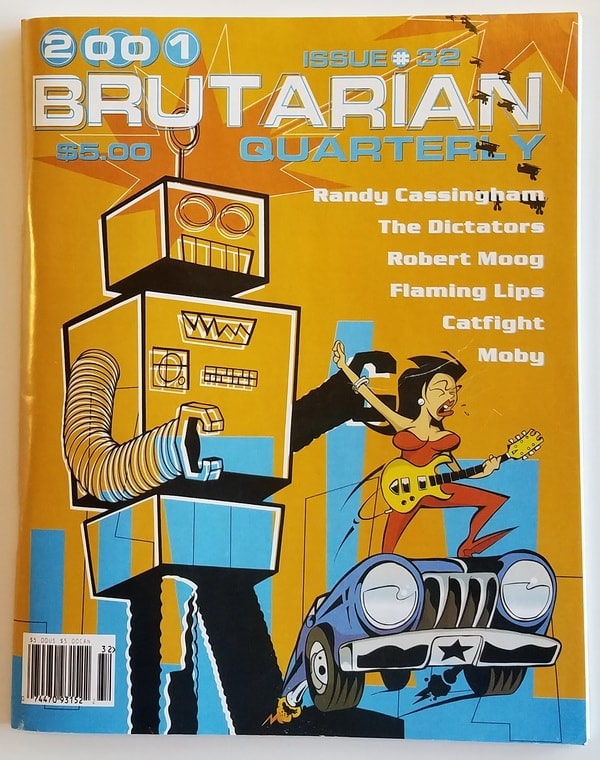
(from Brutarian Quarterly #32, January 2001)
by David M. Fitzpatrick
BOULDER, Colorado (BQ) We often think of music, books, art, and movies as being the avenues where people challenge what society perceives as the “norm” what we at Brutarian consider to be “brutarian”: raw art, as it were. But there are plenty of other corridors for that sort of thing, and as I am fond of pointing out, nothing represents raw art better than the Internet.
Robert L. Ripley once challenged us to “Believe It Or Not,” and while many did and many didn’t, nearly all were amazed, enthralled, and entertained. What Ripley didn’t find while scouring the world over, it found him in the form of mail sent to him from virtually every inhabited corner of the globe.
Robert Ripley is dead, but Ripley’s Believe It Or Not rolls onward like an unstoppable juggernaut of the bizarre and the outré. Following it have been other attempts to amaze and bewilder; many successful, some not. Books abound; a museum near the Space Coast in Florida draws hordes of amazement-seekers. Other feel-alikes, like the Baltimore Dime Museum (Brutarian #31), keep attentions grabbed and imaginations sparked.
But in the modern age of information sharing and the Internet, there are boundless ways to stimulate the mind. A man named Randy Cassingham figured out a few years back that one of the most entertaining modes of mind-sparking comes from something we’ve had around for quite some time, but which is now much more easily accessible: news wires. You see them every day in your local newspapers—stories from the Associated Press, Reuters, and others. News wire services are how local papers get news stories from around the world; it’s been like that this entire century (the Associated Press, for example, has been around since 1848). Now, imagine all the stories that go out across the wires that you never see. Chances are, Randy Cassingham sees them.
And he saw them, all right, a few years back, and THIS is TRUE was born. TRUE (as it is affectionately abbreviated by Randy) is a collection of weekly wire stories, completely rewritten by Randy and doled out to his faithful following by way of a mailing list. In case you’re new to this email thing, a mailing list is a service regular folks like you and I join by adding our email addresses to the mix. When the list owner sends out email to the list, it is then automatically distributed to the many subscribers. This is a hell of a lot easier than Randy typing out everyone’s email addresses every week, since he has something in the neighborhood of 100,000+ addresses to which TRUE gets emailed.
Mailing lists aren’t new. In fact, in Internet terms, they’re older than dirt. And they’re everywhere! If you’re online, you’ve no doubt become familiar with at least a dozen regular “humor” mailing lists like Top 5 or Joke-A-Day, among myriad others. So what makes TRUE so different?
Randy rewrites and summarizes his stories, adding at the end his trademark humorous tagline; trust me, there’s no explaining them away. Subscribe to the list and you’ll see. Included in each regular mailing of TRUE is also a nice feature called “Honorary Unsubscribe,” where Randy honors someone who has recently passed, a name with which you might not be familiar but darn well should be. This, in fact, sparked a secondary list Randy runs called HeroicStories (he figured people could be honored without having to die, and that seems more than reasonable to me).
But I digress; or, rather, there’s so much to TRUE that summing it up just makes my fingers dance like crazy trying to get it all in some sort of order. The subject matter of the news stories isn’t something easily categorized, but suffice to say, you’ll likely have the impression that you should be slapping your face after reading most of them (or at least after one of Randy’s clever taglines which often follow them). Whether gut-bustingly funny, merely a chuckle, a “blink-blink, jaw-drop” bit, or simply something making you stop and think, the best thing about the content in TRUE is one simple, basic fact: they’re all for real.
And so is Randy. He attended a rich, Silicon Valley junior high school in 1972, where computers first captured his interest. Having been online continuously since 1982 (yes, folks, there was “online” long before the World Wide Web hit in the early 90s) and, as a result, he’s intimately familiar with the “online culture and I use that word advisedly,” he says. “You must understand the culture to succeed online; there’s a word for those who don’t understand it and throw money into their online presence anyway: ‘bankrupt.'”
A journalism school grad, Randy first learned the ins and outs of networking computers during a ten year stint at NASA’s Jet Propulsion Laboratory. Here he not only honed his publishing skills but also was a software engineer for a network-distributed client-server information system— okay, okay, no more boring you with the tech stuff; we can agree at this point that the man isn’t a newbie and not just some guy who bought his first computer last year and decided to put up a mailing list.
I’ve been a member of THIS is TRUE for a couple of years now, and amongst the blizzard of emails which beleaguer me and my email boxes every week, this is one I look forward to rather excitedly. The list is free—that’s the best part!—although you can opt to subscribe to a pay-for list which you get before the rest of us get it. It contains more new stories than the free version, and doesn’t have any advertisements (relax, they’re barely obtrusive, and usually very interesting, enough so to be worth clicking on). On occasion I’ve traded emails with Randy, usually poking good-natured fun at something he had said. Not by a long shot have we been best e-buddies, but over those few emails (along with years of TRUE mailings with Randy’s personal commentary) I’ve certainly gotten a handle on what sort of a guy he is.
Randy was more than happy to do this interview, which was conducted in a way the rest of the Brutarian staff found quite alien—conducted via email. For onliners like Randy and me, it seemed like the most logical way to do it; saved on phone calls, nobody had to travel to meet anyone else, and with Randy typing roughly twelve thousand words per minute on his Dvorak keyboard, it was a lot faster. Read on…
BRUTARIAN: Email interviews are nothing new to you, I am sure, but for Brutarian I’m almost certain this is a first; but that’s the way its done in the modern world. The boss wanted me to conduct the interview live, so if anyone asks, we did this on ICQ or in a chat room. Now, Brutarian claims to cover all aspects of pop or fringe culture, and it occurs to me that, although these are public news stories you refer to, there is a certain amount of “fringe culture-ness” to this massive following you have herding after you and TRUE. Would you classify TRUE as fringe culture? Or how would you classify the trend that it has made for itself?
RANDY CASSINGHAM: Interesting question. Without trying to sound Clintonesque, I guess it depends on your definition of “fringe.” The stories come from “legit mainstream” newspapers, but my selection of what to cover certainly ain’t “mainstream”. I generally don’t do the Big Stories that you hear about as front page news—people are sick of them by the time I could do anything with them. OJ Simpson, Princess Di’s or Prince JFK Jr’s deaths, or (shudder!) Elian, for instance. So yeah: in a sense, it is fringe, but it’s also familiar and comfortable, because they’re the stories that when you do see them, you cut them out and put up on your bulletin board at work, like a good cartoon. The classic “They did WHAT?!” kind of stories. We’ve all seen them; I just figured out how to make a career out of them.
BRUT: We know that TRUE is a collection of true stories you have rewritten from facts garnered off news wires, but TRUE is clearly more than that. If you had to explain to a philosopher or an archeologist a thousand years from now about what TRUE is representative of to today’s culture, how would you do it?
RC: First, I think it’d be cool to still be there to explain it to her, but I know what you mean. TRUE’s obvious purpose is to entertain, but it indeed goes deeper than that. In essence, I write about the most stupid things people do all over the world, yet they are often things that real people can relate to. Like today, I wrote about a drunk driver that got pulled over by the cops. Who hasn’t thought of the scam of quick, let’s switch seats with the passenger! But naturally, the passenger was drunk too, and the cop saw them switch, so because he saw both in control of the vehicle on the street, both of them got popped for drunk driving! It isn’t just the sweet justice aspect, but people are able to point at that kind of behavior and think to themselves, “I’m not THAT stupid!” It validates that the kinds of stupid things they do are either quite common, or not as bad as what OTHER people do. There’s deep satisfaction in that. Then to top it off, they get the laugh, or the expression of irony, or outrage, that I add at the end that sets TRUE apart from the several other weird news columns out there—my commentary on the story.
BRUT: When did you launch TRUE?
RC: The summer of 1994. The concept hit me like a bolt of lightning—I literally leapt out of bed with the idea fully formed in my mind.
BRUT: Describe that moment.
RC: Back in 1983 or so, when the IBM PC was really starting to take off, a friend said to me, “Isn’t it amazing how much computer power is going onto people’s desktops?” I replied “No: the power will come when they’re all linked together.” So when I saw it all really starting to happen in the early 1990s, I wanted to be a true part of it.
TRUE itself was born out of several desires. I wanted a creative outlet and to write more. I wanted to create intellectual property—something with a long shelf life that would give me “residual” income over many years. TRUE was designed to be timeless, so book collections could sell for years and years (five have been published, and the sixth is about to go to press). I wanted to create something popular because I wanted just a little bit of fame (I had previously written an esoteric technical book that drew a very limited audience). I wanted to be my own boss. I wanted a portable job—one that I could do anywhere. On the road? On vacation? Perhaps on a cruise ship? How about in Europe? I believe this will be easier and easier to do with the Internet as time goes on.
So one night in June, 1994, I couldn’t sleep because L.A. was in the middle of a nasty heat wave, and I didn’t have air conditioning. Very suddenly, I saw how to put all my wants together and become a part of the Internet explosion. I leapt out of bed, booted my computer, and started taking notes. My mind reeled, and the next day I sketched it all out for a friend. “You’re going to make money giving it away for free?” He couldn’t see it, even though it’s exactly the same thing that the TV networks do: they give away entertainment for free, yet make huge amounts of money. I told him I thought I’d be able to quit my job in two years and do just that full time. He kind of went “Uh huh,” but two years almost to the day later, I did quit my job and moved out of L.A.
BRUT: TRUE is currently distributed to over 100,000 readers in 183 countries, very impressive numbers. When you set out to do TRUE, did you have hopes or dreams of that many subscribers?
RC: I knew it would be big from the start, but I didn’t realize just how fast it would grow. I had 10,000 subscribers within four months, and remember that was in 1994, the Dark Ages of the Internet. I didn’t stop to think quite so much about the international aspect, though—I didn’t know there were 183 countries, let alone think that in a few years people in that many countries would be reading my work every week!
BRUT: Now this wasn’t your initial area of expertise, or at least not your career path. You used to work for NASA. What can you tell us about that?
RC: I have a degree in journalism, and my specialty was science—explaining complex topics to a lay audience. After college, I started at NASA’s Jet Propulsion Lab in Pasadena as a technical writer, and ended up publishing a technical journal for them. When that project ran out of money, I ended up doing software engineering. I was doing pretty well after ten years there, but I really hated Los Angeles and wanted out. I did have the habit of posting the “weird news” items I saw on my bulletin board, and it was a hit, so that became the “content” when my online publishing brainstorm hit.
BRUT: You’ve said that you’re making a more comfortable living now working full-time online, but when you first started the list I’m sure you didn’t expect it to explode like this. What makes a guy give up a job with NASA to send out emails all the time? Not that that isn’t my dream job, because it is! But what made you say, “Hey, I think I’ll do this?”
RC: I like to look at the Big Picture. Yeah, I took a major pay cut when I quit my Day Job, but I had two years of growth under my belt, and I could see where the trend was going. Also, since I was working 50 hours per week at the Day Job, and then going home and working nights and weekends on the new gig, I didn’t exactly have much of a social life, so every penny I made went into the bank. I had a nice cushion by the time I left JPL, and I moved to a cheaper place to live, so I figured I had a good two years to make it work “or else.” It worked.
BRUT: Obviously, we don’t want you to reveal any secret formula, but give me a brief tour of the Life of Randy Cassingham between issues of TRUE… you just sent an issue out yesterday and it’s time to start all over again. How do you put the thing together, what do you deal with in the process, what hoops does Murphy’s Law make you jump through to make it all come together?
RC: It happens because I work every day. Every day, at least eight hours, and often fourteen. It translates to 70-80 hours per week to get everything done. I write on Sundays, since my contractual deadline for the various newspapers that run TRUE is first thing Monday morning, and the last thing I would ever want to is get up early in the morning. But I need that deadline pressure to make me go through the agony of writing the 7-9 stories I need. It takes anywhere from four to ten hours to do it, finding just the right mix, turning 300- to 900-word stories into a tight 75 words to get the point across in a meaningful, understandable way, and wrap it up between a punchy headline and a smart-ass tagline. But when it’s done, I get a feeling like Picasso must have when he put in his last brush stroke and stood back to look.
But work isn’t all. I do love it, but that’s not enough. Because I set my own schedule, I can take time off whenever I want. A working friend wants to get together for lunch? Easy! Except for me, it’s breakfast. And when they rush back to work, I stay for dessert with my girlfriend, and then do an errand or two, and amble back to my office two or three hours after I left. I settle into my chair and look at the Rocky Mountains out my window while I download the morning’s 100-200 e-mails. Need to jet out to Southern California to speak at a Mensa conference? No problemo: I did that recently, after loading up my laptop and jumping on a plane. It doesn’t matter where I connect to the Internet, and the column still went out. And while I was there, I took my girlfriend to Disneyland, since she had never been there.
BRUT: What’s been the worst problem you’ve ever encountered with TRUE?
RC: Nothing I can think of, save the relenting march of deadlines. Another week, another 7-9 stories. I’ve never missed a week since July 1994.
BRUT: Any legal problems ever been presented? Someone claiming copyright violation, someone angry about being embarrassed from their own stupidity making it into TRUE, etc.
RC: No. First, I understand copyright better than most lawyers do; it’s part of my nature to research the hell out of topics I’m interesting in, especially if I have a need to know. I’m quite careful to NOT violate others’ copyrights, and that’s fairly easy to do when you understand the nuances of the law. Second, I have two attorneys: one a specialist in intellectual property issues (like copyright), and a firm that does business law. (It also helps that attorneys and cops really like TRUE; many of my readers are happy to answer questions when I have them.) I rarely have to use them, though. And third, I almost never hear from people I’ve featured in TRUE, even though I do name names. But when it does happen, it’s really pretty fun: they almost always love that they’ve been mentioned, and want to know what book collection it will be in so they can buy some copies. At least, that’s the way it’s happened so far!
BRUT: Doing TRUE and its sister list, HeroicStories, seems to be something of a personal outlet for Randy Cassingham— let me know if I’m wrong on this. Everything from your trademark sarcastic commentary tacked on to the ends of the story to your outspoken opinions on your site. Are you normally outgoing and opinionated, or are you quiet and reserved?
RC: I’m an introvert playing the part of an extrovert. I’m an observer that likes to jump in with an observation, and then sit back down and watch some more. As for my opinions, they’re just that: the way I see things. Now and then, that really pisses a segment of the readers off, such as when I took on the editor of a Catholic newspaper for his glee in reporting on an abortion doctor’s murder, or rant about how the trend of “zero tolerance” in schools is radically fucking up kids’ minds rather than solving the problems the schools face, or the latest case when a reader said I was going to hell for something I said, and I responded by offering readers “Get Out of Hell Free” cards, which readers went wild over.
I post the history of all these things on my web site in a “Specials and Rants” section, and include the letters that readers send in. And that’s where the magic happens: a few condemn me for my opinion, and when I print those letters they get completely drowned out by letters from readers supporting me. It’s incredible how many people really think about the issues I raise in what’s supposedly just an “entertainment” column. They understand that I’m really doing commentary on the human condition, and they are unbelievably loyal in supporting me, even if what I have to say isn’t always pleasant.
BRUT: Ever since Monopoly lost that landmark case way back when someone put out a clone, there have been versions galore. I even have a very old National Lampoon with a Monopoly cheat kit enclosed—new properties, new Chance and Community Chest cards, etc. Maybe you could branch out with this. GOOHF cards and properties like Tarterus and Hades.
RC: Unlikely: I’m definitely not in the biz of producing parody. I did the GOOHF card because of a specific situation allowed me to trivialize both someone complaining to me and the Monopoly concept of getting out of severe trouble for “free.” It was just beautiful opportunity for synergy that I couldn’t pass up. Still, I did register GetOutOfHellFree.com!
BRUT: There’s a “Spam Primer” on your site. You’re a strong anti-spam individual, yes?
RC: Yes. To say spammers are scum gives them too much legitimacy. They steal from people to deliver junk mail to people that don’t want it, or downright hate it, pounding millions of mailboxes in the hopes that one tenth of one percent of the recipients are stupid enough to send them money for their fraudulent products. They literally don’t care about the 99.9 percent of everyone else that are pissed off, or the servers they crash, often in foreign countries where net services have to pay for their bandwidth by the byte. THAT is no way to do business, online or anywhere else. It amazes me that people don’t send mail bombs to the bastards’ mail drops. I want to, and I’m more stable than a lot of people!
BRUT: There’s also a “Dvorak primer.” You once upon a time converted to using the Dvorak keyboard layout, which a lot of people actually still haven’t heard about. You substantially increased your speed after learning the Dvorak keyboard, right?
RC: Yep. I had topped out at about 55 WPM on Qwerty, and now type at over 100 WPM. I’m a writer; output matters! Not to mention I work at my computer 70-80 hours a week, so I need something comfortable to type on.
I think the Dvorak layout has saved me from carpal tunnel. But the real shame is that they still teach kids to type on Qwerty, even though it’s significantly harder to learn and type on than Dvorak. If schools just switched to teaching Dvorak, they can get the mechanics of typing out of the way quickly, and move on to why you teach kids typing: so they can be creative! To write, to program, to explore. With computers, setting whatever layout is trivial; it’s no longer a matter of “We have to teach them Qwerty, since all the typewriters are Qwerty.” There aren’t any typewriters in the real world anymore, folks. Dvorak is built in to Windows, because I convinced Microsoft to put it there. It’s as easy as a few mouse clicks.
BRUT: You convinced Microsoft to put Dvorak in Windows?
RC: Yep. On a business trip to Seattle, a friend who knew some people at Microsoft used me—building me up as some important author who Wrote The Book about the Dvorak keyboard—as an excuse to get a meeting of some of the Windows developers together. This was when they were working on version 3.0, which is the first version that was truly useful. We convinced them that they needed to put Dvorak layouts in, and it’s been there since. The funny part is, I offered to beta test that aspect, but they called back later to say that they didn’t need me since there were so many Dvorak typists there already. Turns out that some of their top people are Dvorak converts, which is no big surprise since it simply makes sense to use it.
BRUT: I agree, the Dvorak layout is far easier, but I myself am a weenie about it. Having done this sort of thing for 20 years, I know fully well that I can click-click a few times and change layouts. It’s easier than loading a device driver like we used to have to do through DOS. But I never do, and I’m a reasonably intelligent guy. Is there a subconscious fear in us that makes old dogs afraid to learn new tricks, do you think?
RC: Absolutely: people think they have to learn how to type all over again, and they remember how hard it was the first time! Luckily, switching isn’t anywhere near as difficult as learning Qwerty the first time. That’s because of two main factors: because of how Qwerty is laid out, it’s very difficult to learn it in the first place, and two, a significant part of it—the dexterity that your fingers must learn to move around the keyboard—doesn’t have to be relearned at all; that part is necessary no matter what layout you use. Still, it was tough for me, as a writer, to suddenly go from 55 wpm (on Qwerty) to a crawl on Dvorak when I first switched, but I’d never go back: I now type at more than 100 wpm on Dvorak which (again, as a writer), is extremely helpful!
BRUT: I promise, in honor of His Trueness, I will haul out Mavis Beacon Teaches Typing and dedicate myself to faster typing. I do about 75 words per minute on a Qwerty. Whaddaya think I could hit on a Dvorak?
RC: Actually, I wouldn’t recommend Mavis Beacon for Dvorak since the lessons were not specifically designed for Dvorak. Keytime (in Seattle: www.keytime.com) has tutorials that are Dvorak-specific, however. It’s hard to say what speed you’d reach with Dvorak. Even if you didn’t increase your speed, though, you’d benefit by less physical strain on your hands and wrists.
BRUT: You know I’ve asked you this one before, but people are reading now, so: You really met Dvorak’s wife? Tell me about that!
RC: Yes. She first contacted me when I was writing my book on the Dvorak layout, which is still available via my web site. She had good timing: I had a lot of questions, and she was able to provide some first-hand knowledge about the keyboard, which was introduced in the 1930s. After my book was published, I drove up to Seattle and gave her a copy. She was about 93, and still sharp as a tack and living alone in the same house she and Dr. Dvorak had bought decades before. She’s been dead for some years now, though—this was in 1986.
BRUT: Interesting as meeting Mrs. Dvorak was, I’m not sure if qualifies as a bona fide celebrity… but this is a lucrative business for you. You travel a lot, do interviews like these, do public speaking engagements, etc. Have you had occasion to run into any famous people? If so, who?
RC: I have a lot of famous people who read my stuff, but I protect their privacy, just as I do all my readers, by not revealing their names unless they give me permission to do so. There is one that just about everyone in the computer industry has heard of that not only said it’s okay to name him, but he wrote a really nice testimonial which is posted on my site. I won’t tell you who it is, but you can read his letter at https://thisistrue.com/woz/.
(Editor’s Note: And we won’t ruin it for you here, either, but the “woz” should tip off you Apple lovers. Definitely worth reading this testimonial.)
BRUT: Who would you like to meet while doing this job that you haven’t yet?
RC: Everyone! I recognize a lot of the names of people on my distribution, but since I do respect their privacy, I don’t write to them and bother them (so I wish they’d come forward and write to me!) I can’t imagine how many others there are who subscribe with anonymous e-mail addresses, but I indeed can tell by the domain names that every major branch of government, most of the big entertainment (movie/TV/radio/etc.) companies, all the major computer companies, all the major news agencies, and virtually every other sector of The World reads my stuff—including people in Congress and in the White House. I love peeking behind the scenes that the public normally doesn’t get to see, so I want to meet everyone and have them show me the wizards behind the curtains.
In speaking engagements, I’ve met MacArthur (“genius grant”) fellows, Emmy and Pulitzer Prize winners, authors, actors, you name it. I love talking to them as people, because that’s what they are—not the gods some make them out to be.
BRUT: Hey! If White House personnel subscribe, you could be called as a witness on all those missing emails.
RC: I’ll take the Fifth, Dave.
BRUT: Any invitations to the White House for supper?
RC: No, and because I’m happy to skewer anyone in power in my column, I don’t think it’s going to happen anytime soon. In fact, I can’t think of one politician who has sought me out….
BRUT: Dana Carvey used to do his George Bush impression, making fun of the President… and he got invited to the White House for a dinner once. He said he was nervous and when he got there, someone close to Bush asked him to get up and do Bush… he was nervous, but he did it, and Bush laughed his ass off. Who knows, maybe you’ll get an invitation. Would you take it if they offered? Would you read some select political pieces that might make the Prez nervous?
RC: Hell yes I would, even if it “wouldn’t be prudent!” But I think there’s a difference between imitation (aka “the sincerest form of flattery”) and specific criticism, so I’m not going to hold my breath waiting for an invite.
BRUT: TRUE is a column detailing true events that are sometimes so bizarre that we wonder if they’re true—even though we know they are. You must receive story ideas all the time… how often do you send people to urbanlegends.com?
RC: All the time. It’s not as bad as it once was, since I posted some submission guidelines on my web site that includes links to sites like urbanlegends.com—and specifically list some of the stories that people have sent me again and again and again, yet never happened. I can just see some newbie get online and get the “hospital cleaner unplugs patient’s respirator to plug in vacuum cleaner” story that’s been going around for years—and since they just got it in their e-mail, it must be true and just happened yesterday, right?—and pop to my web site to see how to submit it to me, and then get blown away when they realize they were duped. Most of the stories never happened.
Truth really is stranger than fiction, though, and who needs old stories that have been going around for years when you can get real stories fresh every week?
BRUT: Naturally, anyone reading TRUE for any length of time has seen the inevitable bout of ignorance with people who get all righteous on you, like with the whole Y2K debate. Does it happen often?
RC: It’s not often, but it does happen, and some of them lead to great stories on my web site, like the guy who absolutely insisted that it was still the 1900s. I mean, HELLO? And when I made fun of him, a few others came to his defense! I figure my readers are pretty much cream of the brain crop, yet now and then, they really do something stupid. But that’s okay; not only do I turn the lights on for some of them, it assures me that I’ll never, ever, run out of material.
BRUT: Two of my favorite lists had constant problems—HumourNet and especially its risque joke counterpart, BawdyNet. Now you know Vince Sabio and Shawn King of those respective mailers, yes? Is HumourNet even around anymore? There hasn’t been one in my mailbox since December 19 of 1999, and no Web site seems to be there. I just tried to subscribe again, but Lyris told me I already was. And BawdyNet I had just about given up on until a couple random mailings trickled in recently. What’s up with those guys?
RC: Yes, I know them. Vince quite well. What’s “wrong” is that they aren’t running commercial operations—they put out their stuff for fun. The fools actually work for a living! As I mentioned, I dispensed with that inconvenience back in 1996, so you can count on your TRUE subscription!
BRUT: So let’s go off the whole mailing list discussion now since I know from trading emails with you on many occasions that there is more to Randy Cassingham than his mailing lists, such as his passion for the Dvorak keyboard layout and his anti-spam fight. But you’re mostly an online guy, so let’s look at several major topics today. Sum it up, in all fairness, what do you think about the whole MP3 battle, with Napster getting their pants kicked and people downloading MP3s like mad?
RC: I have mixed feelings about it all. I think if bands don’t want their music online, it shouldn’t be there. They wrote it, they put their lives into it, they own it, they should be able to control it — simple as that. But the record industry just doesn’t Get It. What happened when TV was introduced? The movie industry said it would ruin the movie business. Did that happen? No: it got stronger because of TV. The record industry said the cassette tape would ruin the music business. Did that happen? No: it got stronger because of cassettes. The movie industry said the introduction of the VCR would ruin the movie business. It created record profits for them. DVDs, same thing. CDs, ditto. And on and on and on. Now we have MP3s, and the record companies are screaming the sky is falling. Give me a break.
In a year or two, they’ll either be laughing all the way to the bank, or crying in their soup because the musicians used the Internet to cut them off completely and go straight to the audience. Either way, there’s nothing they can do about it, so they might as well embrace it.
BRUT: The antitrust trial against Microsoft.
RC: Microsoft has acted like assholes, and turn out some remarkably crappy software (the PC is 20 years old and they still can’t keep it from crashing daily? Hello?). But Bill Gates’ vision is in large part responsible for the richest economy the world has ever seen, and the government wants to put a stop to it? Are they insane? (On the other hand, breaking up AT&T led to a major communications revolution, so who knows what will happen if we break up Microsoft!)
We all want our chance at The American Dream and become rich, but if some bastard succeeds too much, society feeds them to the wolves. Gates dropped out of college and became the richest man on the planet, all by his own luck, vision, and work. A prick, maybe, but he won, and a bunch of damned crybabies just can’t take it. Tough shit, get back to work, and don’t forget to ask the customers if they want to Super Size their Value Meal, because those 39 cents add up to millions by the end of the day, okay?
BRUT: Free speech on the Internet.
RC: That’s not an issue, it’s a reality that is leading to one of the biggest social changes in history. We ain’t seen nothin’ yet, but anyone who says they know what’s going to happen is either lying or fooling themselves. They sure as hell aren’t fooling those of us that are out here making it work.
BRUT: International regulation of the Internet: what is right, what is wrong, what is feasible, and what will likely never be regulated?
RC: Ever hear of the power of the press? Everyone now owns a printing press. Everyone now has an unbelievable amount of power, but few know what to do with it, or how it works. But they’re beginning to learn. It doesn’t take millions in venture capital; I financed my operations with pocket money, and people in 183 countries look every week at what I have to say. What non-net author, or publisher, can say that? I’ll bet none.
BRUT: You’re aware, I’m sure, of the recent ruling by the French Supreme Court against Yahoo! to keep Nazi memorabilia off their site. There are some sticky legal muck-ups with that situation — how to control an internationally-accessible Web site, whether that site can feasibly control who sees what, etc. How could we possibly solve such issues fairly? Doesn’t it seem that it should be the responsibility of local governments to control by law what their citizens are doing? I mean, if Nazi memorabilia is illegal in France and Germany, and people in those countries can look at it online, it seems that making it illegal to ship the stuff across their borders ought to cover it a lot more sensibly than hauling Yahoo! into court over it.
RC: There’s no point in having laws allowing “free speech” if all the speech was something you wanted to hear. I mean, you don’t need a law guaranteeing speech that everyone likes! I don’t think disallowing discussion of uncomfortable matters is any way to stop people from thinking about them.
In fact, open debates are much better ways to shut these people up; their ideas don’t hold up to cross-examination. What better way to show how stupid some ideas are than to shine a public light on them?
BRUT: Do you play any computer games? If so, what do you like? Either now or five years ago or on a TRS-80.
RC: I usually don’t have time for them, but I have a guilty pleasure. Do you remember the 1970s Atari game, Battlezone? It’s still around, but the graphics are incredible now, and you don’t just go against robot tanks, you can connect to game servers and go head to head against other real people all over the world. It’s a major kick-ass fun time, and I can get lost in it for hours — much to the bewilderment of my girlfriend.
BRUT: I must admit that after years of playing video games, my favorite is still Donkey Kong; but I have a terrible weakness for first-person shooters. I don’t play often anymore, as I’d get nothing done if I did; but when I do, it’s in vicious doses. But the old arcade classics are still the best. Did you get into any other classic games that are being remade, like Frogger and Pac-Man? What do you think of all the remakes nowadays?
RC: The remakes I’ve seen usually miss the point of the original games. Pac-Man was already brilliant in its original incarnation. There’s nothing to improve, save perhaps adding additional levels. It’s why I like Battlezone; they put a story behind the game and beefed up the graphics (and, yeah, added the ability to play others over the ‘net!), but the original concept is still visible.
BRUT: Back into mailing list gear: years of regular TRUE mailings, Premium subscribers making you the Rockefeller of the online world, five books of TRUE material selling strong… where do you see TRUE going from here?
RC: First, more of the same. As income grows, I’m hiring others to do the things that must be done, but don’t add to the creation of the content (like entering the orders for books, and shipping them out). More and more TV producers have been sniffing around, but so far none have been able to really “get it” — that is, understand that what makes TRUE powerful is that it makes people think and doesn’t insult their intelligence. All they want to do is try to come up with the new Laverne and Shirley, and that kind of mentality led NBC to its lowest ratings ever last quarter. But someday, someone is going to catch on. And when they do realize the power, I’m ready: I have my own sitcom idea!
BRUT: You have a lot of speaking engagements and do a fair amount of traveling for such. Do you have an agent?
RC: No, I let the web take care of that. I have a page that shows upcoming gigs, and a couple of transcripts of past talks, so organizations can judge for themselves.
One interesting trend I’ve noticed is that I’m being brought in less for pure entertainment and more for staff training on how the heck the company can make better use of their presence online. That is, they’re now understanding that just having a web site isn’t enough to keep them ahead of their competition, and “now what?” I do seem to have a lot of ideas about that…!
BRUT: What’s the most widely seen or heard interview or speaking engagement you’ve done? Anything really up there like the Today Show or Oprah or whatnot?
RC: It’s probably a toss-up between the CNN Morning News and a gigantic personality profile by the Los Angeles Times that got syndicated to a bunch of other papers. I was shocked by how big and glowing that profile was, not to mention the 8×10 color portrait they ran with it! I was rather flattered.
BRUT: Any interest in that sort of circuit?
RC: I’m assuming you mean lecture circuit; yes and no. Yes, in that I like the variety, I like to travel, and I love the audience response. But no in that I hate the disruption to my schedule. I’ve found that even though my fees are slowly going up, the invitations aren’t slowing down. I solved that by getting more selective in what I accept.
BRUT: Actually, I was referring to the talk show circuit.
RC: Sure: everyone in the biz likes the publicity, and I’ve done everything that’s been offered to me, but I’ve never really sought out the spotlight. I’ve never even had a publicist. I’m just a guy pounding out news commentary — that has managed to attract a huge audience all over the world. It’s pretty much the New American Dream: by cutting out the middleman, I can reach my audience directly and make my living online. All in all, not bad.
BRUT: And the big question, of course: You wanna do Jerry Springer, don’t you? “I Sent False News Wire Stories to My Internet Columnist” or something like that.
RC: I don’t think Springer would want me, since I’ve savaged him in my column a few times (not like he’s not used to that by now!) I’d of course love to do Letterman or Leno, because of their huge audiences, but they’re so geared these days to people plugging movies that I don’t think they’re interested in talking anymore. They’re more get on, give some sort of pre-rehearsed story about the kids to show the audience you are a normal human (hah!), show the clip, and split. BORING!
I like the old Carson shows, where a guest would be there for ten minutes (or more!) to talk about something of interest. Amazingly, the last time I watched Rosie O’Donnell (a few years ago), she was still doing that. So there, I said it: I’d like to be on the Rosie show. Montel Williams would be great too; he strikes me as a very thoughtful, and thought-provoking, man.
BRUT: What do you think of these trash TV shows, while we’re on the subject? I bitch and complain about Springer all the time, but I can’t help but watch. I keep digging in my brain to figure out if these people are really for real — which would, frighteningly enough, give it the same feel as TRUE as far as “truth is stranger than fiction,” or if they’re just paid to act it out, which would make it kinda like professional (urk!) wrestling.
RC: I don’t watch Springer, in part because I am sure that so many of the people on are actors. I don’t have much interest in invented arguments; I’d much rather listen to intelligent people talk about interesting things. Politically Incorrect would be a hoot, for instance.
BRUT: Tell us about TRUE’s sister list, HeroicStories.
RC: Where TRUE illuminates the human condition by pointing out the stupidity of others, HS gives a glimmer of hope by pointing out that really, most of the inhabitants of the planet are really very cool, good people. I get mail all the time, from men and women alike, openly admitting that some of the stories make them cry because they are so wowed by what real people are doing out there.
It’s really a cool balance — the Ancient Greeks knew full well the incredible power of combining laughter and tears, and that lesson is not lost on me.
BRUT: Where do you see Randy Cassingham going from here?
RC: What more could I want? But we’ll see what comes up.
BRUT: You know, there’s a running joke with Dom Salemi, my editor, whenever he conducts an interview with girly rock bands, he tells them that the least they could do is provide him with some used panties. A lot of them do, believe it or not. So if you could be equated to a girly rock band — for analogy’s sake, not to insult you in any way — what would we claim you should provide us with? Used newspaper? What would be a good analogy? You know, as in “Girl rock bands are to used panties as Randy Cassingham is to _________.”
RC: It has to be intangible: a glimmer of hope. I can’t compete with sweaty panties, but I can help make you think. Thinking can lead you anywhere: get out your chemistry set, and maybe you can come up with eau de panty and make billions.
– – –
©2001 David M. Fitzpatrick, portions ©2001 Randy Cassingham, reprinted
with permission from the interviewer.
Update: Brutarian is now dead, after at least 50 quarterly issues. And the other mailing list examples given (Top 5 and Joke-a-Day) are also dead. But This is True lives on.
– – –
Bad link? Broken image? Other problem on this page? Use the Help button lower right, and thanks.
This page is an example of my style of “Thought-Provoking Entertainment”. This is True is an email newsletter that uses “weird news” as a vehicle to explore the human condition in an entertaining way. If that sounds good, click here to open a subscribe form.
To really support This is True, you’re invited to sign up for a subscription to the much-expanded “Premium” edition:
Q: Why would I want to pay more than the minimum rate?
A: To support the publication to help it thrive and stay online: this kind of support means less future need for price increases (and smaller increases when they do happen), which enables more people to upgrade. This option was requested by existing Premium subscribers.