
Yes, True is about weird news. More importantly, it’s about thinking, which implies a quest for knowledge and understanding. That’s most evident in my editorials; here are two of them on the same subject, starting with one from May 2002:
You already know I’m a space junkie. One of my former colleagues at JPL got a mission to Pluto up and running — the only planet we haven’t sent a probe to yet. It’s tough these days to get probes built and launched, not because of technology but politics.
A reporter once asked my friend, “What is the most difficult part of the mission to Pluto?” He said that was easy: “the part from here to Washington.” He was too right: the mission was canceled because, Washington says, at $800 million it was over budget.
The problem was it wasn’t really over budget: the final cost estimate was actually $496 million. Former NASA Administrator Dan Goldin admitted later that they needed $200 million extra for Mars missions, so they took it from Pluto, which killed that mission. After all, Mars is a sexier planet, in part because it will take so long to get to Pluto (nearly 10 years!)
But There’s New Hope: NASA requested proposals for a new mission to the Pluto-Charon dual planetary system, with a $500 million price cap (hmmmm, maybe they shouldn’t have canceled the last one after all?!)
In a development that I think is healthy, several teams bid for it, which helps drive costs down. A team led by the Boulder branch of the Southwest Research Institute won, and it includes a flyby of the unexplored Kuiper Belt just beyond Pluto.
I attended a very interesting briefing by the mission’s Principal Investigator, Dr. Alan Stern. They’re now at a critical stage: you guessed it, the government wants to cancel it again! The mission is conspicuously absent from the 2003 Bush budget.
There are significant scientific reasons to study Pluto. Stern says: “Pluto-Charon itself is also the only known binary planet, and has more complex seasons than either Earth or Mars. The Kuiper Belt is a region of the solar system where planetary accretion was arrested in mid-stride during the birth of the solar system, and we don’t know why. Despite that, we do know it is a treasure trove for understanding planetary formation in much the same way that an archaeological dig tells us about ancient societies.”
There are great reasons for getting going now: as Pluto moves away from the sun in its orbit, its atmosphere will freeze and fall as snow, and it won’t be warm enough to revaporize it until Pluto gets close to the sun again — in about 200 years!
Worse, because Pluto is tilted so far on its axis, as it gets further out more and more of its northern hemisphere will be shadowed. So if we want to SEE it within the next 200+ years, we must get going soon.
Understanding the origins of our solar system is worth less than half the cost of a B-2 bomber or, to bring it closer to home, about a quarter of what Americans spent on Easter candy this year. Join me in supporting the mission to Pluto.
And the second editorial, from 23 January 2006:
Update: Mission Launched!
Long-Time Readers May Remember that back in May 2002, I wrote an editorial in support of a planned mission to the only planet in our solar system that we hadn’t gone to yet: Pluto. (The probe will also look around in the Kuiper Belt after it passes the Pluto/Charon binary ice dwarf system, where it’s theorized that there could be 100,000 planetoids, with perhaps 1,000 being the size of Pluto, but I’m talking about the nine known planets in our system. If that’s news to you, you get a sliver of understanding why it is interesting to study this portion of our solar system!)
Anyway, that was 3-1/2 years ago, and the mission did get funded, partly because of letters of support for the mission by people interested in learning more about What’s Out There. (That’s people in general; I certainly don’t claim credit that it was True readers who turned the tide!)
Still, Alan Stern, the Principal Investigator for the Pluto mission, appreciated my drumming up public support for the project. I was quite surprised that he not only remembered it after all this time, but wanted to show his appreciation for it in a very special way: my wife and I were among his invited guests to watch the launch of the spacecraft toward Pluto.

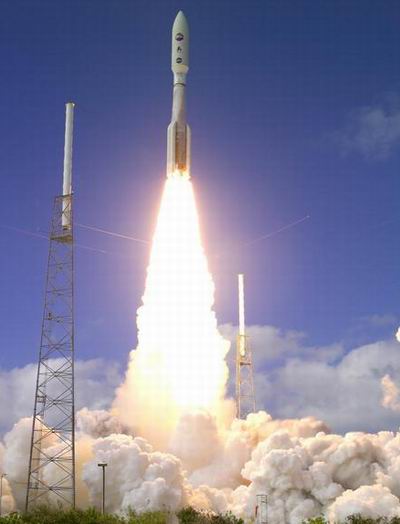
It was spectacular: the Atlas V rocket leaped off the pad, rising much faster than even the Shuttle. They used a big rocket: 2.5 million pounds of thrust to lift a mere 1,050 lb spacecraft.
Why? Because it needs to move fast to get to Pluto in a reasonable amount of time. In fact, New Horizons to Pluto will be the fastest man-made object ever, cruising at 47,000 mph once it gets a 4 kps gravity assist from Jupiter [see clarification in the comments].
But because Pluto is three billion miles away, even at that speed it’s still going to take over nine years to get there!
I spent 10 years working at NASA’s Jet Propulsion Laboratory, but never got to go to a launch. This mission is not managed by JPL, but rather by the Southwest Research Institute, and the payload was not built by JPL, but rather by the Applied Physics Laboratory at Johns Hopkins University. I think it’s terrific that the space game is being “widened” from NASA, and hope that trend continues.
(You can get more info on the mission web site.)
It’s about time we understood our own solar system better. If indeed there are 1,000 Pluto-like, Pluto-sized planets out there, it’s not only time to understand them, but to realize that Pluto isn’t an icy anomaly; rather, it would be the norm for planets in our solar system, and wet, warm Earth would be the real anomaly.
Rocket Scientists and Other Interesting People
It’s very, very cool to witness a rocket launch. But it’s even better to stand around and talk with the type of nerdy people who go to rocket launches! You hear all sorts of interesting stories.
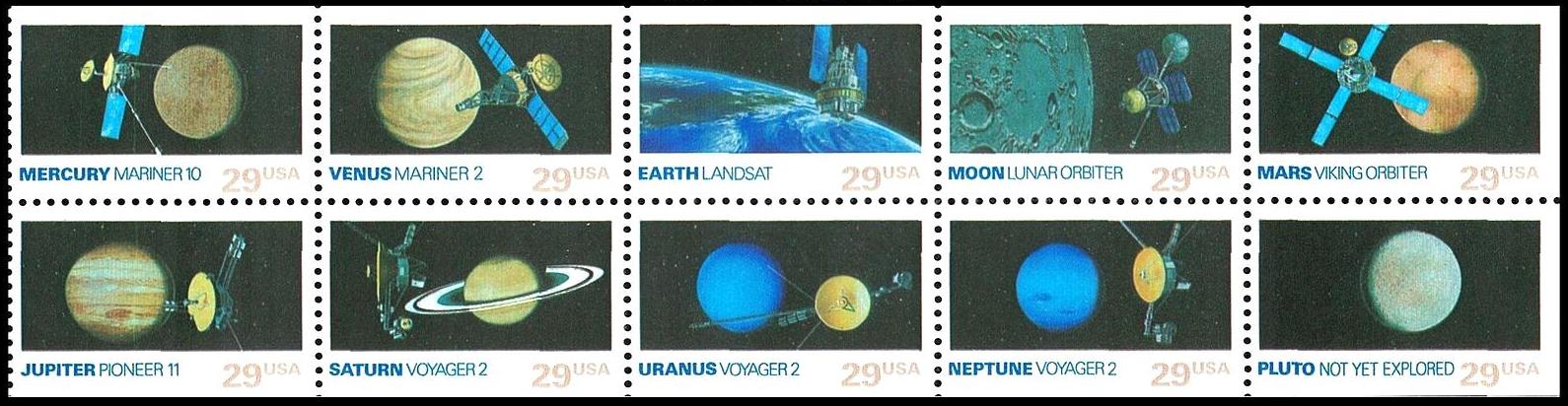
One story I already knew: JPL’s version of the Pluto mission got started when the U.S. Postal Service unveiled a new set of stamps, on 1 October 1991, at the Jet Propulsion Laboratory. The set of ten stamps showed the nine planets (plus our moon) and a shot of the main spacecraft that had visited it. They were unveiled at JPL since the Lab has primary responsibility for the robotic spacecraft sent to explore our solar system. I still worked there; I remember it well, and remember being troubled by one glaring detail on the stamps.
That glaring detail: Pluto didn’t have a spacecraft next to it, just the words “not yet explored.”
That really irked Rob Staehle of JPL. Rob was my first project boss when I was hired, and he went from the stamp unveiling to a colleague’s office to talk about starting a Pluto mission. Later, when Rob got the formal go-ahead to start the mission plans, he called Pluto’s discoverer, Clyde Tombaugh, on the phone and asked for permission to visit “his planet”!
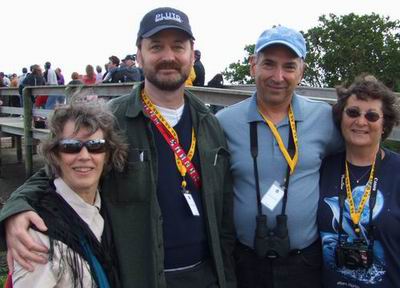
That version of the mission was later canceled for political reasons, and here’s the part of the story I didn’t know until I got to Cape Canaveral for the launch: Astronomer David Levy (see photo above) was Tombaugh’s biographer, and Rob and I were at his table at a pre-launch party when he told the story of how some guy at JPL had called Clyde for permission to go to Pluto, and how touched he was to be asked for “permission.” And sure enough, that was Rob, and he was able to fill in the details for David. It was the first Rob had heard how touched Clyde was by the gesture.
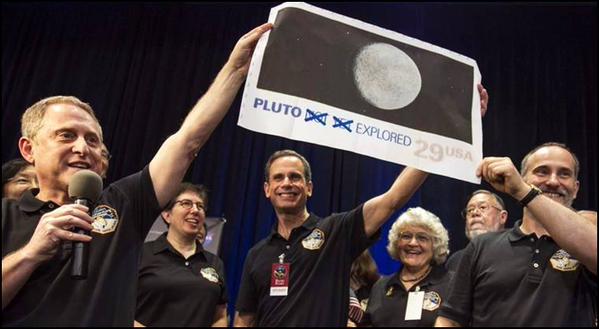
It’s just classy for a mission planner to make such a call, and I’m quite proud of Rob for thinking to do it. Here’s his mission inspiration:
It’s also classy to invite the Tombaugh family to the launch. Not just Patsy, his widow, but also his children and their spouses. I assume that was Alan Stern’s idea; he did a great job of remembering people who made an impact on the mission. In other words, there are a lot of classy people in the space business.
We met lots of other interesting people while sitting around waiting for the weather to clear so they could launch. I already knew Alan Stern, the Principal Investigator of the mission, who invited us to the launch, but it was nice to see him again and, after the launch, personally congratulate him on the nearly perfect start to the mission. It was generous of such a busy, busy man to remember and greet us.
There was Claire, an aeronautical engineering student from Melbourne, Australia, who came to see the launch, even though she hadn’t been invited — she just hung around the visitor areas at KSC in hopes of getting a glimpse of the rocket going up, and I’m pretty sure she got that view. (Alan had given me a mission pin, and I got another when I checked in to get my badge, so I gave her my extra. She was thrilled to get a neat “insider” souvenir.)
Dr. Rick Shope, an educator from JPL who teaches teachers how to connect the space program to their students with kinesthetic learning tools, using interesting tools of his own: he’s a mime who studied with Marcel Marceau.
I like telling people, “That’s not rocket science — and as a guy who worked at the Jet Propulsion Laboratory for 10 years, I should know.” Yet this really was rocket science, and the people who do this sort of work for a living are fantastic to talk to. I enjoyed it for 10 years, and I’m incredibly privileged to still be able to do it now and then. My congratulations to the many men and women who had a part in hurtling some cameras and instruments to another uncharted spot in our sky.
(Disclosure: I briefly worked on the Pluto project with Rob Staehle at the end of my career there. I was even a co-author — with Rob Staehle, Alan Stern, and others — of a 1994 article in the journal Spaceflight. As I recall, I was the one who titled it: “Last But Not Least: the Trip to Pluto”.)
July 2015: Arrival
After nine and a half years, New Horizons zoomed by Pluto. They couldn’t stop and go into orbit: to get there in that amount of time, it needed to fly at 47,000 mph, and there was no way to pack in enough fuel to slow it down enough to stay. Still, New Horizons is expected to gather about 5,000 times as much data at Pluto as Mariner did at Mars.
And after that amount of time and three billion miles of flight, it arrived within one second of the time estimated at launch time, and came within 7,000 miles of Pluto’s surface after traveling 3 billion miles.

Pluto is currently more than four light-hours from Earth (and moving away). That means the spacecraft’s radio signal, which goes the speed of light (186,000 miles per second), takes more than four hours to arrive here, 3+ billion miles away.
When the spacecraft takes a photo, the compressed image is about 2.5 mb in size. With the data rate available at that distance (about 125 bytes/second), it takes about 20 minutes for each photo to be transmitted.
That’s why it will take 16 months to get back all the photos from the flyby.
That won’t be the end of its mission, though: we know little about the Kuiper Belt just beyond Pluto, so New Horizons will be taking more photos, and using its other scientific instrument packages, to learn more about the thousands of bodies there as it speeds past.
For More on the Mission: visit the New Horizons Mission Site
– – –
Bad link? Broken image? Other problem on this page? Please Let Me Know using the Help button in the lower right, and thanks.
This page is an example of my style of “Thought-Provoking Entertainment”. This is True is an email newsletter that uses “weird news” as a vehicle to explore the human condition in an entertaining way. If that sounds good, click here to open a subscribe form.
To really support This is True, you’re invited to sign up for a subscription to the much-expanded Premium edition.
I didn’t know you were involved in New Horizon. I and my family are on board on the CD.
—
I was on the Pluto pre-project at JPL, before it became the New Horizons mission. -rc
Quoting the article: “After all, Mars is a sexier planet, in part because it will take so long to get to Pluto (nearly 10 years!)”
I think that’s an important point. What politician wants to fund something that won’t pay off for a decade? It won’t get them any votes in the next election, not nearly as much as something short term that’ll pay off during their current term.
—
Good insight. Americans have gotten into a terrible habit of short-term thinking. -rc
The transmit rate from Pluto is like sending the high-res images via an old 150 baud acoustic coupler! Remember those?
—
I do, but they were slightly worse, at 110 baud. Pretty slow even compared to an ancient 1200 baud modem! -rc
Did the probe (or did we know it already?) provide any insight to why Pluto’s orbit is off-plane with respect to the rest of the planets?
I’m so happy to hear news… for a number of years, I thought that the space age had died (I grew up reading Tom Swift, Arthur C Clarke, etc)… we still have exploring going on, and private industry is on-the-ball (and all out of gum!), so I have more hope… I think we need big things so that we are not so easily distracted by (relatively) petty problems… but we don’t even get big news of Pluto nowadays with the newsies “wanting to talk about the Pluto-deniers” (seriously, why do we insist on making the challenged famous?)…
Let’s look up and try to figure out what we want to be instead of picking fights with each other.
—
Sounds good to me. I don’t know (or at least don’t remember! It was quite awhile ago that I was on the pre-project) if we already know why it’s off-plane and, if not, whether New Horizons will provide insight into that. -rc
pluto was and always will be a planet.
the minority who made the ridiculous redefinition after most real astronomers went home now again look ridiculous as the fly by reveals pluto is larger than those idiots thought.
anyone can ‘redefine’ that the sky is actually green and grass is blue. that doesn’t make it so.
p.s. – i was asked my location here. but didn’t have room to note it is on a small island on the planet called in english ‘earth’ of the binary planetary system comprising terra and luna. 😉
Thank you for sharing this incredible experience with us and for the background to such an awesome event.
I am amazed that they were so accurate in predicting the fly-by time. I don’t think I could do that for any event nearly 10 years in the future with who knows what obstacles might crop up over the course of those years.
Wayne in UK, glad you pointed out that Terra and Luna are a binary planet system. I remember reading that in National Geographic about 40 years ago, and being amazed. The opening article has it wrong that Pluto/Charon are the only binary planet.
—
There is no accepted definition of what definitely constitutes a “binary” or double planet system, but very few astronomers consider the Earth and Moon to be one. Many astronomers don’t even consider Pluto-Charon a double, even though their point of rotation (barycenter) lies outside of Pluto’s surface. -rc
I like Randall Munroe‘s explanation of just how fast the New Horizons vehicle is going:
“How fast is 14 kilometers per second? Here’s my favorite comparison for putting that speed in perspective: If you were standing at one end of a football field and fired a gun toward the other end, right while New Horizons flew past you, the spacecraft would reach the far end zone before the bullet made it to the 10-yard line. In that same amount of time, a speeding car would travel about an inch.”
Thanks for the insight on the early stages of the mission, especially the detail about asking Pluto’s discoverer for permission. That was great. As is the postage stamp with two words redacted!
Once a planet, ALWAYS a planet!
At a minimum, Pluto should be a planet as an example of a class of stellar objects.
A day late, but Bravo Zulu to Apollo 11, but they were still in-flight. We bought a TV just for the event.
And great kudos to the Pluto team! It was about #$% time. Pretty cool the two anniversaries are basically the same few days.
Pluto-deniers … (snicker). I must admit to trolling some of the “moon landing deniers”. They cannot even get their reasons for why “it was a fake”. One of them (my favorite) claims rockets cannot work in a vacuum. He appears to be (minimally) educated — he went to University, but he refuses to try to understand basic physics. My favorite theory is the moon landing was filmed on a sound-stage on … get ready .. MARS! because the aliens would not let us land on the Moon. (grabbing head about to explode…)
The problem is not that such people exist, but there are a sad number of them.
*Loved* the altered stamp. When is the USPS going to come out with a with a “corrected” version?
Great update, Randy. Well done to all involved!
To Wayne in the UK:
From Douglas Adams’ “Hitchhiker’s Guide to the Galaxy” here is the entire entry for Earth:
ρθ [rho theta – pronounced ‘rth’]
Mostly harmless.
;D
So Michael Minovitch must have been a poofta?
Only explanation I can think of for everybody doing an Alan Turing on him.
Without his contribution New Horizons / Pluto could not have happened.
—
Indeed I didn’t mention all of the tens of thousands of people who had an impact on the mission. Not even Isaac Newton. Instead, I talked about the people I worked with at the start, and at the end, to bring a personal insight to the wider story. If you choose to take offense that I left out someone from history, then indeed, you’ve chosen to take offense. And that, sir, is truly pathetic. -rc
In reply to Wayne in UK –
In the previous edition of “The Hitchhiker’s Guide to the Galaxy”, the entry for Earth was “Harmless”. The later edition updated that entry to “Mostly Harmless”. Man, do I feel like a geek, both for knowing that, and for needing to point it out!
As for what lies in the Kuiper Belt, I will simply quote Mark Twain (his real name was Samuel Langhome Clemens; he never lived to see commercial aircraft, let alone spaceflight): “Truth is stranger than fiction, but it is because Fiction is obliged to stick to possibilities; Truth isn’t.”
We NEED to get out there!
—
Twain was quite aware of the night sky. When he was born, Halley’s Comet was in the sky. He said during his life that he “came in on” the comet, and he would “go out on it” too. Sure enough, when he died, Halley’s Comet was in the sky. -rc
New Horizons is not close to the fastest man-made object ever. At 14 KM/s, it is fast, but Helios 2 made it to 70 KM/s, and Juno is expected to hit 74 KM/s.
Plus there’s the manhole cover. 🙂
I like the SciShow channel on YouTube, they had an episode on exactly this.
Of course, New Horizons is still AMAZINGLY cool!
—
Looks like I was misinformed, but the manhole cover was most likely vaporized. -rc
Thor, the newsies want to talk about “Pluto-deniers” because that’s where the ratings are. Conflict, dissent, drama, and angst are guaranteed ways to draw an audience.
Neil DeGrasse Tyson said what made America great fifty, sixty years ago was our investment in space exploration and discovery, and getting away from that has been a mistake, that we’ve gone from leading the missions to being invited to take part in other country’s missions. He says if we want to be strong again, we need to re-invest in NASA and science and re-ignite the passion for exploration and discovery, and I’m inclined to agree. We need to fire up our collective imaginations and start dreaming bigger and thinking “What if…?” We need to show kids what’s awesome about the sciences and how what’s out there relates to what they’re learning. We need to create jobs for the un(der)employed. I don’t care if it’s NASA or private businesses that carry out the missions, I just want to see things happen. I don’t see any reason it shouldn’t be NASA, but Congress would rather fund pet projects and porkbarrel than NASA, so it’s likely going to fall to private business.
2.5 MB sent at a rate of 125 bytes/sec. would take over 5 hours, not 20 minutes. According to http://pluto.jhuapl.edu/Mission/Spacecraft/Data-Collection.php the rate now is about 2000 bits/sec., which would be about 250 bytes/sec. There will be some overhead for data packet information and error correction, so the effective 125 bytes/sec. might indeed be the correct (approximate) number.
@Patrick: New Horizons had the fastest launch velocity from Earth of any spacecraft.
@Joshua: Interesting. Given how far it had to travel, I guess that makes sense. But it is still different than “moving faster than any man-made object ever”. <Insert quibble about relative speeds, motion of planets, galaxies, the universe itself, etc., etc.>
Either way (as stated before), New Horizons is still amazingly cool — and just plain amazing.
That manhole cover was indeed probably vaporized by atmospheric friction. But it stayed intact long enough to be captured airborne on a single frame by the high-speed camera covering the blast, so it wasn’t vaporized by the explosion.
By New Mexico law, when Pluto is over the state PLUTO IS A PLANET!!
Pluto was discovered in 1930 by Clyde W. Tombaugh, making it the first known object in the Kuiper belt. It was immediately hailed as the ninth planet. However, its planetary status was questioned when it was found to be much smaller than expected. These doubts increased following the discovery of additional objects in the Kuiper belt starting in the 1990s, particularly the more massive scattered disk object Eris in 2005. In 2006, the International Astronomical Union (IAU) formally redefined the term planet to exclude dwarf planets such as Pluto. Many planetary astronomers, however, continue to consider Pluto and other dwarf planets to be planets. (Wikipedia)